Sasha Grbich_Could you tell me a little about your background and how you came to live in Adelaide?
Stephanie Britton_I was born in Cape Town in 1944 after my parents had emigrated to South Africa from the UK. I studied Fine Art and English Literature at the University of Natal, developing an interest in African contemporary and traditional art and music. As a teenager I saved up for a subscription to Studio International and read it voraciously all through university. Thirty years later I was to organise an Australian speaking tour for [British] editor Peter Townsend which resulted in his creating Art Monthly Australia.
I first arrived in Australia in January 1970, aged 26, on a visit from London where I had been doing post-grad painting and printmaking at Croydon College of Art and then working for Bridget Riley as a studio assistant. I was lucky to be in London in the late sixties at the beginnings of a range of new art forms like minimalist electronic and sound art by US Terry Riley, Steve Reich and the Cybernetic Serendipity exhibition at the ICA [in 1968], curated by Jasia Reichardt with artists like Nam Jun Paik. Op Art was happening, and process art in Germany, with Beuys and others.
I knew absolutely nothing about Australia or Adelaide, but family circumstances had changed in 1968. My parents and younger brother had emigrated from South Africa to Adelaide (my father to a lectureship at the Conservatorium). My mother who had been a journalist in Manchester encouraged me to rejoin the family.
A month after I arrived, I took up a position as a tutor at Flinders University and was then head-hunted to start a new weekly art review column for The News which Keith Murdoch had given to his pushy young son Rupert. This served as a crash course in the local gallery scene and gave me entrée to the curators and directors at the Art Gallery of South Australia. Around 1973, Mandy Salomon, a local mover and shaker and talented comedian, asked me to host a weekly interview program “Airing Art” on the new 5MMM-FM community radio station, talking to visiting artists from interstate and overseas, as well as local artists and people doing interesting things related to visual arts.
SG_So how did you come to start Artlink?
SB_I was writing the art reviews and doing the weekly radio program. But things developed quite rapidly, with the EAF [Experimental Art Foundation] opening amidst broader cultural transformation after Don Dunstan arrived [as South Australian Premier]. It just seemed so frustrating that the media really was not dealing with any of the visual arts at all. They focused on the Festival Theatre and productions of various kinds there, and the visual arts were barely visible — not considered worth writing about. And of course, because I was involved with the EAF, (I was there at the birth of it as it were), I just felt it was time for Adelaide to have an art magazine that actually dealt with this really exciting, emerging scene.
But I was not keen on the prospect of publishing an obscure little art magazine for sale with a small print run, so I came up with the idea of involving the five existing active and energetic arts organisations in the structure of the magazine and committing them to one page in each issue for a piece of their own choosing written by someone in or associated with their organisations. They were the Contemporary Art Society, Art Gallery of South Australia, Experimental Art Foundation, Women’s Art Movement (WAM) and the Schools of Art and Design ACAE. In return, they undertook to distribute copies of Artlink to their memberships and we created a print run of 4000 from issue Number 1. As to how to structure the new entity, I discussed this with Noel Sheridan [then Director of the EAF] and he gave me one very good piece of advice — Stephanie, he said, don’t form a collective! This resonated with me, as I knew I was on a steep learning curve and I needed to be able to move fast and make decisions based on gut feelings, and on advice from a wide range of people with different opinions.
Noel suggested I create a simple incorporated association with me as the principal responsible for getting and accounting for funding. Almost immediately I formed an Advisory Committee comprising representatives of the five organisations involved, and this group was later expanded to include other useful people.
SG_What was the relationship of Artlink to experimental art in general, and to the EAF?
SB_It was embedded—very close—the EAF was the best game in town really. I was personal friends with Donald Brook and Noel Sheridan and David Kerr, and a lot of the younger artists were graduates from the South Australian School of Art. There was a huge amount of energy in those organisations. Once you graduated from art school, and if you were doing ephemeral works or performance art or happenings or events, there was nowhere you would dream of going other than the EAF: it was such a challenging place, such a many-levelled, many-headed organisation.
SG_The structure that you had in place in the first five years had a strong emphasis on making space for dissenting voices and for conversations. I observed this through those 'member pages', but also through the letters and columns. Could you comment on the emphasis on conversation in the early years of publishing?
SB_I suppose I always had it in mind that there should be letters to the editor, every magazine must have letters to the editor! There were a few arguments when political issues came up, lots to do with funding for visual artists, as well as side issues relating to the creation of the Festival Centre which was then focused entirely on the performing arts. There was quite a lot of discussion about the place of Art Schools within universities when the dreaded amalgamations happened. My time with the Art Workers’ Union had laid the ground for some of the collectivist politics and members wrote to Artlink when they were enraged about something or other. This was a small element in it, and a relevant one in the early years, but faded away as the visual arts developed its own trajectory, independent of theatre, dance and music.
SG_Were you tracking gender representation when you were commissioning writers or content?
SB_No, not at all, I don’t think so. I never really thought about it consciously but in fact, I think in the early years, the majority of contributors and artists were women, but I haven’t done analysis on this — it’s just what I feel.
SG_That’s interesting to hear, as I have done the analysis and it’s extraordinarily close to equal gender representation in those early years, to the extent that I assumed that you must have been counting! For example, I’ve looked very closely from 1981 to ‘85 and I’ve done close sampling every two years to the end of the decade. During those first four years there is almost no difference in the number of male or female writers and artists discussed — which is extraordinary given that period. Could you comment on that how that might have come to be?
SB_Well, it’s something to do with me being a woman, I think for a start. Women do gravitate to each other. I wasn’t a card-carrying feminist, but I accepted the fact that women are just as talented as men. And the vast majority of art students are women. It just seemed they were strongly motivated, and were perhaps slightly older, many coming from or visiting from Sydney or overseas and moving to Adelaide. Julie Ewington was doing a PhD at Flinders [University] at the time and the women’s art movement was strong — it was quite a force to be reckoned with!
SG_ Could you speak to the process of producing the magazine?
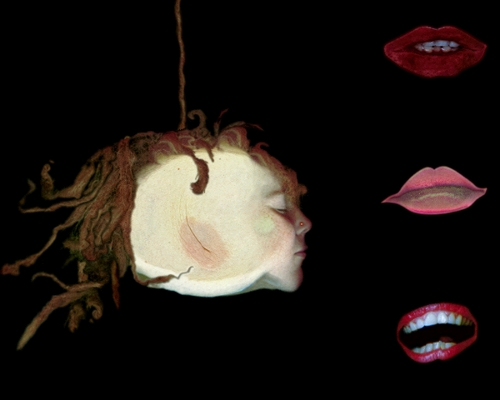
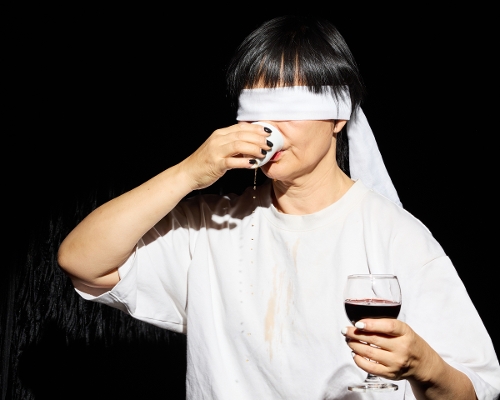
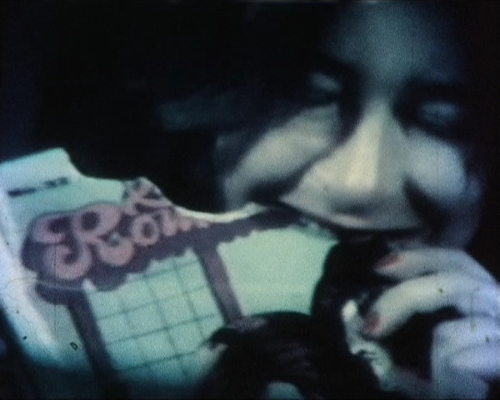
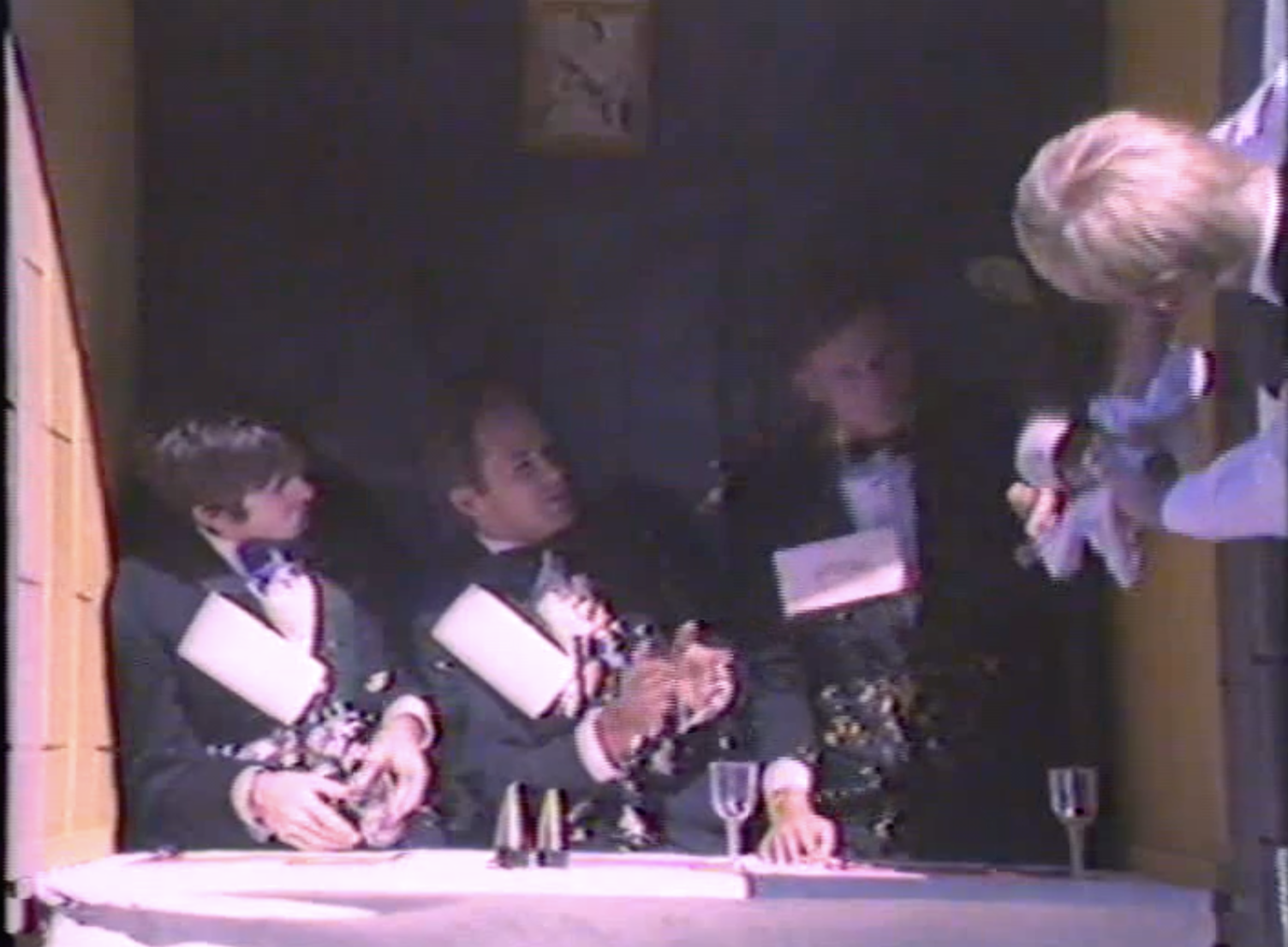
SB_In March 1981 the first issue of Artlink came off the press, followed by five more that year at bi-monthly intervals. Sandra [Nicolaides] Greentree made a riveting performance installation at Underdale [The South Australian School of Art] with fellow students Steve Wigg and David Watt hanging upside-down in a large hole in the ground lined with mirrors and trying unsuccessfully to eat and drink while looking at a reversed image of themselves! This was the cover of Artlink Volume 1, No 1.[1]
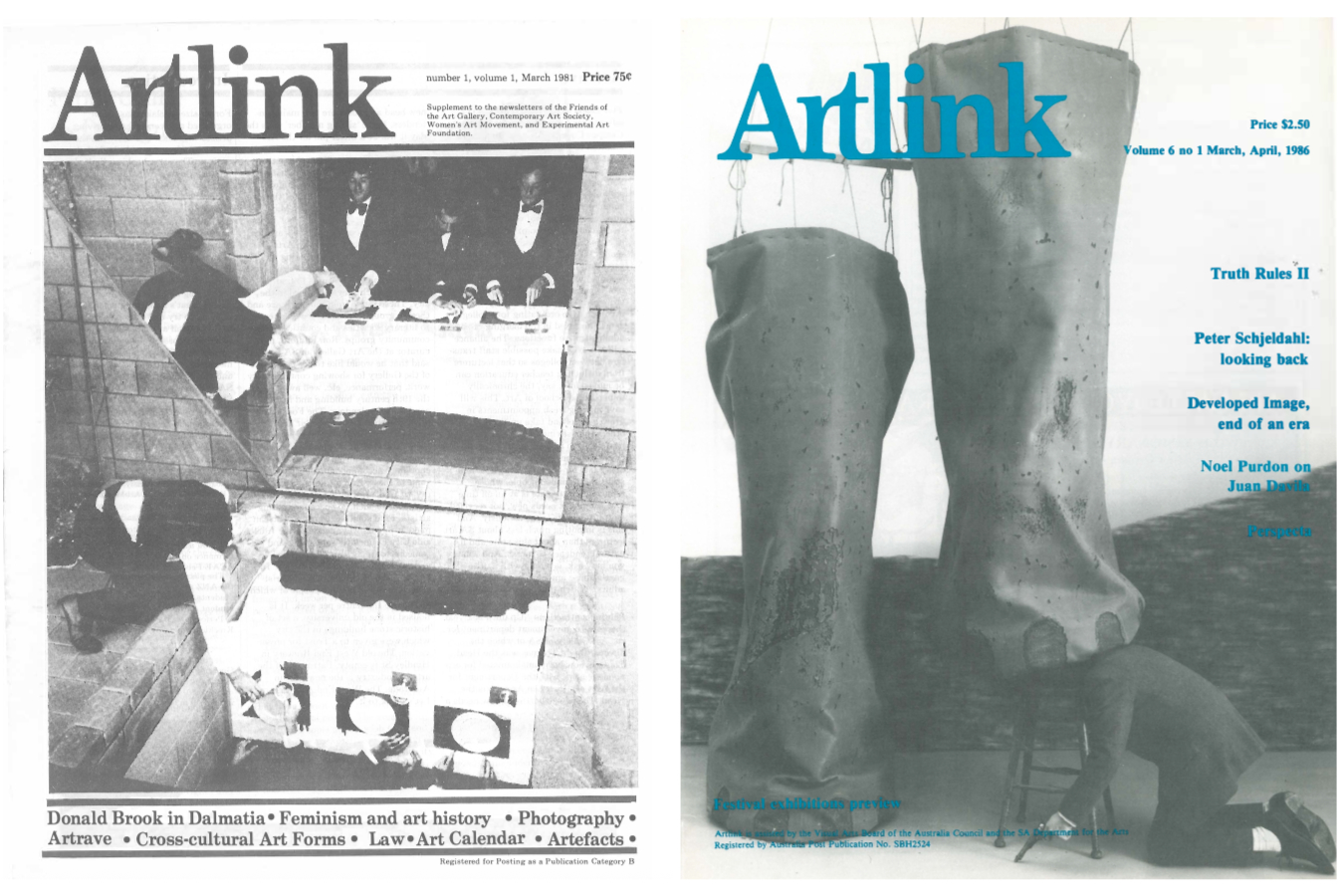
The production and printing was dealt with in-house as it were. The Head of Graphics at SASA [South Australian School of Art], Lyndon Whaite, agreed that his second-year students would design and layout the magazine as part of their college work, and get it printed at the printery of the Student Union on campus at Underdale. A long friendship with student “Helen the Printer” began, and there were many long ink-stained sojourns down at the printery where she and the students conquered the challenges of imposition, page numbering etcetera, and then 4000 copies flying off the press to be stapled together in the right order and the right way up. Boxes were then sent off to the Friends of the Art Gallery, the Contemporary Art Society, the EAF, and WAM for distribution, and the rest went to the SASA students and staff and mailed to subscribers. It was of course exclusively black and white. Artlink was produced on almost no money, just a small $500 startup grant from Arts SA and then $1000 from the emerging Visual Arts Board and a few small ads for galleries and art suppliers.
SG_What was the relationship of Artlink to other art publications?
SB_It was exciting around this time to discover the Sydney publication Art Network which appeared in 1979, edited by Ross Wolfe, Peter Thorne and Terry Reid. It was a largeish format magazine including some colour pages and had a look and feel that said ‘this is a statement, we are new and we are exciting and we want to make a statement about cutting edge art…’ In retrospect the fact that all three editors were male was indicative of a somewhat different orientation for the content and the contributors. It was very much perceived as a "Sydney thing", a bit flashy, but apart from that it was strong evidence that art publishing was finally beginning to attract attention in Australia. It survived for seven years.
As the first few years rolled around, the difference between the rationale for Artlink and that for other magazines, say Art & Text which also launched in 1981, was stark. At the time Art & Text struck me and others (including Donald Brook at times) as a platform for the opinions and predilections of the editor Paul Taylor who was a prolific writer and some of it was quite opaque to readers, often practising artists, even if they were involved in experimental and post-object art.
SG_In the late ‘80s Artlink’s format changes to include some colour reproductions, the thematic issues [from 1987], and a national purview. How did that come about?
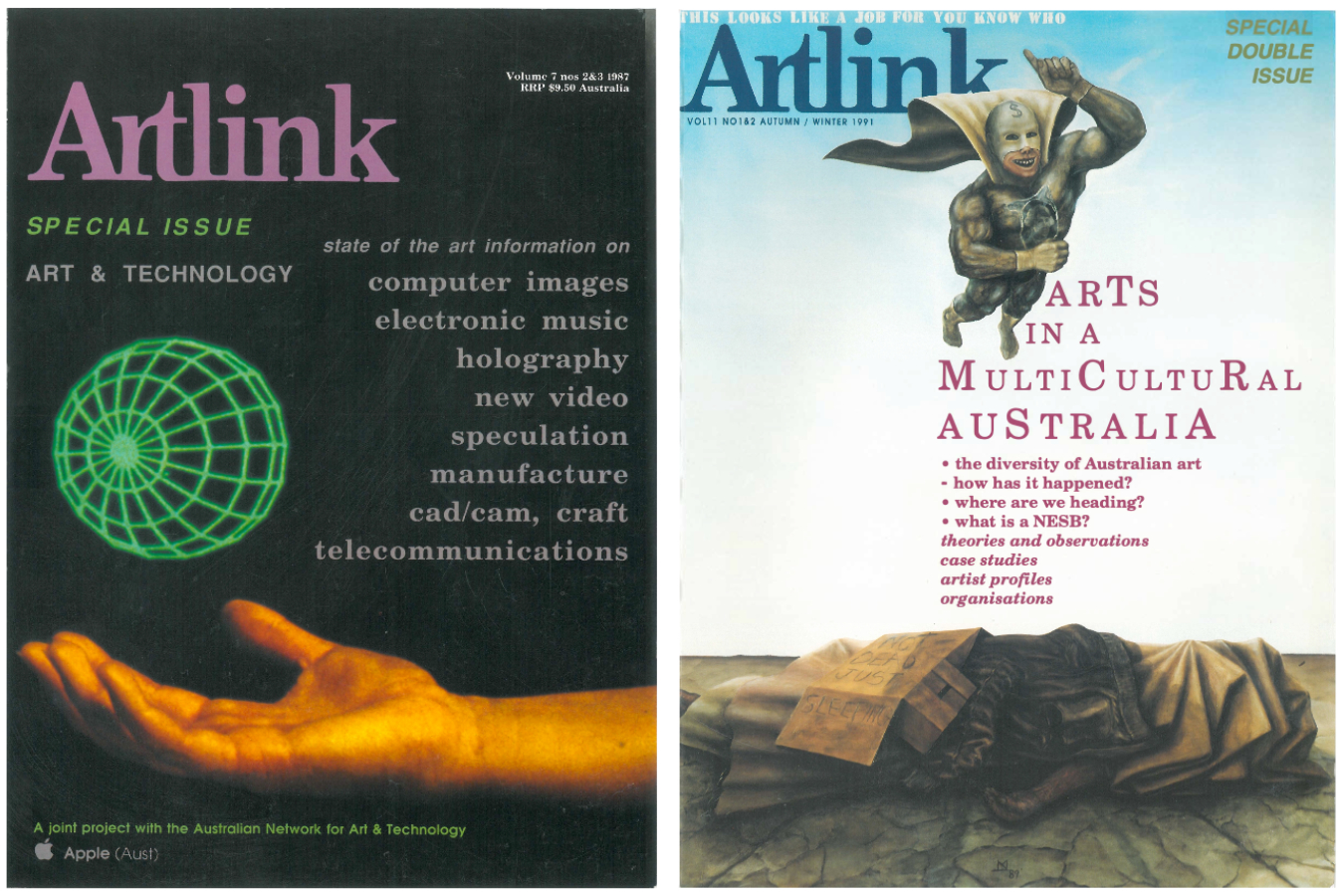
SB_Artlink’s first formal action in engaging with the rest of Australia was to commission reviews of shows and appoint (unpaid) review editors in Western Australia, Queensland, Tasmania and locally in South Australia, recognising the huge reservoir of talent and energy coming out of those "regional" places. We bypassed Sydney and Melbourne due to their existing media channels. This laid the basis for much of the subject matter of themed issues and identified energetic guest editors and writers. Again, in terms of female participation, and without legislating for it, it just happened.
Artlink was able to build on a foundation which valued and used collaboration and group energy engaging with all the reasonably progressive factions in the city and the state, and this shaped how it would develop over the next three decades. I believe Artlink was the first Australian art magazine to go online [c2008] and it was incredibly exciting to contemplate the revolutionary effect of this. It was also hair-raising as in those years the digital environment was subject to sudden wipe-outs where entire sections would have to be recreated.
SG_It is now 45 years since that first issue of Artlink flew off the press, and in 2024 its archive was fully digitised. What would you like to see in art magazine publishing going forward?
SB_Obviously, the artworld is in a very different situation now, and we all know that there is huge freedom to communicate ideas online, and the online experience can be profoundly interesting and rewarding, or profoundly dull. Most serious artists have a strong online presence, and the gallery scene has contracted. But Artlink is not now and never was about the commercial or private gallery scene. It was about a range of ideas in art, and it valued strong opinions, often on the move.
Footnotes
- ^ A re-print of Artlink Volume 1, No. 1 featured Hossein Valamanesh’s work on the cover.