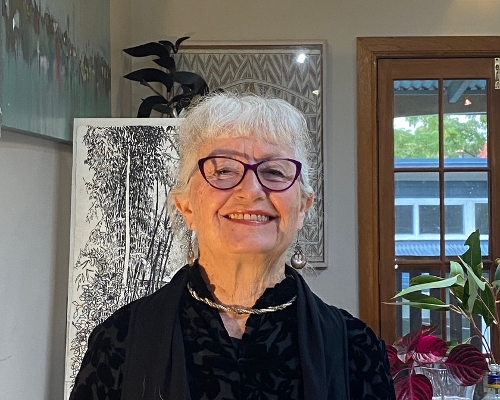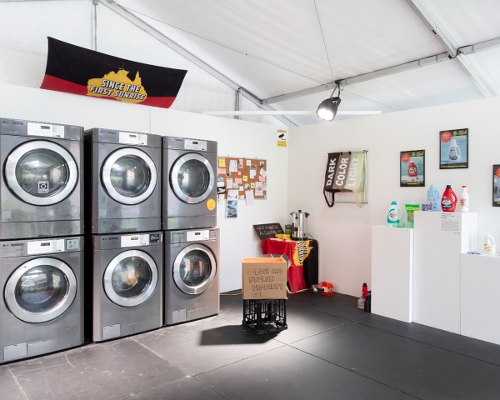
Artlink was born to digest experimental art. Founding Editor Stephanie Britton tells me the rapid changes in 1970s art practice were spurred on locally by the formation of the Experimental Art Foundation (EAF—in which she participated), and the social reforms of leftist protest movements during the Don Dunstan era. She initiated Artlink feeling it was time Adelaide had an art magazine to engage with its changing moment and its dynamic community of artists.[1] Thinking back to those optimistic, radical times, I look down at my T-shirt recently purchased at The Blak Laundry. It asks—WHY WON’T YOU CHANGE MACHINE—its wry humour in solidarity with my own frustration at the slow pace of political and social change today.
Experimental art of the past rattles the archive — rejection of the status quo is hard to collect. Its traces rest uneasily in libraries, social history ephemera files and universities, where they mingle intractably with protests and events. Sounds reverberate in memory, while artist-made publications circulate through many hands. Recorded on all manner of now decaying media, such artworks inevitably become digital copies, their not-quite-art-object status becomes hazier still.
This issue of Artlink does not attempt to discipline these local histories of ephemeral and conceptual art practices, now approaching the half-century mark. Rather, it offers open-ended discussions of experimental art, troubling history-making and re-setting future-making: feeling forward with sensitive antennae.
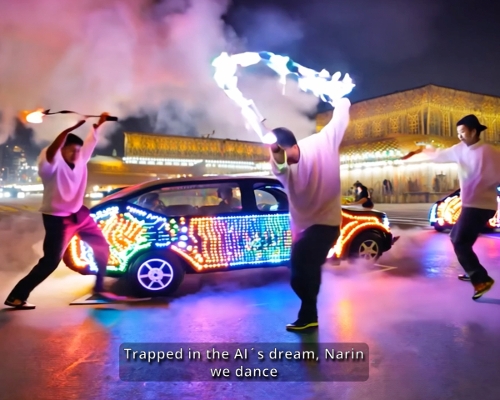
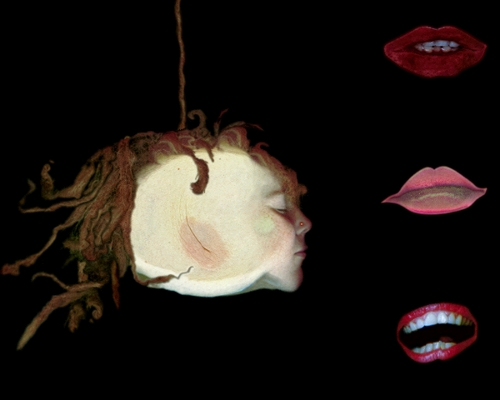
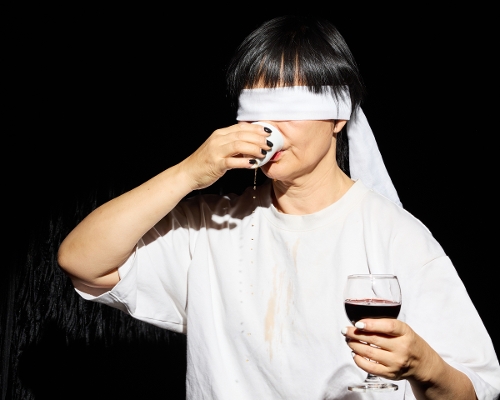
Danni Zuvela begins by leading us away from the violence of the “cutting edge” to find experimental art futures through access and tactility. Brian Obiri-Asare follows artworks that take the rapidly rising temperature of AI, while Daniel Mudie Cunningham considers queer futurity and the resistance of legibility, stability and institutional comfort in Victoria Spence’s expanded performance works.
Locating experimentation in queer marginality brings to mind American academic Avery Gordon, who states that while historical traditions of utopia are most often dreamed up by the privileged, the utopian dreams erupting from within marginalised communities are more urgent and unmapped and arise from need — where another world is possible because it has to be.[2]
Kat Bell, with Angelika Tyrone, reminds us of the different ways Indigenous artists have refused historical containment, and how they assert their presence in systems that often misread or minimised them. Her recent project reanimates Trevor Nickolls’ remarkable paintings using augmented reality, creating a living archive. Troy-Anthony Baylis celebrates The Blak Laundry’s astute institutionally adjacency, from where they host conversations that break colonial power cycles.
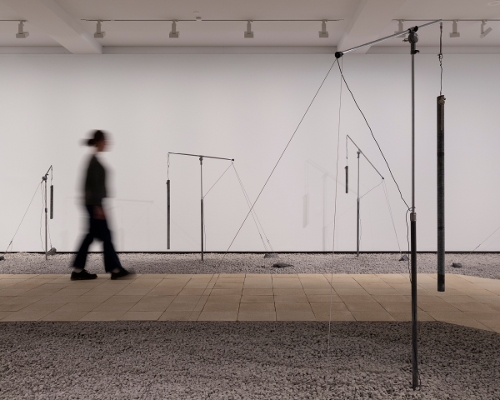
Turning towards questions of institutional holding, the difficulties of conserving and restaging ephemeral digital works are discussed by Candice Cranmer, while Gail Priest takes up questions of collecting and exhibiting arguably the most immaterial of art forms—sound. Simone Hine considers the archives of ephemeral art in university collections, from their knowledge-centric beginnings to their precarity under neoliberal management. Also emphasising the possibility of such spaces, Tracey Clement reports on experiments in sustainability by approaching the university gallery as a laboratory.
A member of the Adelaide Women’s Art Movement (WAM) once gleefully told me about spraying THE EAF IS AN ART INSTITUTION on their exterior wall. I later found a photograph in the EAF’s own archive of graffiti THE EAF SUCKS THE STATUS QUO. It is hard to know whether it was one event—if the messages merged in memory—but regardless, the insults are perhaps the greatest that could be paid to post-object art.
The graffiti reminds me of the ease with which the outside can become absorbed into the centre. Christina Barton brings careful attention to practices in Aotearoa New Zealand that continue to resist institutional capture, drawing on her decades of research into post-object art. Anne Marsh, whose writing has been formative to performance art and feminism in Australia, celebrates the enduring influence of WAM by tracing a throughline of relationality and care flourishing in contemporary practice.
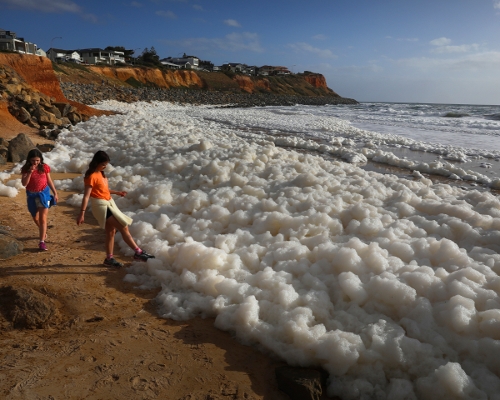
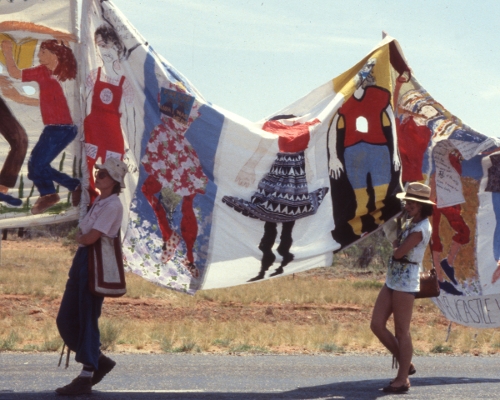
The women who march through Marsh’s article advocate for Country by protesting nuclear futures at Pine Gap in 1983. In South Australia for over a year, waves of fish bodies have beached along the coast — a gut-wrenching signal of oceanic and planetary disaster which Melinda Rackham has documented via urgent responses from local artists which cut through political spin.
EXPERIMENTAL ART: Rattling the Archive forms an extended, unruly reader for my curatorial projects Anarchive: knowledge follows form (at Flinders University Museum of Art) and Anarchive: Gut-feeling (at Adelaide Contemporary Experimental, ACE) in conversation with my research into women’s experimental art in South Australia and its absence in the archives. I gratefully acknowledge the generous intellectual exchanges with Angela Goddard, Fiona Salmon and Danni Zuvela throughout this project, and the collaborative role of the Artlink team. Most importantly, I thank the writers whose polyvocality—assisted by additional financial support from the South Australian Government through Create SA—make this such a rich, extended issue.
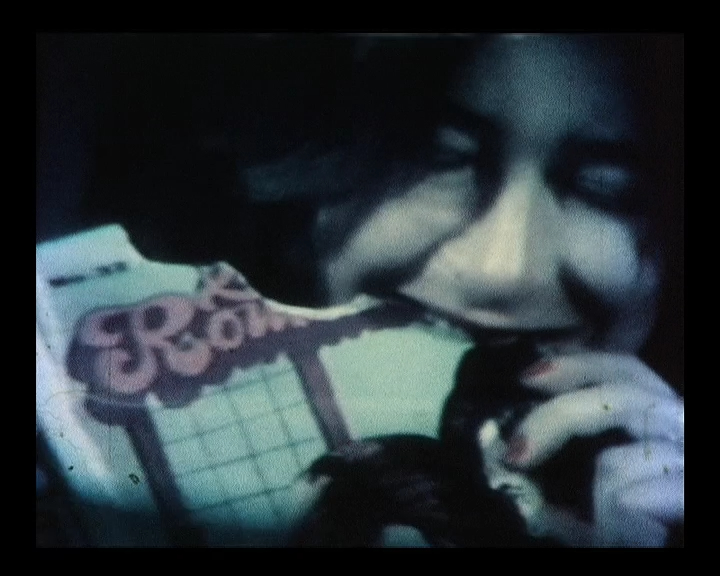
Celebrating 45 years in print in 2026, Artlink is a fully digitised and partial record of experimental art. I rattle its archive to see what shakes out. The first issue carried a photo of a 1981 performance by Sandra Greentree Nicolaides, which encouraged me to interview her and advocate for the collection and digitisation of her performance reels and experimental films. In May, a selection will be screened at ACE alongside Jacky Redgate’s film, both exhibited for the first time since their making: the unfinished histories of experimental art prompt ongoing digestion.
Debuting on our cover, snails are unwitting performers, ingesting their mulberry paper surrounds to make Bridget Currie’s Each surface touched (2026). Their hunger articulates gaps in the archive. Through drawing attention to the slow and un-monumental, I extend an invitation to pause, to take stock — and to delight in the always more-than-human world.