The archives of experimental art are often intangible, and—reflecting the patriarchal commonsense of the time in which they formed—also inequitable. Approaching South Australian archives, this essay considers the disruptive possibilities of women’s (mostly uncollected) practices, and relational approaches to the cultural digestion of them now.[1] I write from the middle of curating Anarchive: knowledge follows form at Flinders University Museum of Art (FUMA), and Anarchive: Gut-feeling at Adelaide Contemporary Experimental (ACE) Gallery. Both exhibitions, in which artists encounter local ephemeral art histories, are opening to the public as EXPERIMENTAL ART: Rattling the Archive launches.
Working towards a PhD on the FUMA Post-object and Documentation (POD) collection, it was immediately apparent that women were under-represented and First Nations people entirely absent as artists in that archive.[2] I found that of the 315 (post) objects it held, the solo inclusions by Australian and Aotearoa women total a meagre five (against the near 200 from men in the same category).[3] These omissions were particularly troubling given the claim it is ‘amongst the most comprehensive national collections that document conceptual art making in the 1960s and 1970s’.[4] Arriving amidst the women’s movement, land rights and homosexual law reform campaigns, the collection sits poised between the patriarchal thinking that preceded it, and the striving for equality that (still) follows.
For a shimmering moment, the founding of the Experimental Art Foundation (EAF) in 1974 amplified the visibility of Tarntanya / Adelaide amidst the burgeoning international experimental art scene. Soon after, the Adelaide chapter of the Women’s Art Movement (WAM) began operation, running for a decade from 1976.[5] These organisations were like siblings: sometimes co-operative, other times adversarial. Both understood themselves as being at the forefront of experimental art, albeit via different methods. The EAF approached art as experimental action, with WAM committed to open access, respecting difference, and developing an evolving collective, non-hierarchical structure.[6] While many of the works made at the EAF were collected by FUMA, the WAM archive became an ephemera file at the State Library of South Australia. These different ways of holding (inside and outside of art institutions) significantly impact their mobility and use.
If archives, like the POD collection, are machines that ceaselessly repeat themselves, eternally trapped within their own limitations, then to speak of “anarchives” is to understand collections as perpetually haunted by the violence of their own forgetting — the anarchival force an ever-present, chaotic flipside to the orderly narrating of histories.[7] The anarchival force haunting the POD collection is decidedly female, and to meet its angry demands I began to develop Experimental Art Anarchive — which, for now, takes the form of exhibitions and publishing projects. My strategies include both interrupting the POD archive (by inviting new works and voices into it) and exceeding institutional historicisation by handing my research to other artists and writers—resonating with Boaventura de Sousa Santos’ “insurgent archives” which flower from within, scattering existing archives and inviting multiplicity—seeding a dense present that claims suppressed pasts.[8]
I read the POD collection seeking those made marginal by it, often finding them in the WAM files and early issues of Artlink, along the way interviewing 29 people (and counting).[9] My research was shared with the contemporary artists commissioned through archive visits, screenings and studio conversations. These include Bridget Currie who presents Anarchive: knowledge follows form at FUMA, and Troy-Anthony Baylis, V Barratt, Grace Marlow, Aidan Hughes, Ariella Napoli, Jingwei Bu, Shenshen Zheng, Jazmine Deng, Tayer Stead, Oriana Julie, Brad Darkson and Tikari Rigney presenting in Anarchive: Gut-feeling at ACE.
Proximity (rather than direct response) underpins my approach to commissioning. Care is taken to avoid instrumentalising art making for the explanation or communication of art history. The artists are tasked with making new work addressing whatever is urgent to them, excited by an encounter with this past. As the commissions take shape, ways of digesting histories emerge — some simply enjoy resonances with earlier artworks, others address archives and remembering, while still others take more direct forms of translation by reperforming or remaking.
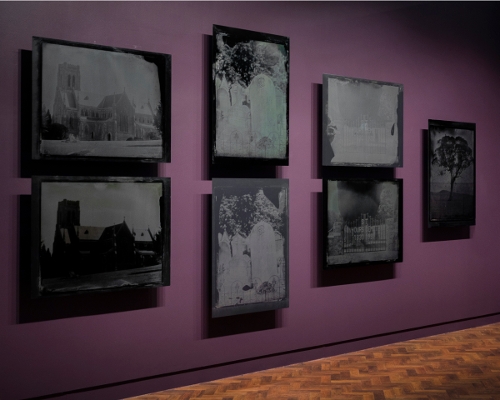
For Anarchive: knowledge follows form at FUMA, Bridget Currie amplifies the phenomenology of archives — the ways they unfurl towards new knowledge within us, while their closing lids enact the quiet violence of shutting others out. Located on the POD’s home ground, she activates its delicious papery materiality. Four large silver archive boxes fit snugly into a custom-made table with a hinged top that opens and closes dangerously, like scissors. Each box holds a new work.
Currie’s works are intimately connected with the more-than-human world. One is snail-eaten, evoking the archive’s potential for holes and nourishment. Another unfolds map-like to reveal a majestic, pruned tree, severed across its canopy to accommodate human infostructure. She tells me that participating in Anarchive triggers rage and sadness about the exclusion and erasure of so many artists.[10] In one box, a fabric is printed with photos of words scribed into tree trunks, cut together like a zine or ransom note. The text—not quite poem nor slogan—rails against the prospect of being forgotten.
Currie’s work is surrounded by a selection of works from the POD archive including those few by women, some compilation editions, and some recent acquisitions. Most are offset printed artist books, originally sold cheaply—following egalitarian aspirations—which now rest untouchable in glass display cases. To augment their exhibition, Bridget and I experiment with ways of putting them to living use. As we turn pages we delight in discoveries and read passages aloud, creating a speculative, conversational narration that runs through the exhibition as a kind of experimental curation in the form of videos and sounds.
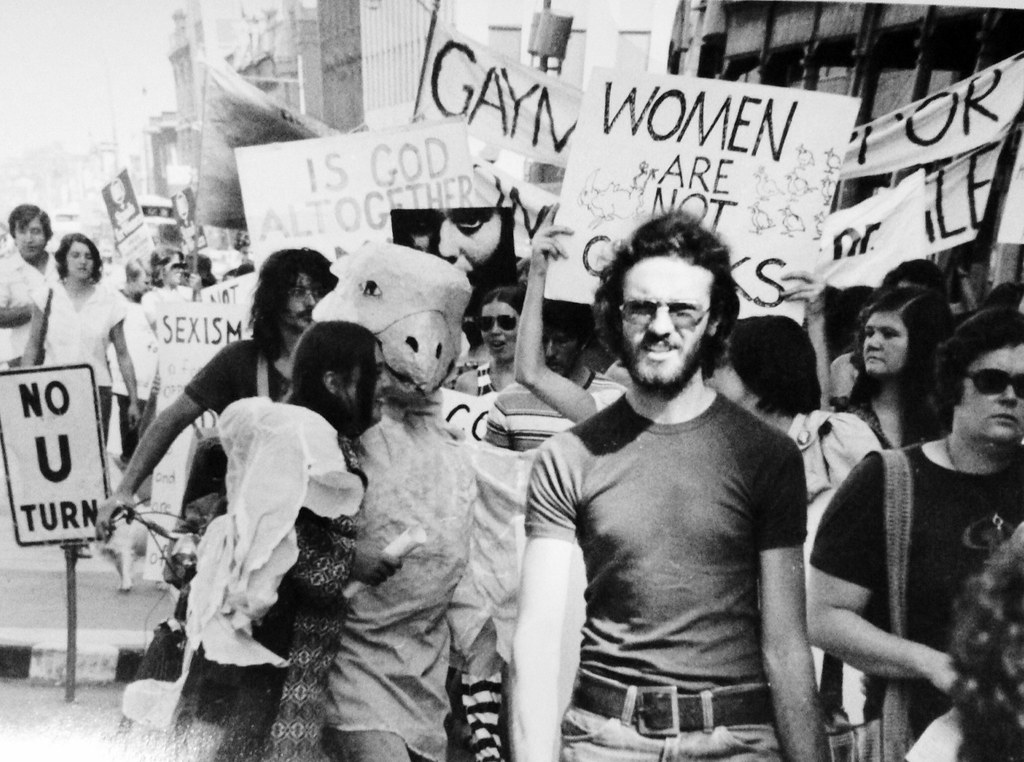
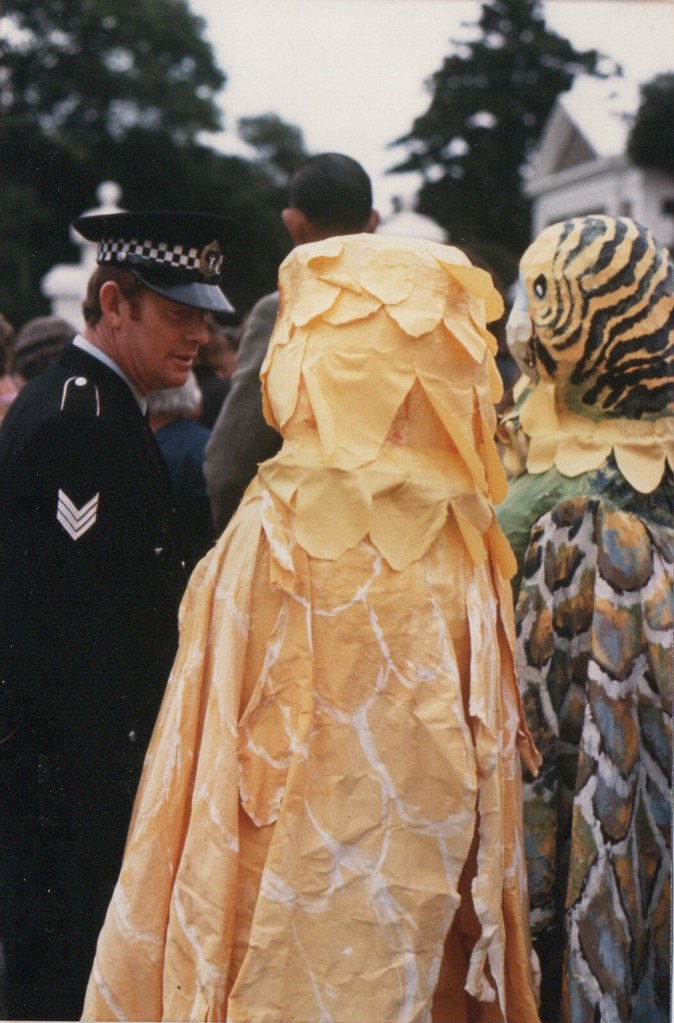
The last of Currie’s boxes cannot contain the two budgie-head masks that spill from it. These have been made in conversation with Dorothy (Dot) Thompson and can be donned like a feathered filter through which to see the whole exhibition. Photos of Thompson’s 1970s bird-clad performances are on loan at FUMA, where they inject an irreverently silly counterpoint into the cerebral quality of conceptual art as effectively now as they did five decades ago. The original budgie costumes perished over the years, and Currie’s remaking offers a lively, embodied foray into the past that continues the masks’ institutionally disruptive potential. Currie also reflects that their garish colour upended the subdued palette of her studio—it was troubling at first, and then welcomed—allowing her to enact more irreverent methods than she would have alone.
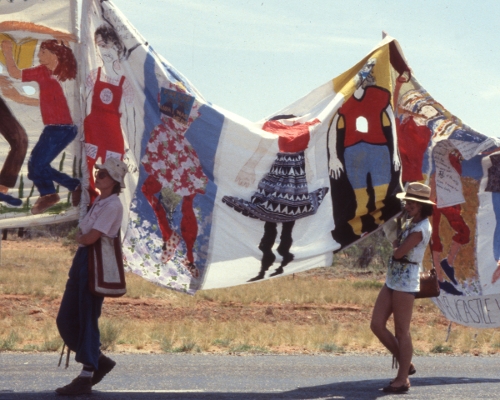
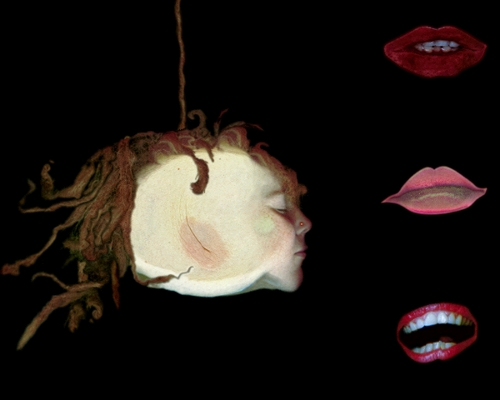
Co-curating Anarchive: Gut-feeling with Danni Zuvela at ACE, new performances, events and sounds tremble alongside documentation of earlier ephemeral practices and experimental films — some shown for the first time since their making. In Jacky Redgate’s super 8 film True Romance (1980) a woman fiercely eats a romance magazine, her consumption both digesting and internalising its gendered content, while at the same time pleasurably destroying its object. In her 1980 performance, Up to Our Necks Sandra Greentree Nicolaides eats a pleasant alfresco meal while nearly choking to death on rising waters. Close by, Sue Richter’s remarkable Blood on the Saddle (1983) takes archival footage of the moment President Reagan was shot, building it delicately into a spiralling depiction of cowboy culture that resonates uncomfortably with post-truth media and American politics now. These inhabit a purpose-built video gallery at ACE alongside key works by Jill Orr, Bronwyn Platten and Margaret Dodd — with additional performances and events recalled on an extensive slide reel. Adjacent, safely ensconced in a booth, VNS Matrix’s queerly erotic Beg and Gen in the Bonding Booth (1993) calls up AI mistresses and pulses with techno-tendrils.
V Barratt is uniquely positioned in the Anarchive exhibition program, represented in the historical works (as part of VNS Matrix) and with a new collaborative performance with Grace Marlow. Developing their work, Barratt and Marlow trawl through the art waste of Barratt’s long practice — props, costumes and sound recordings, as if inhabiting a ruin. Theirs is an ongoing collaboration and a kind of relational history work. Their conversations, rehearsals and performances become sites of transgenerational knowledge exchange that interrupts institutional purchase on history by welcoming the uncertainty of oral and tactile translations.
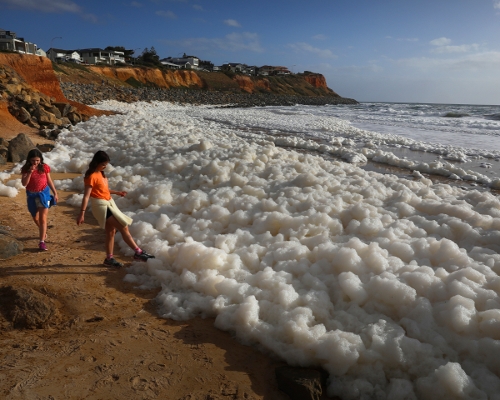
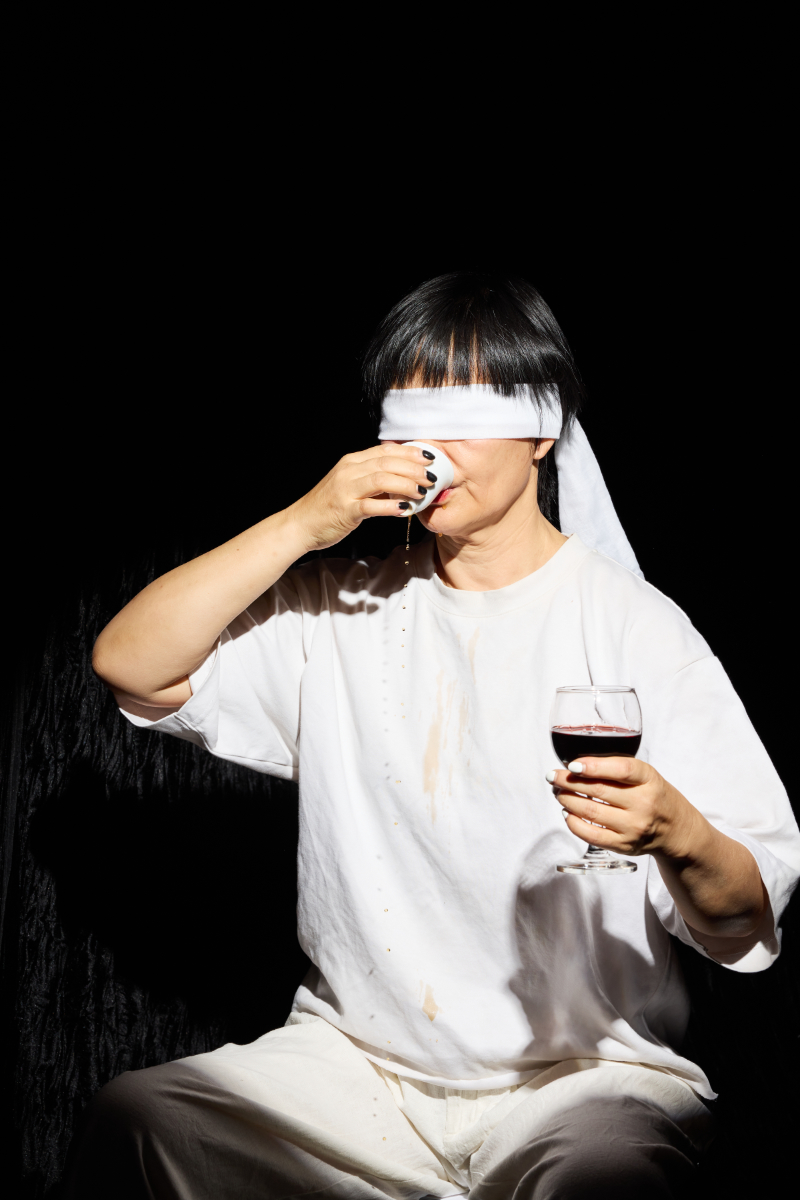
Digestion is a bodily, energetic mode of relation to the world, one that is messy, personal, and resonant with the ways artists bring historical artworks into living use. The now of digestion is that of the living organism constantly in exchange with its immediate environment. Jingwei Bu knows this porosity — and suggests that the world is too much to swallow. In her latest affecting performance wine and tea are drunk and expelled, running down the inside and outside of her body simultaneously. Where they stain her T-shirt, the bloody ghost of a digestive tract materialises. Philosopher Michael Marder suggests that we live on a sick planet with a dysfunctional metabolism, amidst an ‘indigestibility of being’ — his words and Bu’s performance giving form to my own feelings of powerlessness when faced with climate disaster and the daily news.[11]
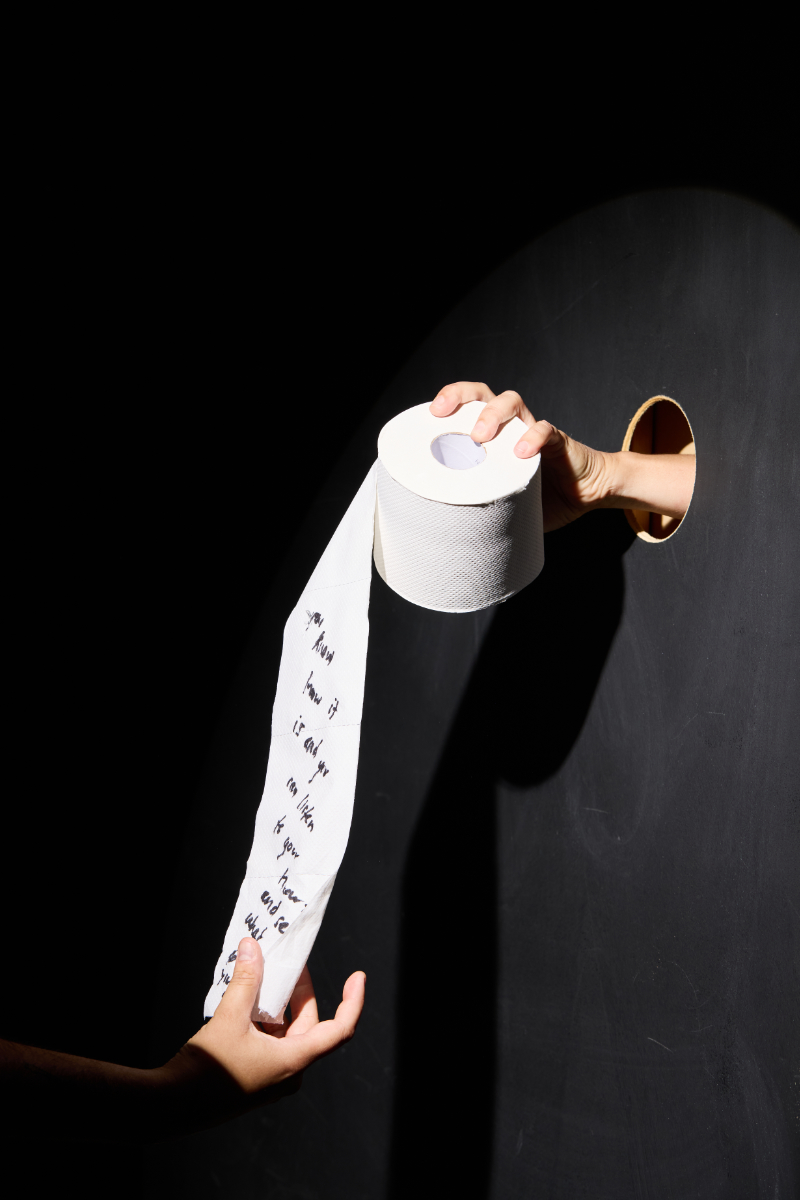
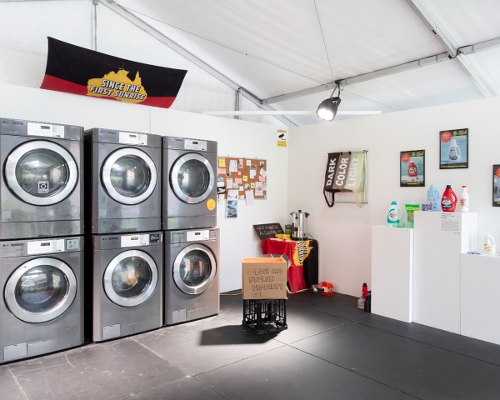
And then to the toilet. Playfully embracing the abject, Tikari Rigney amplifies Beg and Gen’s need for saucy secrecy by choosing to perform in a bathroom stall adjacent to it. From within a purpose-built cubicle they communicate through a “glory hole” in the wall, using toilet paper transmissions to connect one-to-one with visitors. They tell me of the confusing and joyous exploration into their own gender as an AFAB person — with the toilets a charged space for queer kinship, encounters and exclusions.[12] By placing themselves behind a cubicle wall they create an intimate confessional situation they liken to the pleasure of speaking with strangers or imparting secrets in the dark.
Rigney tells me that they have found it freeing to work in conversation with the past. We speak about Jude Adams performing in the EAF women’s toilets, and her audacious ‘stinking up’ of post-object art by using shit covered nappies in Washing Performance (1979). We fossick forward in time to revel in the lo-fi confessional works of Anastasia Klose, I thought I was wrong, but it turned out I was wrong... (2010) exciting the intimacy and audacity of Rigney’s approach. Watching the emergence of Rigney’s work, buttressed by a network of others, reminds me of Judith Butler’s writing against individualism. They assert that we are sustained by virtue of our interdependency.[13] To think in this way is to attend to the webs of bodies, environments and infrastructures that make our every move possible. Butler’s work brings me to the need for collaborative resistance in a world in which some lives are valued and remembered more than others.
My own reach as an artist and writer is limited and sustained by the works that I have access to. My research is driven by my need for women’s experimental art. Despite attending art school in Tarntanya / Adelaide, and stints in the EAF studios, I knew little of the artists who have come to dominate (and disrupt) my understanding of times past. My interrelation with these artists includes the obligation to carry artworks and stories forward carefully. What started as a PhD has spiralled in these exhibitions, magazine publishing, raising funds to digitise artworks, writing “statements of significance” to make works visible to collecting institutions, conversations that span years, and the astonishing generosity and encouragement of those women I have met, and to whom I owe so much.
Working on Anarchive I encounter firsthand the violence of selection. Spatial, budgetary and technological limitations mean that the exhibitions only show a fragment of works possible. No exhibition, book or archive (or anarchive for that matter) can be definitive. At the entry to ACE, Danni Zuvela gestures to a wall. You should fill this with all of the artists, she says. And I am. I am pasting up the constellation of women artists I have come to know, with space left empty for those unknown — a declaration that the anarchive is always unfinished. There is so much more to do.
.jpg)
Footnotes
- ^ A note on language and the use of the word ‘women’. My research considers experimental art 1975–1985 in South Australia. At the time, binary gender boundaries were dominant, with the marvellous gender diversity of the new millennium was yet to come
- ^ This is despite the involvement of First Nations people in experimental art, including Fernanda Martins being the first woman to show at the EAF in 1975, Polly Sumner’s writing for Artlink and her extensive work with WAM, the Aboriginal Women’s Art Festival 1985, among many other examples
- ^ These numbers reflect my archive review of the POD collection at the commencement of my research in 2022. Since that time there have been donations of works addressing the gender imbalance
- ^ FUMA website collection description
- ^ First known as Women’s Art Group (W.A.G) formed in 1976, with the name Women’s Art Movement (W.A.M) first used in 1977— as described in Anne Marsh, “Difference: A Radical Approach to Women and Art”, (Adelaide: Women’s Art Movement, 1985),1
- ^ The EAF’s core values, printed on the inside cover of Noel Sheridan (ed), “Experimental Art Foundation, Adelaide South Australia”, (EAF, Adelaide, 1977). WAM’s values are described in Marsh, 1985, 1-7
- ^ Jacques Derrida, “Archive Fever: A Freudian Impression”, translated by Eric Prenowitz (Chicago: University of Chicago Press, 1996), 51
- ^ Boaventura de Sousa Santos, “The End of the Cognitive Empire: The Coming of Age of Epistemologies of the South”, (Durham: Duke University Press, 2018), 202
- ^ Interview participants included art workers and artists: Catherine Cherry van Wilgenburg, Bonita Ely, Christine Goodwin, Jane Kent, Polly Sumner, Sandra Greentree Nicolaides, Stephanie Britton, Fiona Clark, Philip Dadson, Maree Horner, Christina Barton, Dorothy (Dot) Thompson, Micky Allan, Virginia Coventry, Jude Adams, Anne Marsh, Sue Richter, Ken Bolton, Fernanda (Fern) Martins, Helen the Printer (Rogers), Michele Luke, Michelle Stanley, Julie Ewington, Margret Dodd, Jill Orr, Ian De Gruchy, David Kerr, Karylin Brown, Jacky Redgate, Bronwyn Platten
- ^ Conversation with Bridget Currie, 27 January 2026. All further refences to the artist’s view are drawn from this conversation
- ^ Discussed in Manuela Mehrwald and Anna Pomyalova “Metabolic aesthetics against planetary indigestion”, Research Directions: Biotechnology Design, 3:8, (2025): 1–11
- ^ Conversation with Tikari Rigney 24 January 2026. All further refences to the artist’s view are drawn from this conversation
- ^ Judith Butler, “The Force of Nonviolence: An Ethico-Political Bind”, (London: Verso, 2020), 9