On a dreary Sunday, I made my way down on the ever-reliable Transwa Australind coach service to Bunbury, a southwest port city, to visit the Bunbury Regional Art Gallery (BRAG). The Gallery is housed within a distinctively pink heritage building, which was first home to a Convent of Mercy in the late nineteenth century, before serving a civic function as an art gallery from 1987. In the same way that Bunbury acts as a service and infrastructural hub to other regional spokes (evidenced by a strip of big box hardware, supply and service outlets littered along the otherwise charming road into the town), BRAG is inarguably central to the network of southwest culture.
It is no surprise, then, that BRAG is the central node of the South West Biennial 2026: Tracework, a series of contemporaneous exhibitions across the southwest cities and towns of Margaret River, Narrogin, Albany, Northcliffe, Perth and Bunbury. While this exhibition marks newly inaugurated ‘South West Biennial’ (SWB) branding, similar survey exhibitions are well-established listings in the Western Australian exhibition calendar, and for good reason: opportunities to resourcefully connect in this sprawling state are few and far between, and nearly exclusively hosted in the capital city. In essence, it is a strength, not a quirk or a compromise, that BRAG provides a solid base for southwest regional practices, which are not as alienated from the city as one may think. It is not uncommon to see the same names of regional artists appear in the upcoming Regional Arts Triennale, yearly art prizes, and in privatised spaces such as the Holmes à Court Gallery. The SWB is no mere finger on the regional pulse, but an effective means to create opportunity, visibility and a platform for artists in the region.
The aim of my visit to BRAG was not to assess this effectiveness as such, but to explore the type of exhibition making that accompanies this hub-and-spoke model. In a way, this is a practical affordance — I did not visit any other exhibitions listed as a part of the SWB, and so it would be difficult to analyse the Biennial at large, even if I wanted to. My approach is thus simplified: given that BRAG is a central node to what may be an otherwise de-hierarchised sprawl of regional galleries, what kind of exhibition sits at this centre?
Admittedly, this argument has its limits. Am I simply reproducing centre-periphery models onto a community and audience who don’t adhere to this idea? The curatorial premising of Tracework hints at this contradiction, flattening any perceived centre-periphery exceptionalism through a shared language of ‘trace’, attesting to ‘a shared sensibility … the belief that to understand the world, we must learn to read its traces’. I’ve taken this to mean that while the southwest region is not adequately represented by a sole column like Bunbury, Albany or even Perth, it is in the Tracework exhibition at BRAG that traces of shared ecological, cultural and political concern in the region converge.
The stakes of this curatorial proposal as communicated through the written materials available throughout the exhibition are neither convincing nor compelling. Wielding a well-worn object-oriented reference list including Martin Heidegger, Timothy Morton and Byung-Chul Han, the vacillating and reiterative prose does little to identify the ‘traces’ we are meant to be noticing. Such desultory curatorial frame working is unsurprising in today’s art world of polite politics and civic obedience, but particularly disappointing in this context given the regional conditions that could otherwise open out to alterity and counter-cultural nonconformity. If the centre-periphery model is to be flattened, as the curators intend, it needed a sharper account of what replaces it. It is this absence, more than the premise itself, that the exhibition struggles, and at points, prevails against.
Tracework at BRAG is ostensibly divided into two exhibitions – a survey of a couple dozen southwest regional artists and a suite of five commissions, primarily by Western Australian artists. I was mostly underwhelmed by the commissioned works probably due to my existing knowledge of each artist’s previous work, and inherent issues in curation and presentation. While no longer seeking answers in the Tracework curatorial thesis—but keeping the forces of Hooyberg’s poetic supplement at hand—I sought to discover the new engagements and ambitions of each artist.
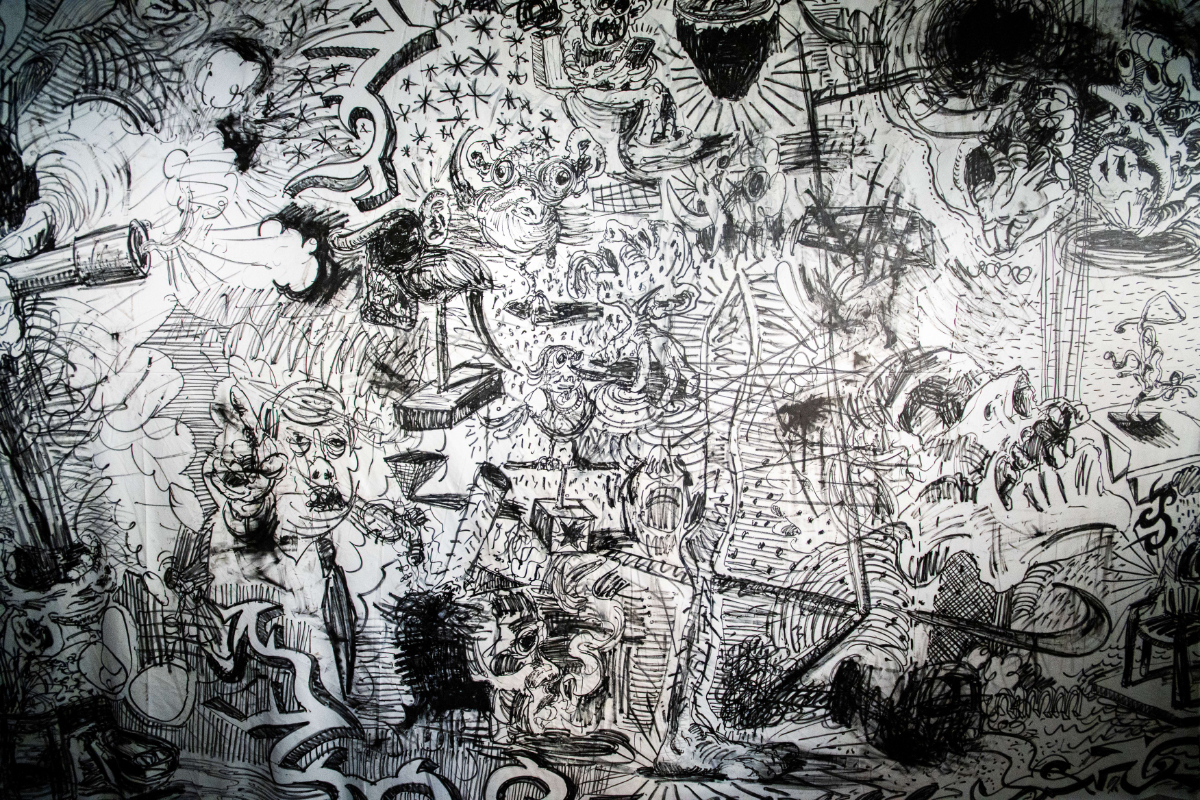
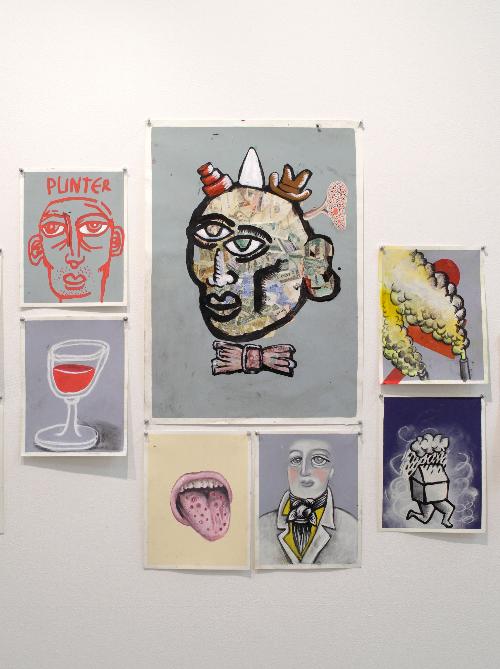
In Jacobus Capone’s display of works, an unstirring set of slow devotional acts in natural landscapes did not engage my attention as the glacier water gouache panels did, despite being overwhelmed by the adjacent video works; overall, Capone’s contribution gave the impression of a repeated, rather than extended, gesture. Disappointingly, Sharyn Egan’s colourful wool balga sculptures needed more space than the hallway, given the expressive forms of this commission. Similarly, a series of works on paper by Andy Quilty presented a density issue: the massive Drawing for Rocko #2 (2026), an epic scaling-up of Quilty’s signature hand style, felt crowded and hard to appreciate in the space it was given.
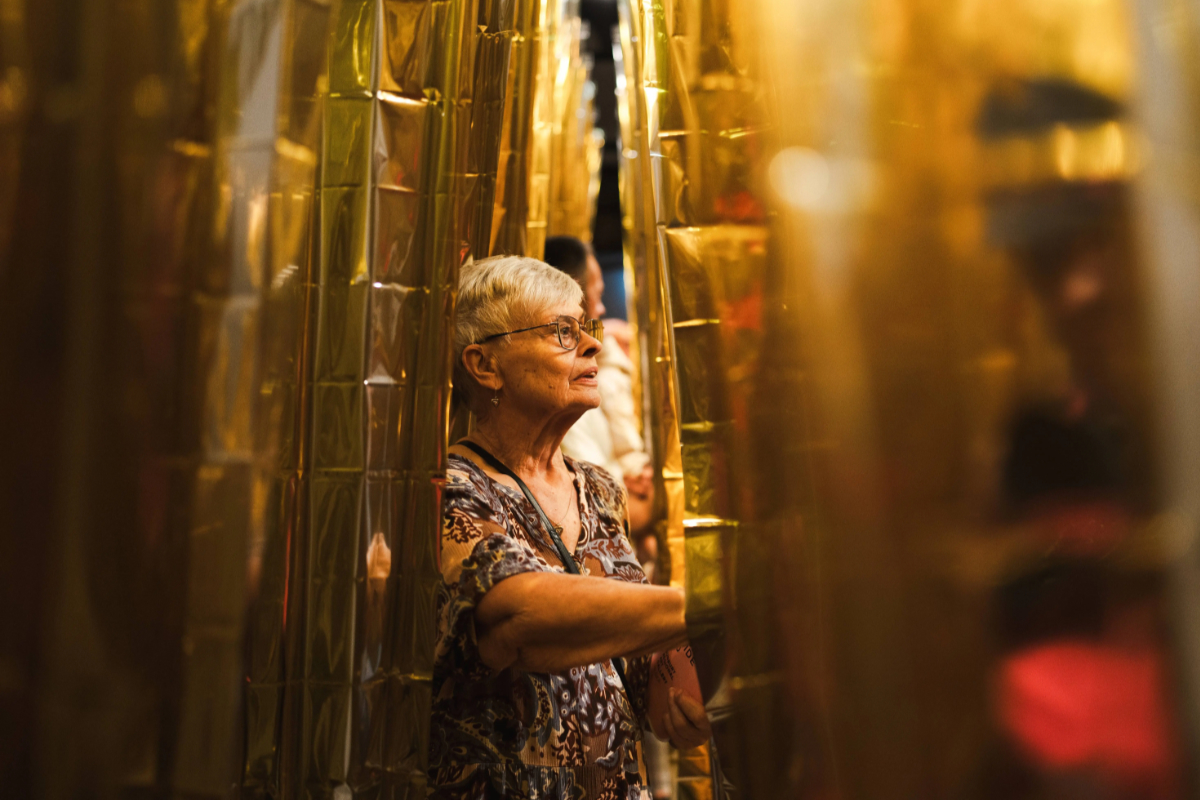
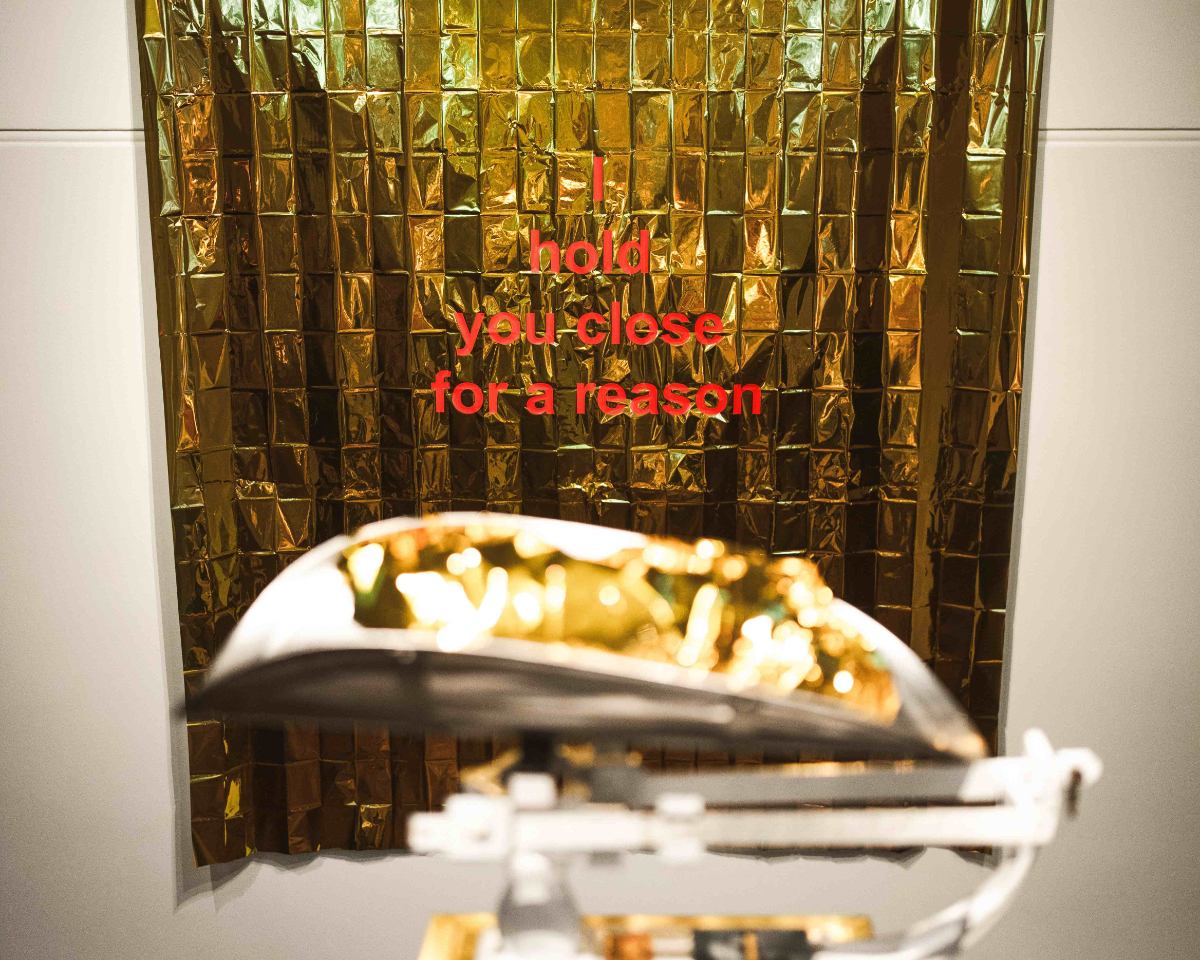
Conversely, the venue of Olga Cironis’ Breathe (2026) served well to match the deferential and solemn content of the work. Gold-yellow foil emergency blankets suspended from the ceiling or curled into a bundle and placed on chairs provide a substrate for Cironis’ aphorisms that guide the viewer through a procession of partial memories. I was provoked to question the work: how lightly should we draw our traces through memory and trauma? The apotheosis of the exhibition—a bundle of emergency blankets sitting on a scale used to weigh infants—places a pit in my stomach, but this confrontation with that feeling is unreconciled by the vague and opaque memories hinted at in the rest of the exhibition.
Cironis’ established use of blankets in her work is particularly pressing and relevant today, yet something felt cold in these contemporary foil emergency blankets. This frostiness is borne out by reality, in the form of the UN’s annual report on Children and Armed Conflict which reported last year the highest number of children harmed or killed in conflict zones since the report began thirty years ago. It is a complex work that left several questions in my mind, but one that I felt was answered: ‘tracing’ as a methodology doesn’t seem to cut it against such a cold, cruel reality. On the other hand, Breathe (2026) is the one work in the commissioned suite that makes good on the curators’ premise rather than merely gesturing at it. It shows that tracing today is a contradictory methodology, but not entirely unproductive.
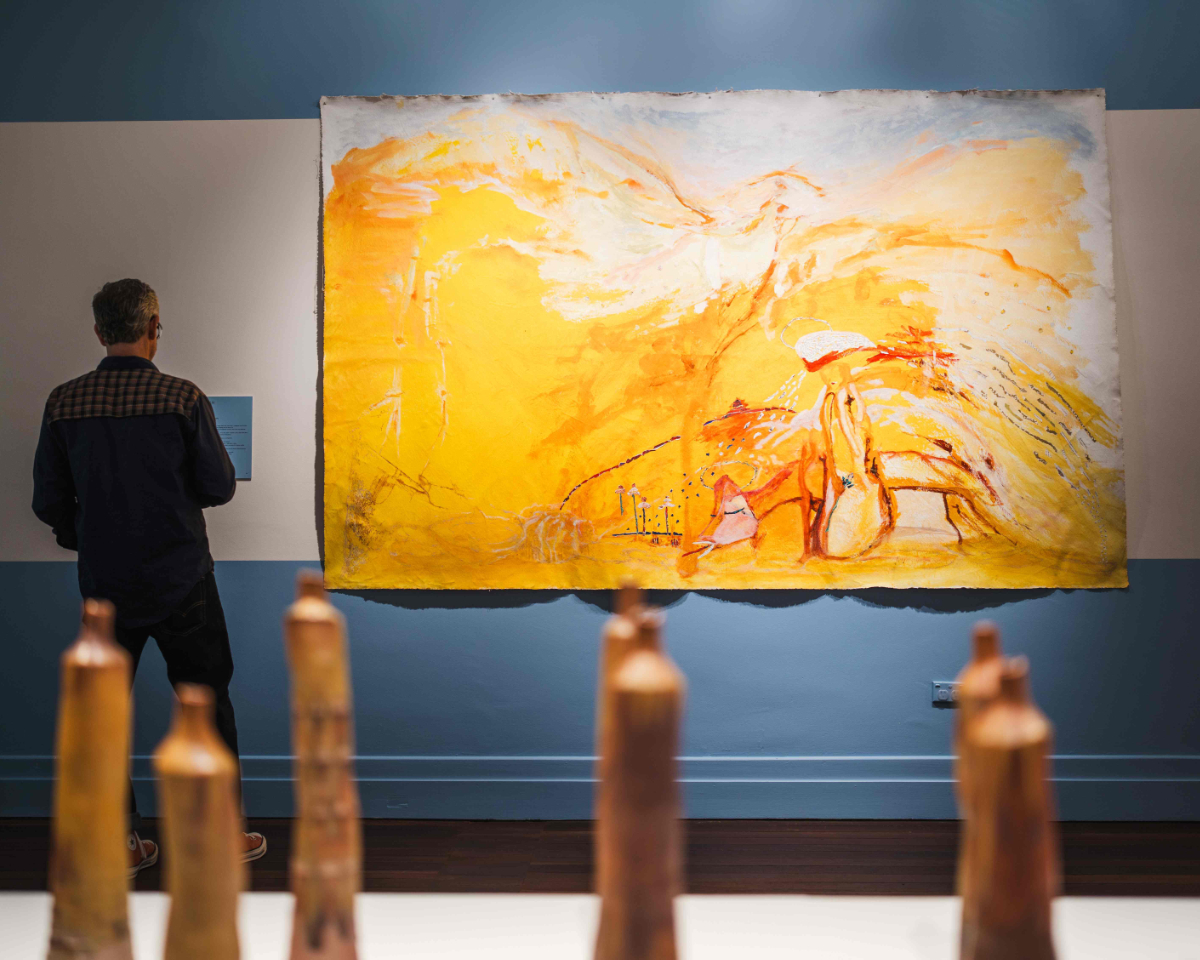
In contrast to the crowded and conceptually patchy maps made across the commissioned section, it is the survey exhibition that presents a more straightforward, tidy and quietly compelling set of works. This is exemplified by Noongar playwright and artist Amanda-Lea Bell’s epic mixed-media work Dog Act(ing) (2026). Large swathes of vibratory yellow work their way back into isolating psychological scenes of Country, with short punctuating words chorusing with Bell’s accompanying poetics. This is an exciting, unpretentious work, curling and imposing in an unstretched, unframed presentation. The neighbouring work is distinct from Bell’s action painting. Heloise Roberts & Moira Fearby’s analytical, sharp chalk and enamel study of a coastline is a sophisticated take on an all-too-common subject of painterly landscape representation. Their cartographic approach is reminiscent of Imants Tillers, whose grid forms are Australian trace-work par excellence.
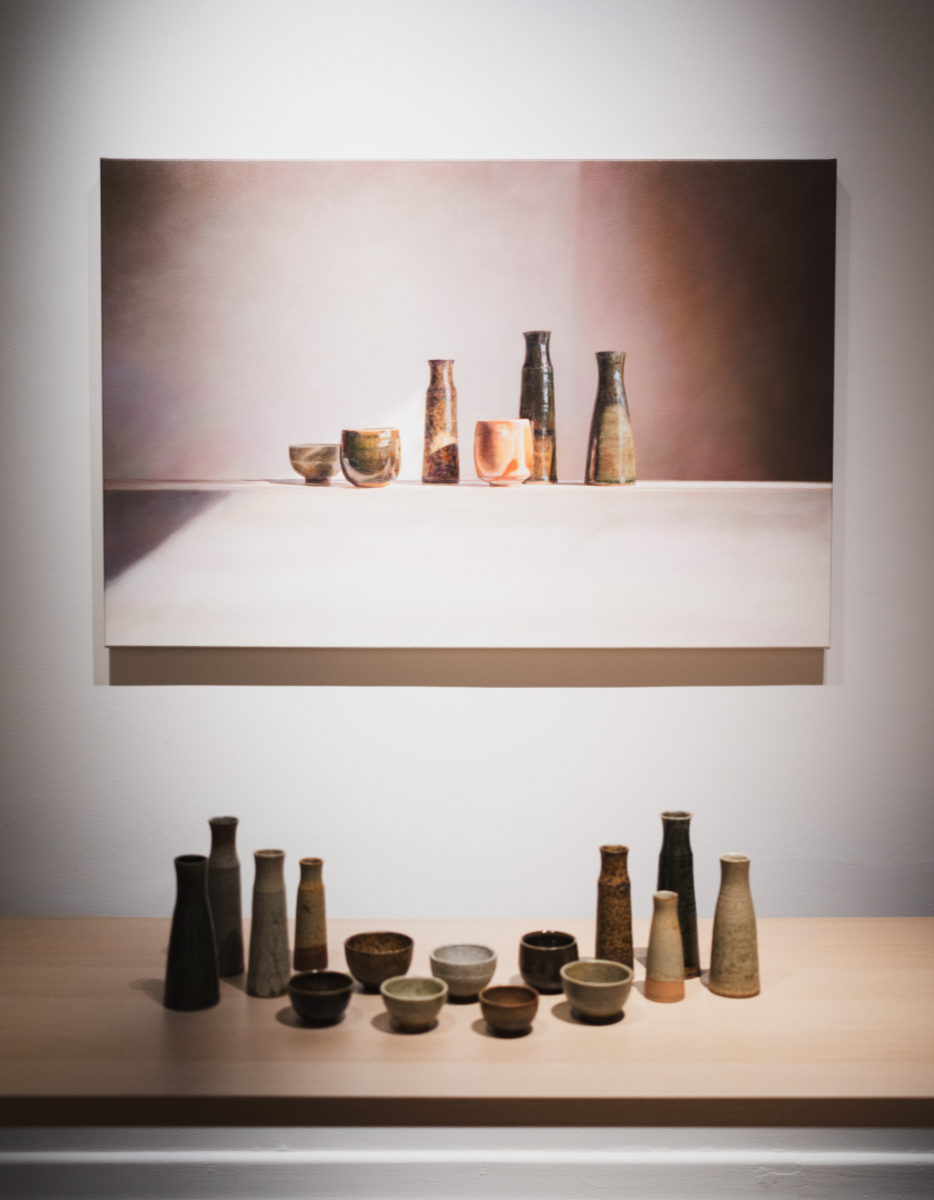
Continuing into the survey exhibition, Tara Boulevard’s leadlight phone booth Thylacine Calling (2026) cleverly references the mythopoetics of the yarn, the pub fable and the journey of the thylacine from a symbol of extinction and colonial ecological violence to a cryptid creature of hearsay. From this wink-nudge vernacular, there are delicate traces to be found in some of the more conventional practices. Samantha Dennison’s bushfire reflections, in both ceramic and paint offer a sombre emotional resonance to the role bushfires play in these regions: destruction, death, rebirth. The phoenix-like quality of southwest forests is hard to describe as anything but magic. These cycles of burn and growth are visible during the rainy winter months, telling a story through the rain-smeared coach windows on my return journey. Dennison’s work is laden with emotion, in a way that is today difficult to convey via representation alone.
Despite the curatorial shortcomings of Tracework, particularly in the commissioned works, the SWB is a sophisticated showing of regional culture, albeit safe in its selection. Landscape painting and ceramics dominate, and I’m left waiting for the weirder vernaculars I know are present within southwest practices to emerge. Maybe these types of work don’t often find their way to Vasse Felix or Linton & Kay galleries, but I have in mind the recent passing of three icons of west coast counter-cultural freak-out: Theo Koning, Hans Arkeveld and Horatio T Birdbath. I leave wondering if the predictability of Tracework represents an actual appetite shift, or if a more daring and honest look at the traces of southwest practice could yield more dog acting in the mongrel and feral margins of this part of the world.