Drawn from the collection of the National Gallery of Victoria, The Stars We Do Not See: Australian Indigenous Art was on display at the National Gallery of Art in Washington over the northern winter — the first stop in its North American tour. After reading Sebastian Smee’s acerbic review of the exhibition in the Washington Post, I was naturally keen to measure his evaluation against my own experience. The two just didn’t line up.
Smee catalogues his ‘crashing disappointment’, but my disappointment came not with the experience of viewing the exhibition, but with the clanging absence of First Nations’ voices and perspectives in his review. Sadly, there’s nothing new here, in fact it’s a tired and typical track whereby the voices of Aboriginal and Torres Strait Islander artists, writers and curators are subsumed by white ‘experts’, despite the strong field of First Nations expertise available. Like most conventional art historical writing, his review abounds in an inability or an unwillingness to think beyond the model of the individual master. But what happens if we flip this masculine, masterpiece-centric approach, and think instead of the collective wellsprings that have sustained a millennial culture across the continent as THE story of Australian art?
According to lead curator Myles Russell-Cook, The Stars We Do Not See references Yolŋu artist Gulumbu Yunupingu, aka Star Lady, for whom the firmament represented shared humanity. But the title is also an invitation to recognise the many non-canonical artists who ‘shine’ despite their invisibility in dominant, national art histories—including Australia’s. Following the logic of Wiradjuri astronomy for instance, dark constellations take their form from the space between stars. Can art history take its shape from the spaces between, from the stars we do not see?
In questioning this canonical thinking, I’m reminded of a quote by Japanese-American artist Ruth Asawa, whose organic metal sculptures I had seen at MoMA just days before visiting The Stars We Do Not See. Asawa speaks to the Buddhist idea of ‘taking care of space’ whereby ‘you're not watching what your brush is doing, but you're watching the spaces around it. You're watching what it isn't doing, so that you're taking care of both the negative space and the positive space’. Surely art history, and curatorial practice for that matter, can play a role in taking care of the non-canonical? I thought we’d arrived here already, but Smee’s review suggests otherwise.
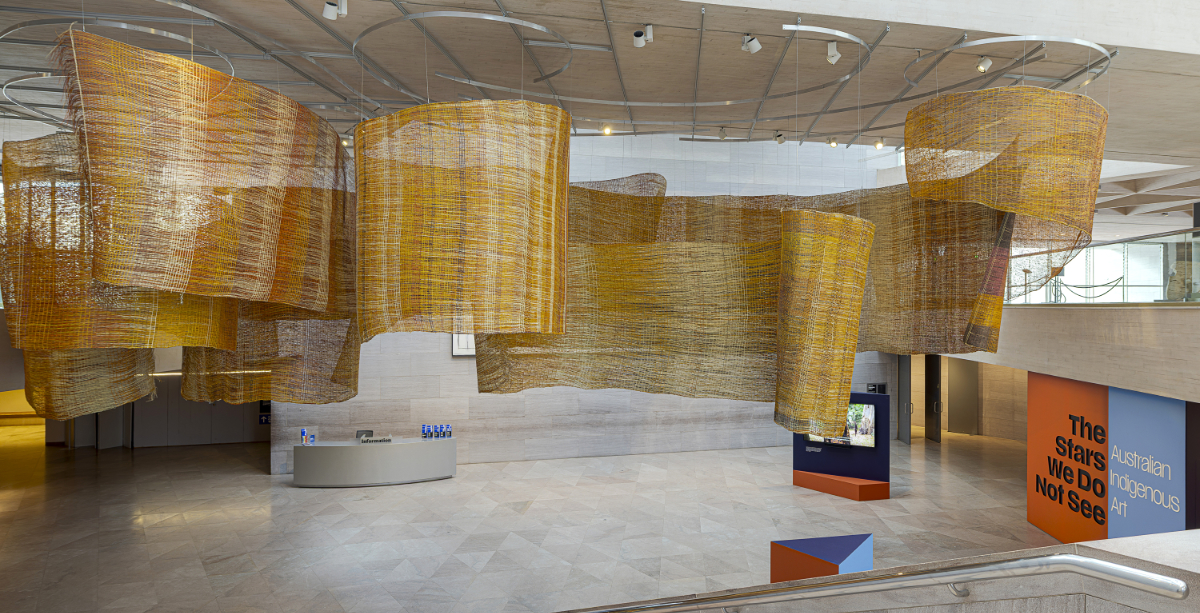
The Stars We Do Not See was introduced at the National Gallery of Art in Washington by Mun-dirra (2023), an over 100 metre-long pandanus fish fence by artists from Maningrida in Central-West Arnhem Land. Woven by thirteen Burarra women, the work is suspended in this installation — in contrast to its grounding when shown in the 2023 NGV Triennial in Melbourne, for which it was commissioned. The positioning of Mun-dirra at the entrance, visible from the Gallery's cavernous foyer, serves to lure the audience into the exhibition like fish into a trap. The raising of the work skywards also signals the show’s celestial thematic. Positioning the grand achievement of these Maningrida matriarchs between Robert Motherwell’s monumental Reconciliation Elegy (1978), and a colossal Alexander Calder mobile, is just one example of taking care of the non-canonical within the stars of Washington's stellar collection. How such relationships play out with collections in the other USA-tour venues remains to be seen.
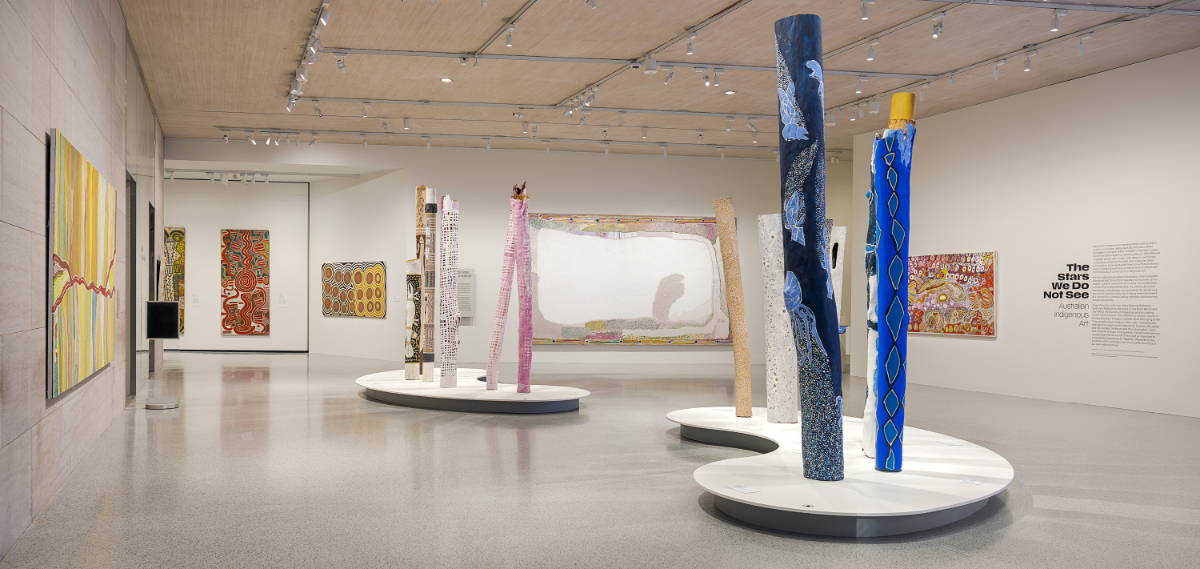
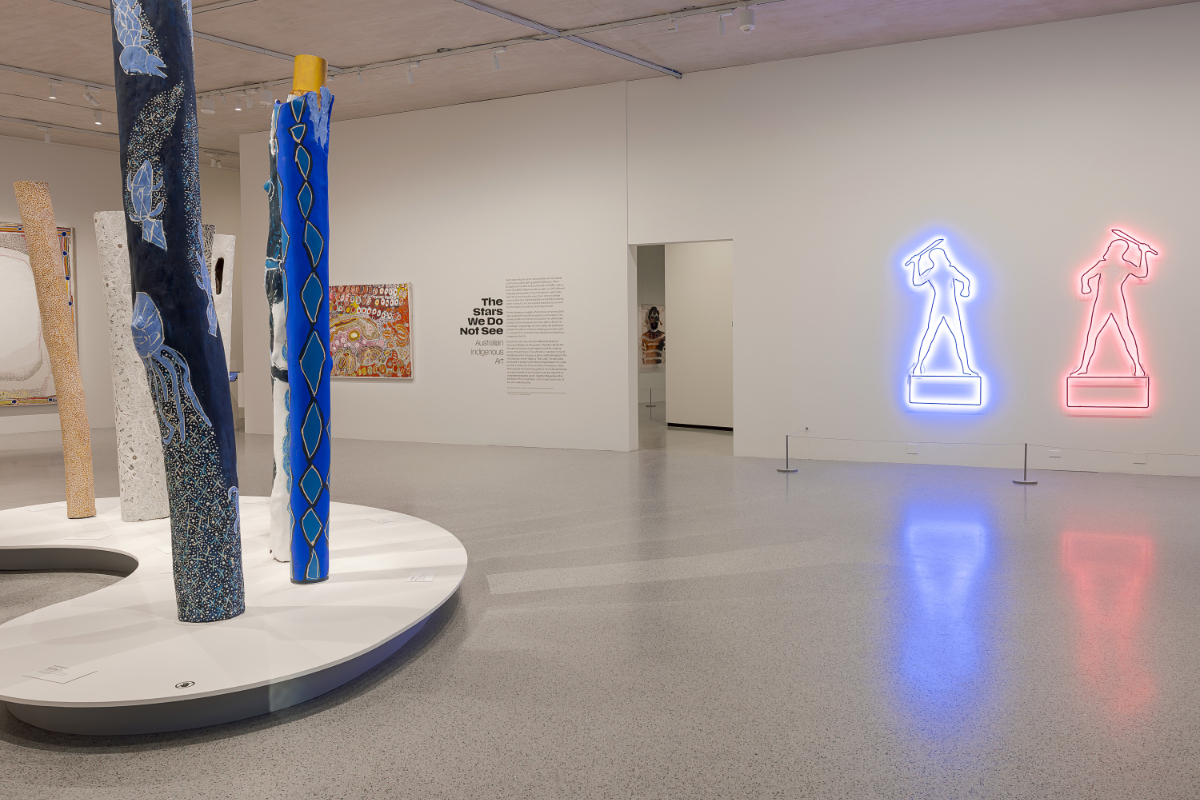
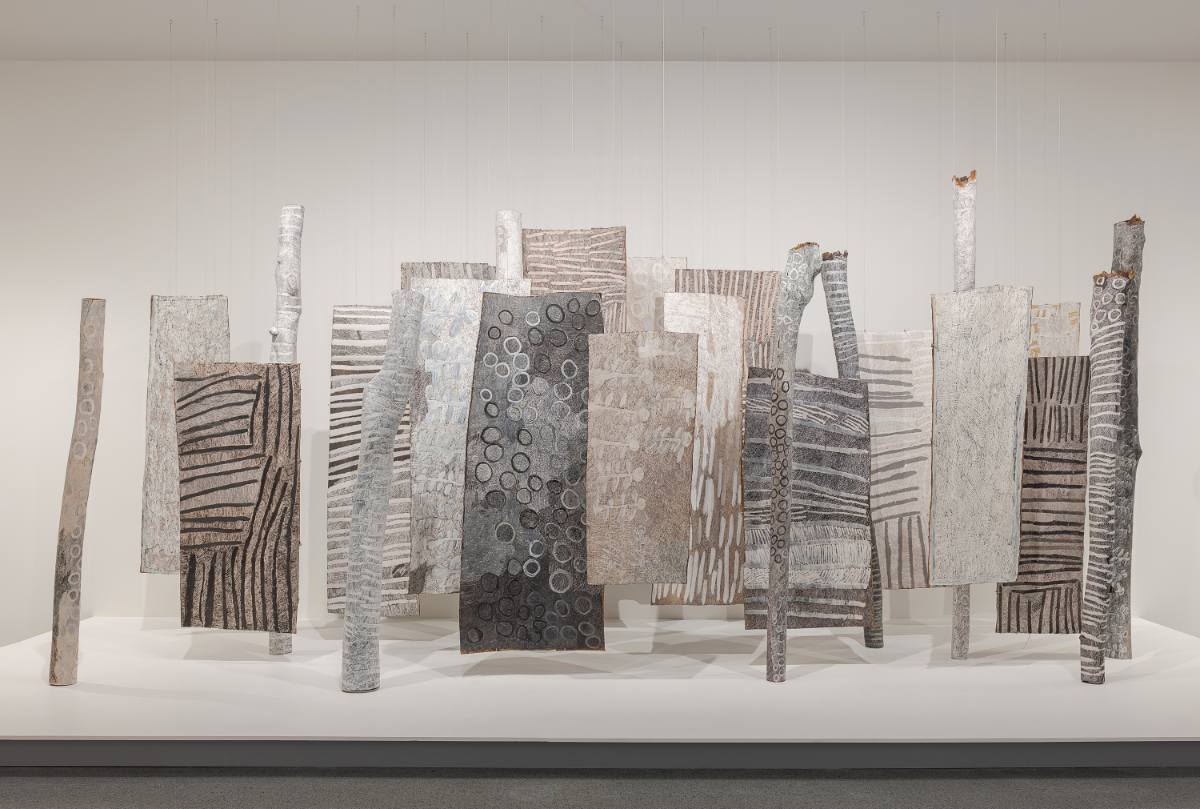
Mun-dirra does more than hold its own alongside these singular American masters, in fact it registers the contemporaneity of this collaborative and ancient culture. It also hints at something that the entire exhibition reveals: that Australian First Nations art is composed of threads linking artists across generations and mediums. This connective breadth is signalled in the first of the exhibition galleries with a conversation between Reko Rennie’s blue and pink neon warriors, the magenta and ultramarine larrakitj of Noŋgirrŋa Marawili and Dhambit Munuŋgurr and the colossal lustre of the acrylic painting Ngayartu Kujarra (Lake Dora), by three generations of Martu women from the Western Desert. It too redefines ‘big’ in the USA, frequently regaled as the home of big painting.
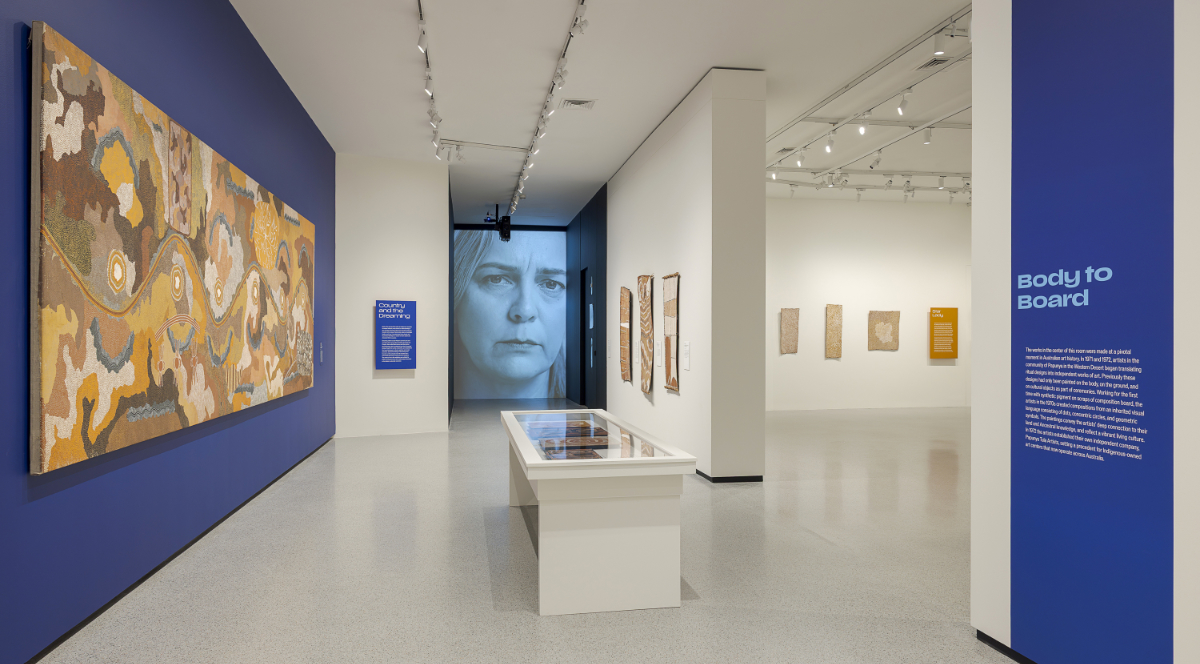
In the second gallery space, the Western Desert art movement—often considered the first wellspring of Aboriginal contemporary art—is played out with a concise selection of boards from the early 1970s. These are shown alongside the monumental Spirit Dreaming through Napperby Country (1980) by brothers Tim Leura and Clifford Possum Tjapaltjarri, with the contrasting scale demonstrating the seismic shift in the sphere of reception and ambition of Papunya Tula art.
Unsurprisingly, the accompanying wall text overplays the site-specific origin story of Papunya, overlooking the multiple desert wellsprings including the ingenious contribution of individual artists like Erlikilyika (Jim Kite), whose carvings and clay work were shown in Adelaide in 1913, or the formation of Ernabella Arts in the Aṉangu Pitjantjatjara Yankunytjatjara Lands in 1948, following the initiation of a women’s craft room in 1939. These earlier milestones, whilst not well represented in the NGV collection (absence compounds absence), underscore the multiple narratives of innovation and the need to think, both curatorially and art historically, beyond a single point perspective. (I’m reminded here of Gordon Bennett’s use of single-point perspective diagrams in his artworks from the 1980s onwards as a synecdoche for colonial vision: we all should have been paying more attention.)
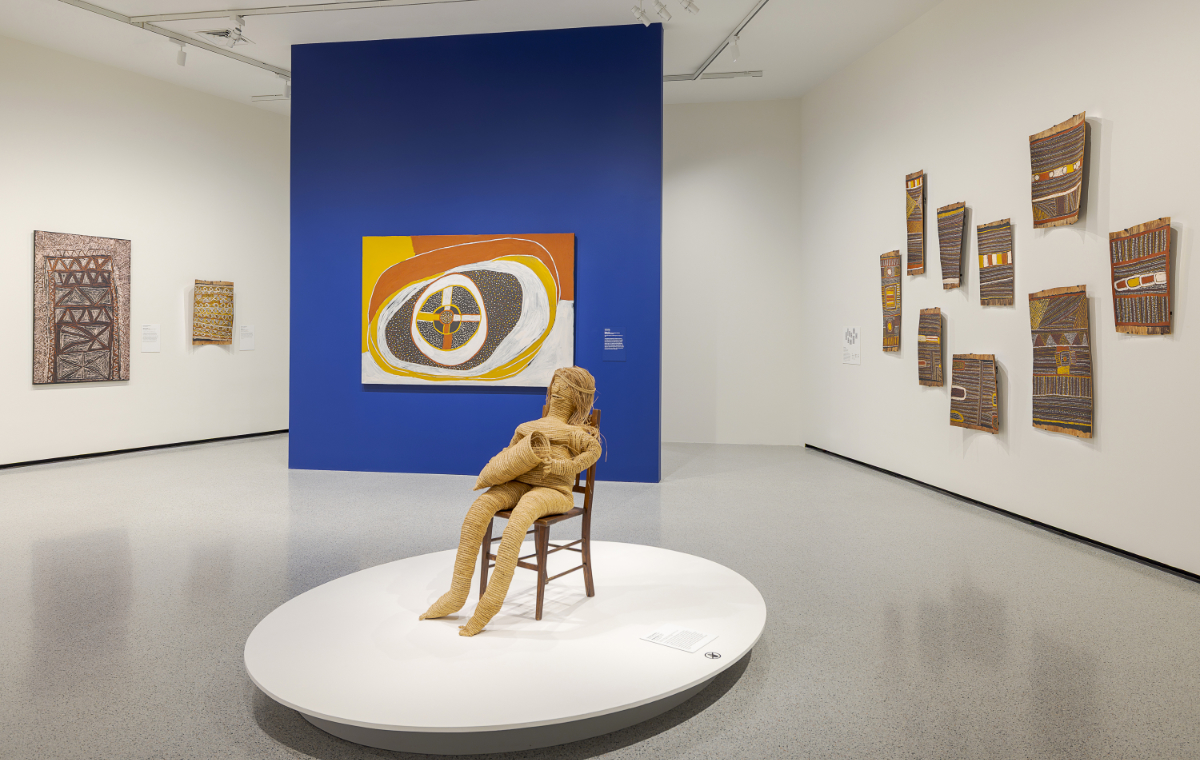
Throughout the exhibition, wall texts developed by Russell-Cook and adjusted by the National Gallery of Art for American audiences, suffer from an over emphasis on arriving anthropologists and so-called pioneering men. This room largely reprises the NGV’s Bark Ladies: Eleven Artists from Yirrkala from 2021. Here the NGV missed an opportunity to mark its own milestones and its conscious curatorial departure from male dominated exhibitions and art histories, however I note with encouragement the constellation of bark paintings by Tiwi artist Kitty Kantilla. Layered with her distinctive ochre tracery, these were all acquired by the NGV in 1992 through general admissions funds, underscoring the role of citizens in collection development.
Smee's claim that Washington's acceptance of a ‘packaged’ exhibition shows ‘a lack of institutional confidence’ reveals the writer’s lack of understanding of how such partnerships operate. Today the art of exhibition development is a diplomatic dance and in this instance all the partner-venues had input into the exhibition’s shape. The benefits here are multiplied, with Australian curators and artists also gaining professional experience and exposure. I would also argue that the collaborations have developed the American institution’s confidence, with its recent acquisitions of Aboriginal art including Arnhem Land lorrkon and larrakitj and an Emily Kam Ngwarray canvas on prominent display on the National Gallery of Art's upper floor.
I had the good fortune of travelling to the United States with Rirratjiŋu clan member and Yolŋu singer/songwriter, Yirrmal Marika. While viewing the exhibition, he spied a modest shell and feather necklace made by his grandmother, Gälpu woman Rose Mamuniny Gurruwiwi. Within Yolŋu culture everything is connected, everything is part of gurrutu which governs the relationships between all things — between plants, animals, people and place. Yolŋu might describe a place as their grandmother or a basket as their child. This cosmology and logic is a stark reminder that audiences bring broad and perceptive experiences to such exhibitions, which certain critics—with their blind spots—cannot see. Moreover, the point of exhibition making is an invitation to think differently.
Visiting Charlottesville at the Kluge-Ruhe Aboriginal Art Collection at the University of Virginia, Yirrmal sang the works of his ancestors held in the museum’s store, ensuring their vitality and voice. Museums and collections have never been more important, and I don’t mean this in the sense of them being passive receptacles of other peoples’ cultures. Their significance today lies in their capacity to host artists and communities and to support the writing of new art histories. Australia is uniquely positioned to do this work with First Nations artists and curators at the forefront of storytelling. The critic’s job, now more than ever, is to elucidate with depth and measure.
Denver Art Museum, Colorado (19 Apr – 26 Jul 2026)
Portland Art Museum, Oregon (5 Sep 2026 – 3 Jan 2027)
Peabody Essex Museum, Massachusetts (27 Feb – 13 Jun 2027)
 18.jpg)