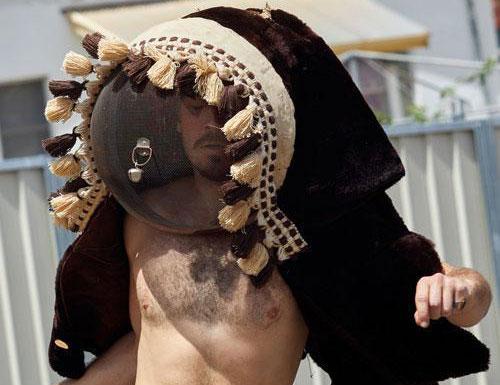
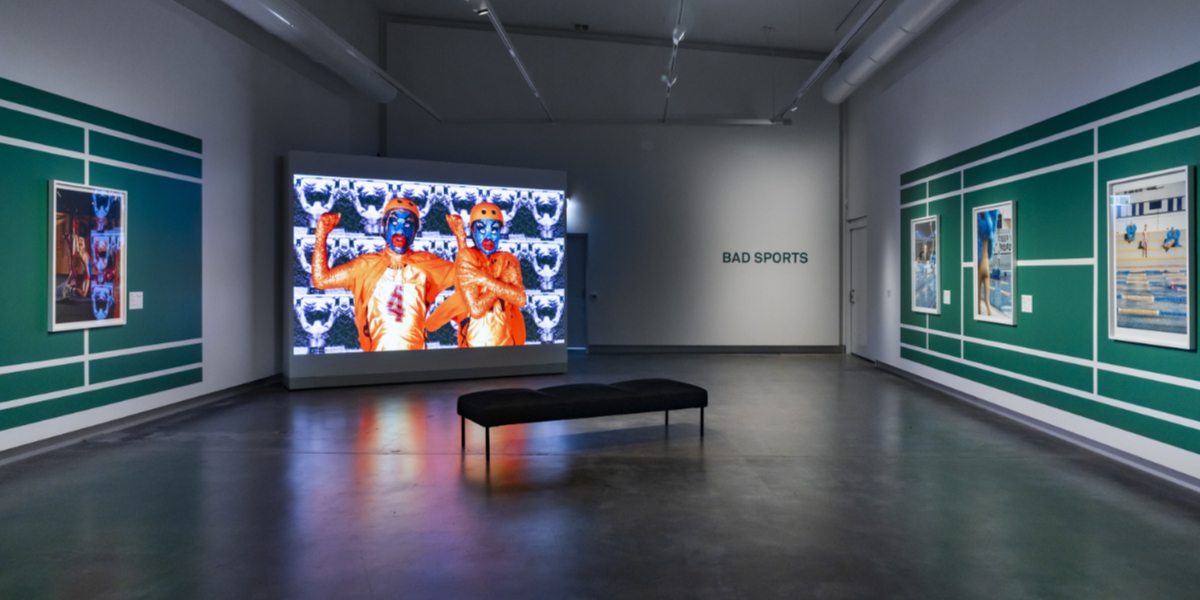
Walking into Bad Sports at Redcliffe Art Gallery felt like wandering onto a sporting field overtaken by camp humour and defiantly queer self-expression. White court lines run across the tennis-green walls, framing seventeen large-scale photographs of The Huxleys leaping, wrestling, posing, and sprawling through different sporting scenes. Their costumes are pure Huxleys: sparkling, sculptural, and meticulously over-the-top, making their bodies read less as athletes than as surreal mascots. At first, the exhibition feels fun and flamboyant, full of cheeky titles and exaggerated poses. But the humour sits close to something more vulnerable: the experience of growing up queer in a culture where sport is so tightly bound to masculinity and belonging.
The Huxleys, collaborative artists Will and Garrett Huxley, have built a practice around performance, film, photography, and costume, often placing themselves in familiar environments pushed toward absurdity. Their work is recognisable for their bold, androgynous personas, often depicting scenes in which everyday settings become strange and excessive. In Bad Sports, curated by Anouska Phizacklea for the Museum of Australian Photography (MAPh), that approach is turned toward Australian sport. The exhibition draws on the alienation that The Huxleys experienced growing up in sport-obsessed Australia. Across the series, they return to those uncomfortable arenas, using humour, costuming, and performance as another way to take part.
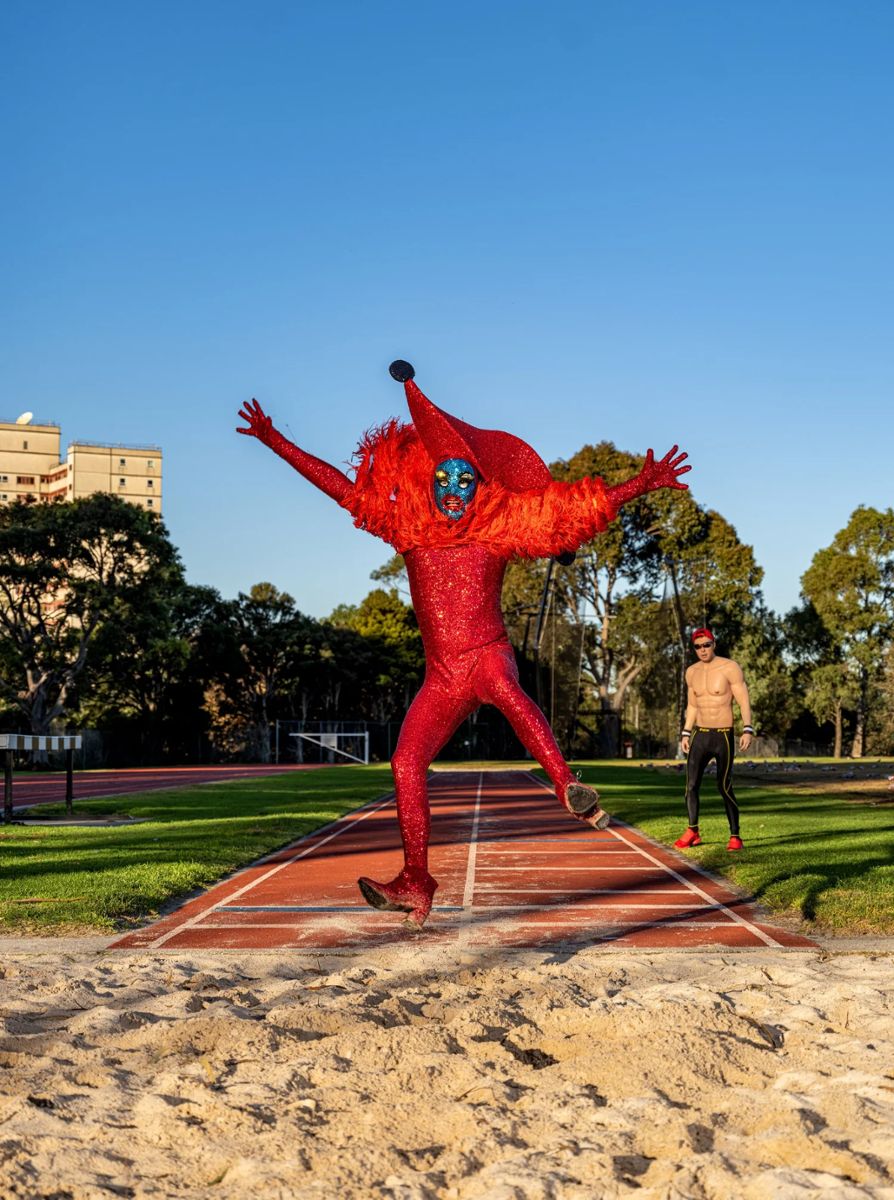
The first image the audience encounters in the gallery, Hop, Skip & Lump (2024), depicts a sparkling, heeled red figure caught mid-long jump, arms and legs flung wide over the sandpit. In the background, a shirtless, athletic figure stands by the track. One body belongs to the scene; the other interrupts it. The scene feels more loaded when you know it’s based on one of Garrett Huxley’s childhood memories. Faced with unbearable attention, he refused to take part.[1] The figure’s wide eyes and clenched teeth make the humour tense, not just silly. They’re joining in but doing it on their own terms.
This tension carries into the exhibition design itself with its mock-sporting arena colours. Moving through the exhibition, I was aware of how my body aligned within these marked zones. It reminded me that sport is not only about competition and physical skill, but rules dictating where to stand, what to wear, and the control you are expected to show. In this context, The Huxleys feel deliberately offside.
Throughout the series, athletic performance is replaced by another kind of performance. The particular code is still recognisable through fields, uniforms, and equipment, but The Huxleys bring different skills onto the pitch. Costumes (various) (2024), displayed on a green platform, highlight some of these skills, featuring two sequinned bodysuits equipped with boxing gloves, shin guards, groin guards, and helmets. Each piece highlights creative rather than sporting prowess, while the sequins shift the gear away from athletic function and toward spectacle. Across the series, costuming becomes a form of participation without assimilation: protecting their identities while heightening visibility and bringing their own idea of sport onto the field.
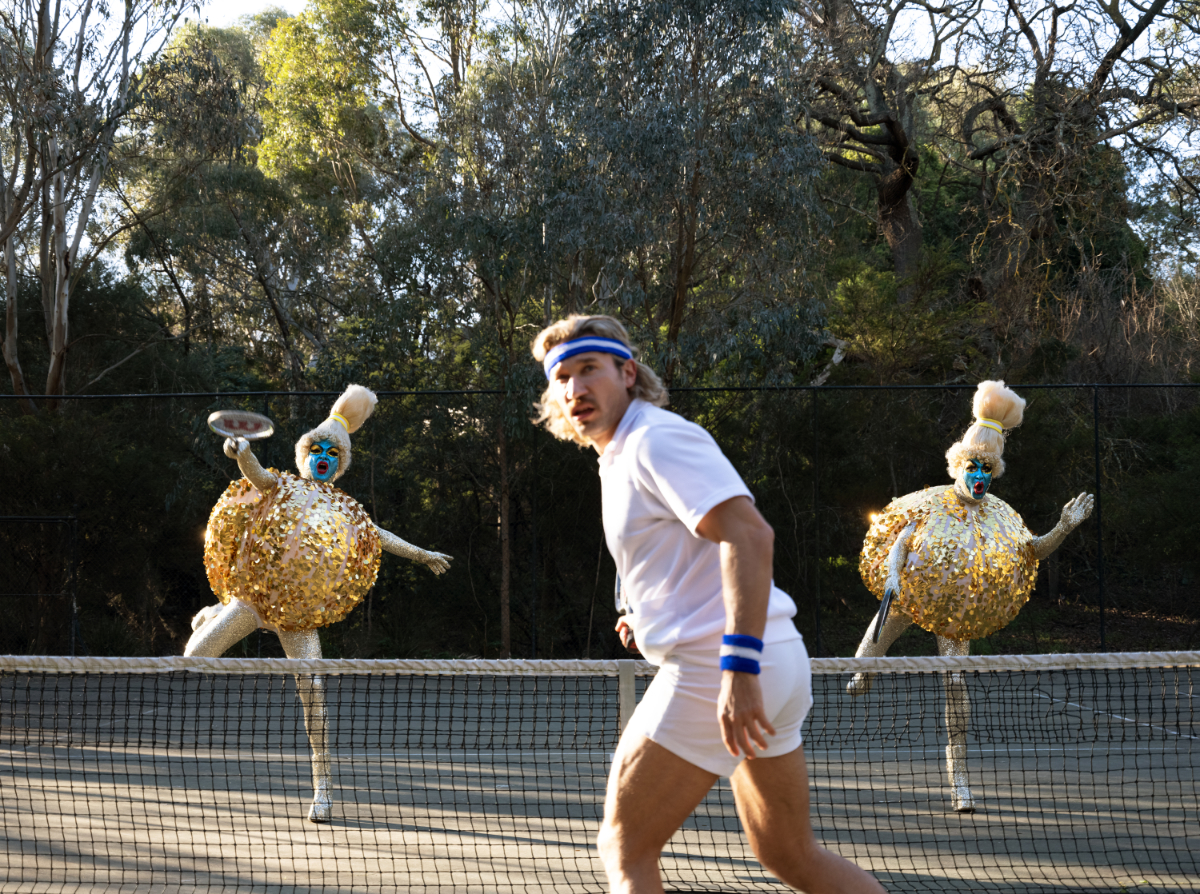
Much of the exhibition’s humour grows out of this clash between strict sporting codes and The Huxleys’ own exaggerated visual language. In Tennis Shrews (2024), The Huxleys appear as two high-heeled, golden, sequinned balls trying to play doubles tennis, more like queer mascots for the game than conventional players. The title sounds like a bent version of ‘tennis shoes,’ while ‘shrews’ accurately captures how they appear across the Bad Sports series: loud, unruly, and awkward. Viewed alongside Show Us Your Balls (2024) and Free Balling (2024), their costumes, titles, and awkward poses collectively build the joke. There is something almost childlike and uncoordinated in the way The Huxleys move across the court, not quite in sync with the rules or rhythm of the game. Yet their wide eyes and open mouths give the playfulness a visible strain. They are joining in, but they never look completely comfortable.
Their humour does more than soften difficult experiences. The puns, costumes, and exaggerated sporting gestures also keep vulnerability, effort, and desire to belong in tension without letting one feeling take over another. Bad Sports is not simply a painful return to sport, nor is participation portrayed as a celebration of belonging; its strength lies in the way both coexist.
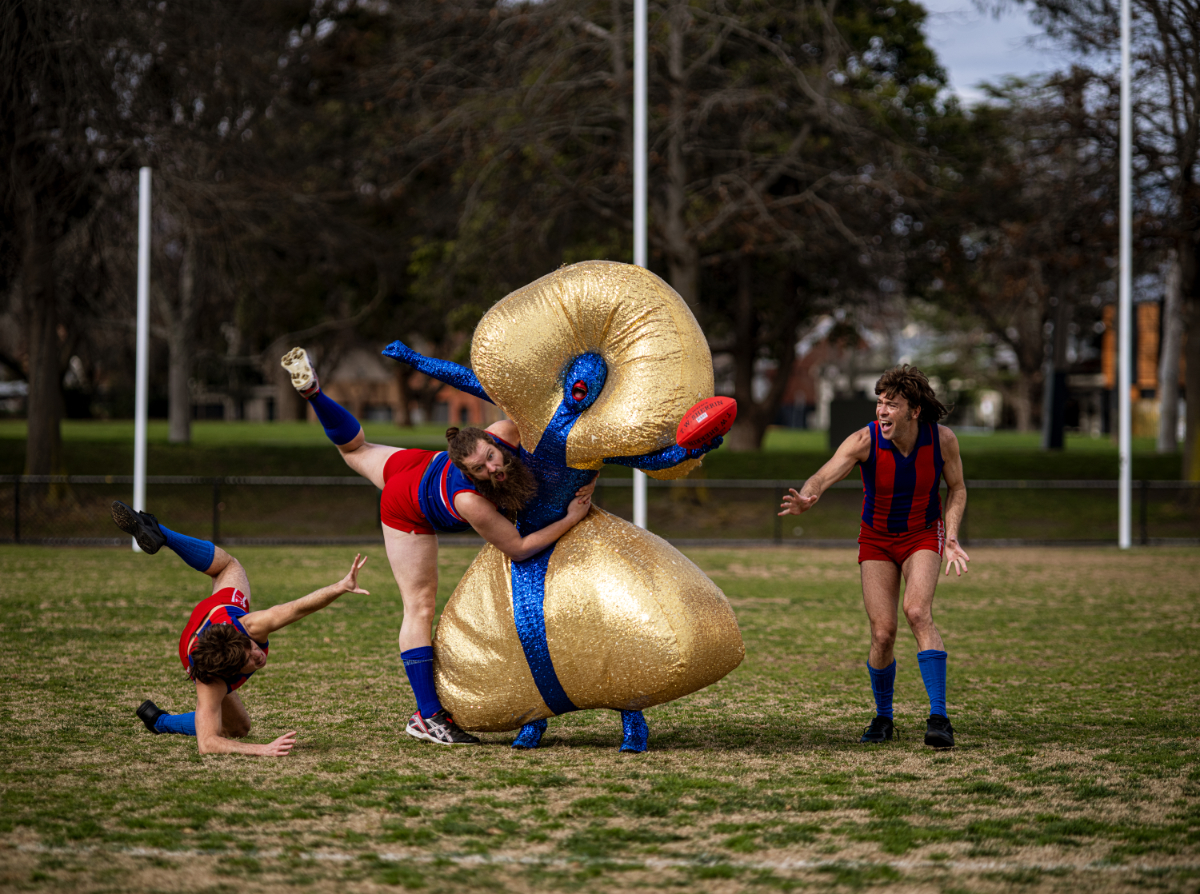
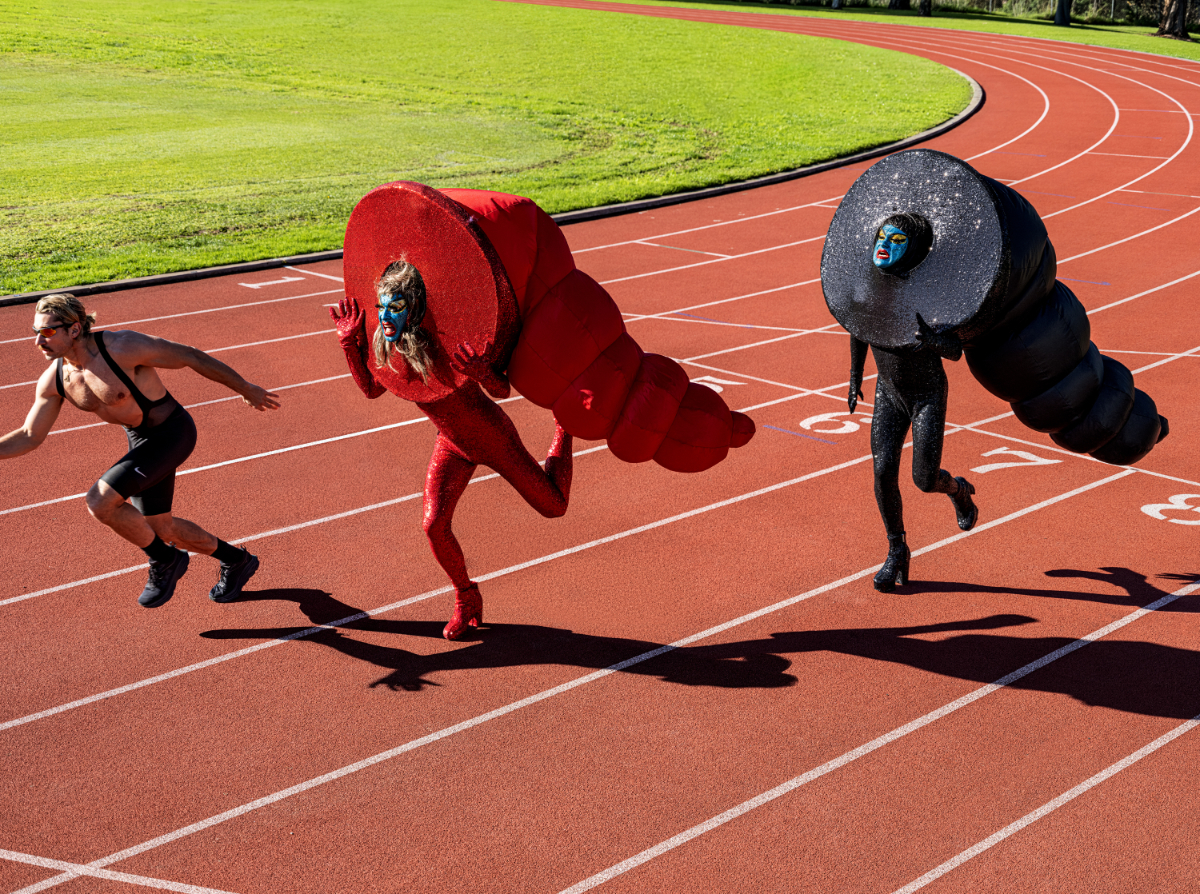
This mix of humour and vulnerability becomes more prominent in the second gallery, where the soundtrack from The Winner Takes It All (2024) echoes throughout the space. The Huxleys’ version of the ballad changes the atmosphere, making the surrounding photographs feel more dramatic. The slow-motion video repeats gestures seen in the Bad Sports series, making every movement feel more intentional. This is noticeable in Running Scared (2024). Initially, the image is amusing: two sequinned figures run across a track, in last place, each weighed down by oversized headpieces trailing behind them. The longer you look, the more you register the strain in their faces, the heaviness of their costumes, and the effort of running in heels. Set against the soundtrack, the image starts to feel sad, almost tragic. The performance begins to reflect not just the effort of taking part, but also the extra effort required to navigate sporting communities when you feel you do not belong.
What makes Bad Sports hit a home run is how spiritedly it captures the experience of participating in a culture you do not easily fit into. In Australia, where sporting culture is shaped by ideals of discipline, competitiveness, and teamwork, that sense of alienation also reaches beyond queer experience. While The Huxleys approach sport from a queer perspective, the feeling is familiar to anyone whose sense of achievement or belonging has never centred on sport. Here, they neither reject sport nor try to blend into it. Instead, they place themselves directly inside the arena, bringing all the heels, humour, and flamboyance in their kit. The Huxleys do not laugh at sport from the sidelines. They enter it fully — proud, playful, and glamorously bad sports.
Footnotes
- ^ Hailey Moroney, “Queer fashion files: ‘The Winner Takes It All’ by The Huxleys” Archer Magazine, 27 August 2024 (online).