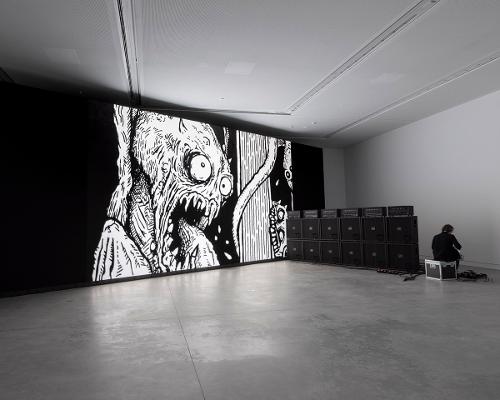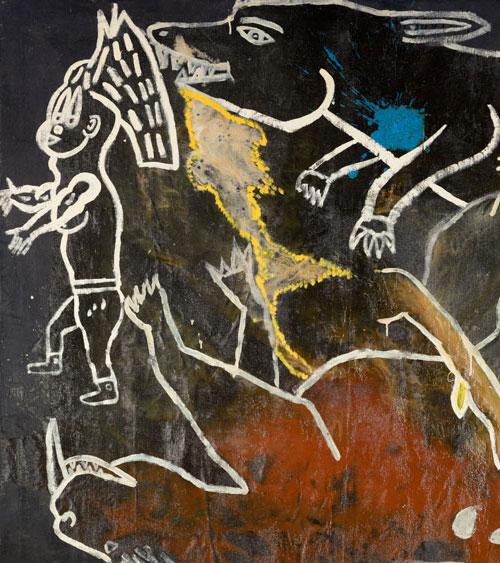
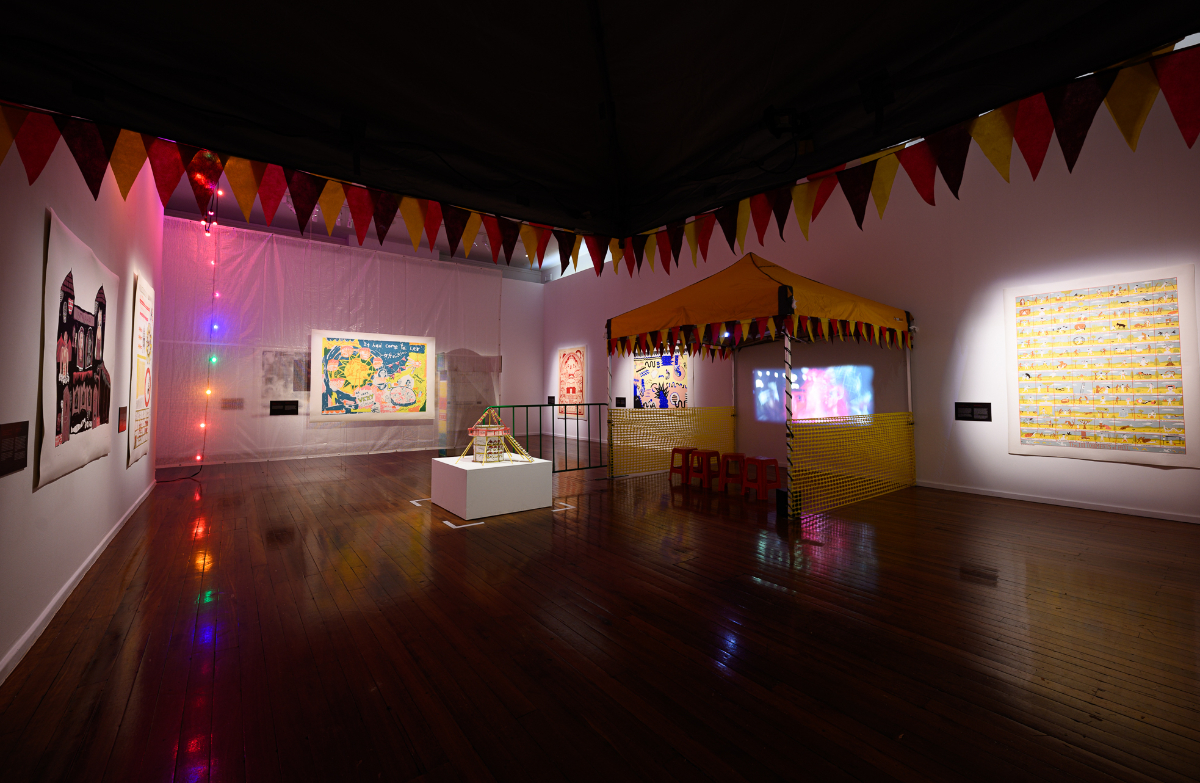
A screenprint show developed by the Yogyakarta printmaking collective Krack! should be enough to generate excitement among those of us interested in the international artworld. Since the Jakarta-based collective ruangrupa curated Documenta 15 in 2022 with a decentred system of horizontal curation, inviting art collectives to ask other art collectives into the show, Indonesia has become a focus for a collaborative model of art and exhibition making. It is difficult not to interpret Pasar Malam’s joyful collection of large screenprints after ruangrupa’s politics, as they celebrate the dancing, circus rides, tea and snacks at Indonesian night markets. There is also a spiritual dimension to these pictures that mingle Islamic and animist, Hindu and Javanese, Buddhist, Confucian, Hindu and Christian, in a mixing of soft pop styles with detailed linework.
Maurice O’Riordan wrote extensively of these bright prints by Australian and Indonesian artists when Pasar Malam opened its national tour at the Northern Centre for Contemporary Art in Darwin, where the works were spotlit on dark painted walls.[1] The Walyalup Fremantle Arts Centre have instead immersed them in a light clutter of camping gazebos, plastic stools, crowd control barriers, and glitzy false walls. The installation recalls better times at this local institution when it hosted pathbreaking, blockbuster shows and chock-a-block opening crowds. This was before attendances collapsed after Covid-19, the café closed for refurbishing, and a near fatal changeover of managerial and curatorial staff turned the sprawling, heritage complex into a ghost of its former self. Let’s hope Pasar Malam is a sign that the ambition has returned, though the attempt to carnivalise the gallery tends to accentuate some of the tensions in bringing artworks, rather than the collectivism and partying they represent, into a formal exhibition space. Hanging the prints amidst videos showing south-east Asian carnival rides and dancefloors, with didactics emphasising their cultural and spiritual iconography, lends the show a pedagogical feeling, as if we were being transported into an ethnographic wonderland.
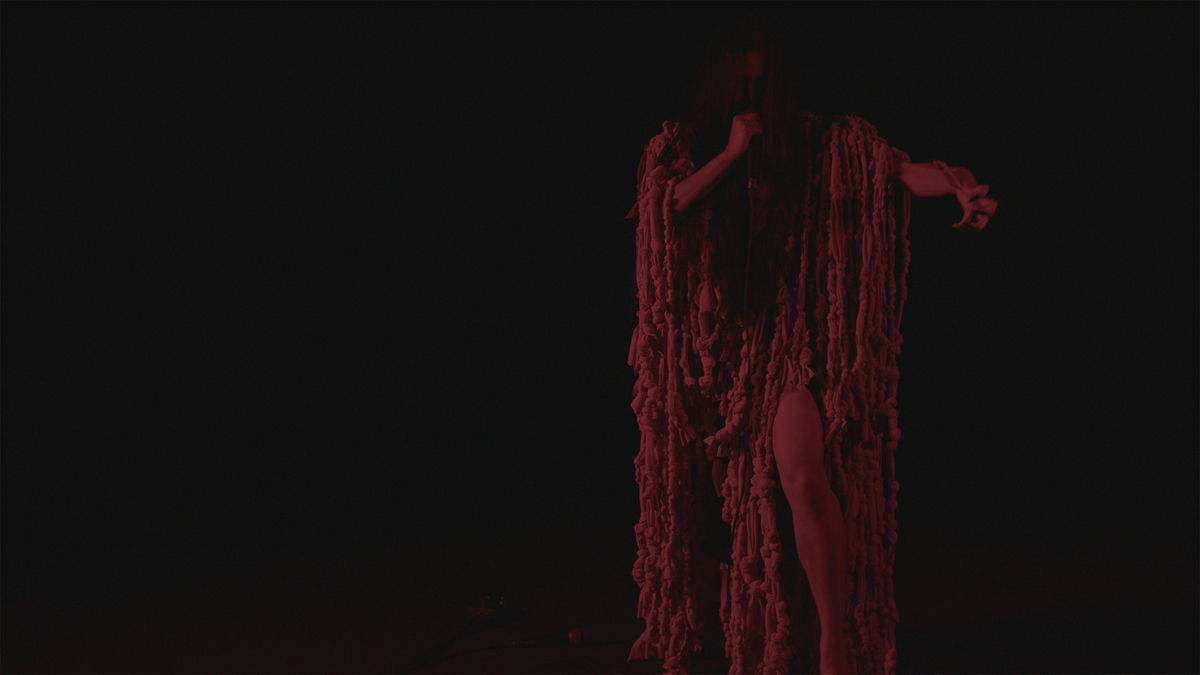
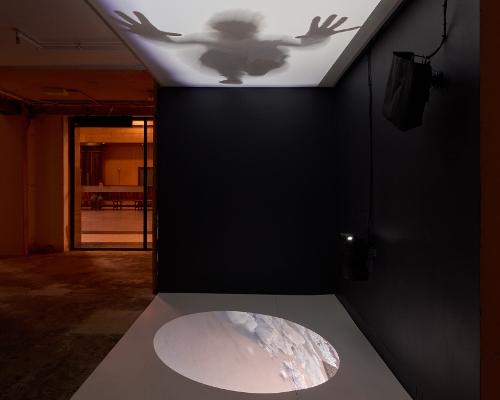
Pasar Malam is accompanied by two more subtle solo exhibitions by Indonesian-Australian artists Leyla Stevens and Ida Lawrence. Stevens’ GROH GOH (Rehearsal for Rangda) (2023) is a video showing performances of Balinese dance inspired by the Hindu deity Rangda. The performers are mostly women, taking the place of men who typically play the clawed and fanged baby-eating queen. One is Karina Utomo who appears covered in dirty, rope-like hair, metamorphosing across genders and forms with death-metal growls. These performances are far from the tourist operas many of us have seen in Ubud in central Bali, stepping out of an arthouse horror movie rather than a holiday island. Bodies and faces shapeshift to the sounds of dark winds and slow, apocalyptic bells. In the rehearsal space of the film’s setting, one of the performers starts practicing without direction, possessed by Rangda, her movements not her own. As the other dancers turn to watch her, she transcends the rehearsal space, the women’s chatter shifting into an eerie, barely audible high-pitched tone.[2]
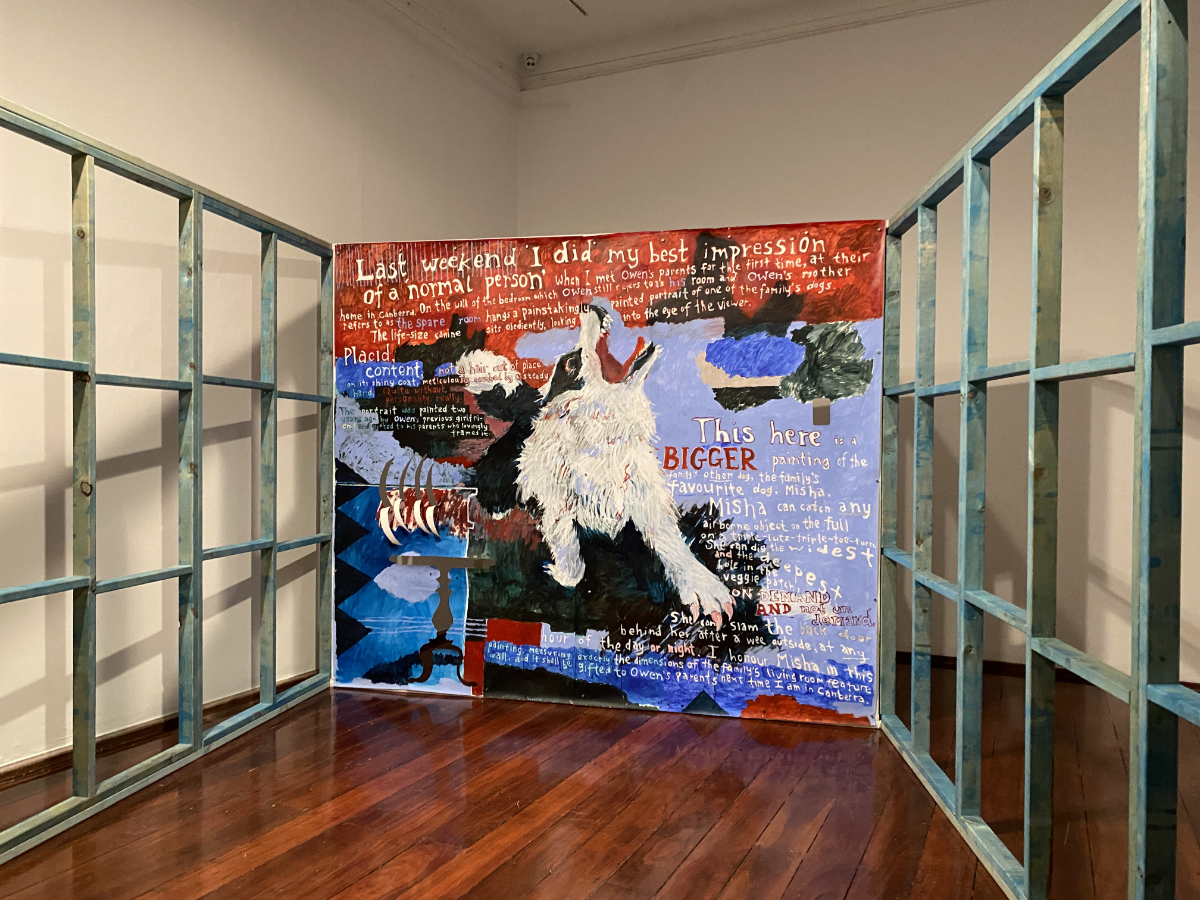
The installation by Ida Lawrence, A Bigger Misha, consists of a wall-sized painting inside a builder’s timber-framed carcass of a room. The painting is a glorious, colourful tribute to her boyfriend’s family’s messy, noisy dog Misha, and tells the story of another dog portrait that hangs in the family home. This other portrait is small and neat, done by her boyfriend’s ex-girlfriend. Lawrence declares that she will gift the wall-sized painting ‘to Owen’s parents the next time I am in Canberra,’ and it turns out that the room she has constructed replicates a room in their home. The size of the painting gives passionate scale to a doubled sense of jealousy of the ex-girlfriend and love for the cheeky Misha. The painting even has great claw marks gouged out between tales of Misha’s crazy antics, the lovable rogue made more endearing than the obedient, polite painting by the ex-girlfriend.
The whole apparatus is a little post-hipster, drawing upon an ironic, neo-expressionistic style and one-liner, relational conceptualism, but it is also friendly and fun: a work about storytelling as much as about the story. The continuity with the other works showing in Fremantle lies in its relationality, here with the artist’s boyfriend and his family, rather than with community (Pasar Malam) or with tradition (GROH GOH / Rehearsal for Rangda). The work also shares a sense of mobility, not only in its free brushwork but in the feeling that at any moment it is about to be rolled up and moved around the country.
Collectively, these three shows, by testing ideas of metamorphosis and transformation, represent an artworld, and a world, in transition. At the risk of generalisation, there appears to be a contemporary zeitgeist expressed here that exhibits all the sensibilities that the ruangrupa collective made visible in Germany in 2022. The more one looks, the more one sees the relational values of community and localism becoming essential features of contemporary art.