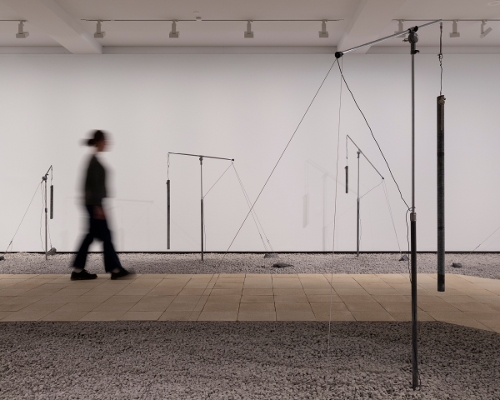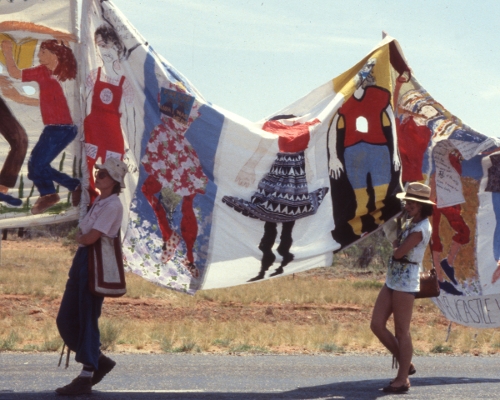
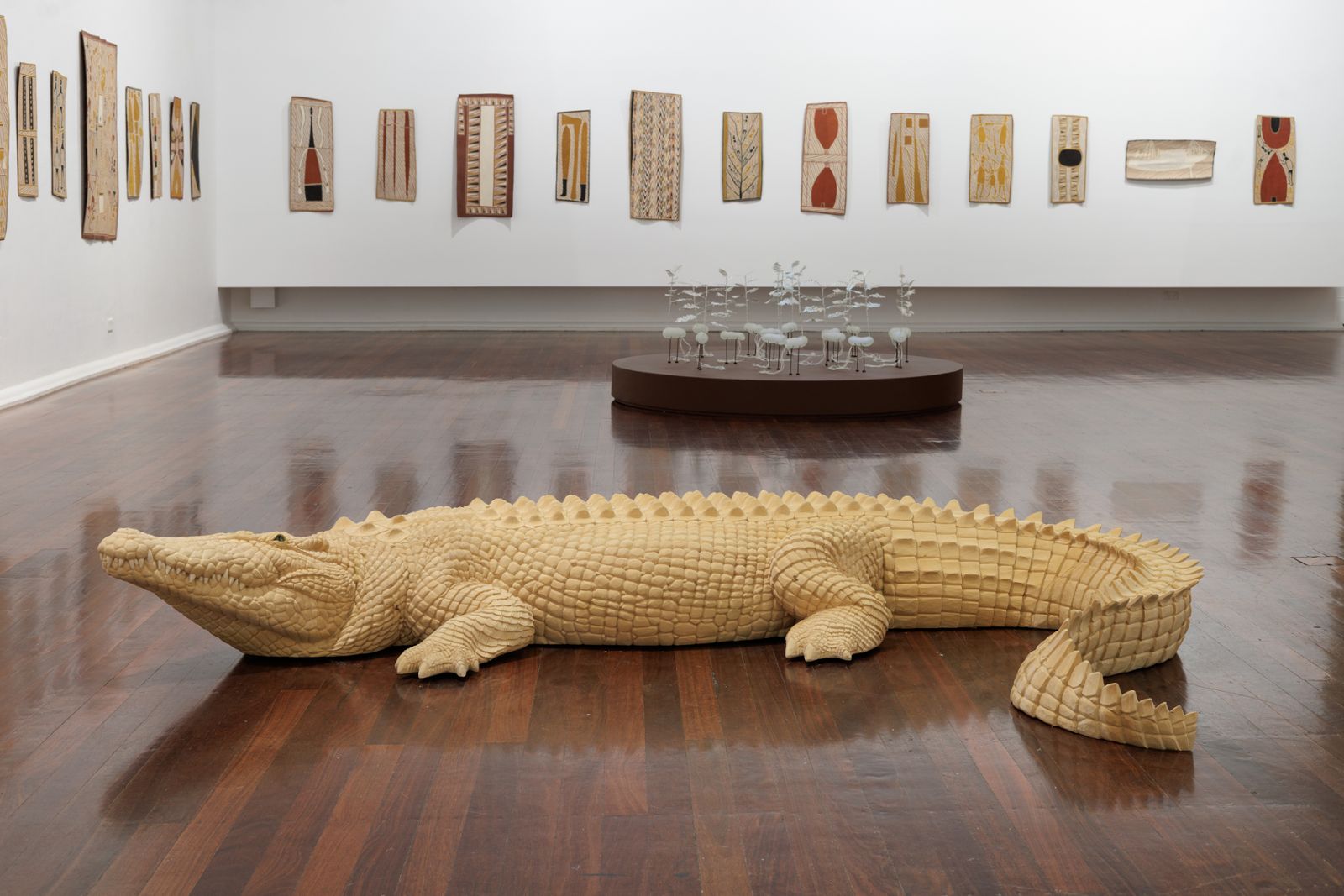
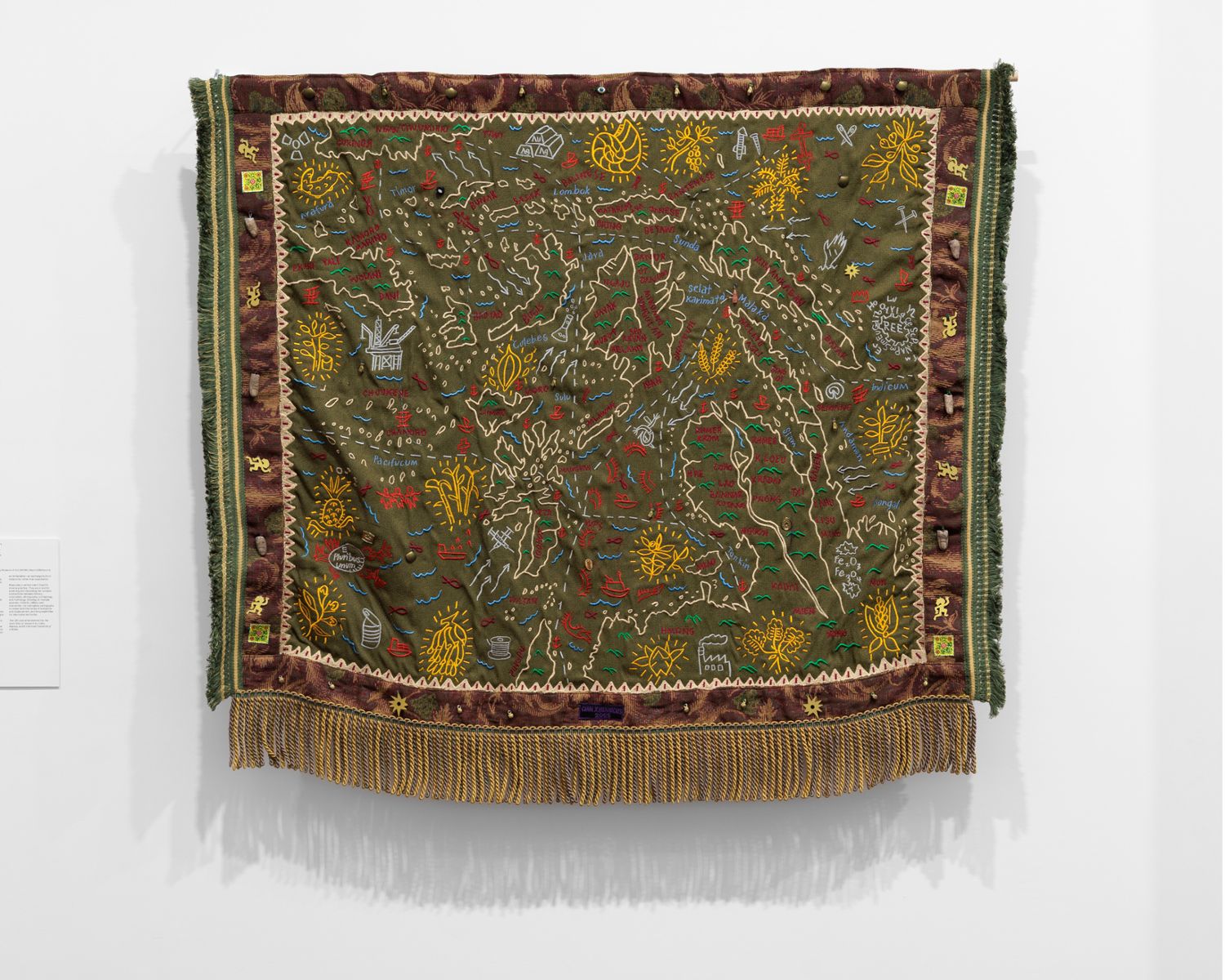
Cian Dayrit’s Footprints of a Battle (2025), a textile map depicting the archipelagos between the island-continent of Australia and the region of South-East Asia, is an effective introduction to this exhibition. In Dayrit’s own description, the map ‘becomes an anachronistic account of the land as shaped by civilization...’ And it conveys well the enmeshed nature of the cultures of this part of the world.
It is a gentle irony that an artist whose ancestral homeland was colonised by the Spanish, then the US, should refer to historical maps in an exhibition so much shaped by an Australian desire to envision pre-European trade and Indigenous sovereignty. The curatorium of nine scholars who developed this exhibition are—with the exception of one from Makassar—all connected to Monash University. An outcome of the ARC project Global Encounters and First Nations Peoples, the exhibition was first presented at Monash University Art Museum in 2025.
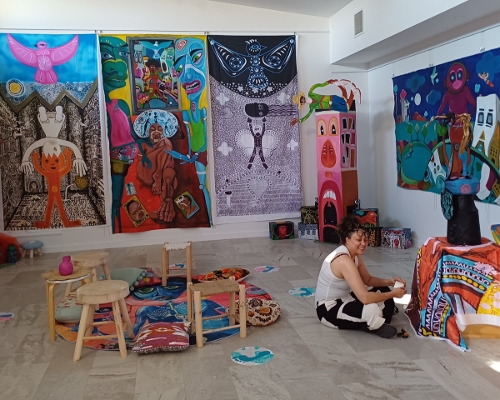
Awakening Histories is scholarly, in its effort to assert objective attention to the artefactual and the historical—differing from that more general attention usual in contemporary art—but also haptic, with a careful selection of objects from collections or commissioned for the project. The ambition is to illustrate the persistence of cultural connections that have existed between the cultures of the region and across the centuries. Clearly a product of extensive research, there is an elegance to the curation rare in this kind of more academic project. Through the linking of objects and activities, the works each contribute to narratives of inter-island and Northern Australia life.
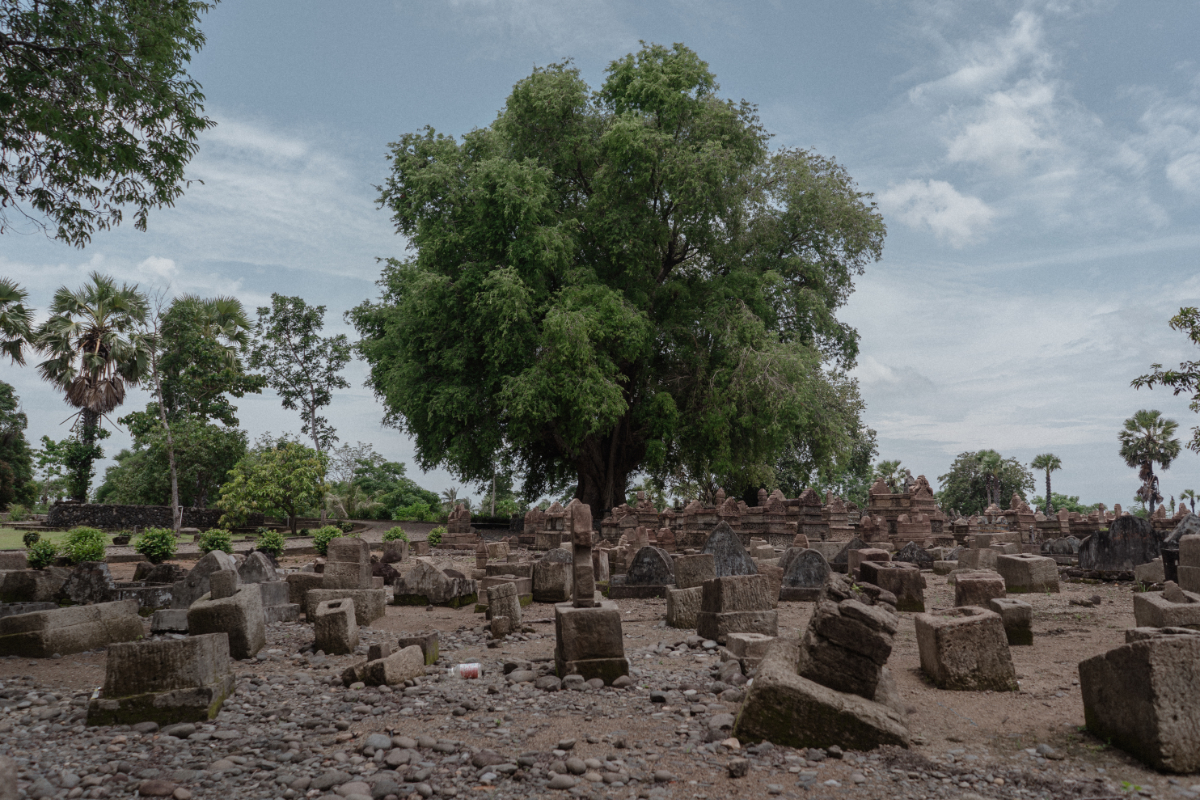
There is the trope of the machete imported from—or through—Makassar. It appears in a video recording of a dance (Yumutjin Wunuŋmurra’s Yiki Bunggul (2023) and is depicted in historical crayon drawings by Mawalan Marika). Then there is the tamarind tree, which is presented in Jenna Lee’s small sculptural installation Category of Significance: Ancestral (Tamarindus indica) (2025), as well as in the work of Aziziah Diah Aprilya, Under the Tamarind Tree (2025), whose photographs are of the trees in a cemetery in Sulawesi and in Perth Zoo, where they provide shade for its African lions.
Then there is that central trope of these oceanic exchanges: the now well-documented trade in trepung (sea-cucumber). It is this connection, while underlying much of the exhibition, that is too simply presented as fact. This trade should have been further examined, as it is part of much larger trade network, one which leads back to China, that long-standing superpower. To ask what this trepung trade means within the history of exchange between the South-East Asian archipelagos and the empire of China, might have led to a questioning of what sovereignty meant across history, and continues to mean, for the people of what is now Eastern Indonesia, in relation to their own north and to the various Asian kingdoms.
This is something that the prominent sculptor Abdul-Rahman Abdullah hints at in his artist statement: ‘The Bugis heritage that arrives through my mother’s family linage in Malaysia and back to the old Luwu Kingdom in Sulawesi Sulatan provides the foundations of something new, somewhere new.’ In that, he seems to mean Australia, but he could have been indicating elsewhere in Asia. This, along with the work by Dayrit, affirms that, as much as being a region of archipelagic “sovereignties”, it was also, as it remains today, a zone of contestation.
While the curatorium have taken good advantage of the ambiguities afforded by the contemporary art context, wherein the factual framing of exhibited objects as historicised artefacts is not essential, there is an implicit tension between the rhetoric of assertions of the almost timeless sovereignty of the various peoples or nations and an understated accounting of those cultures within larger polities.
Leaving this unaddressed leads to a political idealism. The statement for Karrabing Film Collective makes this more explicit than elsewhere: ‘These early relationships were both peaceful and collaborative, providing a model of contact that undermines the violence of white settler colonialism’. But is it a significant model? Surely it is simply one model of small-scale, pre-modern exchange. Despite the historicity of the research, it is possible to have the impression that, in addition to evoking a significant position for the indigenous peoples of Australia’s north in relation to Makassar, what is part of a revised Australian attitude to the region, the curators were searching for peaceable alternatives to the established histories that have led to our globalised present.
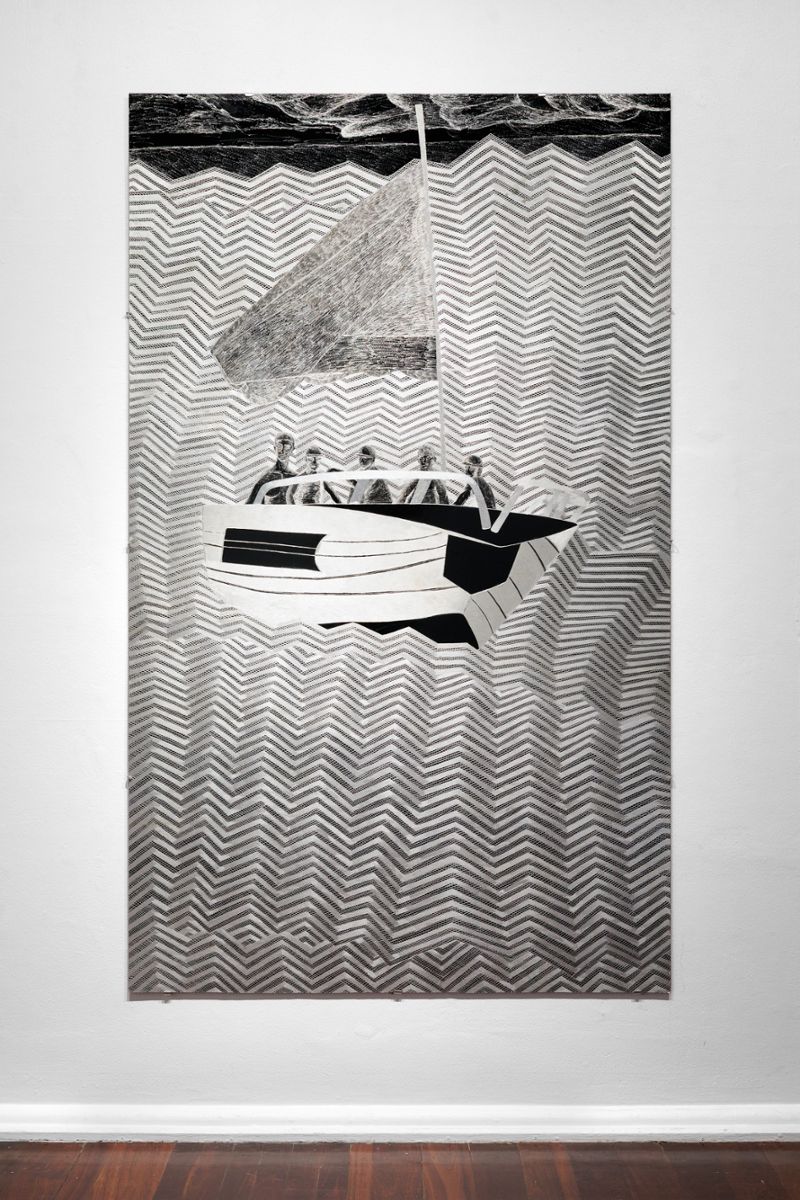
Many of the exhibition’s themes are encapsulated in an understated way in Djirrit (2021) by Gunybi Ganambarr. Etched on aluminium, a common medium for the artist who often uses abandoned road-signs, the work’s style is derived from bark painting, while the image itself draws on a mobile-phone picture that appeared on the Facebook page of the Northern Territory Police. The story it illustrates is that of a fishing expedition that was delayed overnight when the fishers’ boat engine failed. But that is to simplify an adventure involving an attempt to cut a pipe for smoking tobacco from a Makassan tree, the making of a temporary Indonesian-style sail, and the group’s departure the following day when their boat was pulled out into deep waters by a turtle. It reads like an episode from the Warlpiri Media television series Bush Mechanics (2001).
This kind of happenstance and its haptic quality combines with the museological method of the curators to give the argument for a specifically historical connection between the Indigenous people of the Australian north and the pre-Indonesians of their own country’s far west a convincing gravity.
In the sculpted recollection of sitting under a tamarind tree that was seeded from waste in the process of cooking seafood by the Makassan visitors (Jenna Lee’s work), or the presentation of ceramics that use designs of images of clouds representing trade winds by Bulthirrirri Wunuŋmurra—a Yolnu potter who made the work in Sulawesi—or in the contextualisation of the fabrics from the northern traders which are worn during the famous Garma Festival in northeast Arnhem Land, there is throughout this evocative exhibition the sense that history is indeed networked and powerful, remaining an active part of everyday life for the people of that part of the world.