Rex Butler might be wrong about Margaret Preston in his recent Memo Review. Butler, an art historian, claims that because Preston is an ‘unresolvable’ artist, we won’t hear from her ‘for a long time’ and suggests that she might simply fade away, or perhaps become a footnote to the work of Gordon Bennett. Butler declares that Bennett—whose series Home décor (Preston + De Stijl = Citizen) and Home décor (After Margaret Preston) feature throughout the exhibition—is best equipped to ‘symptomatically express’ the question of black-white relations in contemporary Australia,’ while suggesting we don’t need another Preston show because ‘we are all Preston’. But history is more black and white. Plus, I doubt Bennett would have wanted to become the spokesperson for Preston’s unresolved legacy, a woman who spoke emphatically on her own terms.
Margaret Preston at the National Gallery of Victoria over the 2026–27 summer is a remarkable curatorial feat by Michael Gentle (former NGV Curator of Australian and First Nations Art) and Beckett Rozentals (Senior Curator of Australian Art, NGV). The exhibition, which brings together over 200 works across a dozen rooms, includes many rarely seen works from private collections and is the first major institutional attempt to reckon with the artist’s complicated legacy in over twenty years.[1]
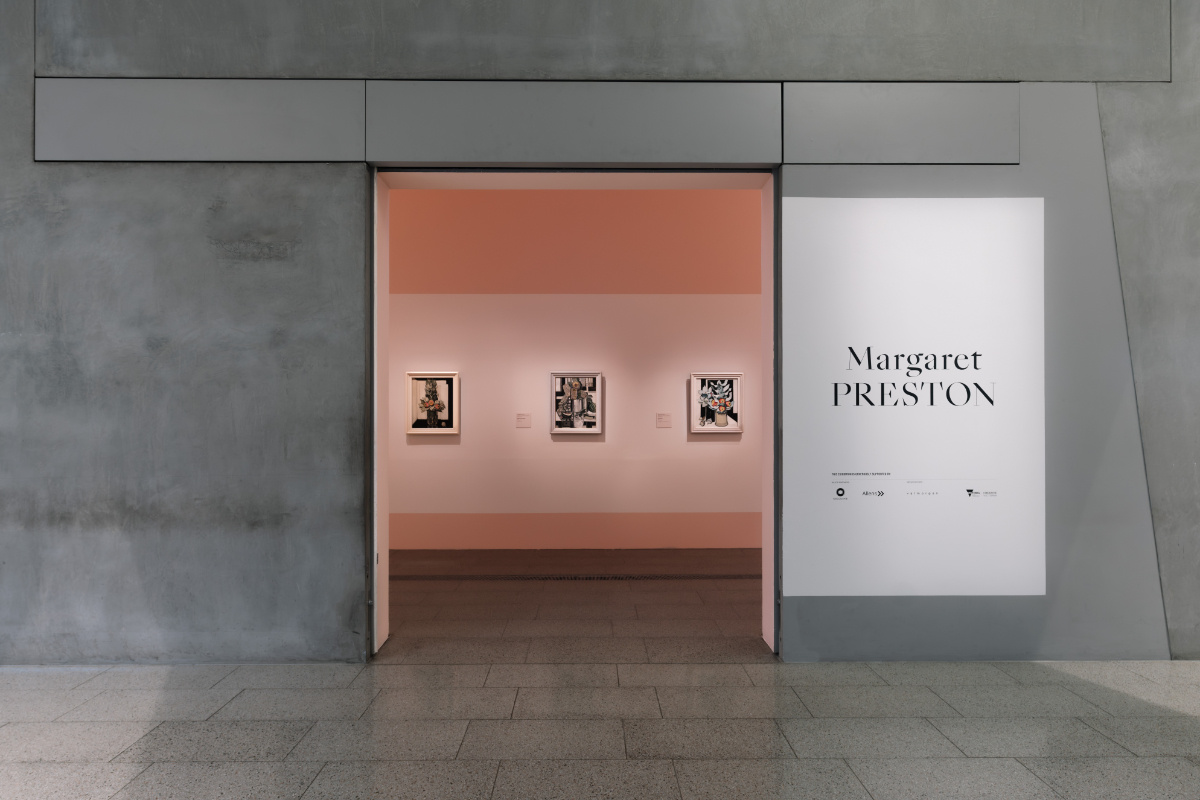
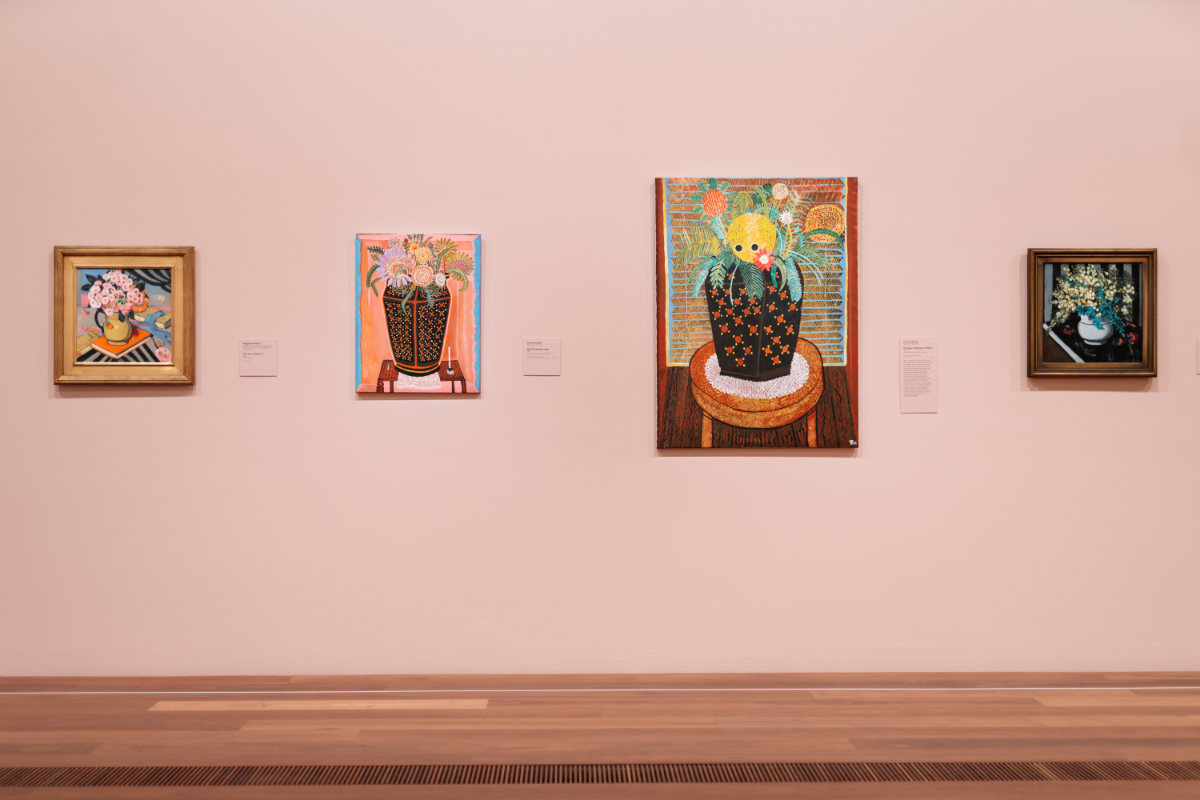
On entering the exhibition proper, the viewer is faced with three still life paintings of gum blossom, honeysuckle and eucalyptus arranged in Art Deco vases set against geometric black-and-white backgrounds. Painted in the late 1920s as her career was reaching full momentum, the works look chic against the pink wall. Here we meet Preston the painter — not the printmaker, the medium for which she is most renowned.
Adjacent to the first room are two black, white, vermilion and yellow stencils, both titled Aboriginal glyph (1953). Made towards the end of Preston’s career, these designs reproduce a pattern from a Wiradjuri scar tree that, according to the exhibition’s wall text, she encountered in ethnographer Lindsay Black’s 1941 book Burial Trees: Being the First in a Series about Aboriginal Customs in the Darling Valley and Central New South Wales. I can imagine new audiences to Preston reading this and thinking: ‘She picked a pattern from a Wiradjuri burial tree and made it into a stencil … WTF?’ For those familiar with Preston, this artistic decision foreshadows a familiar critical reckoning.
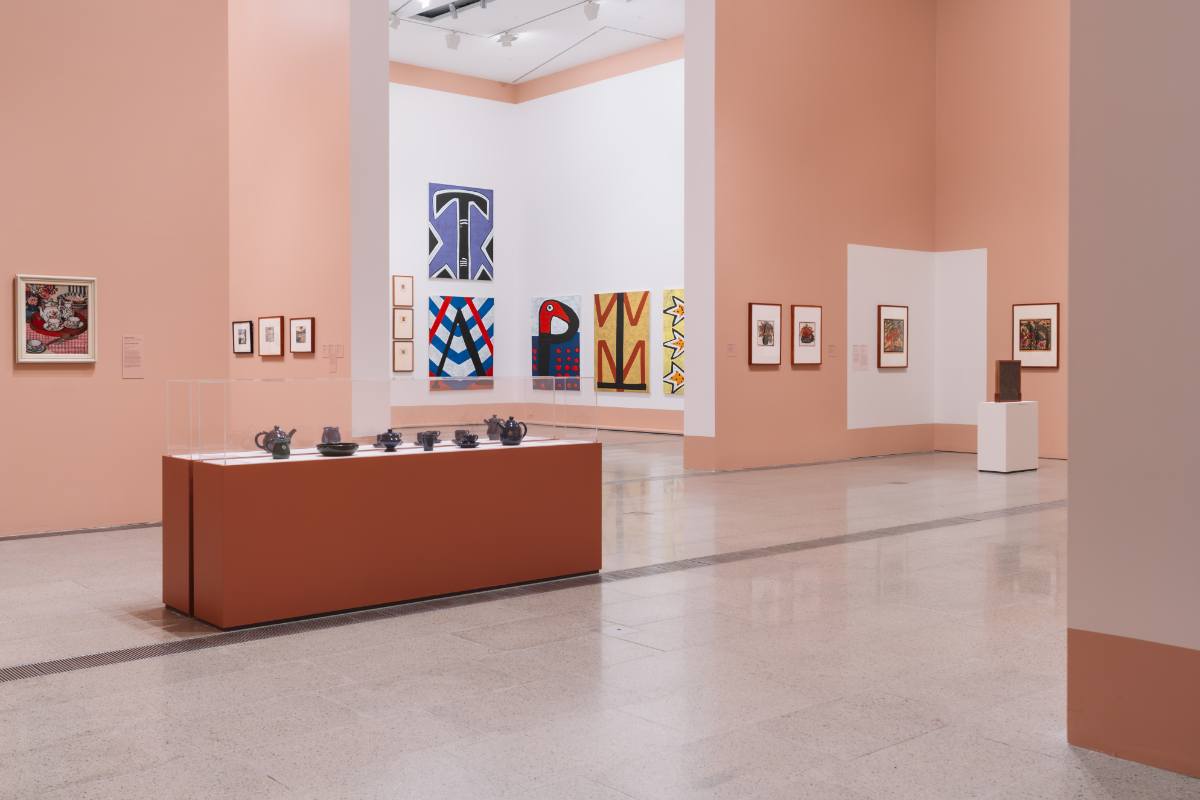
From here, the exhibition unfolds as a biographical account of Preston’s life. Beginning with student works (made when she was known as Rose McPherson), we encounter a young South Australian woman who fell in love with painting at the Art Gallery of New South Wales as a twelve-year-old. Preston studied at the National Gallery School in Melbourne in the 1890s with a coterie of women artists. Returning to Adelaide in 1898, Preston studied and taught at Adelaide’s School of Design, Painting and Technical Arts (now South Australian School of Art) where she met and formed close personal relationships with Bessie Davidson and Gladys Reynell, which shaped her professional career and life. Preston travelled to Europe with Davidson in 1903, and again with Reynell in 1912, where she was introduced to the avant-garde trends of Parisian modernism, including Post-Impressionism, European Primitivism and Japanese ukiyo-e printmaking.
The pairing of Bessie Davidson’s The Rag Mender (1906) and Preston’s Le Chiffonnier (1906), student work made while in Paris, playfully conveys the intimacy between the two artists, and it intrigued audiences who I watched compare the works closely. A highlight of the exhibition is Le livre vert (The Green Book) (1912), Davidson’s exquisite portrait of Preston also painted in Paris (where the two lived with Reynell). Held in a private collection, its presence in the exhibition’s third room, alongside Reynell’s earthenware, highlights relationships that shaped Preston’s art. These connections continue in the display of ceramics by Preston and Reynell, who were lovers. Women friends were often subjects of her staged composition, for instance Thea Proctor’s Tea Party (1924) and The Tea Urn (1909) depicting Davidson’s family’s tea set. Proctor’s woodcut The fountain (1925) is also included in the exhibition: it was Preston who introduced her to woodcut printmaking.
After returning to Australia in 1919, Preston married William Preston, who facilitated her career through financial support. They settled in Sydney which saw her artistic turn towards graphic design and prolific printmaking, which intersects in the latter rooms of the exhibition. Here, we meet Preston the fully realised Australian interior design “influencer”. The display of the original woodblock for Wheelflower (c.1929), a hand-coloured woodcut, offers the viewer insight into the physical process of the design-making and a behind-the-scenes glimpse into Australian art history through its provenance record. Preston’s Aboriginal-inspired woodcut prints which were reproduced on the covers of Australian magazines Art in Australia and Home, together with reproductions of her writing, are exhibited together in a small, crypt-like space given their light-senstive nature.
One of the illuminating challenges to a near art historical chronological exhibition of an artist like Preston is the abruptness with which subjects shift. In the fourth room, after looking at mostly still lifes, we suddenly encounter a small figurative woodcut that depicts an Aboriginal family with a mother and child sitting cross-legged in the bush with two animal companions. This work is a sudden indicator of a major shift in Preston’s oeuvre. Titled The Third Generation (1923), it is Preston’s first figurative representation of Indigenous Australian peoples. Who are they? According to the wall-text, the woodcut ‘constructs an abstracted, artificial vision of Indigenous life, placing colonial ideas of “primitiveness” against Western modernity.’
The curatorial restaging of Carolyn Christov-Bakargiev’s display of Gordon Bennett’s Home Décor (After M. Preston) 2010 series of paintings exhibited at dOCUMENTA13 in 2012 was a playful art-historical homage by the curators. In the series Bennett appropriates Preston’s ‘colour by number’ templates of ‘Aboriginal designs’, and in doing so transformed what was intended as women’s DIY craft for home décor into statements about colonial violence. For contemporary audiences, one of the most troubling of Preston's Aboriginal-inspired designs is Aboriginal design – design from Pikan shield (c.1927) in which she aesthetiscises the bullet holes seen in a Mamu rainforest shield acquired from the Russell River region of Far North Queensland by the Austrlain Museum in 1891. Becoming black dots in Preston's pattern, the artist sublimates the brutality of the settler-colonial frontier into a distinctly Australian design.
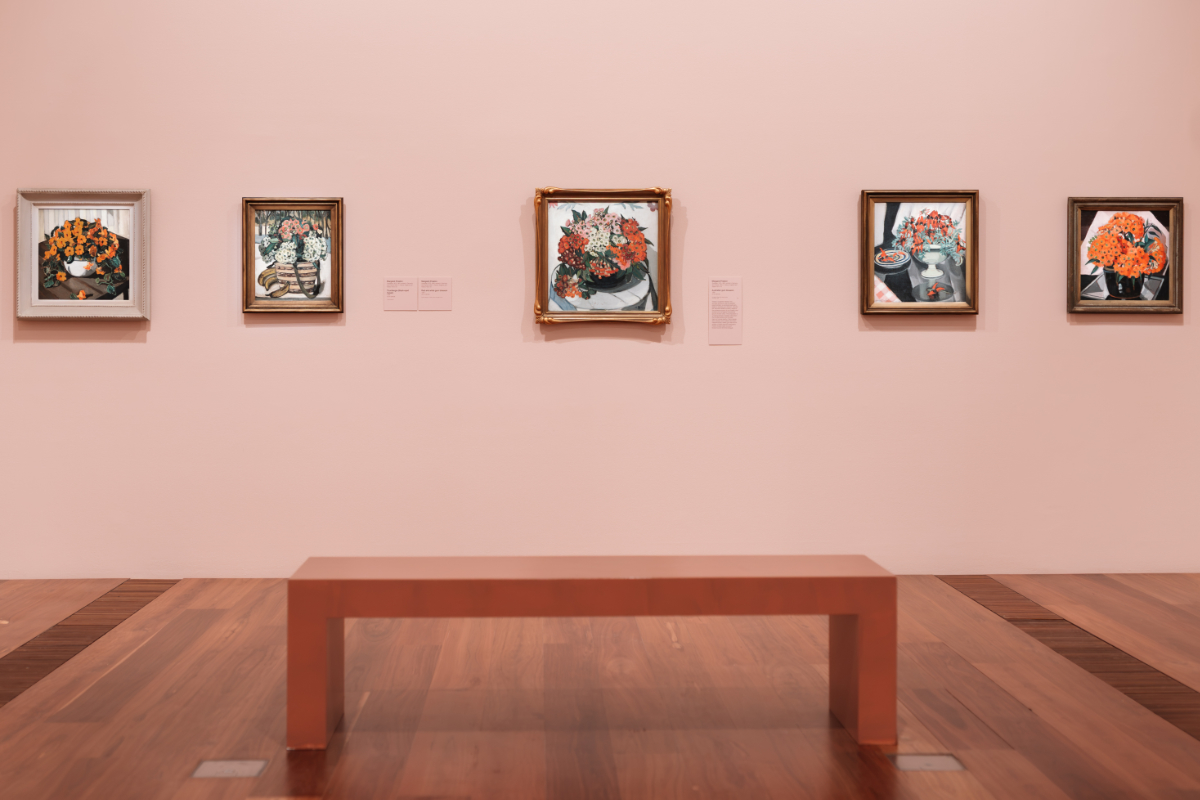
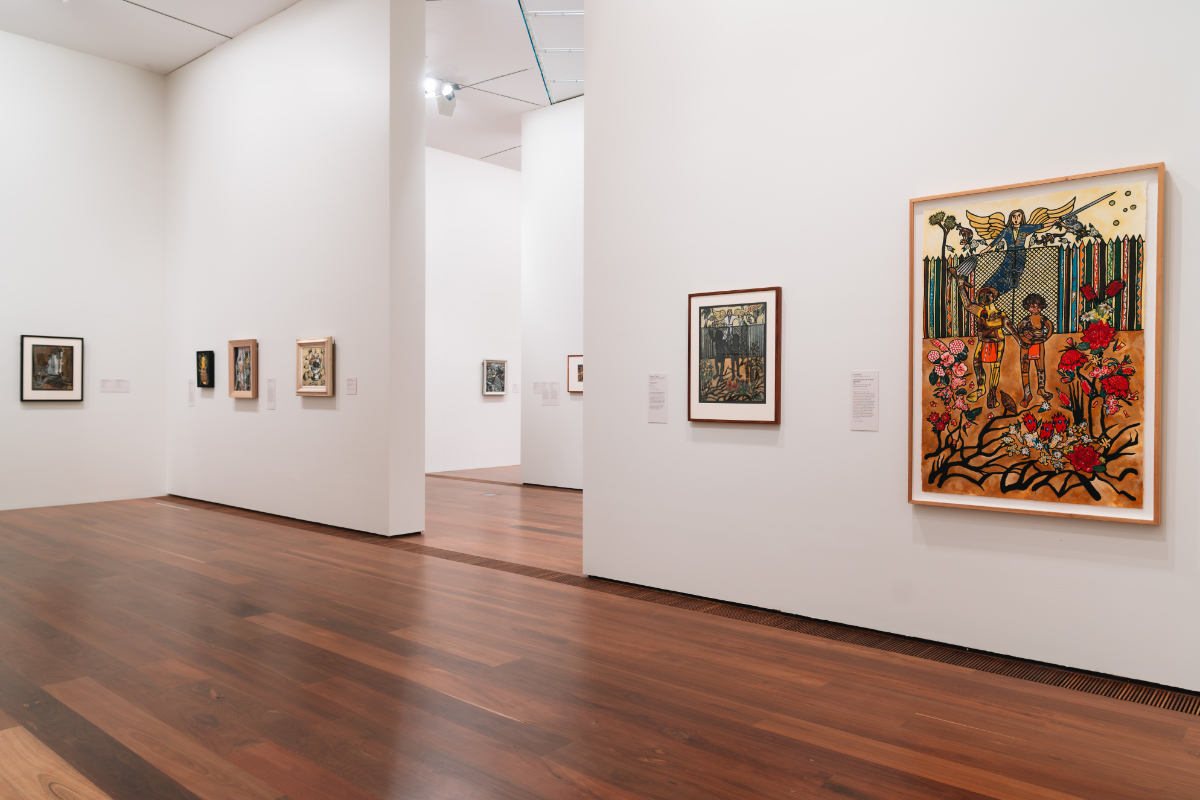
One of the exhibition’s shortcomings is the repetitive display of still lifes, which underplays the influence of Preston’s landscapes, and misses an opportunity to interrogate her lesser-known monoprints or to consider the pivotal career shift towards the end of her life when, in her eighties, Preston depicted FIrst Nations peoples in violent scenes of conflict and despair. A room dedicated to Preston’s six large still lifes commissioned for the 1939 New York Fair compounds this imbalance. Giving a disproportionate amount of space to this series is at odds with the final rooms which are comparatively overcrowded with works by contemporary artists responding to Preston’s entanglements with Aboriginal art.
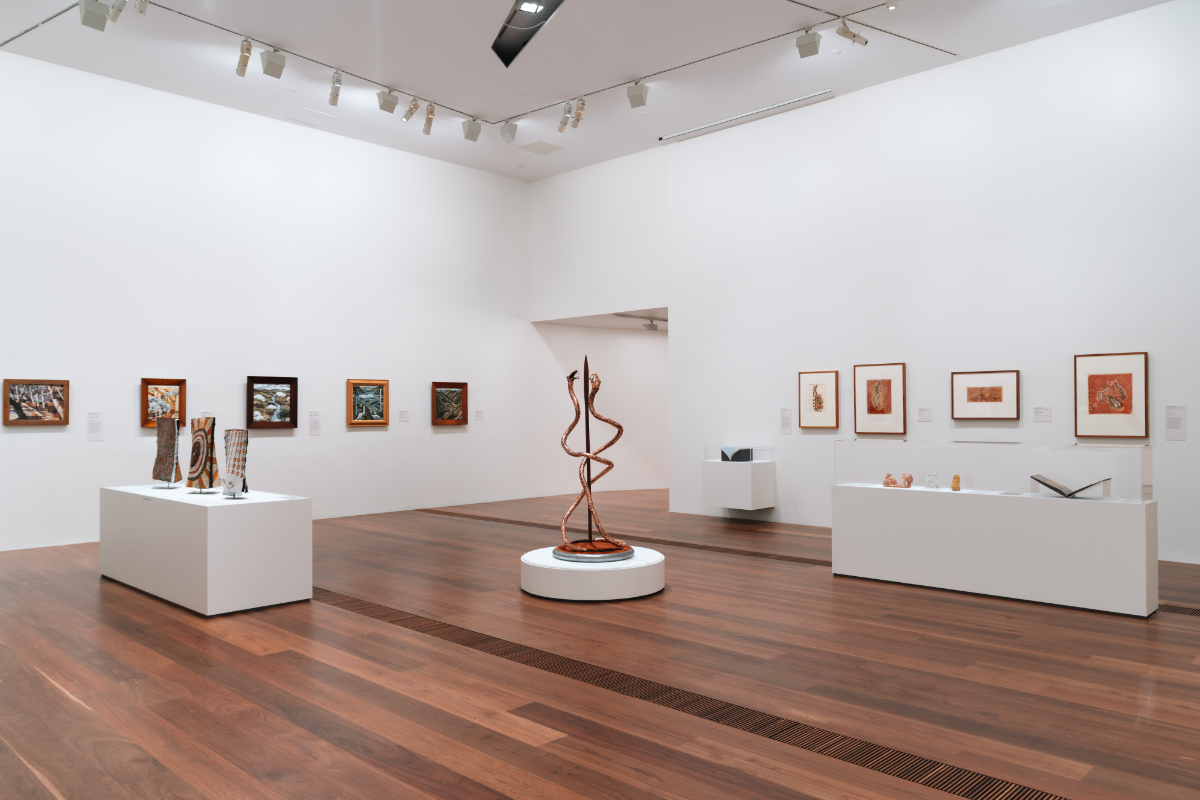
The inclusion of Preston’s personal art collection is however one of the exhibition’s more insightful propositions. In 1947, Preston travelled extensively throughout Central Australia, Northern Territory, Queensland and Western Australia where she collected two tunga—bark baskets—from the Tiwi Islands. The NGV commissioned and acquired three tunga by Tiwi artists Mary Elizabeth Moreen, Raelene Kerinauia Lampuwatu and Kaye Brown, in response to Preston’s collection as a statement of cultural continuance. Preston also collected sandstone sculptures of women by Pitta Pitta mother and daughter Linda Craigie and Nora Nathan, on loan from the AGNSW where they are often on display with La Perouse shell-work in close proximity to Preston and Ngarrindjeri artist Trevor Nickolls. According to the exhibition catalogue, (a substantial publication that includes three essays by Preston and ten commissioned articles), Nickolls was the first Indigenous artist to critically engage with Preston’s legacy in his 1988 painting Homage to Margaret Preston. Through Preston’s N.S.W. everlasting flowers (1929) we are introduced to a La Perouse shell-work box, curatorially contextualised with three commissioned jewellery boxes by Bidjigal artist Marilyn Russell which are placed rather unceremoniously in the exhibition.
In the final rooms, the viewer is caught in a call and response between Preston and First Nations artists. In signature style, Tony Albert’s Conversations with Preston: Expulsion (2020) recreates Preston’s stencil The Expulsion (1952), Adam and Eve being banished from the Garden of Eden, depicted using cut-out tea towels printed with racist representations of Aboriginal people. Albert draws attention to the reality that people continue to materially benefit from Preston’s privileged place in the canon of Australian art. Albert’s work reminds us that Preston’s appropriation is not just a matter of cultural theft as it is now comprehensively understood but also the making of a commercial market that financially benefits from exploiting Aboriginal people and culture in the name of Australia.
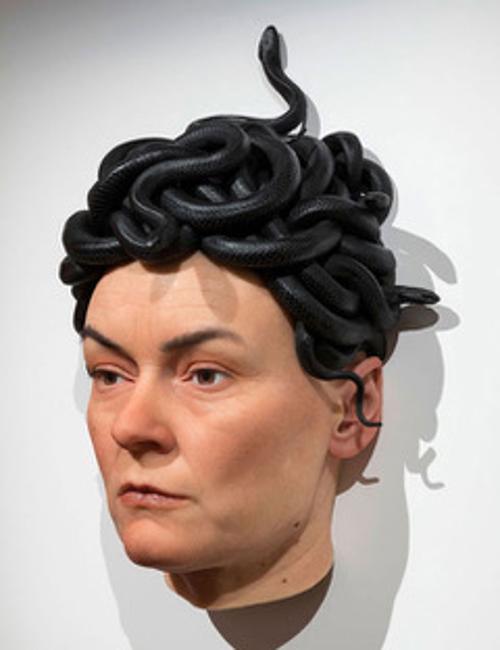
Another NGV special commission includes work by Jimmy Frank Jupurrurla, a Warumungu/Arrernte artist and founding member of the Tennant Creek Brio. The catalogue details the inside knowledge ‘acquired’ by anthropologists Baldwin Spencer and F.J. Gillen when they visited Tennant Creek in 1901, with which Preston would have been familiar. This episode of historical transgression is referenced in Margaret Preston via Frank’s Untitled (2026), a caduceus in copper and steel, the staff associated with the Greek messenger god Hermes replaced with a wooden spear around which two serpents climb.
The exhibition closes with two works by Bennett facing a self-portrait by Preston from 1930. Bennett’s linework appropriated from Dutch De Stijl artists Theo van Doesburg and Piet Mondrian was, the wall-text explains, ‘conceived as a form of visual weaving’. Michael Gentle told me this technique became a type of meditative practice for Bennett during a period of heightened racial tensions in the 1990s, fuelled by politicians Pauline Hanson and John Howard. Had this dynamic setup opened the show, audiences might have had a greater opportunity to consider Preston’s legacy today, which raises an important question about the distribution of labour. Once again, First Nations artists are being invited to explain to Australian audiences why cultural appropriation is a form of colonial theft, and why this is wrong.
In the contemporary context, perhaps only First Nations art can speak back to Preston in poetically disruptive ways. It is a shame Margaret Preston is ticketed (and expensive at $35), meaning many audiences will miss out on seeing this show and the issues it is trying to air and resolve.
So, what to do with Preston? And is Preston actually a problem to be solved?
In the exhibition catalogue Levi McLean argues that there is a barely concealed anti-colonial feminist rhetoric to Preston’s appropriation of Indigenous material culture; he suggests her still lifes were seeking to rattle the cages of the conservative, typically sexist and anti-modern nationalists who dominated the arts establishment at the time. Among them was J. S. MacDonald, who praised her work as ‘lean but sturdy’,[2] and writing in his 1925 Herald review that ‘Preston practises much better than she preaches, and her sermons are original enough.’[3] Three months after her death in May 1963, Hal Missingham wrote in Art and Australia: ‘If Margaret Preston had been a man I feel sure she would have enjoyed public reputation equally great as Dobell, Drysdale or Nolan in our time. But she was belligerently and seductively a woman; proud of it, imperious in her demand that she be accepted as an artist.’[4]
We need to understand the sexist structural forces Preston was fighting — without disregarding the impact and consequences of her attempted assimilation of Indigenous culture into Australian national identity. Similarly, we might consider that given the social and political undercurrent in Australianising Aboriginality at a time when the constitution rendered Indigenous people subject to a political apartheid, Preston's works could also be seen as evidence of her advocacy for Aboriginal rights.The discipline of history requires this context and the uncomfortable reality the exhibition asks us to sit with is that Preston enriched Australian art while engaging in practices we now consider a form of cultural pillaging. The challenge is accepting that two seemingly opposing truths can coexist and learning what to do with that fact.
Secondly, Preston isn’t going anywhere. Is this what Butler was getting at when he wrote that ‘we are all Preston’– implying that we are all a little bit complicit in the unfolding history of settler Australia? There is an appetite among contemporary audiences to deconstruct the legacy of settler colonialism in Australian art, and a responsibility for curators to carefully mediate Preston’s place in history. The curators force us to sit with this uncomfortable inheritance, and that alone makes this one of the most significant exhibitions in a long time.
Footnotes
- ^ The last major retrospective of Preston’s work was the exhibition Margaret Preston: Art and Life at the Art Gallery of New South Wales (29 July – 23 October 2025).
- ^ J.S. MacDonald, “Two women artists,” The Herald, 1925, November 23, p. 4. Retrieved October 13, 2026, from http://nla.gov.au/nla.news-article243715189
- ^ MacDonald, “Two women artists.”
- ^ Hal Missingham, “Margaret Preston,” Art and Australia 1, no. 2 (August 1963): 28. Retrieved October 16, 2026 from https://artandaustralia.com/archive/web/index.php?id=3&fast=true&q=Preston#page=1