Almost Here, Almost Now is a portrait of Mount Gambier via images of elsewhere, as its glancing title might suggest. Staged at The Riddoch and curated by Chris Clements, the exhibition considers the genius loci of a regional centre with a shifting demographic and cultural identity. To this end, it draws on numerous entry-points through the wide angle of landscape.
Framed by a twentieth-century national vision, which still holds water across much of regional Australia, Clements has drawn out this spirit of place using the titular ‘almost now’ of post-bicentenary fin-de-siècle works from the National Gallery of Australia’s (NGA) collection through their Regional Initiatives Program. The NGA’s ongoing remit to ‘nationalise’ the national collection is effective in this instance. Not only can Mount Gambier audiences see professionally displayed works by canonical artists between the 1980s and early 2000s–alongside the Riddoch’s strong holdings of Utopia artists Emily Kame Kngwarreye and Gloria Tamerre Petyarre–it is also an occasion for Mount Gambier to see itself through the eyes of others.
The works of Almost Here, Almost Now are shepherded across three curatorial concepts: mapping, land use and adaptation, all in a clear nod to Mount Gambier’s agri-colonial histories and present industries. They are also the sign of changing times as the town moves towards greener economies and tourism, of which the cultural sector plays a vital part. The main gallery features work by big-name artists, who either powerfully materialise their respective Country in paint, or visualise the burgeoning concept of Country as an adopted socio-linguistic phenomenon. Paintings by Fred Williams, Kngwarreye and Angelina Pwerle, hung cheek by jowl in the adjacent Cathleen Edkins gallery, play out this call and response to great effect.
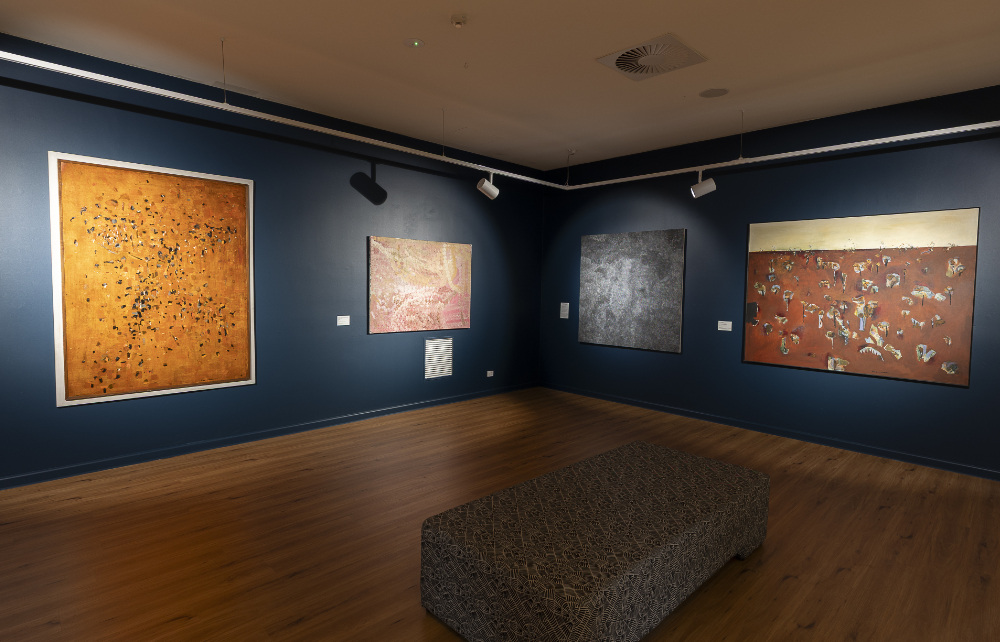
Across the main gallery, just two works reference the specificity of Mount Gambier / Berrin: Shay Docking’s 1986 pastel painting Blue Lake Crater and Volcanic Landscape and Margaret Worth’s So Many Raindrops (2007). Worth’s aerial view, a pointillist patchwork of verdant timber fields saturated by manmade rains, echoes the flight into Mount Gambier as a FIFO art critic. From above, the local terrain is a carpet of high-key agricultural greens abutting dense plantations of pinus radiata. Blink again and you could be in California.
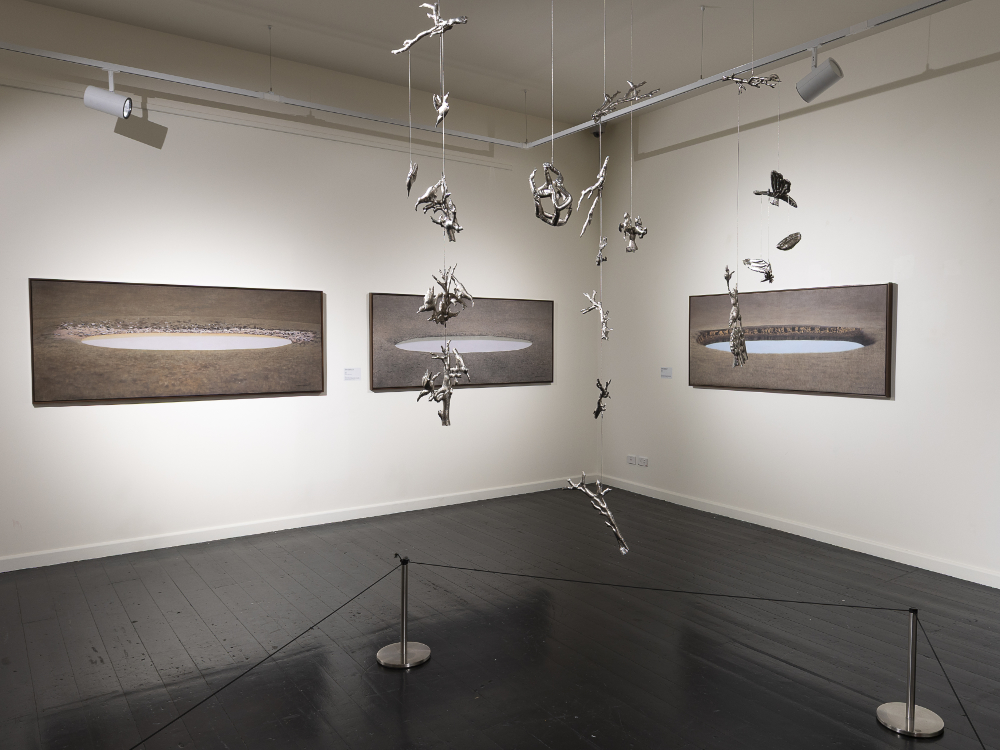
While Docking offers a visual touchstone for Mount Gambier’s iconic Blue Lake and nearby Mount Schank (despite being a reference to her childhood backdrop of Tower Hill in Victoria), it is William Delafield Cook’s photorealist paintings of dams that resonate with the unnerving stillness and suppressed energy of a dormant volcanic crater. Occupying a corner of the gallery’s mezzanine level, Dam 2 and Dam 5 (both 2007-08) are like peering eyes. Perfectly smooth, their surfaces are, at once, a portal and a mirror — without reflection. Dam 7 (2007-08) extends this optical trickery with its slippages in scale. The typical muddy banks of a dam are instead sheer escarpments, cliffs recognisable across the Limestone Coast. Although the azure dam waters are tonally distinct from Mount Gambier’s Blue Lake in summer, the painting’s pictorial flatness, lack of horizon and contained inversion of the sky make it altogether a psychological portrait of place.
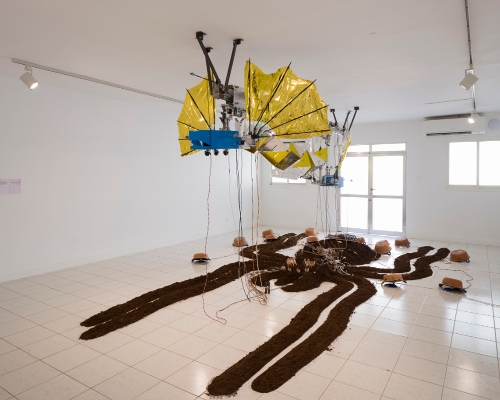
Delafield Cook’s portals are seen through Caroline Rothwell’s hanging Scape mobile, also from 2007. Her soft-casting technique, where pillowy textile forms are transformed into nickel-plated alloy, is a great counterpoint in material trickery. Rough edges and dystopian symbols–hydra-like brolgas, burning horses, disjointed wings, severed limbs of trees–are suspended in the air like truncated, Boschian biblical scenes: the late-stage fall of man.
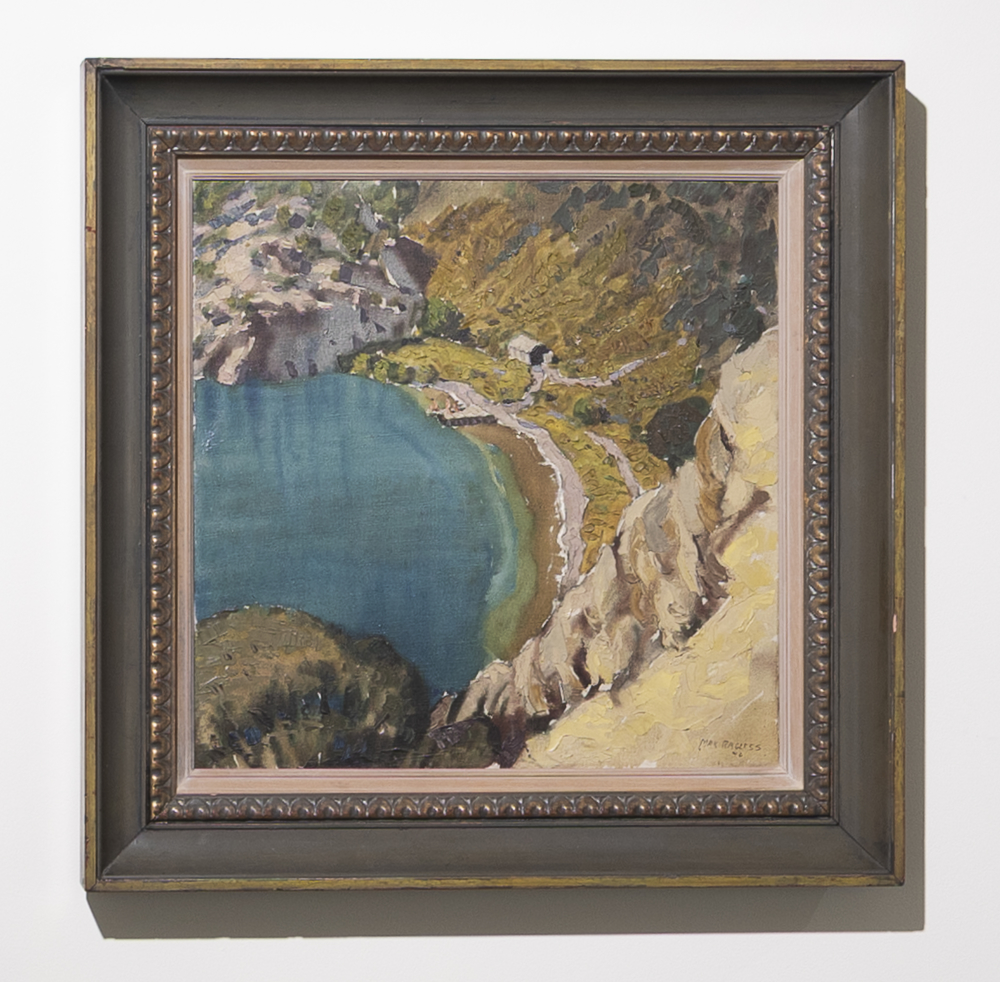
Overall, the mezzanine offers the most compelling mix of works and glancing angles on place. Rothwell’s cragged edges are redeemed by the burnished luminance of Marion Borgelt’s Lunar arc: figure D (2007), a reminder that the world keeps turning. Raymond Arnold’s Imaginary landscape - eighteen months in Tasmania (1984) is not just a political document of the Franklin River during one of Australia’s most significant environmental campaigns, but another syncretic portrait of place. Dean Bowen’s 1989 lithograph Volcano offers a naïve-style counterpoint to Arnold’s sophisticated line work. The playful scenes of logging, timber and hunting industries, factory work and, at the centre, a cratered volcano, is an untethered yet bizarrely prescient insight into the almost here and almost now of Mount Gambier. Rick Amor’s small-scaled painting, wholly occupied by the visual weight of a black bull, is another dark portal and last hurrah for bucolic, pastoral painting. Across the way is Max Ragless’ 1940 oil painting The Blue Lake, Mount Gambier. For all intents and purposes, this is the most direct transcription of place. But Clements recounts that, soon after the exhibition opened, a local came in with a photo proving Ragless’ scene, in fact, depicts the nearby Valley Lake. Another image of elsewhere.
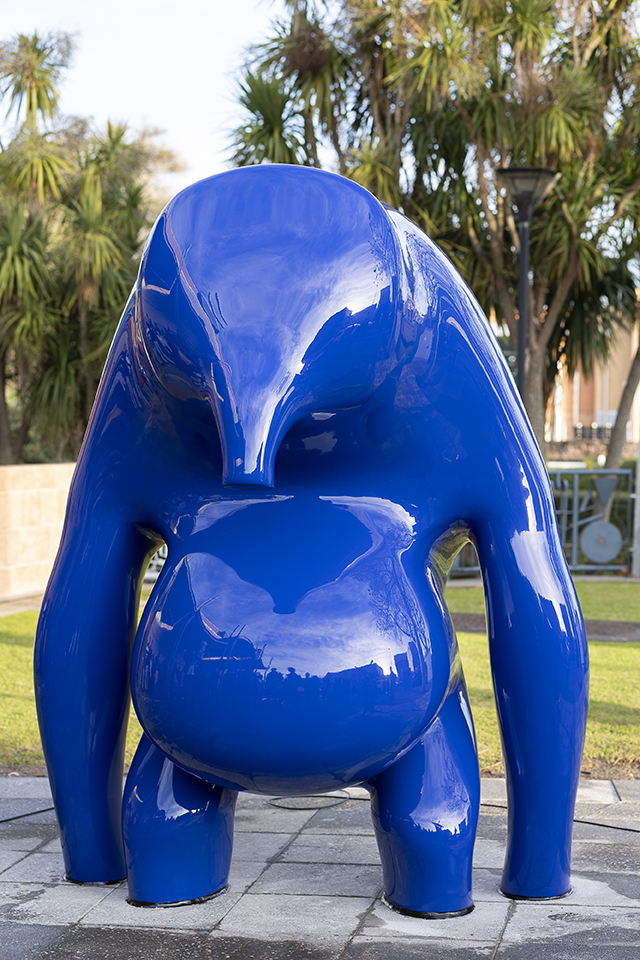
Concurrent to the exhibition, the Riddoch and Mount Gambier City Council unveiled the town’s newest public artwork: Cast in Blue. In mirror-finish signature Blue-Lake-blue cast aluminium, the anthropomorphic mythological character appears to have climbed out of the sunken cave garden (thugi) behind the gallery. Modelled on paleontological fragments of megafauna from the region, the hunched creature is full of pathos, past and future. It has emerged from the depths of not quite here, not quite now.
Like any public artwork, Cast in Blue has attracted its share of community resistance and open criticism. News media are among some of the worst trolls (pun intended). Such is the curse of public art. The resilience required of artists, fabricators, curators, galleries and councils to back these hugely logistical and bureaucratic projects can oftentimes be as monumental as the object itself.
While the Pixar aesthetic of Cast in Blue makes it a friendly, slightly larger-than-life character–lovable even–the public reaction is, in part, fueled by a perennial centre-periphery struggle. The artists Tom Proctor and Mitch Walker of Huna Studio–an emerging public architecture and design firm based in Melbourne–found themselves in the tricky position of being ‘from away’ (thank you Hester Lyon for that turn of phrase). Artlink’s Regional issue (in 2024) teased this out with Lyon’s case study on Broken Hill City Art Gallery being a classic example of the difficulties inherent in shifting parochialism, political conservatism or, simply, the premise of bringing ideas to a town. Time with tell if locals adopt Cast in Blue as one of their own but for the time being, it has arrived, here and now.
 2018_watercolour and gouach on tracing paper.jpg)