.jpg)
Cocos, Imagined (2020). The artist is sawing an imaginary fiddle, so close to the camera she swings in and out of frame. She is seated beside a window in a small room, playing to a desktop computer, the date inferring she is in lockdown. She rocks to and fro, dripping wet, her face in its red-framed glasses morose, preoccupied, eyes falling closed in concentration. The music is a Scottish reel from the Cocos Islands, where Supina Bytol’s Malay ancestors were taken as indentured labour in the early nineteenth century. It’s a slow, rusty screak and squawk, as though from an old recording. The Scottish reel, a bright seesaw in 2/2 or 4/4, is usually played faster and has travelled across the world through the long centuries of colonisation and emigration from the British Isles, endlessly morphing in the hands of Québecois, Appalachians, African Americans, Cajuns, and more. But I have never heard the Cocos Islands version.
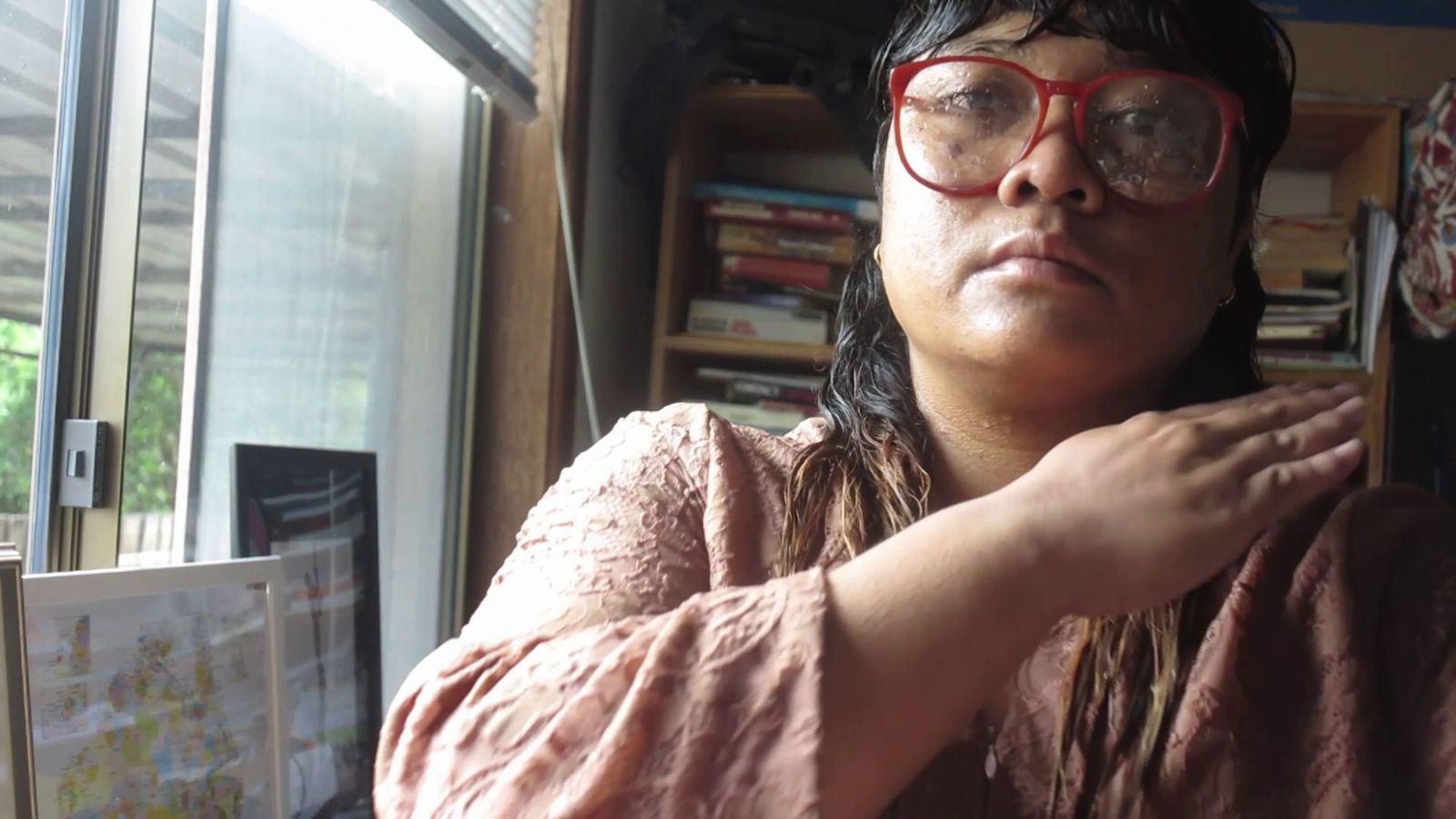
Scattered like breadcrumbs halfway between Perth and Sri Lanka, the Cocos Islands were settled in 1826 as terra nullius by Scottish merchant John Clunies-Ross. He planted forests of cocos palms, brought in Malays to work the crops, and ruled the atoll as a personal fiefdom. Subsequent British and Australian sovereignty did not give the Cocos Malays their freedom. They were Sunni Muslims, many cleaving to their religion as part of their resistance. Their language did not change much, although some words are unique to them. Along with others, the Bytol family moved off the islands in the 1960s to escape poverty. Supina is of the second generation to be born in Katanning, a multicultural town on Wagyl Kaip southern Noongar country, in the south-west corner of the Australian continent. Home Island (2026), the major work of the exhibition at Shoalhaven Regional Gallery, gave Bytol the opportunity to go in search of her ancestors. Its predecessor, Cocos, Imagined, encapsulates the yearning that led to it. Bytol’s background in music is evident in this deceptively simple work. Her gestures are deft and assured. In that tiny room with books spilling from the messy shelf behind her (John Pilger’s Heroes, a psychology textbook, sudoku), so much pathos is delivered in just under four minutes. The loneliness of lockdown, the ad hoc selfie, the dream of a faraway place. Bytol finishes playing her air fiddle before the end of the track, wipes her face and turns away from the camera.
Bytol explains that in Cocos, Imagined she is wearing a kebaya, a traditional garment worn by women across South-East Asia, of which we only see a collar of coral-coloured brocade. ‘It’s me thinking, “Am I ever going to see this place?”’[1] This choice, and the drenching of herself ‘to make it look as though I’d just come from the ocean’ are the only artifices in the video. The music was by a friend, who transcribed and played the Cocos Island reel for the work.
Bytol sang for her family as a child, at naturalisation and other ceremonies. ‘In Katanning there are three generations of my family now. A lot of my cousins married into Aboriginal families in the area. They would engage with mob by sharing food, socialising, that sort of thing. I ended up being friends with some. We were all marginalised, we had the same colour skin.’
Her life turned out as peripatetic as her ancestors’. When still a child, she moved to Bunbury on the coast, then later Boorloo/Perth to attend art school where she also wrote songs. Next it was east, to Naarm/Melbourne, where Bytol formed a band called Miso: ‘We were just a bunch of scallywags playing festivals and stuff. I couldn’t make a living from it.’
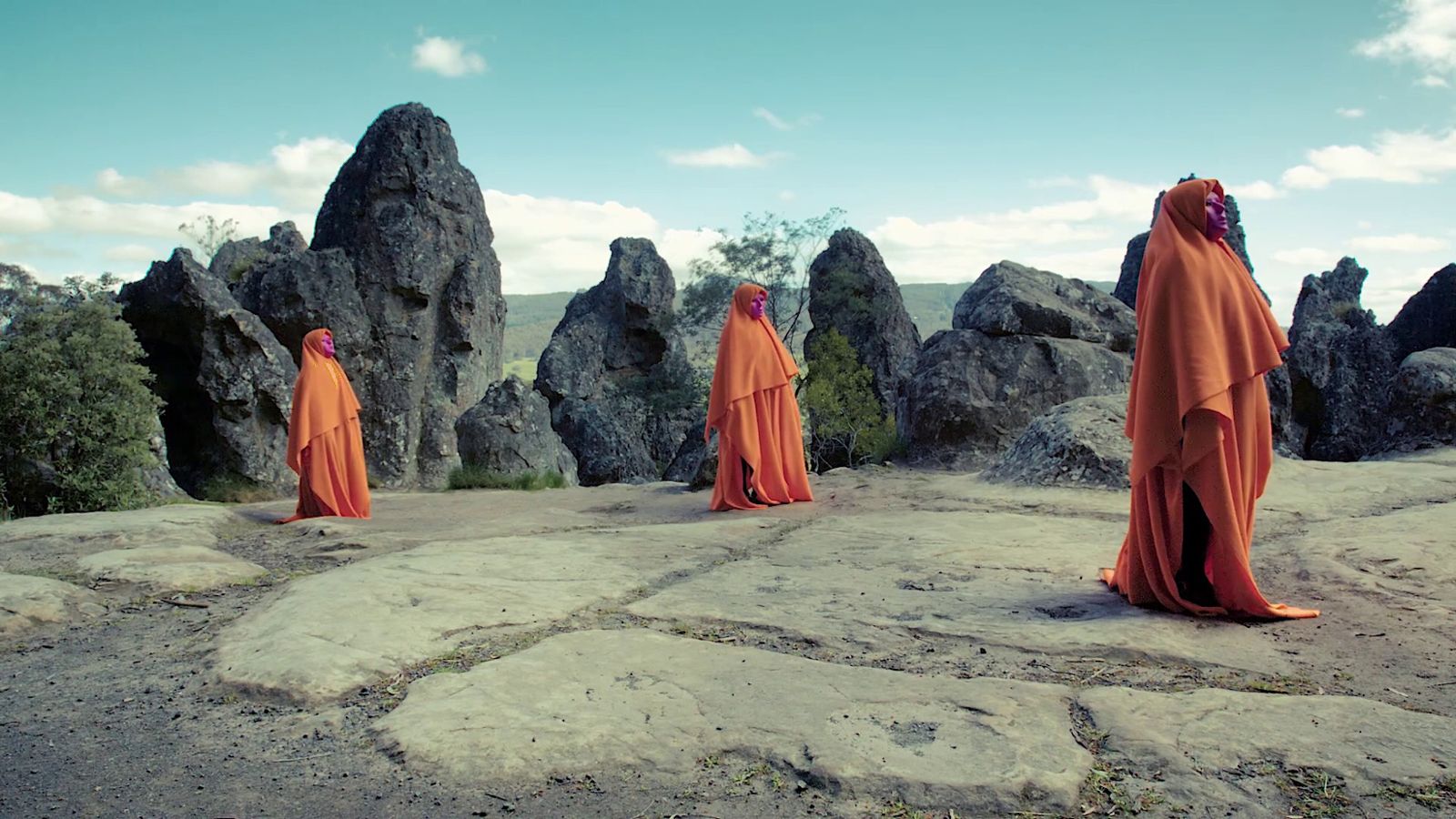
Ten years ago, when she began making video work, the artist turned back to her heritage. Batu Bela Batu Bertangkup (Split rock) (2016) is a collaboration with filmmaker Marcus Salvagno and was filmed at Ngannelong/Hanging Rock in Mount Macedon, the location of the 1967 Joan Lindsay novel Picnic at Hanging Rock, and Peter Weir’s far superior 1975 cinema adaptation. For Bytol, this film recalled a Malay legend about a grieving woman who is swallowed up by a rock. Batu Bela’s dramatisation of this is raw, awkward and enigmatic—containing more than immediately meets the eye.
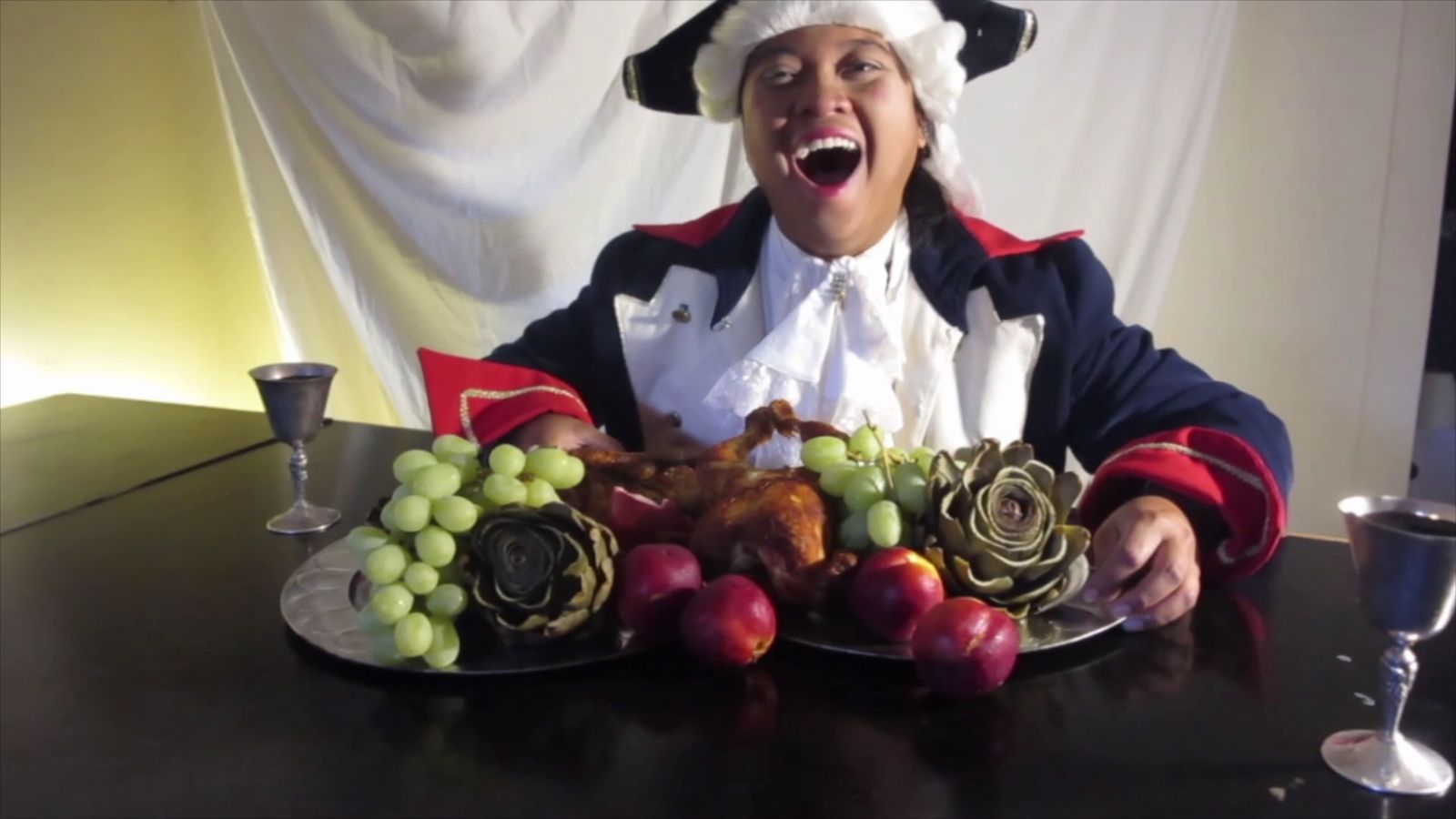
It birthed a Bytol motif: the pink mask. ‘When I first used it, I think I was quite shy. I was going through a deep grieving period, and I used it subconsciously to change my identity.’ Bytol also cites the early 2000s avalanche of social media and how exposed she felt as the only woman in the band, and Muslim. Bytol wears the mask again in Where is my high vis mate? (2017), with a long dress and hijab in which she plays out a scenario of Australian working-class masculinity. She ends the video dressed in English imperial regalia, gorging fruit. I thought of Fijian artist Salote Tawale’s award-winning You Make me Nervous (2017), where the artist, with her face painted, eats for the camera. But Bytol was more interested in mukbang, a Korean video trend where people film themselves eating, to instruct, indulge, demonstrate and fetishise.
When Bytol began asking her father about her heritage, some stories were apocryphal: ‘Dad has a bit of dementia and he’s quite a fantastical storyteller. Part of my family came from Sulawesi — the Bugis people from Macassar. So, they were seafarers. This is going back to when the Dutch were in power. Dad’s take is that when the Macassans were at war with the Dutch, one of dad’s ancestors wanted to trade but his brother didn’t want to cede, so he chose exile. John Clunies-Ross was looking for workers, so they went off with him.’
In their ancient quasi-mythological text, La Galigo, Bugis dynasties are described as rulers of the island of Sulawesi, cosmopolitan cross-roads for Sumatran, Tamil, Javanese, Indian and Chinese trade, with traces of Buddhism and Hinduism in the first centuries AD. Later, Sulawesi was Islamised along with all the Malaysian archipelago. Some of Bytol’s cousins went to Doha, Qatar, for their education. Saudi influences are significant, yet ancient practices remain. Bytol tells me her uncle from Singapore ‘brought in a spiritus sort of healing knowledge, and martial arts and full moon traditions where the ancestors would come into the room. Prayer is practiced across the community and it’s all still connected to the ocean.’ In Batu Belang we see the spirit of the rock. ‘That spiritual and mythological underpinning is what I’m interested in. There’s a special language there I want to explore.’
The focus on the ocean, and labour, brings to mind diasporic Oceanic artists. South Sea Islander Jasmine Togo-Brisby and Tongan John Vea, both based in Aotearoa, have researched and exhibited on Pacific migrant labour.[2] Shivanjani Lal’s exploration of her own ancestors’—Indian-Fijian—history of indentured labour and enslavement.[3] Or Tongan-Australian Latai Taumoepeau’s work around exodus, labour and climate change.[4] Historian Christian Pelras claims Sulawesi’s long history of deforestation ‘has been taking place since probably the fourteenth century.’[5] First for rice, using a traditional slash and burn method which let the land fallow for years in between. Cultivation accelerated in the sixteenth century with the arrival of the Portuguese, in turn coinciding with the other most significant trade—humans—which proved long and lucrative: ‘shiploads of slaves still arriving in Singapore on Bugis boats in the early 1820s.’[6] By this time, the Dutch were attacking the Macassans, and Sulawesi was no longer densely forested. Bytol’s ancestors had a lot to run from, but she contends: ‘I didn’t want to focus on the slave trade because when I’ve talked about it to my family, there are different opinions. There’s a bit of shame about it.’
More than a century later, after their arrival on the Cocos Islands, the Cocos Malays’ long struggle against the Clunies-Ross began to bear fruit. The UN was brought in, ousting the dynasty as plantation managers, and Australia took over the islands’ administration. The mere phrase gives one pause. ‘Out of the frying pan, into the fire?’ I say to Bytol. ‘Totally!’
Her family kept moving, running from poverty, exploitation and oppression. The Cocos Malays were offered jobs on nearby Christmas Island’s phosphate mines, which had been founded by another Clunies-Ross in 1897 on a 99-year lease from the Crown. Christmas Island was named by Captain Mynors from England, who sailed past on Christmas Day in 1643. Such fleeting observation: such permanent marking. By the time Bytol’s great-grandparents arrived, the mines were run by the British Phosphate Commission in partnership with the Australian and New Zealand governments. Ever the opportunistic partnerships between merchants and Empire, between corporations and nominally democratic governments.
In 1974, 1100 workers on Christmas Island demonstrated against poor working conditions and wages. Bytol’s grandparents on both sides moved to Australia. 'Gough Whitlam was in power. Others went back to Borneo, where they were given land on Saba to mine, and some went to Singapore.’ In Katanning, most work was in the abattoirs and tanning factories that service the agricultural industry. Bytol’s father befriended a farmer and worked for him.
It all seemed a better option than staying on the Cocos Islands. For those who did, things did not improve. Bytol alerts me to another artist with a connection to the islands: Canberran ceramicist Sally Clarke, who lived there in the 1970s when her father worked as the islands’ doctor. Clarke describes an idyll for her white family. ‘But it was very apparent there was this feudal society.’ [7] The Cocos Malays were confined to Home Island, one of the two islands inhabited, each with a population of just 500. They were paid in plastic money, as impoverished as their ancestors, and ‘pretty much enslaved.’ Clarke later conducted a ritual and artistic return of the shells she had collected on the islands as a child.
And now the islands are sinking. The oceans are heating. Everything is tenuous.
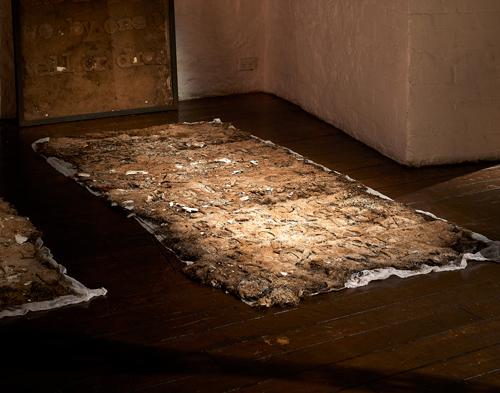
Bytol’s sheepskins are literally marked by this complex, unsettled history. For the series Cocos Island Colony 1826-1955 First Iteration (2020-24), the artist made photogravure etchings collating imagery from a plethora of sources: ‘family photographs, archives, online material, community stories. I’ve also looked at a lot of books on Islamic art, and Malaysia.’ Dansa shows fiddles, drums, a man dancing before a crowd. The decorative borders ‘come from a presentation style of historical texts like the Malay Annals from the 1600s, to old Javanese mythological texts.’ Some of the etchings explore historical events. The Agreement[8] collages photographs of British soldiers with Malays, one group of men seated on the ground, weary, resentful. Along the bottom border are horizontally stacked rifles. The lacuna in the centre of the image is possibly its most articulate feature. A third etching, Ikan Burung, displays the abundant sea life around the islands.
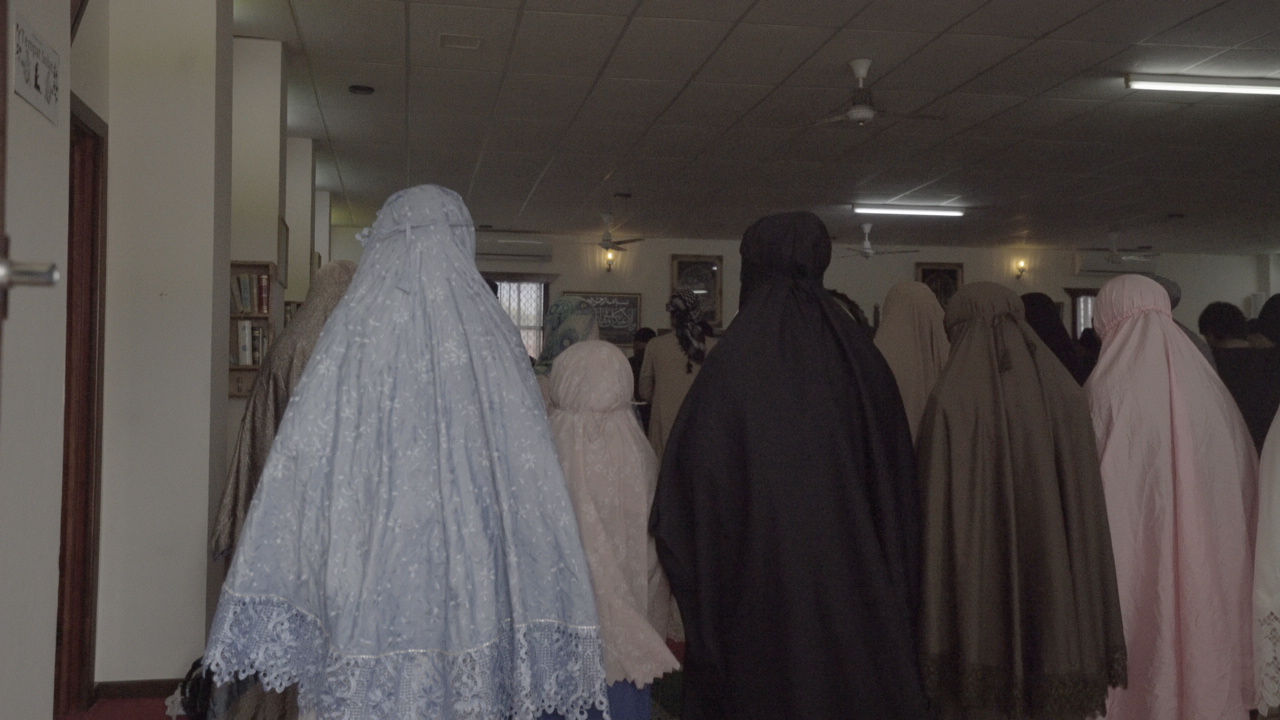
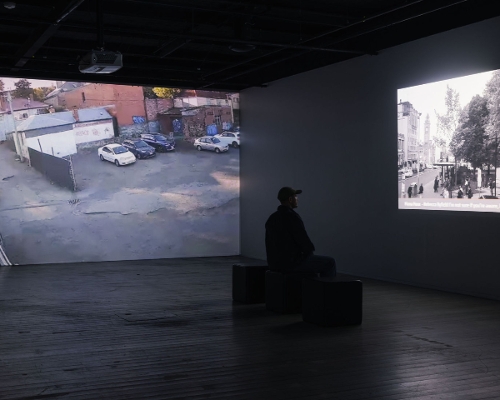
These multivalent fractured centuries’ long narratives of Supina’s vast Malay family coalesce in Home Island (2026). The opening shots were filmed on Noongar country. We see the bush after burn-off, smoke rising from blackened ground through charred tree trunks; a wide paddock with a large crucifix planted before hay bales cuts to a shot of Katanning’s low slung brick mosque at dawn. Bytol’s camera is always still, the framing often asymmetrical, the progression of scenes fittingly nonlinear. Likewise, the shooting of people from the back, the side, or passing in the distance. Elusive, elliptical, yet always there. Worshippers in the mosque are off-centre, sometimes accompanied by silence, sometimes with sound. A high window in a dark featureless wall tips out of frame, through it an image of a coconut palm gently swishing in the breeze. This small bright aperture in its obscure expanse struck me as a metaphor for Bytol’s endeavour overall: the oblique capture of a place at a temporal and geographic removal, itself a mere pitstop in a long history of removals. The voice-over is Bytol herself, narrating in Cocos Malay:
I am learning how to return.
Everything looks rudimentary. The typical South-East Asian interiors—pistachio walls, plastic chairs, synthetic curtains spangled with lights—are interspersed with stunning panoramas of tropical islands: a low dark coastline in the distance, a body of water smoky with reflected clouds, or translucent azure over white sand. The collusion of colonisation and commerce which destroyed so much land, so many communities, countries and lives, continues to this day.
Not to one place. … To many.
The film’s insistence on people’s working conditions reminds us of what always propelled them: through the doorway of an old caravan, we see a dim interior where someone is cooking at a bench. Outside, in the foreground, a wok sits on a drum of oil. It could be the back of a food truck; it could be a car park. People and cars drift across the background.
Sometimes one image contains several layers of the diverse Bytol history. A dark interior with the glint of an upturned bowl in a rack, above this a window framed by a lace curtain with an arched hem such as one might see in a Muslim household, through the window an Aussie flyscreen and through that, the silhouettes of passing women in western dress.
Bytol timed her return to coincide with Eid so she could film the Islanders celebrating the end of Ramadan. The first people filmed front on are what appear to be three generations of adult men. The eldest is nonplussed, the middle and the youngest smile disarmingly at the camera. Cut to a fiddler seated against the wall of a hall, resining his bow. He takes up his instrument to play that indolent tropical reel, accompanied by drum and vocals. The musicians are all men, dressed in Malay sarongs and songkok hats. Watched by children seated on the grass, men and women do a circle dance in the same traditional dress, then we return to the coconut palm swishing through the high window.
I used to think that returning meant finding the place where everything began. Now I am not so sure. People leave. People stay. People return.
Footnotes
- ^ This and all subsequent quotes from zoom conversation with Bytol, September 2026.
- ^ For instance, Outcast – Gus Fisher Gallery, Tāmaki Makaurau/Auckland, Aotearoa/New Zealand. 20 October 2023-27 January, 2024
- ^ For instance, Aise Aise Hai (how we remember), Campbelltown Arts Centre, for The National 4, 2023
- ^ For instance, The Last Resort, Cockatoo Island, 22nd Biennale of Sydney, 2020
- ^ Christian Pelras, The Bugis (Blackwell Publishers, 1996)
- ^ Pelras, 119.
- ^ Charlie Mills, Artist Sally Clarke to return shell collection to Cocos (Keeling) Islands, ABC Pilbara, 19 May 2024.
- ^ In 1963, a founding document signed in London, provided for the colonies of North Borneo and Sarawak, and the state of Singapore, to be federated with Sabah as part of Malaysia
_Card.jpg)