If art is a kind of developer, it needs no justification and no arena for ‘speeches of evidence’. Art itself should be a place for revealing the diversity of truth; it allows us to feel the pulse of the presence whose rhythm is stronger than our lust for power. [1]
If biennales of art can be best judged by their capacity to reflect the tempo of their times, then the 25th Biennale of Sydney (BoS), Rememory (2026) seemed poised to out-perform all others. By the close of its opening night events, the BoS had been absorbed into the performative ‘totalwar’ that permeates our social-mediatised cultural ecosystem.
In the online kingdom of the Hate-O-Sphere, fixed positions of identity, opinion and divisiveness have supplanted nuanced cultural critique. (For the first time, the BoS didn’t publish an exhibition catalogue). Fed by controversy and the motivation to harness ‘likes’, pundits operate in a kind of no-persons land, where the writer’s capacity to identify villains and victims fertilises their appeal to the masses.
Within this grey domain of post-truth opinions and outrage-farming, the recent BoS was transformed into a cameo-role corpse for whoever was writing the post-script obituary. But cynical reductions of the event to rage-bait-par-excellence only masked a general failure to engage with the real substance of the exhibition. The rage and grief generated around the calamities of the war in Gaza, the escalation of populism, and the tragedy of the events in Bondi that occurred in December 2025, so close to the launch of the Biennale, surged and spilled over to infect all responses.
The BoS is one of a number of cultural events that share the aim of moving issues of social, political or cultural cohesiveness forward for deeper scrutiny. It’s committed to present less obvious pathways than a collapse into global dividedness and inequality. Aiming to raise questions rather than showcasing set opinions at a time of imaginative terror, Rememory was sure to set ire ablaze. Because on the surface, such cultural events have been made to appear propagandistic.
Nothing could be further from the truth.
Biennales have always thrived on controversy, while providing safe spaces where dangerous ideas can be trialled. It’s been part of their appeal and one of the many reasons audiences flock to participate in biennales’ scenarios-of-contention. They’ve gained their reputation as events where you must be present as a participant to feel the frisson of contradiction; to enjoy the titillation of friction.
Not all that long ago, on the cusp of another global collapse, philosopher Simone Weil described spaces of contradiction as positive and constructive. In her pre-World War Two journal entries, later published as Gravity and Grace (1947) she wrote, ‘the contradictions the mind comes up against — these are the only realities: they are the criterion of the real.’
But the capacity to engage with the positive frictions of art and ideas requires a kind of humility — a preparedness to admit that your mind has not yet been completely made up, and a sense that there may be more to a situation, a context, a series of experiences, than meets the eye.
Weil made her desperate call for recognition of the fact that what might appear to be intellectual, existential or spiritual dead-ends are ultimately capable of opening ways to new transformational possibilities. When everything seems impossible, final, inevitable, her words urge us to accept the grace of unknowing, to loosen the shackles of fixedness, to embrace the union of contrariness and move forward.
.jpg)
The fact that we have entered a self-described post-truth era where the fixity of beliefs, of dogma, of intellectual and cultural prescriptiveness have been abandoned, makes calls to jettison an event that fosters scepticism all the more ironic.
There are quick and simple answers, of course, none of which holds water. While it’s entirely appropriate that the appointment of Artistic Directors of major art events should be met with critical responses, the appointment in 2024 of Sheikha Hoor Al Qasimi, daughter of the ruler of Sharjah, as the Artistic Director of the 25th BoS, raised questions that seemed particularly fraught against the crises in the Middle East.
And many questions were raised during the numerous public presentations made by the curator in the months running up to the event. Each was responded to professionally and with transparency, courtesy and grace. I had many reservations of my own that I raised in public at that time. And I’m prepared to admit that, in retrospect, questions like the extent to which access to unimaginable wealth might influence an Artistic Director’s capacity to be selectively dispassionate might seem naïve: after all, since when has access to wealth not played a role in influencing major international cultural events? And questions about whether the curator’s direct association with particular political affiliations might also influence her capacity to make dispassionate artistic decisions may also have been naïve: after all, since when has the selection of art and artists for major cultural events not been influenced by the political positions of those in charge?
Nothing new to see here. From its inauguration in 1973, the BoS has claimed ‘to develop and present a program that challenged traditional thinking and encouraged new levels of enthusiasm for innovative creative expression,’ and to showcase ‘the freshest and most provocative art from Australia and around the world’.
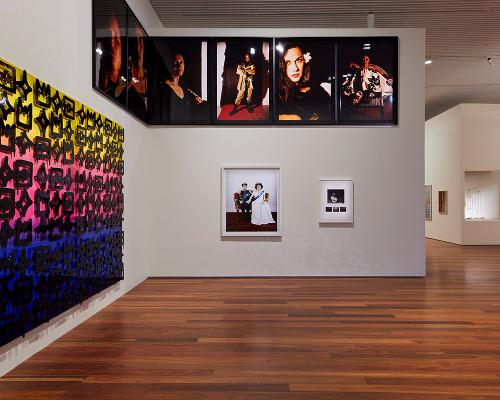
Such claims have been justifiably critiqued from the get-go, but be that as it may, the 25th BoS was a proud inheritor of some of the more worthy ambitions of that tradition.[2] The curatorial cohesiveness of Al Qasimi’s Rememory was tight and consistent. The narrative passage of the show offered a continuity that unfolded in connected pathways from venue to venue across its five metropolitan and suburban-based exhibition spaces.
Often surprising, intermittently challenging, consistently unsettling, so many individual works counter-balanced the heart-rending with the poetic. As a journey through a series of inter-connected experiences, the exhibitions did indeed offer a sequence of contradictory conundrums — spaces of experience where the incommensurable aspects of our present state-of-being moved viewer/participants into what Weil may well have described as productive prevarication.
These days, it seems as though those who are not literally fighting for existence are suffering from paralysing fatigue — fatigue from grief about the world-at-large; fatigue from frustration about our own inadequacies in responding to the injustices and insanities broadcast on a 24/7 news cycle; fatigue from being urged to think over and over about issues of identity-politics with a monotony that obscures the more radical proposition that we are all, at some level, interdependent; fatigue from having hoped for so much and seeming to have achieved so little. In this shared, extended exhalation of grosse fatigue, the question about whether expensive biennales can still offer anything positive, deserves considered responses.
Confession: I cling to hope in irrational ways. And although I was, at first, dubious about the capacity of the BoS to offer anything of value to the melee of discontent, I capitulated, squandered my ecological footprint, booked a flight from Brisbane, and embarked on the pilgrimage.
And for me at least, it worked. Time after time I was brought up against the vast gaps in my knowledge and my lack of understanding. Some of these were things I thought I already knew. But I left thinking about them in different ways.
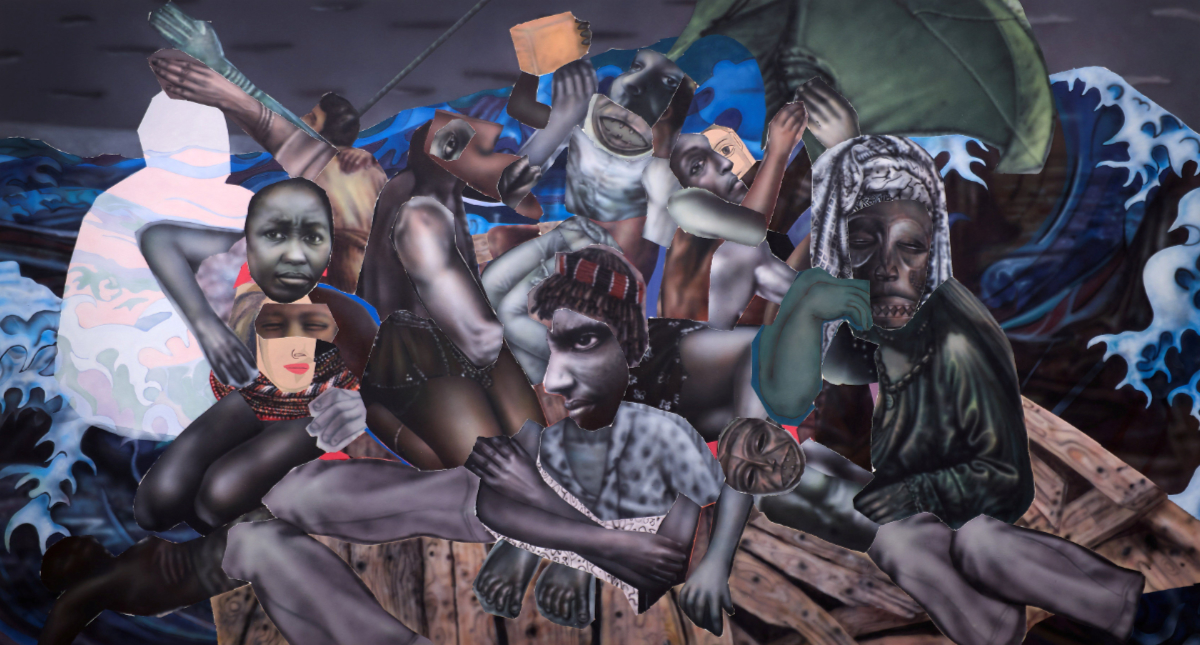
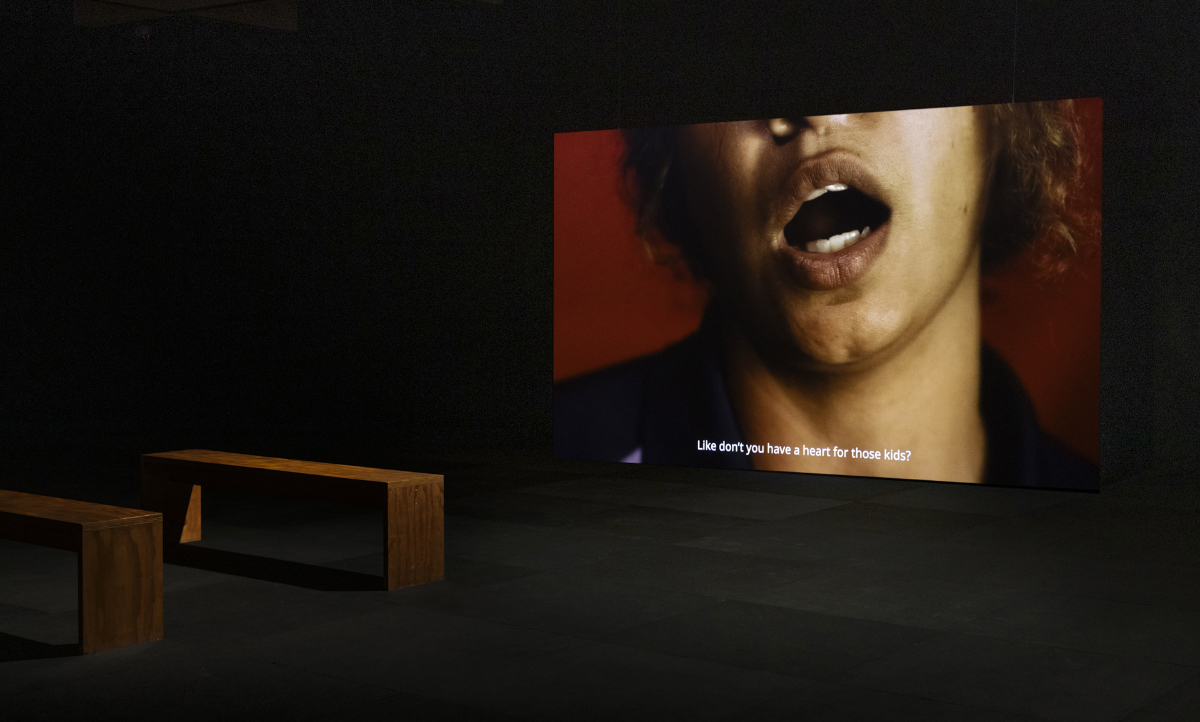
So, I confess again: who would have guessed that there was a slave trade that linked the capturing of young men in Nauru to work as part of colonial plantations in Peru? (Benjamin Work’s PĀPAAKI, 2025). Who could imagine that flickering images of tragic, silent silhouettes of prosthetic limbs against rain-drenched, bomb-littered paddy-fields could sing so clearly of the searing persistent pain that lingers long after the war is over? (Tuấn Andrew Nguyễn’s The Unburied Sounds of a Troubled Horizon, 2022). Who could have thought that the wilfully obscured and perfect lips of our incarcerated Aboriginal children could condemn the systems we create with such poetic simplicity and precise articulation? (Vernon Ah Kee, Behrouz Boochani, and Hoda Afshar, Code Black/Riot, 2025). Who could have thought it possible to stand before a small screen dwarfed by the towering ceilings of a former power station, transfixed by the strange playstation-seductiveness of images featuring the exploitation of child labour across five different countries? (Bertille Bak Mineur Mineur, 2022).
Within the imaginative spaces of these works, something inside me shifted. Weil may have described such experiences as spaces where reason reaches its limits, where the things-you-thought-you-knew are confronted by such absurdities and complexities that ultimately, new imaginative doors are prised open. It’s true that beyond these individual moments, nothing shifts in the world of realpolitik. But art has always clung to the fragile hope that transformations of any kind—even those that surprise in the most incremental ways—might still accrue into a broader will-towards-change.
The decision to attend or participate in a biennale entails a kind of pilgrimage. And although many pilgrimages are fuelled by belief, it is persistent, nagging doubt that is the catalyst for setting off from what’s familiar. It’s a vote to embark into waters less charted, to travel into territories less plotted. In a Homeric sense, the value of the pilgrimage, or odyssey, lies in the getting of hard-won wisdom shaped by experiences of displacement. Yet resulting wisdom does nothing to stop cycles of suffering or doubt. The final verses of Homer’s tragic tale trails off towards this bleak realisation, one that Dante was later to take up in the Inferno. The pilgrim never arrives; the pilgrimage is a process that must be submitted to again and again.
Origin stories
Since the first Venice Biennale of art in 1895, similar art expositions popped up around the world; today approximately three hundred are officially registered as recurring events. That initial cultural festival was created following the city’s emancipation from Austrian rule in 1866, with the intention of re-establishing Venice’s position as a global cultural magnet. But the decision to include artworks from across the world was intended as much more than a cultural Olympiad; it was also anticipated as a way of gauging the tenor of the times; of refocusing from the past towards the future; of harnessing contemporary prestige as a means of moving towards cultural rebranding and urban regeneration.
Like the world trade fairs before them, art biennales initially reflected what was most ‘cutting edge’. The celebration of discovery and inventiveness drew crowds and fomented discussion that continued well after the event itself had closed doors. Controversy and contention were crucial aspects of the biennale’s appeal; dissenting opinions fuelled art world interest; competing worldviews could be trialled within an arena that was inclusive and tolerant rather than exclusive and prohibitive.
And the look of each event morphed in response to the times, attracting the sharpest critical responses and keeping public interest alive. As the preference for increasingly mediatised experiences grew in the 21st century. From 2010, the curatorial focus shifted to include artworks with Instagram-appeal. Often immersive, frequently spectacular, the capacity of work to raise questions or generate discussions seemed less important than sensory impact.
Art establishment responses were less enthusiastic about the transformation of biennales into core drivers of a global market for cultural tourism and corporate sponsorship. In 2007, art historian and critic Claire Bishop described how such spectacles promoted hierarchies of ‘art-stars’ in a system of de-contextualised display. She dismissed curator Hou Hanru’s spectacular biennale in Istanbul as an ‘internally disconnected exhibition that could happen anywhere and nowhere, divorced from material realities.’[3] Curators also came under criticism for the elevation of their roles as ideas-magicians. The words of lauded writer/critic/curator Okwui Enwezor ring with irony as much as pertinence: ‘There is a danger attached to […] one “Star Curator” who orchestrates the entirety of the show... resulting in the loss of intimacy among art, its makers, and its engagement.’[4]
Venice, again
Where we stand now, as fraught global politics continue to escalate, the appetite for spectacular, showy visual statements seems inappropriate. In response, biennales have shifted towards expositions that harness structural fragmentation as a means of reflecting the inequalities and growing discrepancies that emerge whenever global cultural overviews are attempted. The 2026 Venice Biennale, In Minor Keys, continues this shift through a curatorial overview that moves the marginalised, the overlooked and the under-represented to the fore.
Biennales are currently undergoing some pretty tough scrutiny, and this would be an easy event to critically bury. Questions about the relevance of contemporary art and national pavilions are consistently mounted as attacks. There is always a chorus in the wings baying for closure of biennales on the grounds of growing irrelevance.
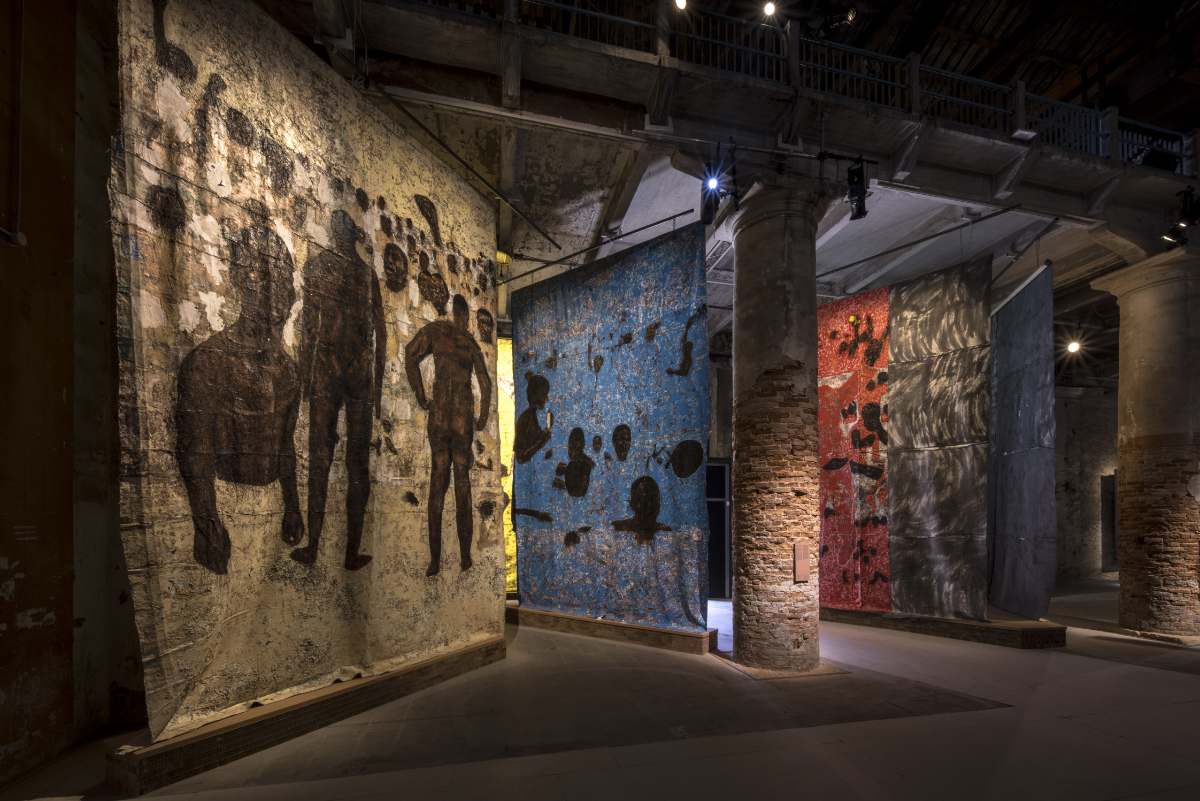
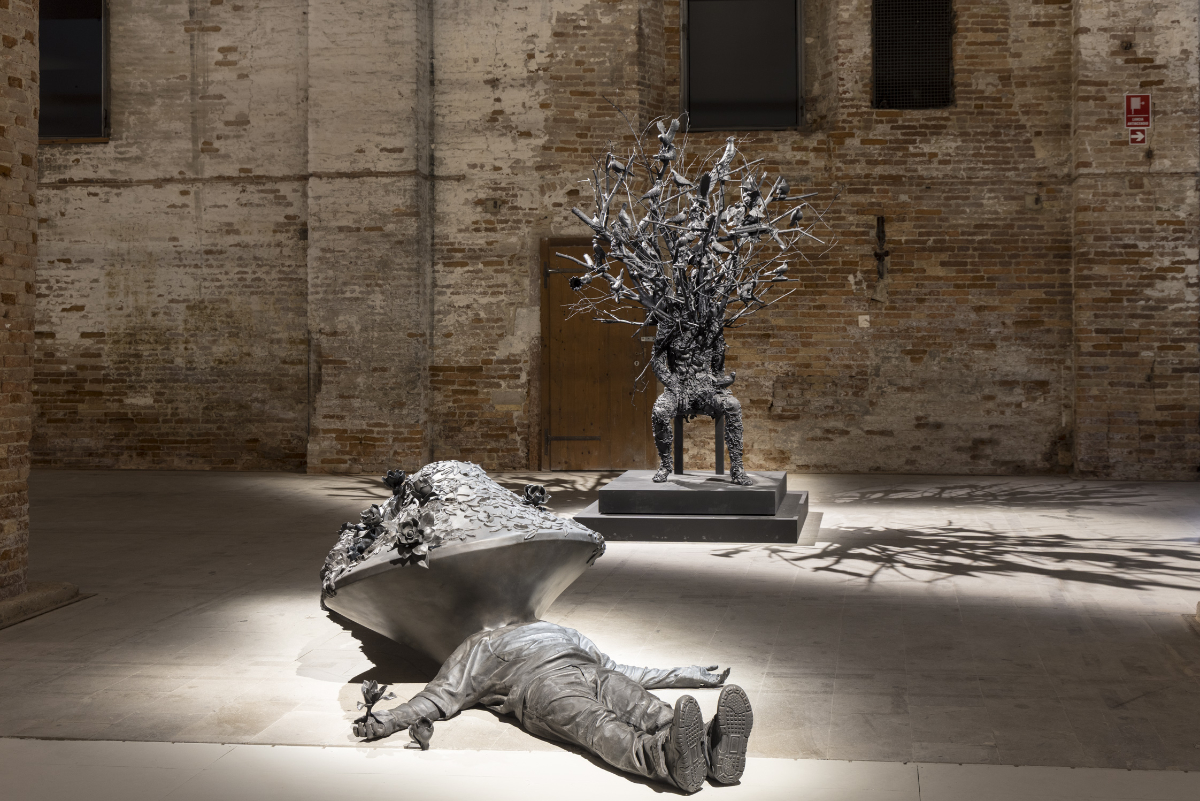
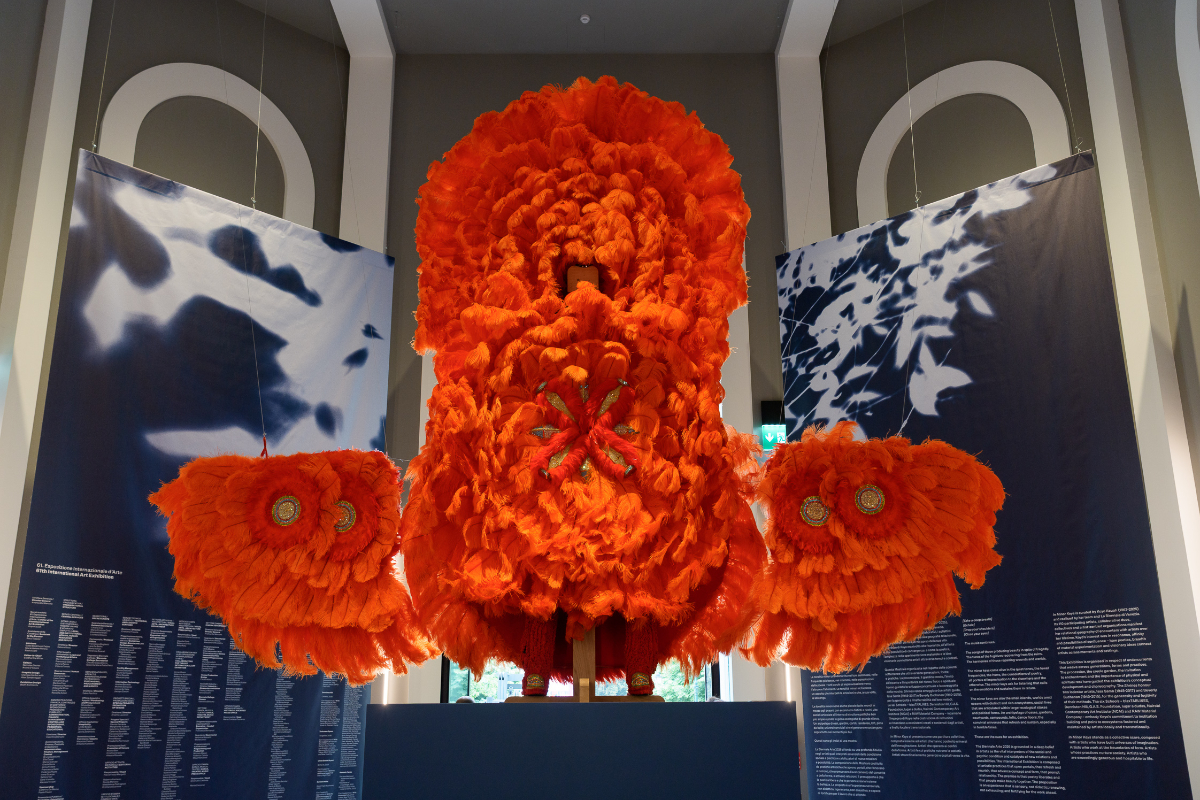
As has been widely remarked on, In Minor Keys was birthed in the caul of loss and grief following the untimely death (in May 2025) of Cameroon-born Koyo Kouoh, the first African woman invited to curate the grand event. Entrance porticos in both the Giardini and the Arsenale appeal for collective mourning: under the historic frescos of Galileo Chini, Big Chief Demond Melancon’s soaring fabric costume/sculpture Amistad Takeover (2026) spreads its ritualistic, garishly beaded and dyed ostrich-feathered arms wide. In a gesture that simultaneously embodies campy resistance and elegiac acknowledgement, it stands as a complex sentinel for the works that follow. At times solemn, at other times playful and irreverent, the scattered, disparate nature of the work is linked only by the most fragile curatorial threads.
In the smaller portico marking the entry to the winding Arsenale odyssey, words by the late Palestinian poet Refaat Alareer (killed in Gaza on December 6, 2023, two weeks after writing the poem) provide a simple, unsentimental validation of Kouho’s belief in art’s role as a means for radical remembering:
If I must die,
you must live
to tell my story
to sell my things
…
and bid no one farewell
let it bring hope,
let it be a story
Other artists died in the months between their invitation to participate and the opening of the biennale. They include Senegalese artist Seyni Awa Camara (died early 2026), whose sculptural work is featured in the central pavilion, Henrike Naumann (died 14 February 2026) artist for the German pavilion, and Alexander Kluge (died 26 March 2026) who worked with Hans Ulrich Obrist, Ben Vickers and others on the pavilion for the Holy See.
Many critics have described the exhibition as being shot through by references to hauntings and ghostings. And the sense of melancholy and spiritual exhaustion driven by the passing of key individuals, was intensified by the mood of mourning when the international jury resigned in response to Pietro Buttafuoco, president of the organising foundation for La Biennale di Venezia’s insistence that the Russian and Israeli pavilions should remain in the program. Many disagreed. Protests were fierce. Several participants withdrew.
Kuoh’s aims had been to bring ‘the songs of those who create beauty in the face of tragedy; the melodies of refugees rising from the ruins; the harmonies of those who tend to wounds and mend worlds’.[5] There is plenty of evidence throughout the exhibition, that 'Things Fall Apart', as Nigerian writer Chinua Achebe, and Irish poet William Butler Yeats once warned.[6] And although In Minor Keys embraces moments of bright celebration, unbridled joy, playful critique and sheer fragile beauty, evidence of censorship, political erasure and corporate control are threaded through many works.
The complex and often contradictory sequence of experiences of the 2026 Venice Biennale is partly the reason you buy the ticket: pilgrimages of all kinds entail immersion in a sequence of consecutive realms. Like it or not, issues of death and dying, mourning and remembering are never far from the spotlight of celebration, carrying whispers of the current geopolitical melee beyond the gated curated cultural spaces of Venice.
But Kuoh’s biennale deserves to be associated with much more than sadness: she has brought other aspects to the fore that are deeply and quietly radical in experimental and unpolished ways: fourteen national pavilions from the African continent are represented, four for the first time. And her invitation for the participation of African institutions and collectives was driven by her conviction about the vital importance of community anchoring and local training, commitments she herself maintained throughout her life. The often scrappy, provisional nature of much of this work and the fact that some of it may appear unfinished and experimental, are part of its strength. Such aspects remind us that art is a verb — a process that can never be fully contained, that is always moving towards new forms, chasing to catch the tail of risky ideas, reaching out towards new audiences, foregrounding the processes of testing, reassessing, reviewing. It’s often messy, clumsy work. And whole realms away from the polished perfection of luxury fashion branding seen across Venice’s premier cultural event.
The inaugural Bulgari Pavilion within the Giardini marks the first time a corporation has been included within the highly sought-after spaces amidst the Giardini’s national pavilions. There’s every chance this move may be remembered as the first in an ultimate take-over of luxury brands from national pavilions. For beyond the ‘official’ biennale fencelines of the Giardini and the Arsenale, ultra-luxury fashion brands that include Fondazione Prada, Bottega Veneta, Louis Vuitton, the Dries van Noten Foundation, Chanel and Yves Saint Laurent sponsor their own glitzy exhibitions as a form of culture-washing made possible through their high-class, globalised sponsorship.
As I mentioned earlier, since when has art not been lubricated by privilege and monied interests? The billionaire companies’ buy-in for space to fly their flags of opulence along the Grand Canal grows with each biennale: in 2006 and 2009 François Pinault established his Fondazione at Palazzo Grassi and then his massive Punta della Dogana; in 2011 Prada did the same, now followed by Fondazione Dries van Noten. The art showcased in these modified palazzos has already ‘arrived’, been tried out, vetted and sanctioned no matter its radical or alternative origins. For fashion-brands, association with contemporary art is taste-making writ large.
Meanwhile, somewhere in the distance, different discussions about nationalism and its relevance continue. Along the shabby borderlines of small countries and even smaller communities, in those wastelands where wars and skirmishes are endlessly played out, the relevance of Country and Place still holds strong. Ulysses made his way out of the land of the dead to continue his journey towards his homeland — one that no longer resembled the form it had taken in his memories. Memories of what was, and of when it was better, are wraiths of another kind. They suck you in and down and under just like the whirlpool of Charybdis. In a fractured global ecosystem, despite all odds, biennales can still raise pertinent questions about the extent to which contemporary cultures are capable of navigating through corrosive cultural annexation and systemic breakdowns.
Footnotes
- ^ Issa Samb, Criticism of Representation in Anthology of Contemporary Fine Arts in Senegal,1989, quoted by Remy Mallet, DakArtNews in Bridging Africa and the World through Contemporary Art, 2026.
- ^ See for example Ian Milliss, “Let’s boycott all biennales!”, Artlink 36:1, (March 2016).
- ^ Claire Bishop, “The 10th International Istanbul Biennial”, Artforum, 46:3, (November 2007).
- ^ See Shristi Sainani, Between Paradoxes: Deconstructing Biennale Culture, ResearchGate online, 11 July, 2021.
- ^ See Stach Szablowski, The 61st Venice Biennale: Moral Anxieties in a Minor Key, Culture.Pl, 12 June, 2026.
- ^ Chinua Achebe ‘s novel, Things Fall Apart, 1958, and W.B Yeats, The Second Coming, first published in 1920.