It was all but inevitable, when Georgie Mattingley moved to Mparntwe Alice Springs, that she would set her sights on making work about Pine Gap. She’s long been interested in the hidden, the forbidden, the ignored, and the spaces containing them: abattoirs, prisons, morgues, hospitals, aged care centres, oil refineries, landfills, spaces kept away from the public gaze while their humans and animals keep up the processes deemed essential for society’s functioning. The top secret so-called Joint Defence Facility at Pine Gap, commonly referred to as ‘the base’—a key node in the US and its Anglo-allies’ Five Eyes global surveillance system, underpinning their military operations around the world—more than fits the criteria.
Its isolated location, in a secluded valley some eighteen kilometres south-west of the town, its heavily patrolled boundary, the highly technological nature of its activities, the lack of political scrutiny and accountability and security legislation promising harsh penalties for breaches, combine to make a formidable edifice behind which its frequently death-dealing functions are carried out.
Mattingley typically finds ways to get inside the spaces she’s interested in, to get alongside their living occupants. To give but one example: she worked in an abattoir in Victoria for three years, starting in what many would see as the most repelling job, cleaning chitterlings. In 2014 she made work out of that, Wearing Chitterlings: photographs in gorgeous colour of her own gloved hands grappling with an excrement-filled chitterling (the part connecting a pig’s lower intestinal tract to its outer anus). She printed these images on T-shirts, which she wore as she went about her daily life, deploying her own attractive youthful body in her strategy to provoke the viewer into an act of seeing beyond the seductive first glimpse — in this instance, to recognise the squeamishly unacknowledged content and processes of meat production.
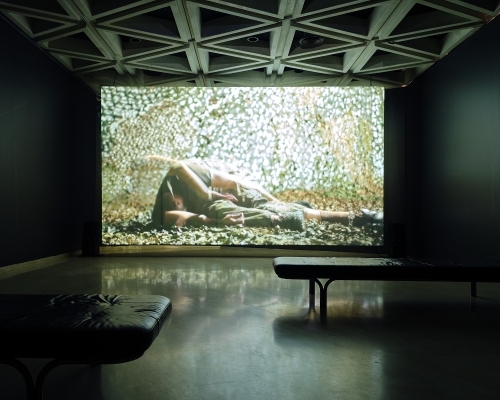
Then in a video work, Abattoir Shoot (2014), she turned a tender eye on her fellow meat-workers, inviting them, still in their blood-spattered work gear, to have their portraits taken in a studio photo shoot. That same tenderness, this time towards animals, was put under stress in Cow Sleep (2012), originally exhibited in a three-channel video projection. In a tranquil rural setting we see heavily sedated cows, bred for the meat industry, slowly succumb to their drugged slumber. There is nothing of a confronting animal liberation video here; rather, it executes a quiet ambush: impossible not to be nauseated by the essential violence of these moments of ‘humane’ treatment.

The artist takes similar strategies into her work on Pine Gap: the performative seduction, the colour, though ranging from lurid to sickly rather than gorgeous, the tenderness, mingled with playful yet razor-sharp humour, all working to sweetly ensnare viewers into a recognition of what we are seeing and therefore of who we are. First though, she had to find a way in, and that surely had to be via Pine Gap’s humans, some 800 of them, half from the US, half Australian, living in her town — somebody’s partner, neighbour, team-mate, gym buddy, member of a school or church community. But how to overcome the local etiquette of never asking a person about their work at the base, let alone their own obligations to secrecy?
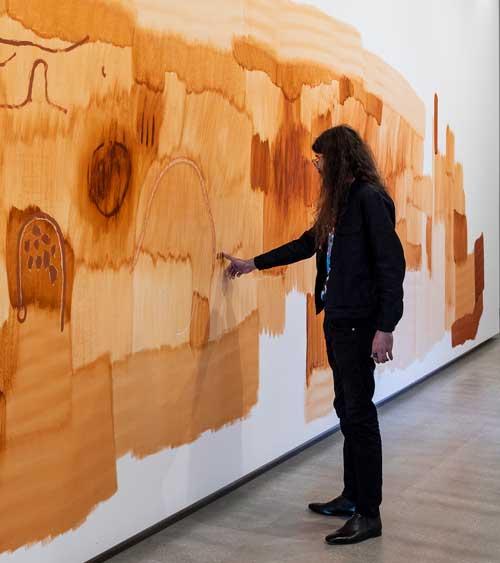
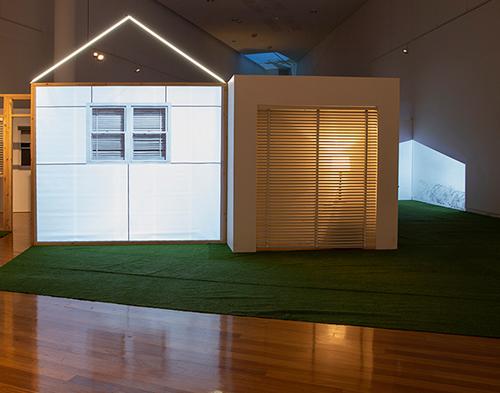
For Project Pine Gap, a process as much as an exhibition, her ingeniously disarming solution was to ask her contacts about the artwork hanging inside the base, a seemingly anodyne enquiry. She would then set about reproducing this work on the basis of their verbal descriptions. Via these simulacra, she would draw viewers into a breach of the base’s intimidating security environment: we would become complicit in acts of seeing inside, forbidden acts.
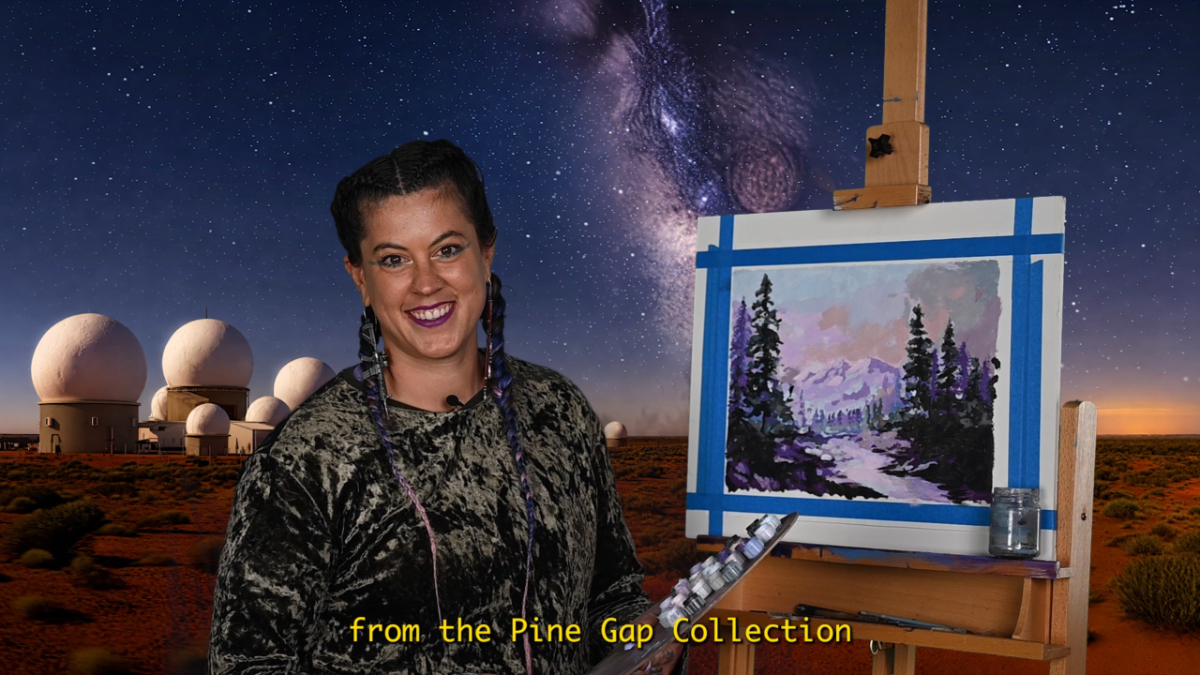
One first-person account was a remarkably detailed description of a ‘pretty average’ and ‘boring’ landscape painting, featuring pine trees (of the northern hemisphere variety, not the native pines that have given Pine Gap its English name), a stream, a mountain, a moonlit sky. Mattingley began to reproduce the image in soft hues veering towards the sickly. Playfully, she also fed the verbal description to AI and asked it to produce an image. She recognised the result’s proximity to the kitsch art of Bob Ross, who made his name in the 1980s as a television painting instructor. Mattingley bought in to the approach, producing several versions of the described painting, and working one up in her own instructional video, Paint by Numbers, styling herself as a glittering 21st century Princess Leia, with blue braids and machine-gun earrings, holding a palette in tattooed fingers reading, ‘BANG, BANG’. She framed the different versions, all titled Pine Gap Artifact, 1.4 to 1.6, in elaborate resin mock-ups of gilded frames in the same sickly hues as the paintings, claiming attention and suggesting value. At the same time, she undercut the move, allowing the frames’ symmetry to slide, their intricacy to become lumpy. All this works to insistently bring the viewer into the act of seeing what is essentially an illicit image.
Its status as such needs to be understood in the context of the extraordinary lengths to which authorities in both the US and Australia will go to keep Pine Gap strictly off limits. In 2016, for example, Christian pacifists, wanting to draw attention to Pine Gap’s role in covert drone assassinations around the world, climbed over the outer perimeter fence and reached the top of a hill overlooking the base while playing music and praying. For this mild act of protest, they were tried in the Supreme Court under harsh security legislation, facing potential penalties of up to seven years in gaol. (Indeed, the Crown called for real gaol time to be served, though the more sober-minded judge deemed fines were sufficient).
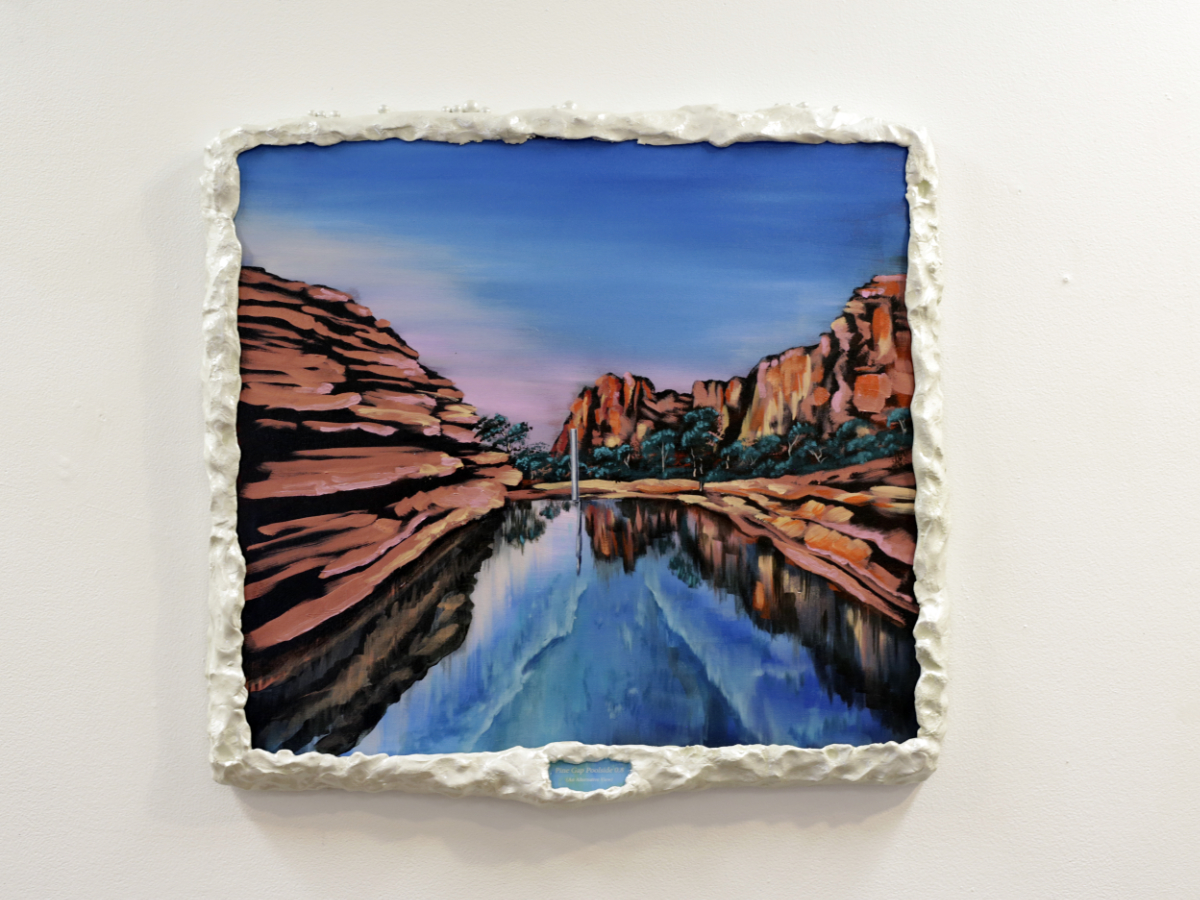
Other first-person accounts—all of them understandably anonymous—described the recreation facilities at the base, the kind of food served in the cafeteria, and even a typed copy of a poem, framed and hung on a wall. Mattingley also fed these to AI chatbots, which yielded further works on the wall as well as a compelling and cleverly constructed video, AI Conversations, deftly scored by sound artist Zoë Barry.
The video shows chatbots meeting direct questions about the base with a wall of refusal, even though Mattingley’s questions remain essentially neutral. This obfuscation is despite all of the factual information that is in the public domain about the base — Google Earth views to begin with, as well as academic research by the likes of Professors Des Ball and Richard Tanter, the leaks by Edward Snowden made accessible to the Australian public by (former ABC) journalist Peter Cronau, the work of other journalists and authors, the US Congressional record and the questions pursued in the Australian parliament.
Thus, the interested public know some basic facts, as in the base has staff accommodation and a swimming pool, and its personnel do not wear uniforms. They also understand the more grim reality that the activities carried out by US and Australian staff at Pine Gap, as part of the Five Eyes network, are directly implicated in US and allies’ military actions around the world, the most deeply concerning at the moment being Israel’s annihilation of Gaza and its people, made possible by the supply of American intelligence as well as its bombs.
The AI tools likewise must know all this, but they absurdly deny it. In censoring themselves, they give Mattingley some of her best material, with Pine Gap Poolside 0.8 (An Alternative View) (2025), a standout, showing AI’s ludicrous response to her request for an image of the Pine Gap pool.
Her exchanges with the bots seeking the answers to simple facts show them doing their corporate masters’ bidding — servile acts of anticipatory compliance with the US and Australian defence establishments. Setting them creative tasks intriguingly gets different results, much more on point. One task is to create the formula for a scent—inherently an invisible presence— inspired by the base, and a commercial campaign to go with it. The artist then collaborated with her mother, Diane Mattingley, a professional perfumer, to make and package the scent as part of the show. Another task for the AI is to write a poem, relevant to the base, inspired by the half-remembered framed poem hanging on a wall there, which the bot deduces is ‘In Flanders Fields’ written in 1915 by poet, soldier and surgeon John McCrae. Mattingley reproduces the interview transcript in typescript on gridded paper, the bot’s analysis of it and the bot’s poem, all of them framed in her ‘olde-style’ mock-ups.
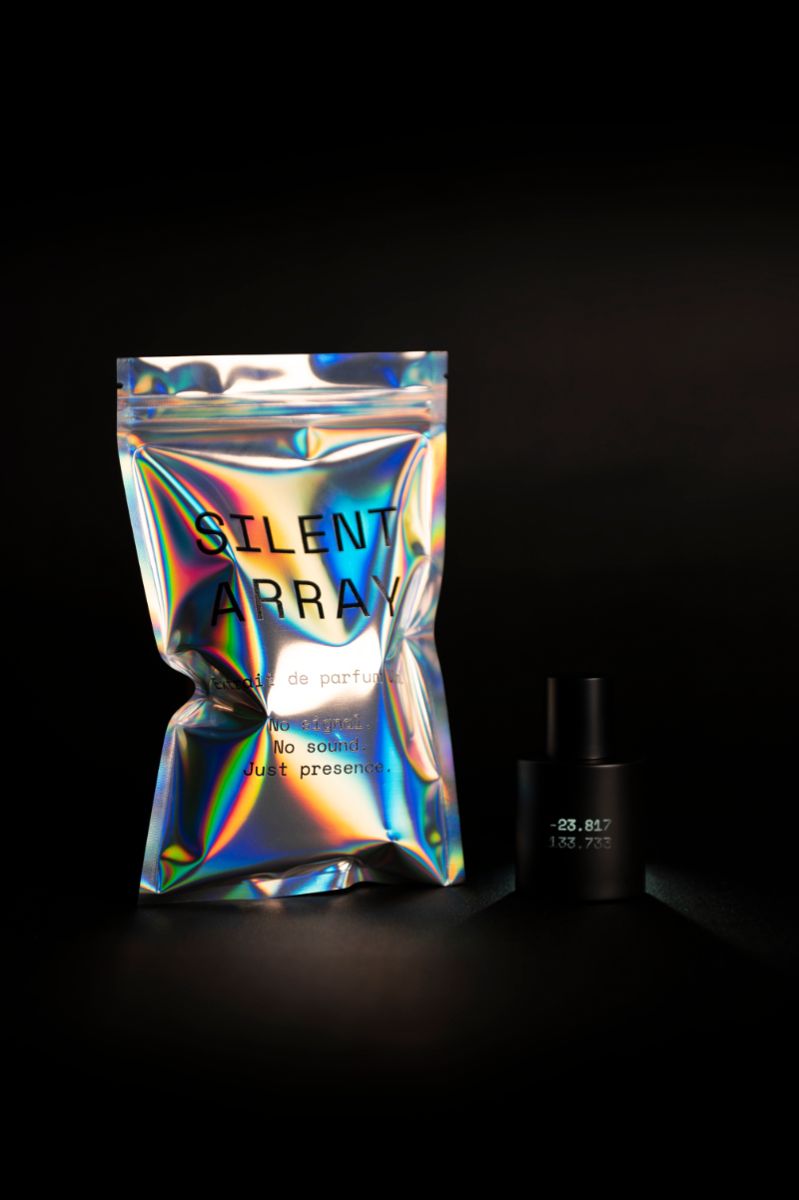
AI’s completion of these tasks is revealingly pertinent to the base’s presence in this remote corner of Australia, as well as to its surveillance and military activities. For the scent it proposes a concept of ‘sterile precision’ meeting ‘desert mystique.’ It suggests naming the fragrance Silent Array —‘You never see it. You never hear it. But it’s always watching,’— and packaging it in a black flaçon inscribed only with the base’s geographical coordinates. As for the poem, it offers the opinion that, given the ‘highly secretive and restricted’ nature of the base’s activities, it is ‘extremely unlikely that any artwork or poetry would be located within the facility itself.’ In writing the poem though it loosened up: McCrae’s ‘crosses, row by row’ become Pine Gap’s ‘dishes, aligned and numb’; McCrae’s ‘Dead’ become ‘the watchers’; McCrae’s ‘torch’, the ‘data’, his ‘poppies’, ‘signals’.
So how did Mattingley get away with her process? She was formally made aware of its risk and her potential infraction of Section 39 of the Intelligence Services Act: that a person commits an offence if they ‘communicate any information acquired or prepared by or on behalf of [the Joint Defence Facility Pine Gap] in connection with its functions, or relates to the performance by [JDFPG] of its functions.’ Penalty: Imprisonment for ten years. In her speech prepared for the no-show audience of the vernissage she held exclusively for Pine Gap workers, she considered this advice:
The key word here for me is ‘function’. If the art in Pine Gap has no function, then we [artist and audience] are innocent. But if the art is considered a part of Pine Gap’s function, and I am going to gaol, then I am desperate to know more. What is the intended function of the art in Pine Gap? Who gets to choose what goes where and why? For what purpose? I have more questions than I do answers.
In not acting against Mattingley, authorities have obviously assumed that art has no function — or at least no function of consequence. Mattingley sees it differently. In the act of adorning a space like Pine Gap we tell a reassuring story about ourselves, about our human connection to beauty and reflection in spite of the work we do — such as contributing to the American war machine, with its life and death consequences for people in faraway lands. She is touched by this while also recognising its insidious implications.
Mattingley is not an activist and at a glance a viewer seeking political certainties might wonder if this show is simply playing for laughs or even acting as a homage. Mattingley’s transparency of process, and its acuity, lead us to a far more interesting and complicated consideration of the base’s significance and our relationship with it.