As Walter Benjamin put it, 'that things are "status quo" is the catastrophe'.[1] The temperature rises fractionally. The ocean acquires another millimetre. Another species numbers one fewer. Another transaction crosses the planet. Each increment is negligible enough to be absorbed into the continuity of things. The world remains recognisably the world.
The peculiar violence of continuity is that transformation can occur without appearing to interrupt it. There is always another morning on which things appear sufficiently like yesterday, until they do not. But even this until is suspect. It retrospectively grants a particular moment the status of rupture: the fire, the flood, the disappearance, the crash. More difficult is the catastrophe whose violence consists in resembling the continuity it transforms. We mistake the moment at which transformation becomes sensible for the moment at which it began: we encounter consequences and call them events. There is, in this sense, a lateness internal to perception.
That lateness persists even as images of catastrophe arrive ever closer to its occurrence. An unattributed, widely circulated tweet describes climate change as ‘a series of disasters viewed through phones with footage that gets closer and closer to where you live until you're the one filming it.’[2] Its force lies in this almost imperceptible change of position. At first, catastrophe belongs to the image. Then the image comes from somewhere closer, until the screen changes sides and you are the one filming it. The catastrophe crosses no discernible threshold because the threshold was perceptual rather than spatial.
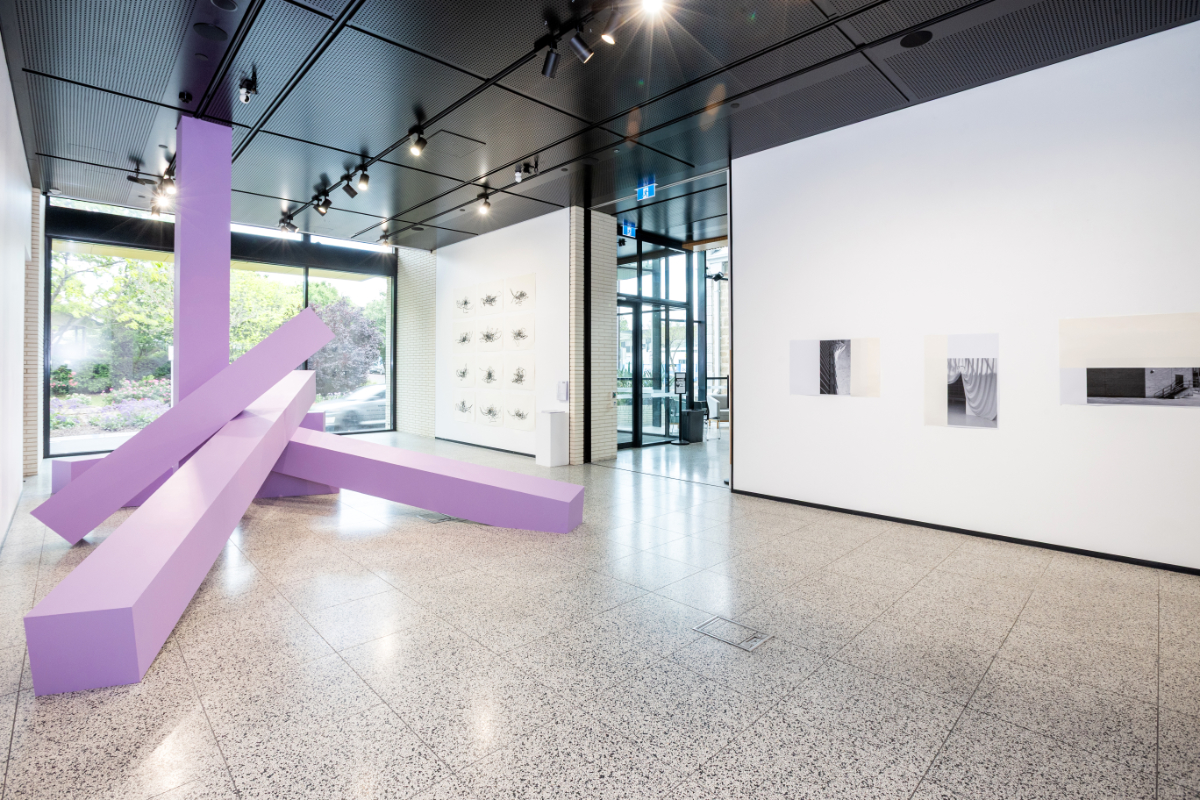
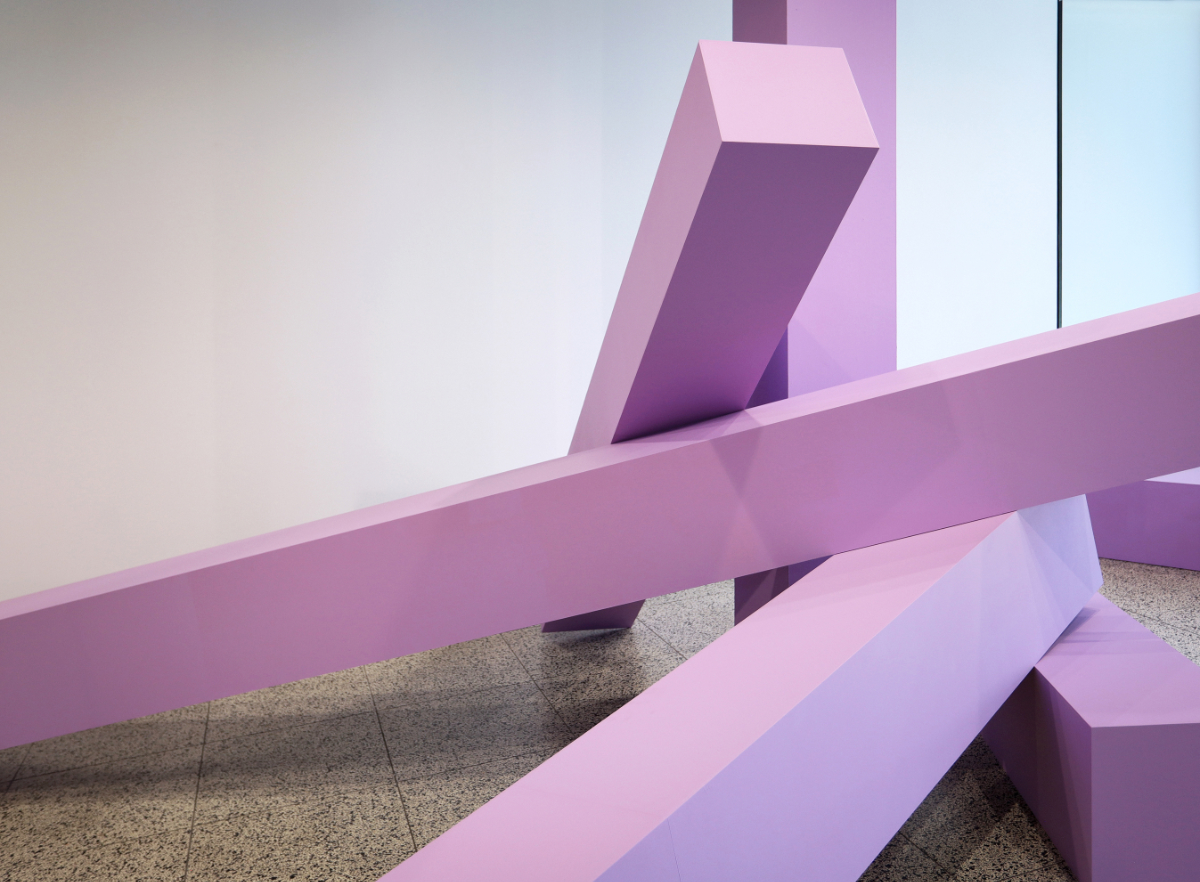
Somewhere within these contradictions, Tom Borgas’s Hyperobject takes shape, the latest in a decade of his attempts to give form to what resists being seen whole.
There is something almost unreasonable about the scale of the object Borgas presents at Newmarch Gallery. It is singular, materially present, yet refuses the easy coincidence of presence with apprehension. Rectilinear vectors appear to have exploded outward, extending across (and through) the room and filling its volume with lines as large as bodies. One is the gallery’s own column, cleverly absorbed into the sculpture. Painted a synthetic, almost-acid lavender, these vectors are at once graphic and insistently material: something like a drawing enlarged until its lines cease to describe space and begin to occupy it. To stand before it is not necessarily to possess it visually. The body must negotiate it: approach, withdraw, look across, look up, move around. Spinoza's seventeenth-century uncertainty of what a body can do acquires a strangely literal dimension: apprehension belongs as much to these movements as to sight.[3] The object is there, but its being-there does not guarantee its availability.
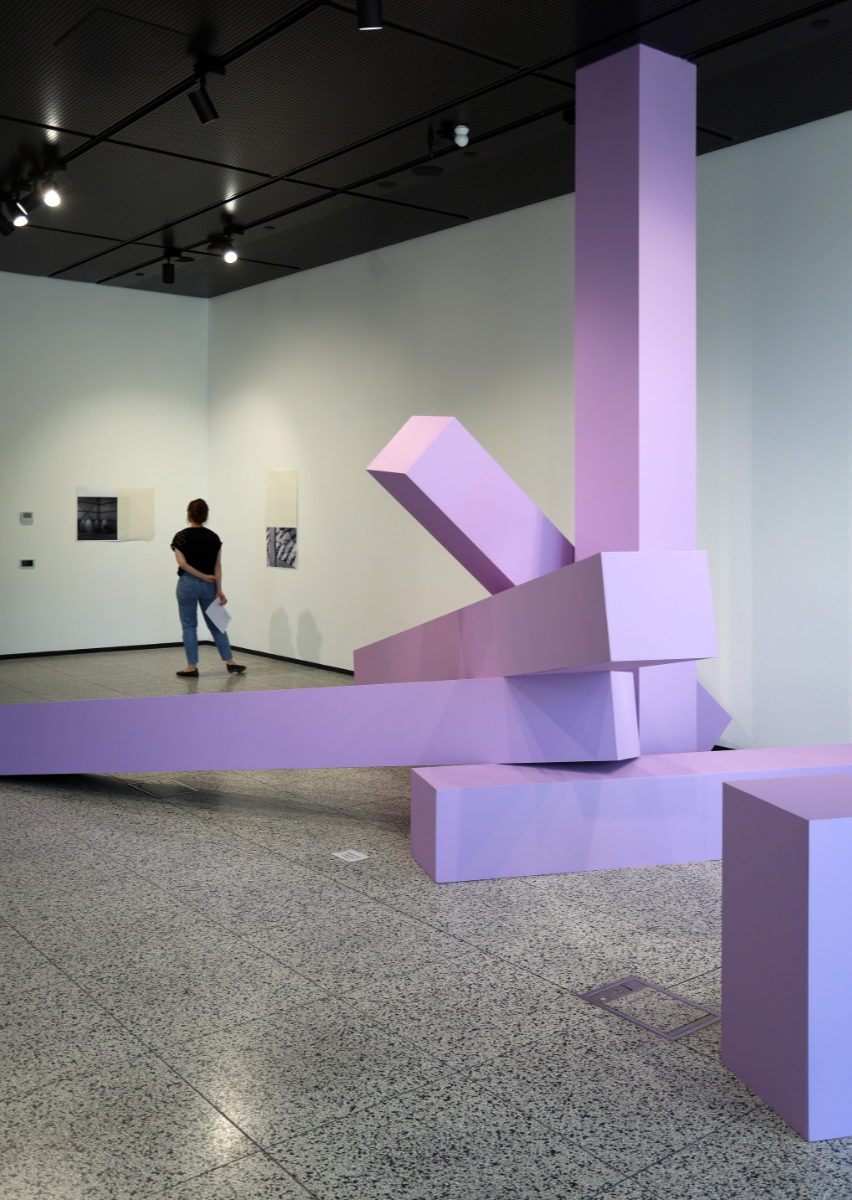
Representation ordinarily promises the opposite. It gives distance to what is too close, reduces what is too large, and arrests what is moving. Representation makes the world available by putting it somewhere else. The map puts territory into the hand; the photograph gives an edge to the visual field. Borgas reverses something of this movement. One moves backwards to see more of the object and encounters again the desire for a position from which the whole might become available. The closer one stands, the more materially present it becomes and the less visually available it is. What if some things remain imperceptible precisely because we are too thoroughly inside them?
This is the strange intimacy of what contemporary philosopher Timothy Morton calls a hyperobject, a thing for which spatial and temporal enormity leaves no exterior position available from where to see the whole. Its very enormity may be experienced as intimacy: climate as weather, computation as interface, and capital as price. We encounter fragments and mistake their partiality for distance.
Around Borgas’ object are sketches. Their smallness matters: the hand can hold what the body cannot. The object that disturbed the possibility of a single view returns as image, or proposition, or fragment. But the sketches do not simply explain the larger work, nor does the larger work complete them. Something passes between them without becoming identical to either.
Perhaps this is the difficulty of scale: not that the whole is invisible, but that seeing and being inside it cannot quite be made to coincide. The closer the world comes, the more urgently we produce an image through which to put it at a distance again. Borgas' object produces something of this unease. It is emphatically here; however, the attempt to apprehend it continually produces another elsewhere: another view, another sketch, another position from which it might finally cohere. And yet, it never quite does.
Perhaps the distance necessary to see the world is also the distance at which we begin to arrive late to it. By the time the image coheres, something has already changed. Another view becomes necessary, then another. The difficulty is not simply that the world exceeds our representations of it, but that it does not wait for them.
Meanwhile, the world continues.