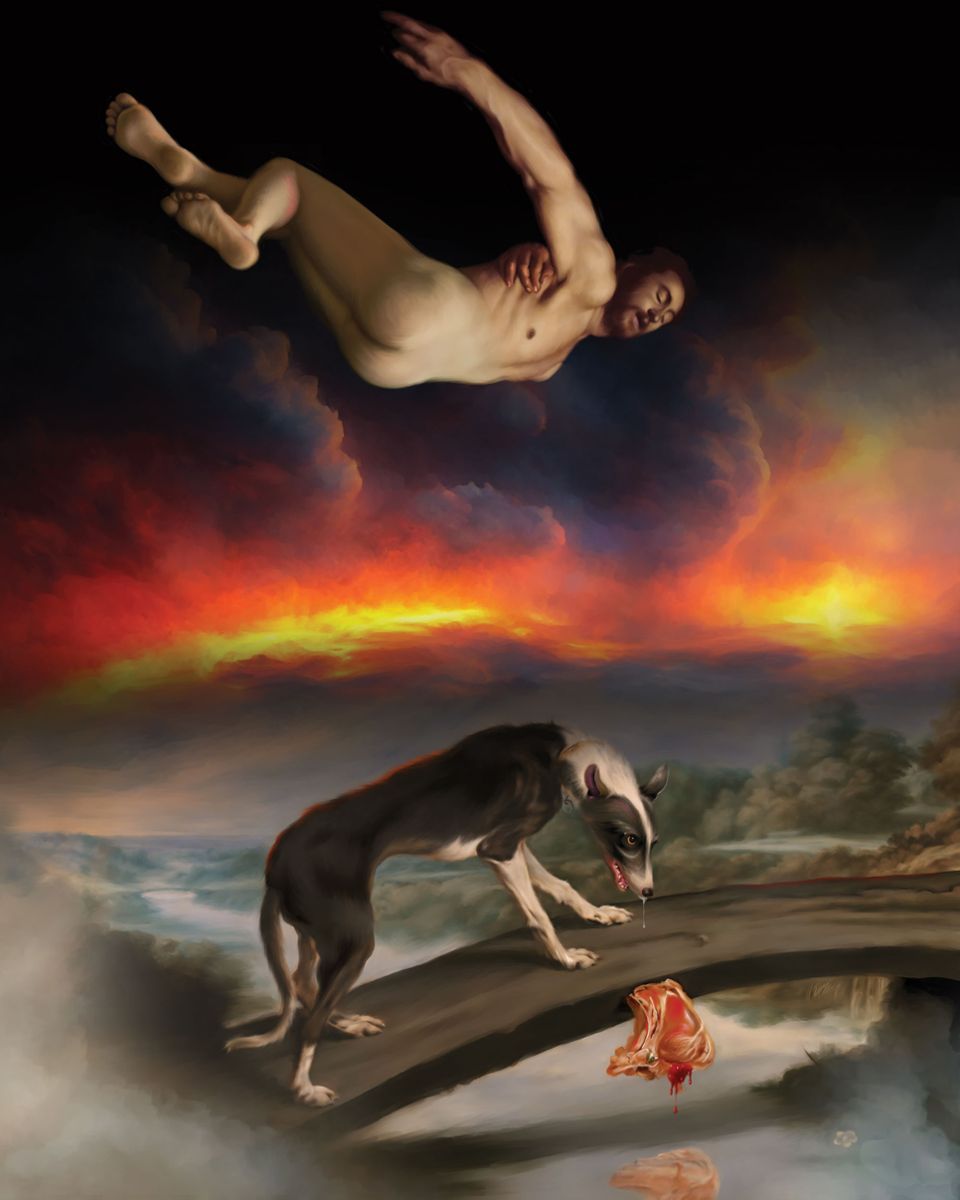
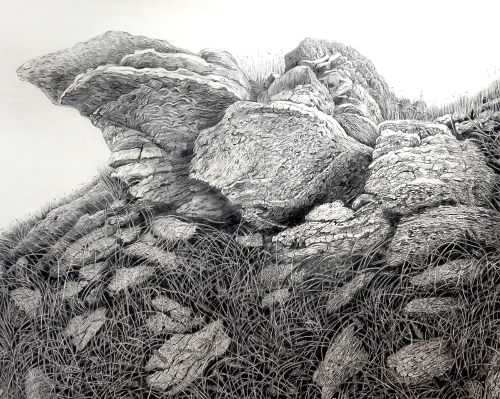
Therese Ritchie, Crisis capitalism, 2026, digital print on cotton rag, 75 x 60cm. Courtesy the artist.
Timothy Parish
MAN O MANOSPHERE
Gallery Two Six
19 – 26 July 2026
In the floating platforms of the mirror world, a pale skinned boy folds himself into the algorithm's idea of beauty. He is suspended in the Caravaggio darkness. Frozen into poised inaction. Deer-eyed. Headlit. Looksmaxxing his own extinction. Caught between the monoliths of industrial attention his body flails, soft and biological, trapped in doomscroll's unblinking gaze. A macho posture mistaken for grace.
Somewhere, out of the frame, a child is teaching itself the binary grammar of machine languages. Elsewhere, a needle finds a peptide vein, testosterone poured in like scripture. Manosphere dogma snapping at the heel like a dog bred for sports betting, always chasing the mechanical bait. Fossil flame flickers on the horizon, an altar to a god with ADHD. Chiaroscuro without an angel to gift perspective, framed by server farms. Predators sniffing out the next prey in the chatroom with the patience of pimp philosophy.
Are we all meat in the meta-crisis now, watching ourselves be farmed in Narcissus' oil-black meatworks? Therese Ritchie does not aim to diagnose the dis-ease or offer any vaccine. She merely holds up the mirror and lets the void look back: patient, unblinking, symbolic.
And you’re probably already scrolling past, deeper into the infinite void.
Forever.
Timothy Parish is a Darwin-based artist, writer and documentary filmmaker. He is the Creative Director of Undergrowth Productions and Editor-In-Chief of Wild North Comics.
Jalak Graphics and Chips Mackinolty, Nyuntu anangu maruku ngurangka ngaranyi [You are on Aboriginal land], 1985, screen print, edition 2/44, 97 x 114cm, printed by Jalak Graphics/Redback Graphix. Courtesy of Library & Archives NT.
Cj Fraser-Bell
Paste 'Em Up — Territory Poster Art from the 70s-90s Library & Archives NT in Darwin 29 July 2026 until early 2027
It became a game in those early days, Therese Ritchie recounts, between herself and NT screen-printing progenitor Chips Mackinolty. Any colour they would see in the wild, what percentage of cyan is that? How much magenta and yellow to get this skin tone correct? A way to see the world.
Paste 'Em Up — Territory Poster Art from the 70's-90's is exactly what it says on the... well, on the poster. This retrospective curated by Charlie Ward for Library & Archives NT lovingly spotlights the Territory's rich poster art roots, displaying originals and reproductions from the early days of the land rights movement together with swamp-punk gigs, public health messaging, art-deco play-bills, and a sprinkling of miscellaneous hand-printing ephemera: a cacophony of visual messaging from before the digital revolution changed poster art forever.
Perhaps the standout is the freshly commissioned video interviews with the people who shaped the NT's visual language for decades. This beautifully shot oral and visual history features key artists, including Mackinolty, Ritchie, Franck Gohier, Todd Williams, and their contemporaries in an homage that feels particularly timely in the age of AI marketing. These artists trained generations in the print techniques and paste-up politics that still shape much of the NT arts landscape today.
Cj is an artist, student, and activist living on Larrakia Country, Darwin.
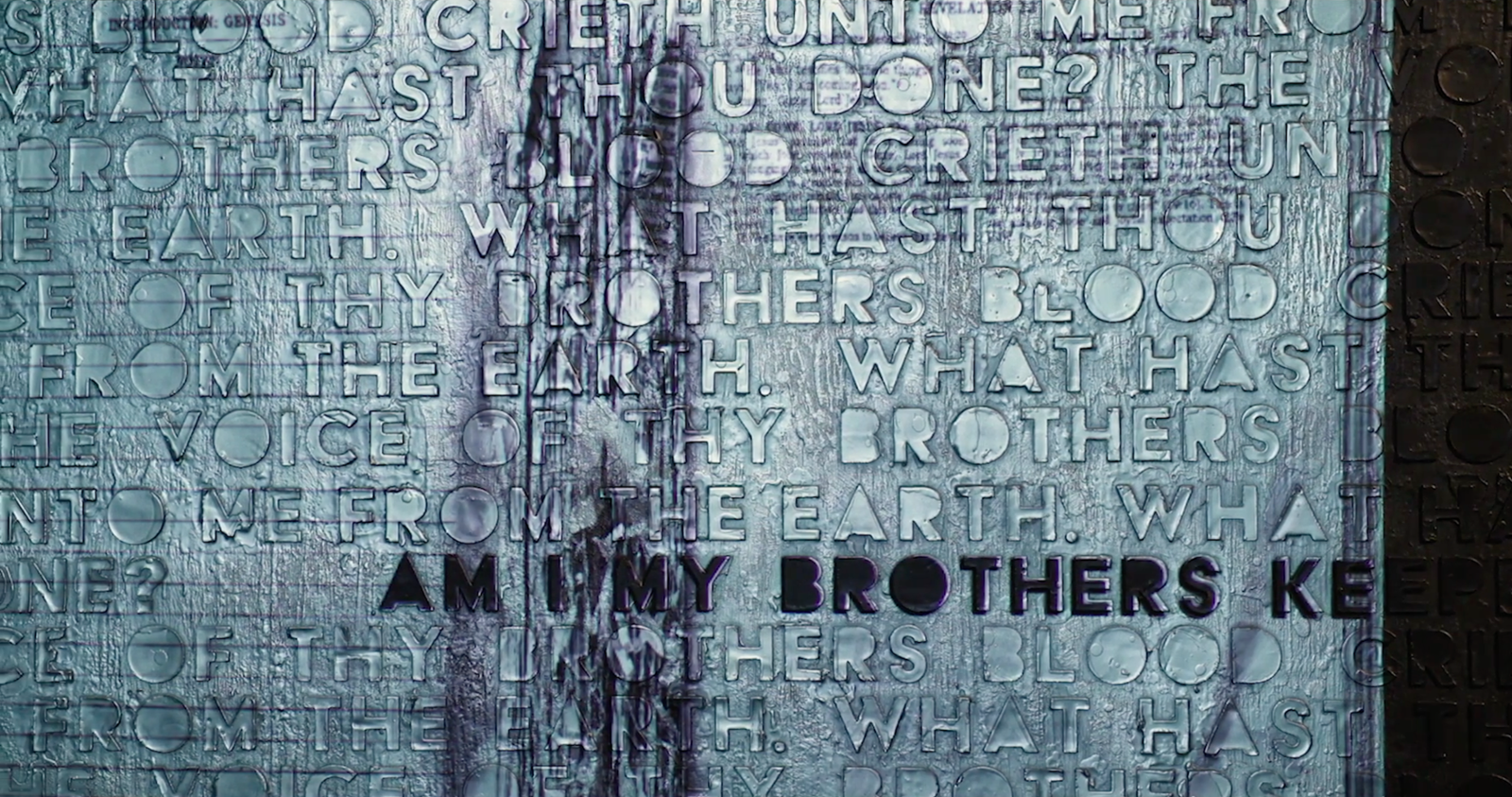
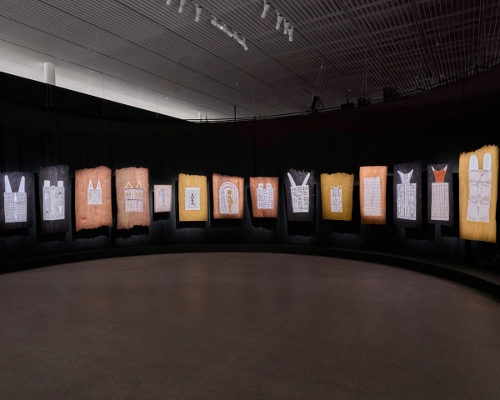
Matthew van Roden, Am I my Brother’s Keeper?, 2026, detail/installation view, Meeting the Text Halfway, Charles Darwin University.
Tom Lynch
Meeting the Text Halfway
Charles Darwin University
21 July 2026
I first saw Matthew van Roden's artworks in 2018 when the video My Body is a Text led their show at NCCA, Parap. The composition was striking, staging mobile text as the matrix which van Roden's filmed body overwrote as an aleatory figure of courage and vulnerability, accompanied by oratorical declarations: ‘my body is a text / my body is a context’.
Van Roden's recent show Meeting the Text Halfway at Charles Darwin University proves the continued excellence of their maturing practice.
Conceptualism questions if the encounter with art corresponds to thought, as readymades force their recognition as art, can we relinquish the traditional medium? Van Roden enlivens this much-overwritten question, sparking thought with its provocations while unfolding an ambiguous and layered material mediation.
Ecce Homo (behold the homo) (2026) is a large-scale video work that goes straight on the attack: ‘I AM A BIBLE BOTHERER’, high-impact capitals glower. ‘GIVE ME MY SIN’. A counter-point appears as wax-formed letters melt away amid temporal variations of text and mood, side-eyeing some tender suspension of judgement.
Re/membering Babel (2026) is a series of four Roman-arched risograph prints also layered in wax. Together they deliver a cathedral ambience that braces formative hours between the promise of Heaven and the captivity of the Word. Scripture half-occluded by clouds passes over tongues that serve as inadequate windows of the spirit. A thicket of upright digits below could be votive candles, sexual instruments, or blind fingers lifted to God's absent touch.
Tom Lynch is an independent researcher and writer interested in technology, art and work, whose current project is building infrastructure for ethical human–AI organisation.

%5B5%5D.jpg)
 Bisma (2023)_Card.jpg)