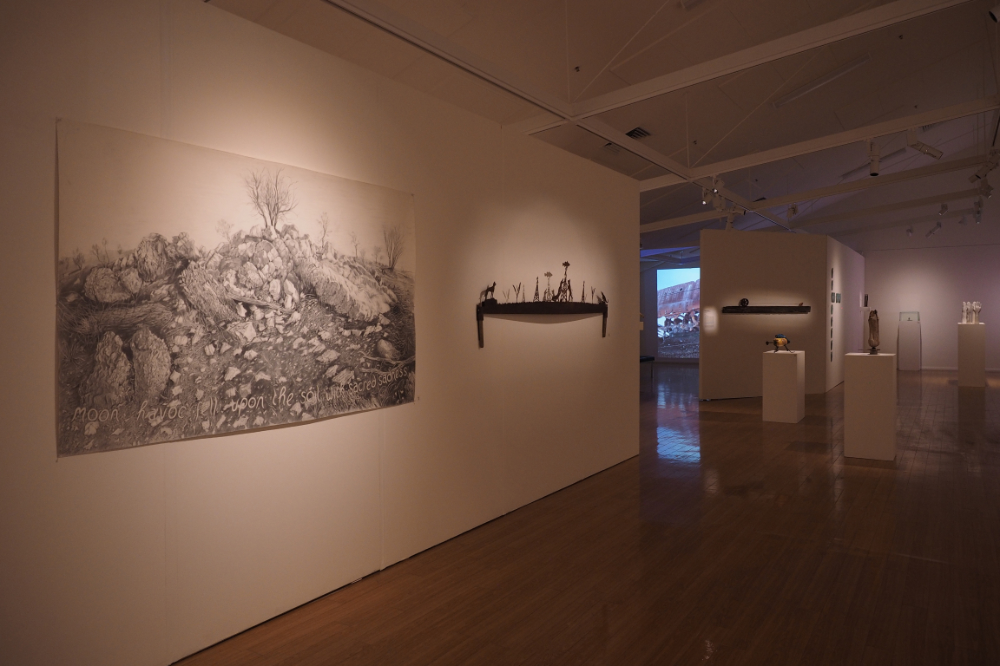
One gallery space, two separate shows by two artists, Pip McManus and Rod Moss, with two very different modes of expression. Eschewing partition, curator Stephen Williamson’s artful installation allows Saw Points and Moon Havoc to meet one another in a sum greater than their already strong parts. Subtly mirroring one another, the titular works of each show are presented side by side on a partition opposite the gallery entrance, an installation that points to the artists’ shared disquiet about the state of the central Australian / Northern Territory environment as well as something common underlying their process: their recognition of the emblematic force of what might be seen as the inanimate objects of their gaze. These ‘objects’ are themselves and they hold a bigger story.
All of Moss’ works in the show are large-scale drawings in graphite — all but one of rocky ridgetops and outcrops in and around Mparntwe Alice Springs, encountered in walks setting out from his front door. The title work takes its name from the poetic fragment inscribed across it: ‘Moon havoc fell upon the soil with sacred sadness.’ Such inscriptions occur in the majority of the drawings, the text integral to their expressive power without being explicatory. The 2023 drawing shows a bright quartz outcrop topping a ridge, with quartz shards scattered across the slope below. At a sacred site some two hundred kilometres away, shown to Moss by longtime Arrernte friends, quartz shards are said to be ‘pieces of the moon.’ Thus, the lunar association of this outcrop and the drawing’s aura of reverence; the rest of the lyric is his own, as is the visioning. Moss is clear that these drawings are not about representing Arrernte ways of seeing Country. Still, they cannot not be influenced by his experience of their Country in his friends’ company, and with this particular drawing he speaks of direct inspiration.
While Moss has always made drawings and paintings of the landscape, for almost four decades narrative paintings in which these Arrernte friends figured were central to his work, framing his first two volumes of memoir. The first of these, The Hard Light of Day, won the Prime Minister’s award for non-fiction in 2011, bringing him national attention as an artist and writer. His friends and subjects remain powerfully present in his day to day life as well as in his mind, as his commentaries on the drawings reveal, but the stream of narrative work has exhausted itself, and with it, thus far, paint and colour. He always used graphite for his Arrernte friends’ skin, richly coloured acrylic paint for everything else – cars, dogs, whitefellas, Country. Something of the intimacy of that graphite skin, burnished by his rubbing fingers, has transferred to the new drawings. They are in no way views or descriptions, but rather encounters: human, this human, to rock, these rocks.
It is the symmetrical rise of the quartz ridgetop that is gently mirrored in the slight arc and symmetrical organisation of McManus’s Saw Points (2025). Formerly a ceramist of refined skill, McManus turned away from the medium around seventeen years ago for largely for environmental reasons: the energy-intensive firing process and the fact that the fired objects, cherished or discarded, remain forever. In her three-dimensional works she now frequently uses found objects as the starting point. The rusted two-man crosscut saw that is central to Saw Points had been in her possession for some forty years, waiting for its moment. This arrived when she recognised its possibilities as the foundation for a darkly humorous, subversive coat of arms for the Northern Territory. From either end of its jagged expanse (almost two metres wide) she marches figures of laser-cut steel towards the centre — the Territory’s apex predators, the dingo and the crocodile, along with the recent invaders, buffel grass, cane toads and fracking towers, the lot crested by a barramundi. The saw holds this motley crew together, structuring their story. Instrument of land-clearing, primal act of the European invasion, it is a colonial emblem par excellence. It brings the reach of that history into the work — the ‘sore points’ of the European response to the place, from the start and ongoing, the ambivalent fascination, the fear and ignorance, the commodification and ruthlessness.
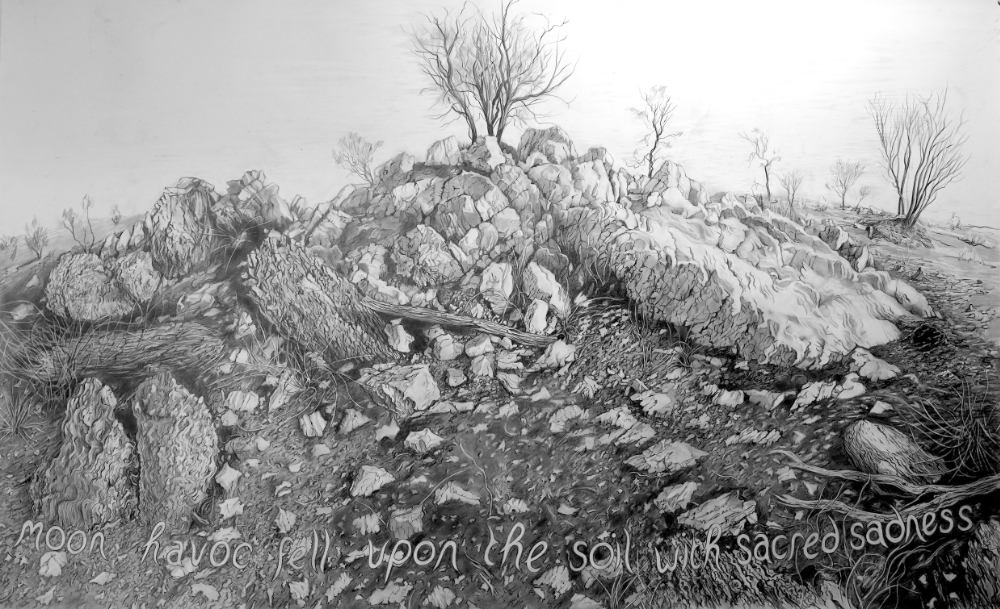
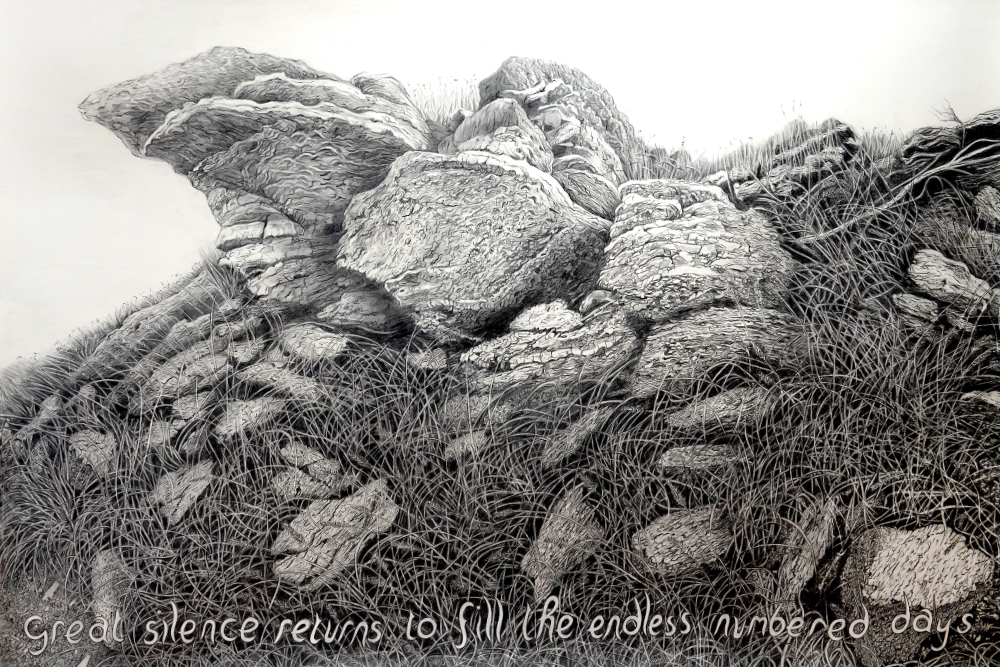
McManus’s imagery is explicit in its political intention without ever being stridently polemical. Moss is explicit about his environmental concerns in the text of his artist’s book published to coincide with the exhibition. His drawings are more mysterious but gather their force collectively. The viewer, moving from one to the next, seventeen in all, cannot ignore their unsettling intensity. The rock formations, drawn with loving, at times obsessive attention to detail, are pushed to the fore, looming and creaturely, alive with urgency. Vegetation is sparse, small trees mostly leafless, jutting up from the rocks like skeletal fingers. Only the buffel grass flourishes. This is not the case in Moon havoc fell upon the soil with sacred sadness. The quartz slope doesn’t favour the grass, and it is one of the earlier drawings of this show. Increasingly, in later drawings, densely clumped buffel occupies every crevice, licking at the rocks, like the flames it holds in its future. Scientists now recognise that the grass has wrought an ecological change on the landscape and, boosted by the warming climate, it is not finished yet. With the repeated wildfires it fuels, destroying fire-sensitive species, it threatens to become a monoculture. This environmental catastrophe, reaching into the arid interiors of bordering states, is not yet widely known nationally, but it weighs heavily on the minds of many in the Centre. Viewers bring, or may not bring, this knowledge to the drawings, but they cannot escape their gravity. Inquiry soon leads here: the rocks will endure, but what else? And who will be able, or want, to live in that world? Its dystopia is evoked in the title poem of the most recent drawing, rocks like a gaping mouth against a blank sky: ‘Great silence returns to fill the endless numbered days.’
In the most unrelenting of the drawings, it is as if Moss is prefiguring the picked bones of the Earth. Love has become grief. Indeed, the works in this exhibition, with the exception of one, came in the wake of personal grief, following the sudden death of his younger brother. This death inhabits the drawing Call My Rippled Self. I Will Arise (2022). It shows a place among other places high in the hills not far from Moss’ home, passed on many occasions but on this day made transcendent by his loss. He catches it in a moment full of movement and light, and draws it with the lightest of touch as rocks, trees, grasses reach up into a soft sky. The title, scribed into the drawing, is preceded by these lines: ‘Skipping stones you named each ripple, mine amongst them…’ Naming ripples — it is a good metaphor for what Moss achieves in these virtuosic drawings, matching his intensity of vision and feeling with each stroke of graphite, each touch of his fingers.
This mental image leads me to the major work of McManus’s show. A video of almost eleven minutes’ duration on an unceasing loop, its glimmer of water under a pale sky beckons from the back of the gallery. This installation acts as a release valve for the intensity of the experience of Moss’ drawings, although the most proximate of his works, First Laughter, Then the Whispering Across Uncertain Sands (Wigley Gorge) (2022), is the most light-filled and spacious, the only drawing in his show to open up onto an extensive site, the only one to depict water. A subtle curatorial segue by Williamson.
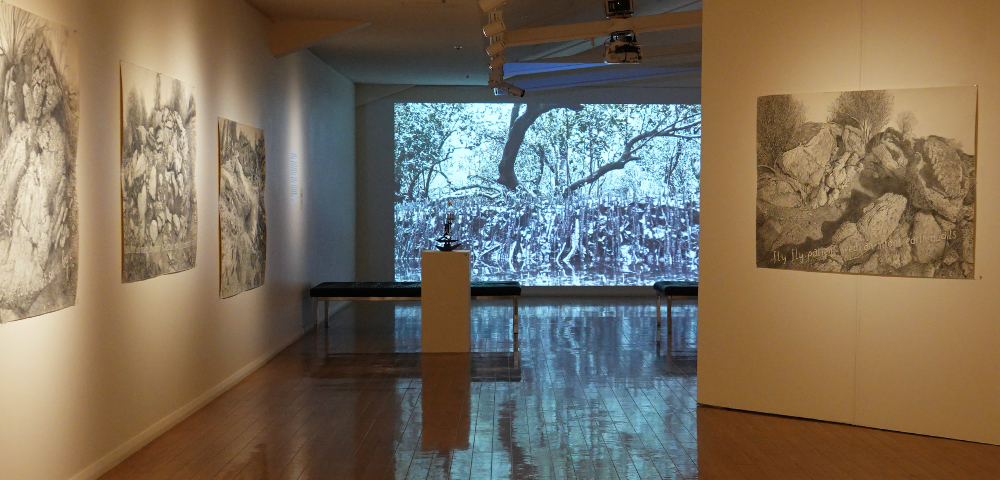
McManus’ video is titled Place of sleep (2024). About halfway through we learn, via slowly unfolding caption, that this is a translation of the Kaurna name of the place, Yarta Puulti. In English it is known as Port Adelaide and, whether or not we recognise it, we have been immediately introduced to the sense of place that name conveys via the hulking rusted bones of a wrecked ship, half protruding from the lapping water, and by the signs, glimpsed in the distance, and sounds of a working industrial port. McManus’s camera seems to swim right up close to the wreck, creaking and groaning as it heaves in the water. Her proximity and fascination with the texture of the surface are akin to Moss’, its roughness heightened in this first passage by draining the image of some of its detail and colour.
Falling across the screen are scintillations of light, imparting a sense of the slightly strange to the scene. Then we hear their pick, picking on the water. Rain. It passes as we pass into the rejuvenated mangroves that line this part of the shore. At first, the bleaching of the image continues, as if we are in some archaic world, making a link between industrialisation and the damage done over its course to mangrove swamps around the country. We take our time, gliding along the banks, a dense weave of mud and exposed roots, under the overhanging branches, deeper and deeper into the labyrinth. As we return to the wreck, colour and detail return to the image, the wreck even more intensely looming, in the here and now, the camera almost caressing its flaking skin of rust and paint, its boil-like eruptions, its curves and cavities. And back now to the mangrove, sun on its bright green foliage and warm muddy banks reflected in the water, the hum of insects, and a long-legged, long-beaked bird, looking about as it saunters along before finally lifting into flight. A caption tells us that this is a place where migratory birds take their rest overnight — their place of sleep.
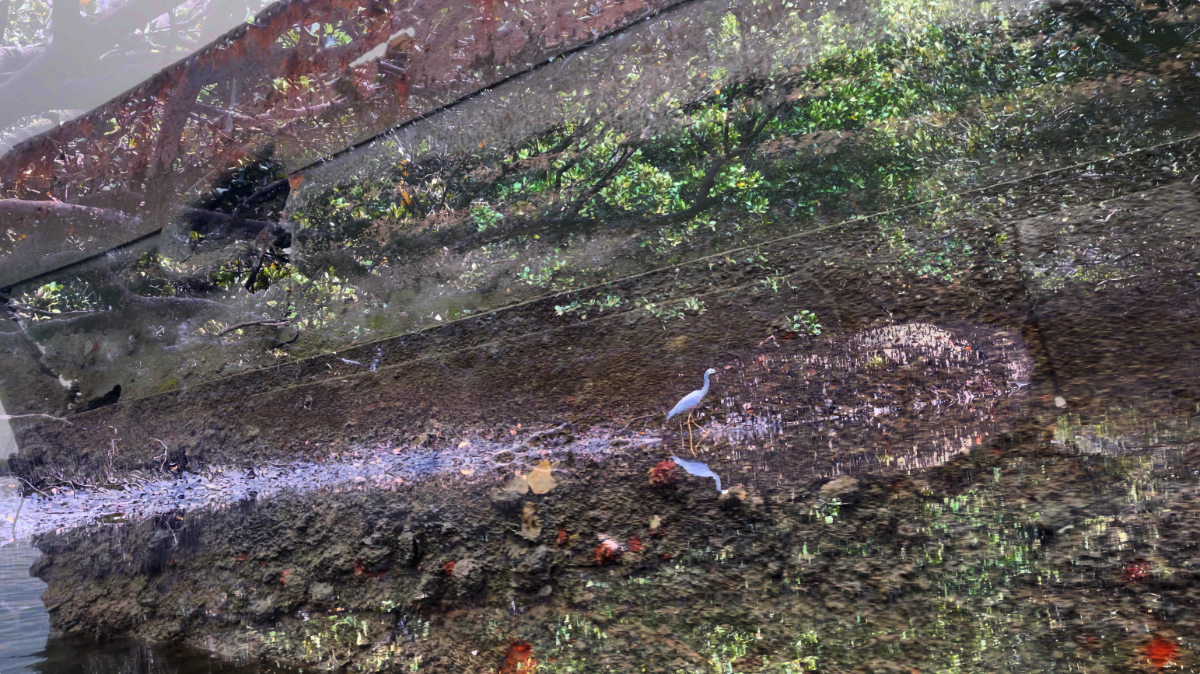
This beautiful, immersive work shows McManus working with ever greater fluency in video, particularly in her use of the camera. From the start, when she turned to video in her transition away from clay, she strove for the fine balance of duration with visual attention. In Place of sleep, time as much as image is her medium. The imagery passes before our eyes fittingly dreamlike, to the rising and falling rhythm of lapping water, of groans and strokes and breath and heartbeat.
McManus pulls us from one powerfully evocative rusted emblem to another, from the saw to the wrecked ship. The link pushed me to see in the ship another emblem of colonisation, with its wreckage suggesting that not everything is going the colonisers’ way, foundering upon the limited, even false assumptions of economic progress. The mangrove swamp has a contrasting paradisical quality, but seeing in it the possibility of a return to the untouched pre-colonial past would be illusory. More helpful and hopeful is to take our cue from that past, encapsulated by the Kaurna name for this place, and to recognise the possibility of recovery — if we make way for it.
Human history, particularly at this time it seems, does not allow for a lot of hope. Gaza, Sudan, Ukraine, the warming planet and the tolls it is exacting, across hemispheres and across species, with little more than hand-wringing by way of global response — all provide cause for despair. McManus’s travels in the Middle East in her late teens and early thirties, including a year spent in Egypt, take her into this domain in other works in the show, not to despair itself, but to recognising and naming what may well give rise to it.
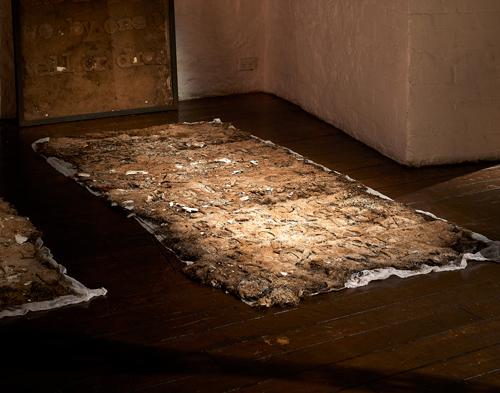
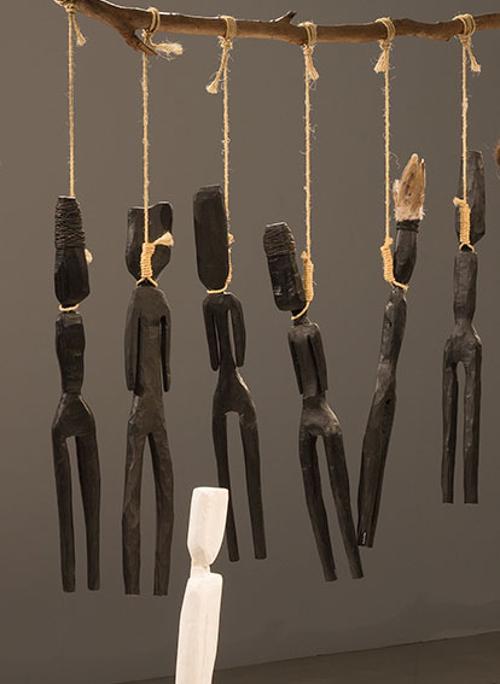
Two potent installations rework earlier versions. One, History (2025), about the blighting of the present by past wrongs, is an edited form of The Poisoned Well, from 1999, which explicitly addressed the history of genocide across the twentieth century. It consisted of one hundred clay tablets in the form of raised hands, incised with plant intaglios and assembled in the shape of an eye, each one representing a year of that bloodied century. History is whittled down to fourteen tablets, as if to express, at just twenty-five years into the new century, our moral exhaustion and political failures. The referenced texts of the original installation, from Anne Michaels’ 1996 Holocaust novel, Fugitive Pieces, remain, inscribed on the hands, and are as devastatingly pertinent as ever: ‘A forest shares a history which each tree remembers even after it has been felled’ and ‘History is the poisoned well seeping into the groundwater.’
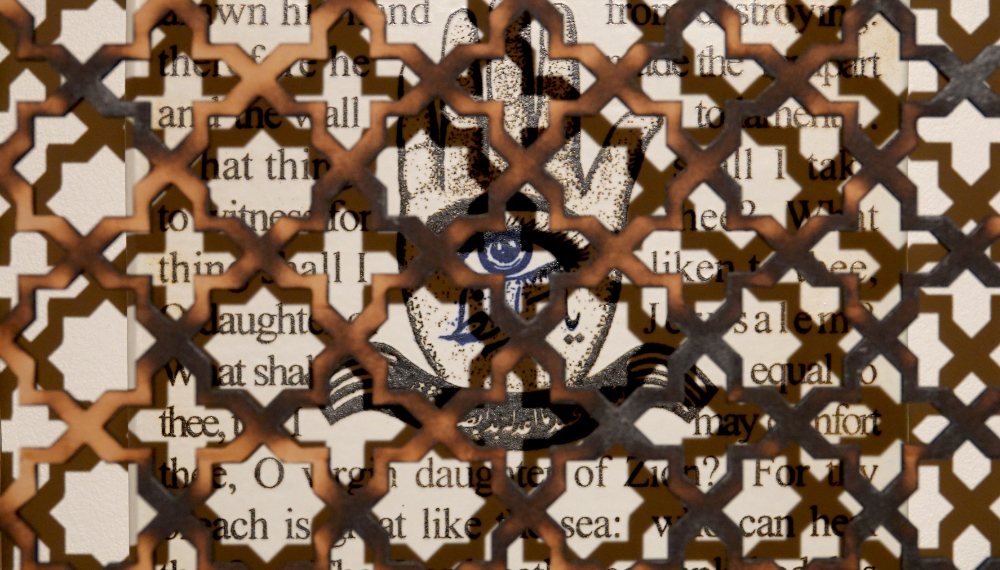
The other installation, Lamentations (2025), reconfigures parts of green line, from 2001, with a striking new element. The earlier work looked specifically at the long, self-devouring violent history of Jerusalem, holy city of the world’s three great monotheistic religions, using texts, symbols and a Byzantine mosaic map printed and inscribed on clay tablets. In Lamentations McManus has added a representation of a mashrabiya, a type of projecting window screen traditionally used in Islamic architecture for passive cooling and enhanced ventilation as well as for privacy. Its latticework of recognisably Islamic design is scarred by fire, and on either side shredded as if by a blast. Linked to but almost obscuring the history-laden clay tablets behind it, it points to the present all-consuming devastation of Gaza and, it would seem, of any hope for Israelis and Palestinians of peaceful co-existence.
McManus’s early ceramic practice was light-hearted and decorative, and a playful stream persists in her small sculptural works, often inspired by animals, with several installed in this show amongst her serious work. For viewers, and for herself as she makes the work, they leaven the experience, although proximity to the serious works can lend them unsuspected depth. Opposite Lamentations a pair of stout-bodied creatures with short legs and lumpy pin-eyed heads belligerently stare each other down. Titled War of the Welds (2025), it laughs at patriarchy’s pig-headed pursuit of violence, a bitter laugh. What consolation then to turn back to Place of sleep or to any of Moss’ drawings, works that, for all their recognition of the dangers we face, are deeply connected to life and its necessary nurture.