I was prompted to write this review for two reasons. I was struck by two different but complementary exhibitions at the 8 Hele in Mparntwe Alice Springs. When seen together, Wangka Walytja – the Life and Times of the Papunya Literature Production Centre and Doris Bush Nungarrayi, Nyunmanu, both exhibitions embodied the narrative urge in Western Desert visuality to such an extent that I was compelled to reconsider the centrality of ‘story’ in desert art. They also tell a ‘story’ of how 8 Hele is reflecting creative developments as they happen at Aboriginal art centres across arid Australia. In an era when most commercial galleries foster a ‘stable’ of known artists, the 8 Hele program is responsive to a greater number of makers, most of whom live in remote communities.
A small purpose-built gallery, 8 Hele is located in the town’s northern industrial area, close to petrol stations, Territory Wrecking and Repairs, Centre Canvas and Upholstery, assorted used-car dealerships, a coffee roastery and the Central Land Council offices. Like the adjacent businesses, the gallery is a critical cog in the engine room of Central Australian enterprise.
Instrumentally, the gallery is co-located (and owned by) Chapman & Bailey, the region’s most prominent framers and art suppliers. It’s a busy location where artists and art centre managers can get professional advice on materials, then saunter next door to pitch a concept for a prospective exhibition. Sometimes, as was the case of Martin Mbitjana Hagan’s recent show, Urrempelang Angampekarl: Born from Ceremony, the artist was able to create his works under a trussed roof outside the gallery, and then store the fragile assemblages - made with native daisies - out of the rain, in advance of the exhibition. So, to employ an appropriately organic metaphor, the gallery and adjacent art suppliers, are enmeshed in the cultural ecology of a region in which Aboriginal art is a key export.
For readers familiar with Northern Territory’s art scene, 8 Hele occupies the building Raft Artspace inhabited from 2010 to 2021, having relocated from Darwin where it was established by Director Dallas Gold in 2001. Raft was famed for its quality shows, the most exciting of which coincided with the influx of cashed up visitors to the Araluen Art Centre’s annual ‘Desert Mob’ festival, becoming an institution attracting the very best work from remote Aboriginal Australia. Today, Azura Nicholls, 8 Hele’s Director, is stitching together a program that builds on Gold’s approach and Raft’s foundations, but which is even more adventurous. Recent exhibitions are notable for the prominence of non-conventional materials. Hagan’s chopped and pigmented native daises, the Mimili Men’s petrol caps and blueprints recovered from abandoned mines by the Tennant Creek Brio, are just a few of the materials employed by artists to reflect the world outside the gallery.
Other exhibitions imagine an alternative to the modern world. A highlight of the classical ‘acrylic on Belgium linen’ style of desert painting was Simon Hogan, Lingka in 2024. Hogan then a 94-year-old Spinifex man, had lived as a hunter gatherer for the first half of his life, and his paintings focussed on a single site of ancestral connection in sandy Country north of the Great Australian Bight.
Like the most attentive galleries, 8 Hele's program is reliant on the creative director walking a tightrope, negotiating timelines with an ever-changing, frequently febrile network of art centre managers, while keeping a watchful eye out for novelty and those artists who best express their affinity with ancient traditions. The gallery’s location at the epicentre of a constellation of remote Aboriginal art centres, together with its willingness to embrace works that employ less-polished means of production, serve to differentiate 8 Hele from staid, yet entirely proper big city galleries specialising in First Nations art. You feel like you are seeing new work in a location where the artist is likely to appear, and be able to discuss how, and why they create the work. The space is definitely worth watching.
It is a brave gallery that confidently presents non-commercial exhibitions, even in association with tangentially relevant commercial offerings. The current juxtaposition at 8 Hele of a solo show from the ever-expressive Papunya-based painter Doris Bush Nungurrayi, and a meticulously curated collection of historic illustrations created at the Papunya Literature Production Centre (1978-1990) caught my attention, particularly as I have a long association with the Papunya community. The contrast between Bush’s unfettered brushy gesturalism and the punctilious cartoons, created by young men with Rapidograph pens on small sheets of paper is stark.
Yet, looking beyond surface treatments, it is apparent that the recollection and reconstitution of history is a guiding theme in both exhibitions. The artists’ immediate ancestors, in each instance, were free-living Anangu of the Western Desert. By way of contrast, the artists, who are now elders in their own right, have chosen to remain at an ex-government settlement, far to the east of their traditional country. The historical references are most explicit in Wangka Walytja (literally ‘talk family’, or, in translation ‘family stories’). So, let’s start with this radically condensed but gritty exhibition.[1]
English Literacy is a critical prerequisite to gaining meaningful employment, good stable housing and achieving targeted political influence. From the late 1970s, during the early phase of the ‘self-determination’ policy, it was recognised that bilingual education was the most effective means of attaining functional literacy for children born at communities where Indigenous languages were spoken. At Papunya, bilingual education was delivered in the lingua franca, Pintupi/Luritja, as well as in English. Characterised as ‘two-way’ education the program was embraced as a means by which a coming generation of Anangu could claim their rightful place in Australian society, while maintaining connection with their ancestral culture.
Bilingual education was funded and delivered at Papunya for almost two decades, comparable programs were also rolled out at other communities across the Northern Territory. The cartoon-like readers displayed in Wangka Walytja – the Life and Times of the Papunya Literature Production Centre, provide evidence of the two-way education programs that were central to the concept and practice of self-determination. Despite local support for the program, the principles of two-way education were incrementally eroded, and by 1998, the Northern Territory Education Department withdrew all specific funding for bilingual education. Potential leaders, who had been educated under the bilingual system looked on in despair as decisions made in Darwin trickled down the line.
By the end of the millennium, all that remained of the program was an abandoned archive in an asbestos filled room at the Papunya school. Outside, on the wall adjacent to the school playground, a mural by William Sandy (1944-2023) encoded the operation of the two-way education program. It remains as a mute reminder to those who care to read its message.
Though modest in scale, the exhibition, Wangka Walytja is the endpoint of a fifteen-year effort by a committed intercultural team. The project was initiated by sociologist and art historian Vivien Johnson, and included teacher-linguist, turned academic, Samantha Disbray. A curatorium of Papunya Literature Production Centre alumni, comprising of Charlotte Phillipus Naparrula, Karen McDonald Nangala, Roslyn Dixon Napurrula and Kulata Dennis Nelson Tjakamarra were critical to the process. After an initial assessment, the team sought funding to undertake a ‘significance report’ and rehouse the archive (in excess of 350 titles), plus the contents of sixteen filing cabinets of related materials including original drawings, audio/video tapes and photos. The grunt work done, the curatorial team then approached the National Library of Australia with the concept of a travelling show and associated publication. So, with the backing of the library, the exhibition will be restaged, and the book launched in Canberra in April 2026.
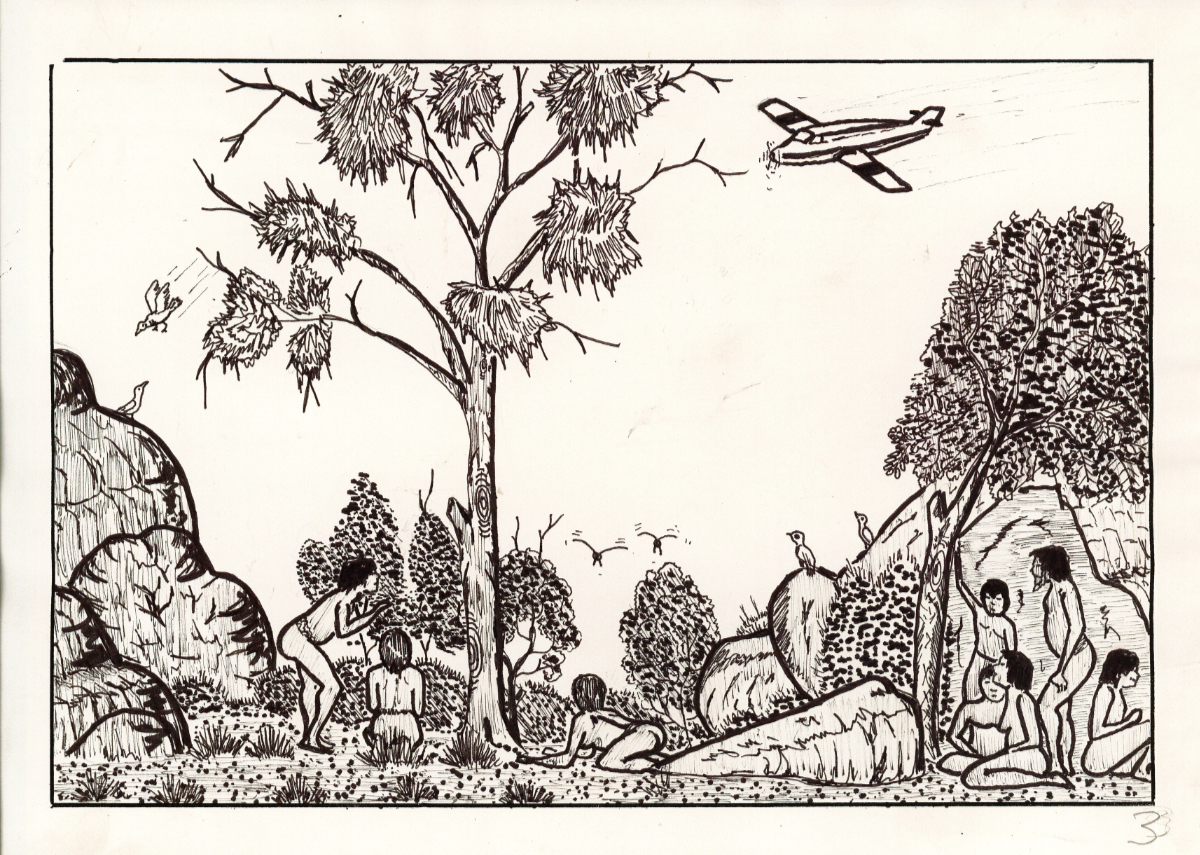
The stories were generally told by an older generation, then transcribed by young women such as Charlotte Phillipus, who describes how after collection and transcription the stories were illustrated by young men.
It was really wonderful how they illustrated all those traditional cultural stories with such fantastic authenticity and creativity. And we focused on the collecting and recording process of the stories and the transcriptions. So that was our working life. [2]
The stories reveal the shock of first contact with white strangers, events from traditional life, or Indigenous epics whose totemic heroes destroy and subsequently recreate the land and its inhabitants. Other stories tell of settlement life in the 1970s and 1980s, when families sat under a shade, or around a campfire, before television came to Papunya. The images selected for Wangka Walytja manifest as crystal-clear stills from the artist’s visualisation, unspooling like cells of a story board from an imagined movie.
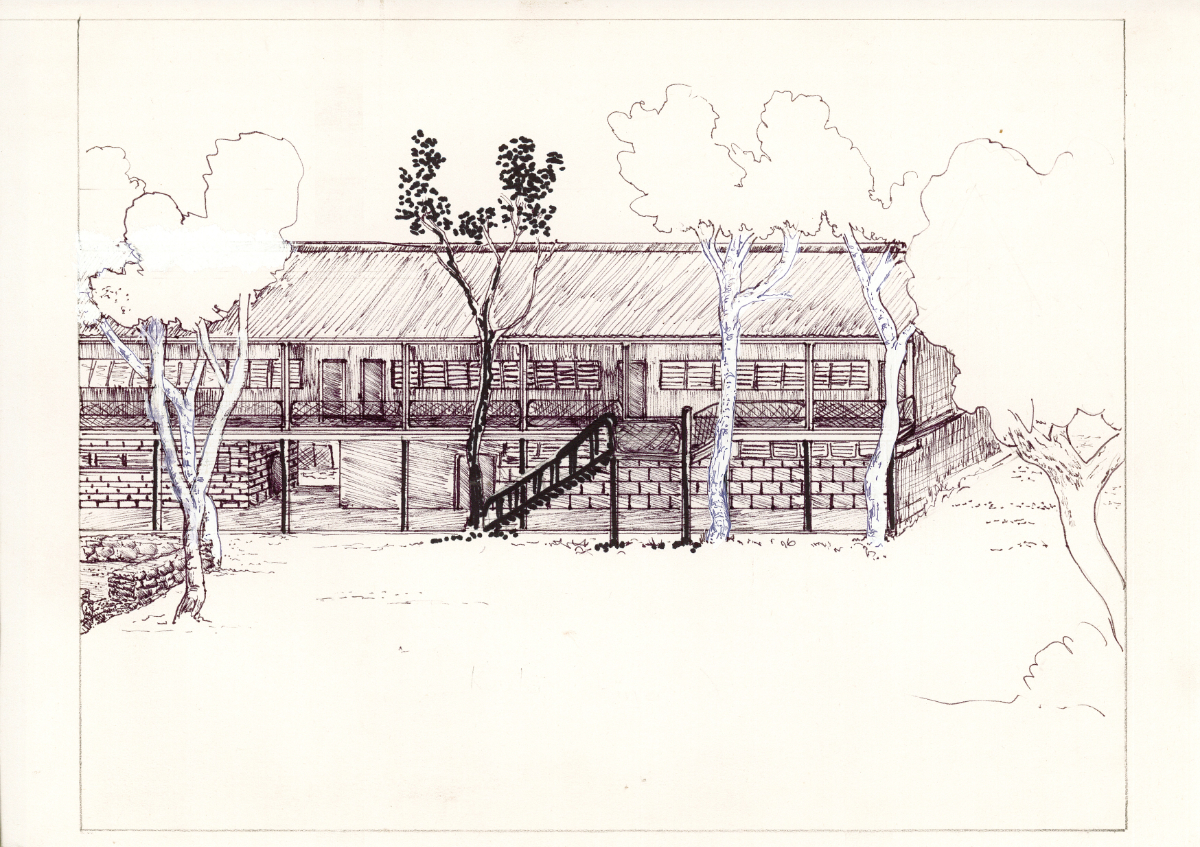
Thomas Stevens Tjapangati (1950-2005) was a Pitjantjara man, whose acute observations bring the settlement to life. Stevens came to Papunya from Areonga as an accomplished landscape painter. After a stint at the literature centre, he became an innovative ‘dot’ painter and the illustrator of a popular children’s book, The Lost Boomerang (1983). Images in Wangka Walytj, reveal Stevens as a gifted draftsman with an eye to the vernacular architecture of settlement life.
Kulata Dennis Nelson Tjakamarra is the son of founding Papunya Tula artist Johnny Warangula Tjupurrula and the most prolific of the Papunya Literary Centre illustrators.[3] Kulata recalls his youthful collaborations fondly.
We created all these books together with the old people in Papunya, many of whom have now passed on, those dear things. We devoted a great many years to this work – more than ten years – a lifetime.[4]
Kulata was clearly transfixed by his father’s stories, animating them carefully, while adding naturalistic flourishes, such as birds nesting in the trees or snakes slipping unseen past the human dramas; such animated themes were also reflected in drawings by Abraham Stockman Tjungarrayi.
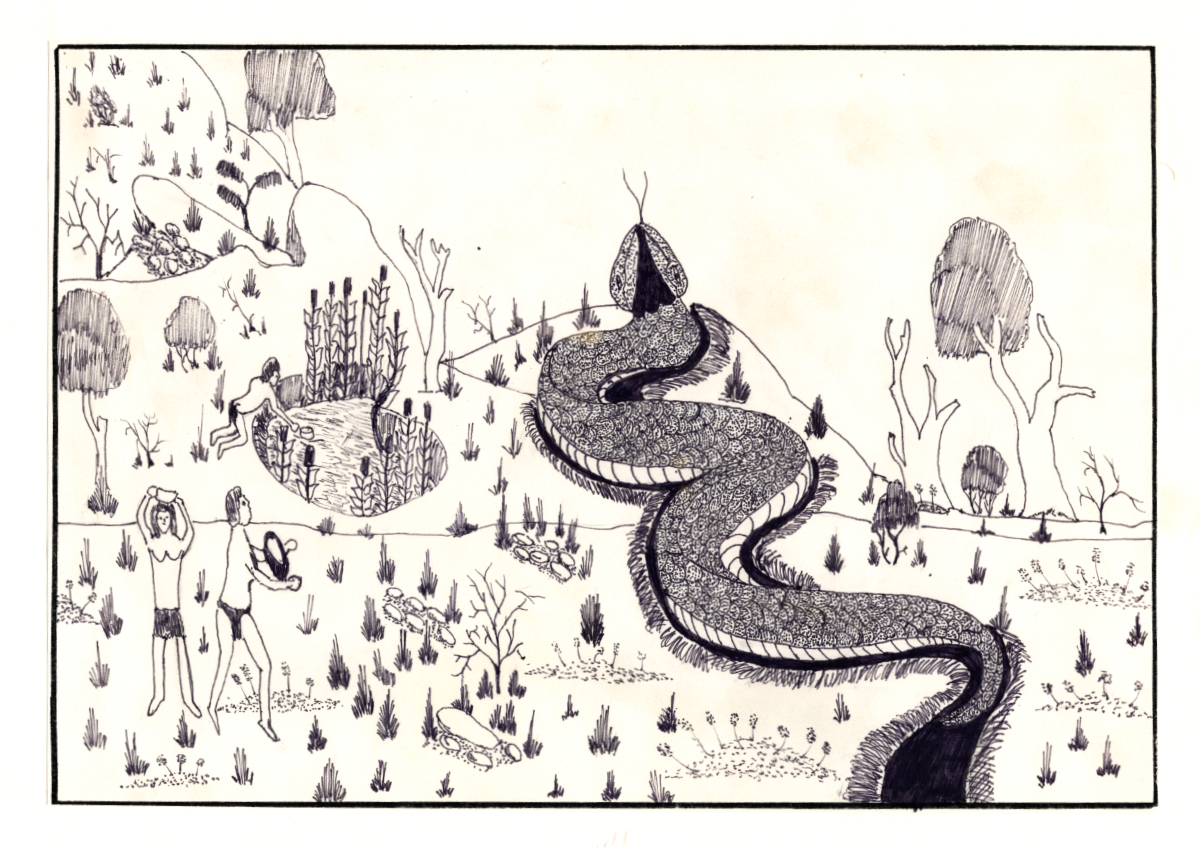
Forty years later, Kulata continues to sketch incessantly, and increasingly eccentrically. A recent drawing on paper, included as a postscript in Wangka Walytja, demonstrates his dedication to the cartooning style he perfected ‘a lifetime’ ago. Old Man Dreaming of a V8 (2021) describes an artist, brush in hand, working on a large canvas in the shade of tree where, rather than concentrating on the painting’s sacred content, the ‘old man’ is daydreaming of a new car, and a new love. While Kulata’s practice is unique, he gives voice to a generation of men, who grew up hearing of their parent’s epic tales of life in the bush ‘before whitefellas’. Whereas Kulata’s fascination with the old way remains, his sensibility arises at the intersection of popular and Indigenous culture, in the grungy, chaotic reality of an outback settlement.
Three days before the launch of Wangka Walytja in Mparntwe, I spoke to Linda Anderson Nakamarra as we waited for the funeral of her education mentor, Kumanytjayi Nelson Nakamarra to commence. It was an unseasonally hot October day as we perched under a large shade at the Papunya School, looking towards the classrooms where literacy in Pintupi /Luritja had once been taught. Anderson lamented the demise of the program, of which she had been a vital part, and pointing to William Sandy’s ‘two-way’ mural, she proposed the reconstitution of bilingual education at Papunya. Somewhat deflated, Anderson then recognised the pragmatic reality that the cohort who had shared the vision of bilingual education are getting old, and that their agency had been worn down by decades of government inaction and destructive intervention. The mournful mood of Kumanytjayi’s funeral spread over us like a blanket. We were, after all, about to say goodbye to a dear friend, a sister, and an education worker who made full use of bilingual readers for years.
The dynamic cells of these lovingly-drawn Wangka Walytja (family stories) are now being publicly exhibited for the first time. Their acuity signals the value of the bilingual education that was implemented, then cruelly withdrawn from Papunya, and similar remote Aboriginal communities. It is no wonder that attendance levels at remote community schools have declined, and literacy levels faltered, when the education department proved so disinterested in the priorities of parents.
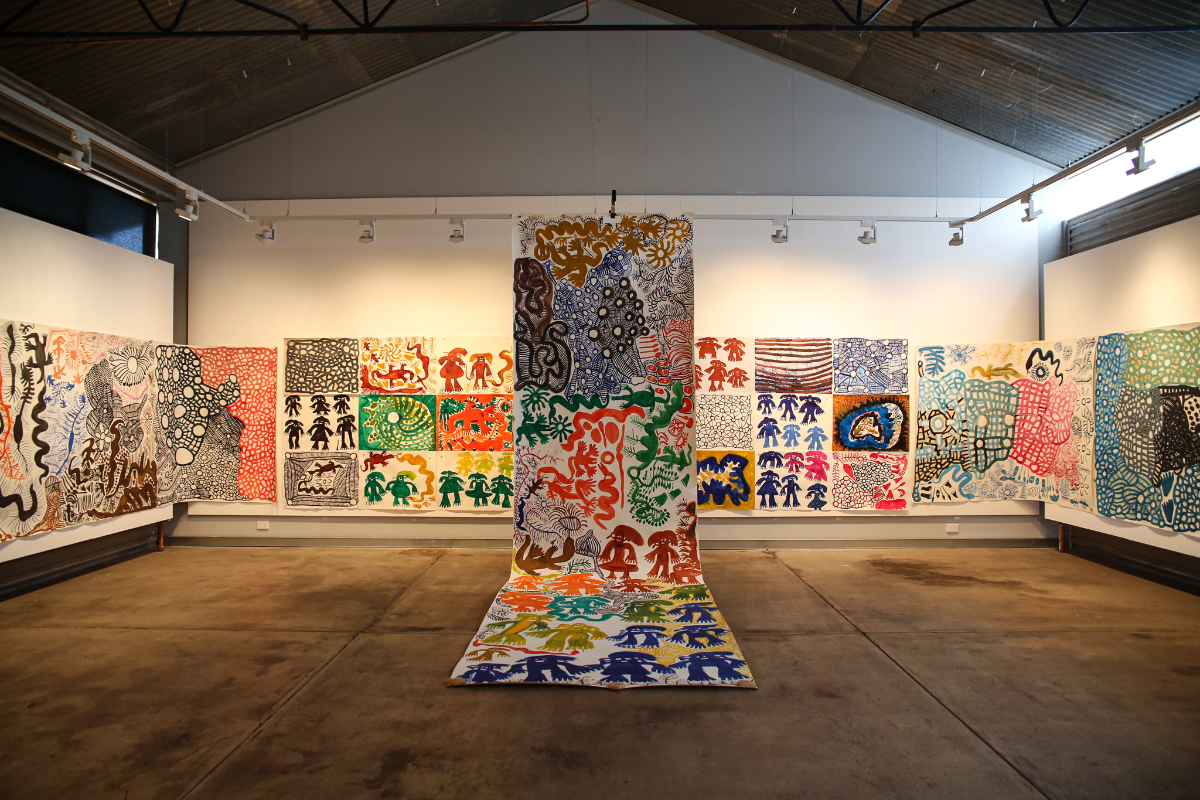
Turning from Wangka Walytja into 8 Hele’s larger space, I was confronted with the scale, intense colours and ceaseless flow of Doris Bush Nungurrayi’s evocation of Nyunmanu, a Dingo Dreaming site 200 kilometres west of Papunya. Readers may know me as the author of Dot, Circle and Frame: the making of Papunya Tula Painting (2023), and therefore be amused that I found Bush’s exhibition to be a thoroughly convincing refutation of my book’s central thesis: that the conventions of Papunya Tula painting resulted from the resolution of inherited iconography within the governing rectangular frame of Western Art.
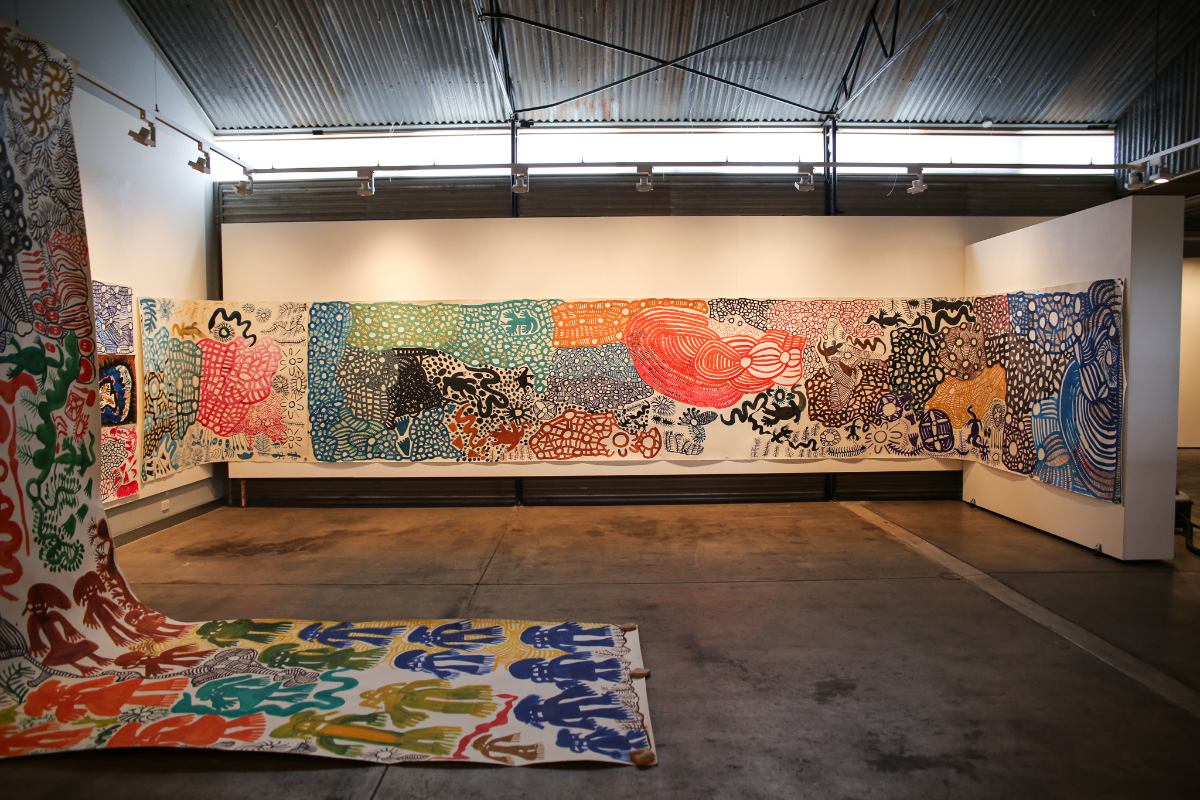
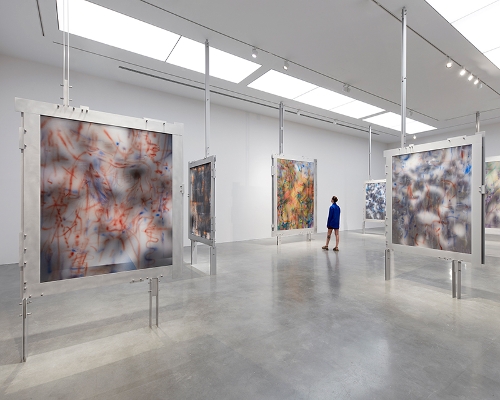
After squinting closely at the tightly cropped black and white miniatures in Wangka Walytja, Doris Bush’s Nyunmanu offered an instant and wholehearted embrace. Rather than containment, Bush’s brushstrokes wrap around the viewer to form a breathtaking flow of icons and images. Pausing to identify any breaks, I discovered that the bulk of the exhibition is composed of just three jumbo sheets of 150cm high paper, respectively 565cm, 860cm and a full 1000cm, (yes, that is 10 meters!) in length. The smaller of these sheets is draped informally from ceiling to floor in the centre of the space. The result is akin, at least in a formal way to James Rosequist’s F111, (1964-65) but way more intimate.
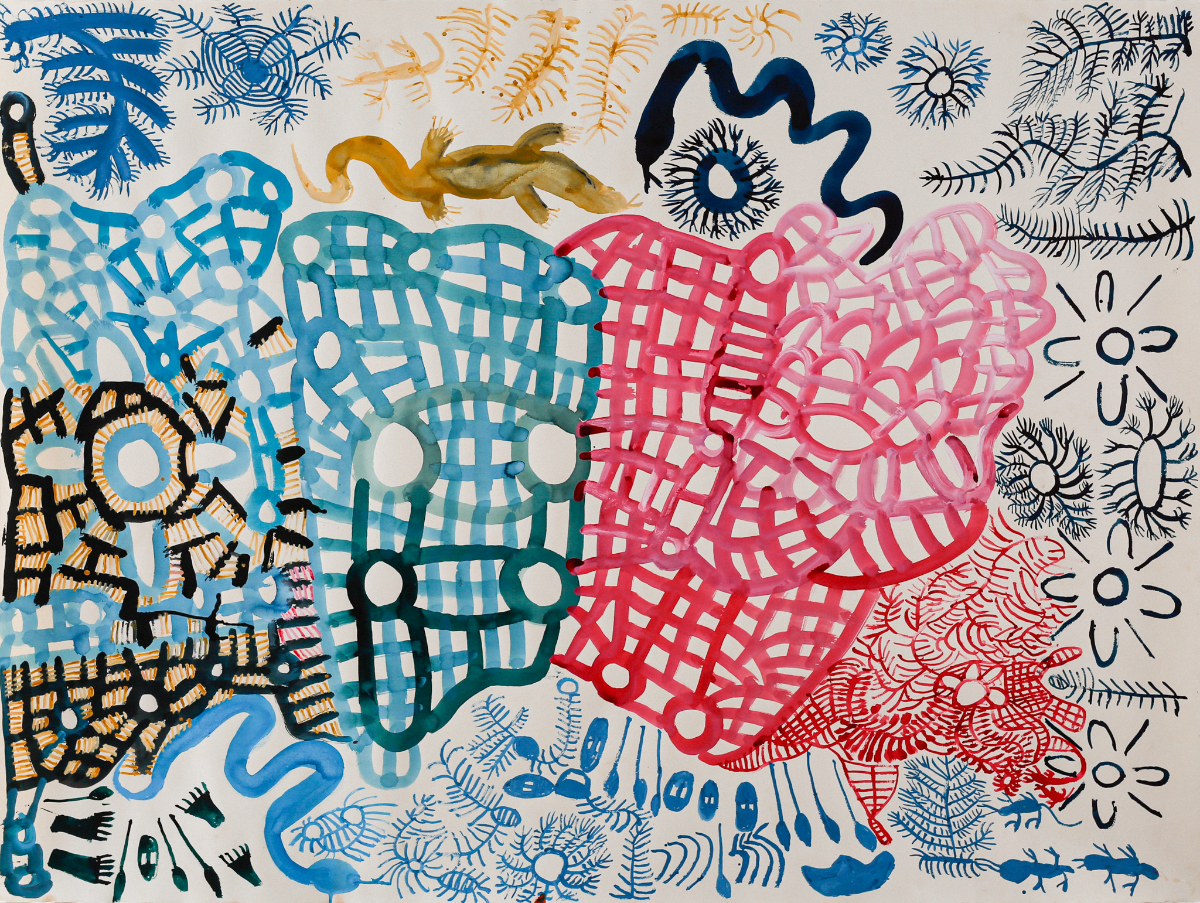
Earlier, when introducing the commonality between these otherwise divergent exhibitions, I described both as reflecting the ‘narrative urge’ in Western Desert art. Whereas Wangka Walytja is comprised of stories told from start to finish in a conventional Western sense, Bush’s paintings unfurl as fluent, free-flowing and unconstrained statements of identification, the narratives circular and discursive rather that linear. Sacred images derived from ceremony are interspersed with schematic views of plants and episodes of hunting scenes, connected through the slippery semantics of Western Desert visual language. There are no hard boundaries between the sacred and the secular in Bush’s immense scrolls — memory, sentiment and ceremony flow from the artist’s hand like automatic writing, unedited and totally unconstrained by scale.
Nungarrayi was born c.1942 at Ikuntji (Haasts Bluff) around 30 kms south of Papunya, following her parents’ exodus from Pintupi Country far to the west. After marrying George Bush Tjangala and raising three sons, Doris lived for a time at Nyunmanu outstation on her mother’s Country. As an aside, Nyunmanu outstation was established in the early 1980s by Mick Namarari Tjapaltjarri, one of the most celebrated of the founding Papunya Tula artists.[5] Tjapaltjarri is Doris’ mother’s brother. Like her uncle, Doris Bush paints episodes of the Dingo Dreaming at Nyunmanu. Indeed, echoes of Namarari’s icons appear in the rush of Bush’s epic animated landscapes. Where Mick Namarari was a master of patience and restraint, Doris Bush exceeds with exuberance.
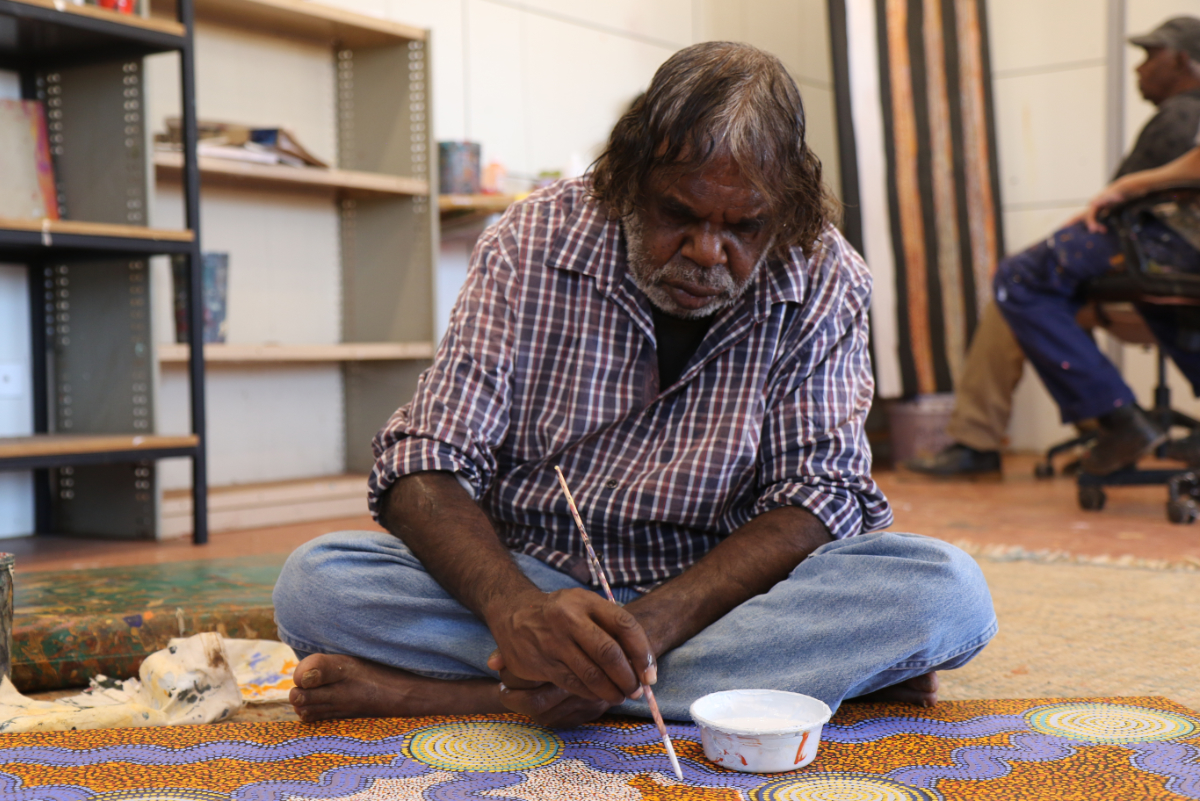
Now one of Papunya’s oldest residents, and having long lost her hearing, Doris Bush paints daily at the Papunya Tjupi studio, pouring herself onto canvas, and on this occasion, paper.[6] If you are willing to listen, Nungarrayi’s paintings convey her memory of being on Country. They carry the sensory excitement of running through the scrub, feeling the spiky tips of spinifex grass pierce your shins while chasing a goanna, or trapping a slithering snake. She recalls the low escarpment that defines both sides of Nyunmau, and the long bastion of rock, located in the exact centre between those parallel landforms. Nyunmanu is the place of Papa (Canis familiaris dingo), a site where Ancestral dingoes were conceived and raised.
Doris Bush’s Nyunmanu paintings pulse and pant with Dingo energy, forever restless, her stories keep unfolding, attention trained to the earth. The vivid mural- size scrolls, tacked to the wall of the gallery, appear seamless — there is no white space between individual sheets of paper. The installation demands that we enter Nyunmanu as a site, and experience it from Nungarrayi’s point of view. The sound of her memory resounds across the gallery. And if you choose to stay with Doris Bush Nungarrayi’s story of Nyunmanu, the thud and grind of 4-wheel drives trundling down the bitumen outside 8 Hele Street is sure to retreat like a muffled mirage.
Footnotes
- ^ Wangka Walytja – the Life and Times of the Papunya Literature Production Centre is being toured nationally by Artback NT.
- ^ Charlotte Phillipus Nakamarra, Wangka Walytja - The Life and Times of the Papunya Literature Production Centre, 2025
- ^ Johnny Warangula was a founder of Papunya Tula Artists in 1972. Warangula is also famed as a storyteller who worked casually in that role at the Papunya School.
- ^ Kulata Dennis Nelson Tjakamarra, Wangka Walytja - The Life and Times of the Papunya Literature Production Centre, 2025
- ^ Mick Namarari was a founder of Papunya Tula Artists in 1972. The ‘company’, as it was referred to by its artist/shareholders, shifted its operational focus from Papunya to further west, initially to Kintore, as Pintupi families returned to their ancestral country in the 1980s. Papunya Tula Artists continue to service artists living at Walangurru/Kintore and Kiwirrkurra.
- ^ Papunya Tjupi Arts was established in 2006 as a community-based art centre to service Papunya residents.