The simmering rage of a nice girl
Travel back in time, some sixty odd years, to a property in a forgotten corner of the Riverina. See the lonely farmhouse, not another building for miles. Inside, it’s quiet. A clock ticks on the mantlepiece beside a statue of Our Lady of the Rosary. In the living room, a little girl picks up a needle and thread as a scruffy terrier wanders past. She focuses intently on the sharp point as she pushes it through soft pink fabric, careful to avoid her thumb. Mary Coughlan has begun her life’s work, but she doesn’t yet know that. What she does know is that if she sits quietly, sewing, she might be safe.
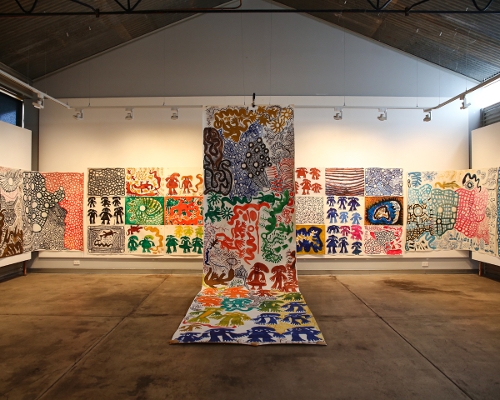
Upon entering the exhibition at the Wagga Wagga Art Gallery, all seems cosy, familiar to those of us who have grown up in rural and regional areas. Quilts, embroidery, soft pinks, mint greens. It’s charming. But disarming. And while it tells the story of a small girl, it’s an adults-only space.
In Covered in Roses / Covered in Ashes at Wagga Wagga Art Gallery, Mary Coughlan shares her story of survival. Of life in a strict, deeply religious and violent household. Of surviving years of child sexual abuse. Of surviving rape by a stranger as a young woman in Melbourne. Intensely personal, it’s a tale the artist has recounted, examined, and analysed in exacting detail over many years with needle in hand, but it’s a tale she has rarely exhibited.
The little girl and the scottie
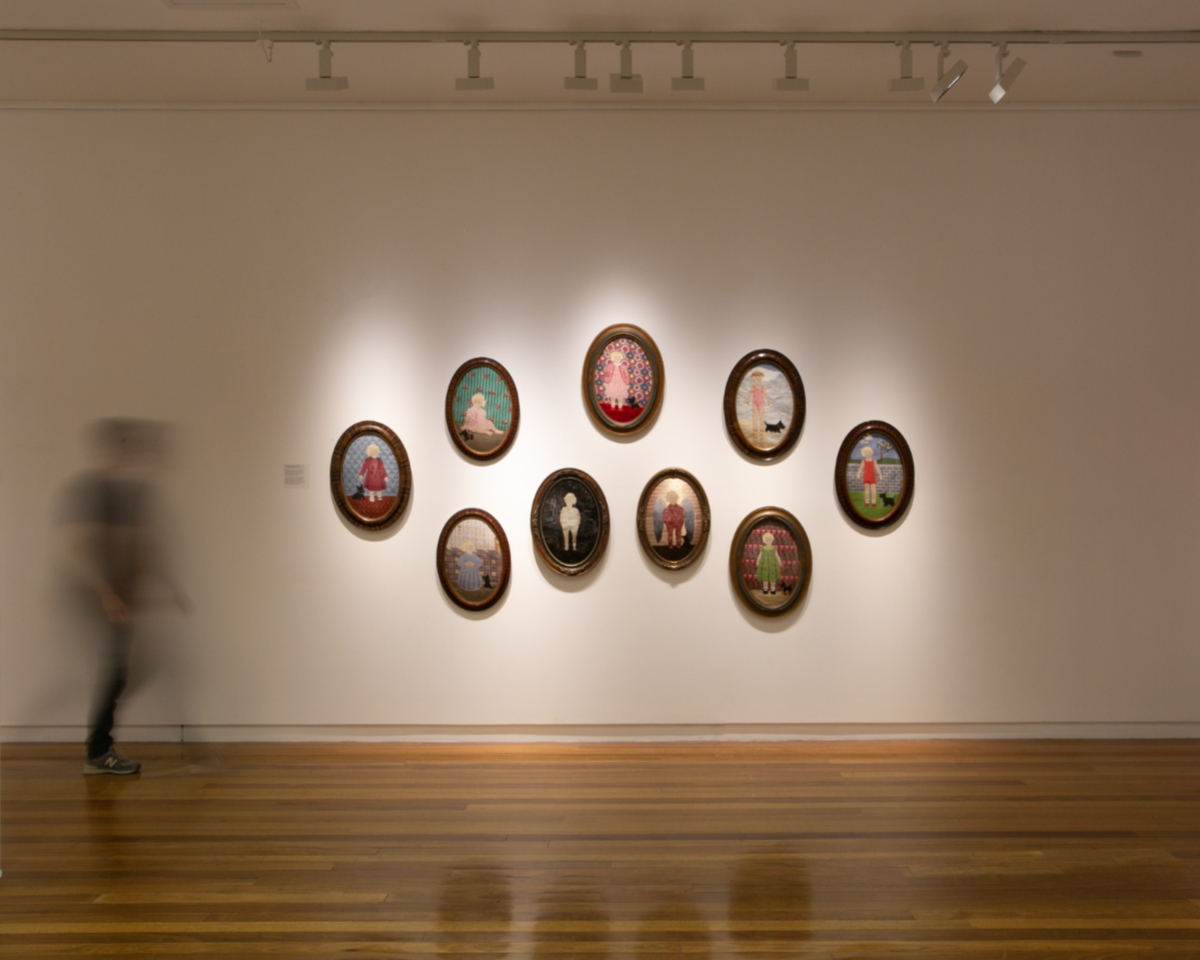
The exhibition begins with Reparation (2010-2019), a series of embroidered self-portraits of the artist as a small child. In each oval frame, little Mary is dressed in a cute outfit, accompanied by a faithful black scottie dog. Here she is in a pretty dress. On a day at the beach. In her bedroom. They’re beautiful images. But there is something in her stillness, in the performative nature of each scene, that is haunting, unsettling.
Two of the Reparation works are twin portraits. The first shows Mary birdlike with wings. During an episode of violence, she would disassociate from her body, flying up to the ceiling where she could look down at the scene below. In the second portrait, now in her undergarments, Mary is surrounded by dark feathers. Far from granting her freedom, these feathers are threatening, suffocating, symbolising the return from her airborne safety. As Coughlan said, ‘How do you make the coming back bearable?’ Yet in Reparation, in which the artist works to restore her child-self’s sense of belonging and self-worth, she has gifted herself a motif of hope: the scottie. The loyal companion of her adult life is by her side in art, a reminder she is safe in her embroidered world.
Secret survival
Coughlan’s art reflects the quintessentially rural nature of her story. Nobody does isolation quite like regional settler Australia. Take a small group of people and scatter them across lonely properties miles from the nearest tiny town, add a church or two, a pub, a general store, sometimes a school. It can be a dangerous mix. Everyone knows everyone, but no one knows everything. Without a car and the time to drive, your neighbours are well out of reach. Days and nights are long. Secrets gather weight, tightly gripped in the church pulpit and in the breasts of the families seated together on hard wooden pews. After mass, rough hands smooth ties over bellies; lipstick smiles and strands of pearls chat as children run about and squeal. Perpetrators and survivors, silent as the graves that dot the cemetery grass.
Coughlan was raised with a strict rule to stay quiet, be loyal. ‘You never dobbed on anyone,’[1] she said. Which makes her decision to speak, shout and scream out through her art admirable, even astonishing. Likewise, her decision to work as a counsellor, where for over 30 years she helped countless others rebuild their lives. The work was personally healing but required careful management of her own post-traumatic stress disorder (PTSD). Upon returning home from work, Coughlan would sit and sew, relentlessly interrogating her experiences. With no exhibition planned, no works for viewing or for sale, this was art with one purpose: to process trauma. As necessary as breathing. And it worked for years. Until it didn’t.
‘I held it off for a long time,’ said Coughlan. ‘That’s why each night I came home and created. But it [PTSD] does eventually get you, there’s no escaping that.’
It was at this point that Coughlan retired to devote herself to her art. A torrent of furious creativity followed, and her discomfort quilts were born.
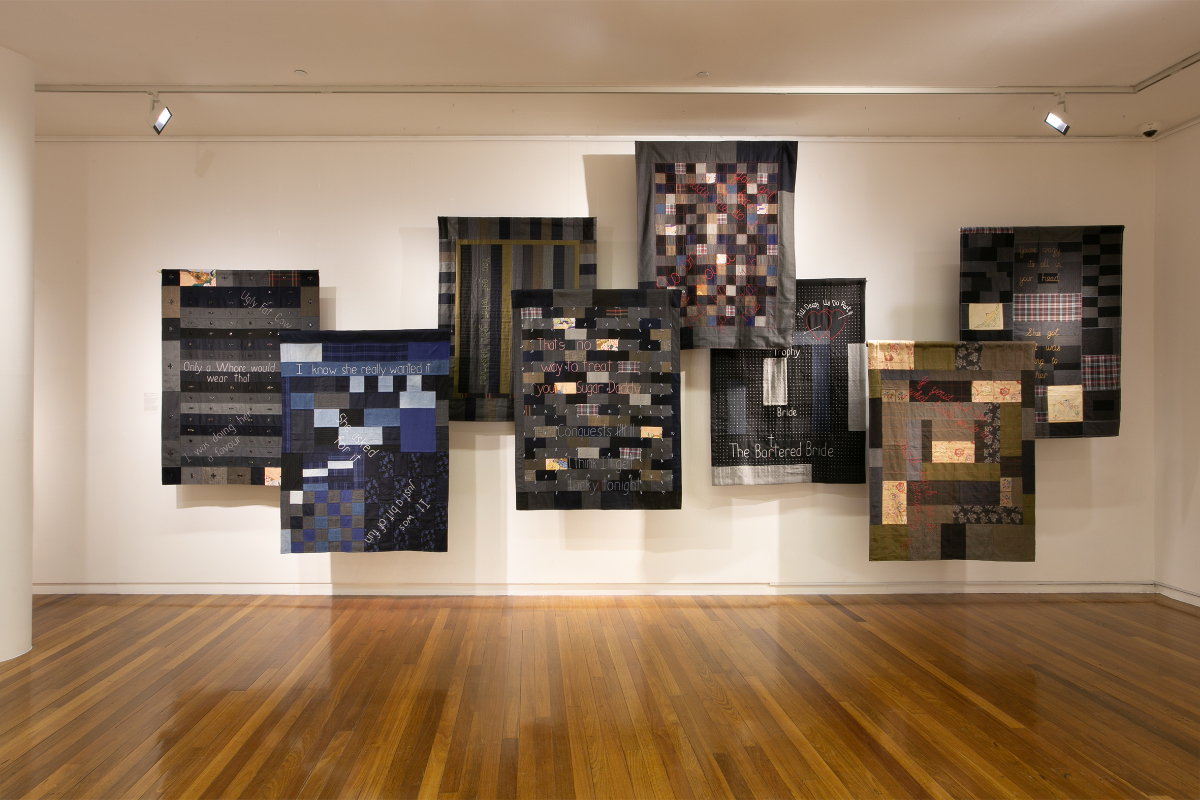
Made from men’s suiting fabric collected from op-shops and interspersed with swatches of florals, pinks and pastels, Coughlan’s comfort quilts are anything but. In some, fabric from schoolgirls’ uniforms sits biliously beside dark suiting material. The quilts bear embroidered sentences once spoken by perpetrators, recounted to the artist by her counselling clients. If you’d just do what I told you to do. She got what was coming to her. It was just a bit of fun. Their lazy brutality speaks of the enforced control and violent silencing so many women navigate throughout their lives, especially those surviving such ferocious assaults on their selfhood.
Mother church
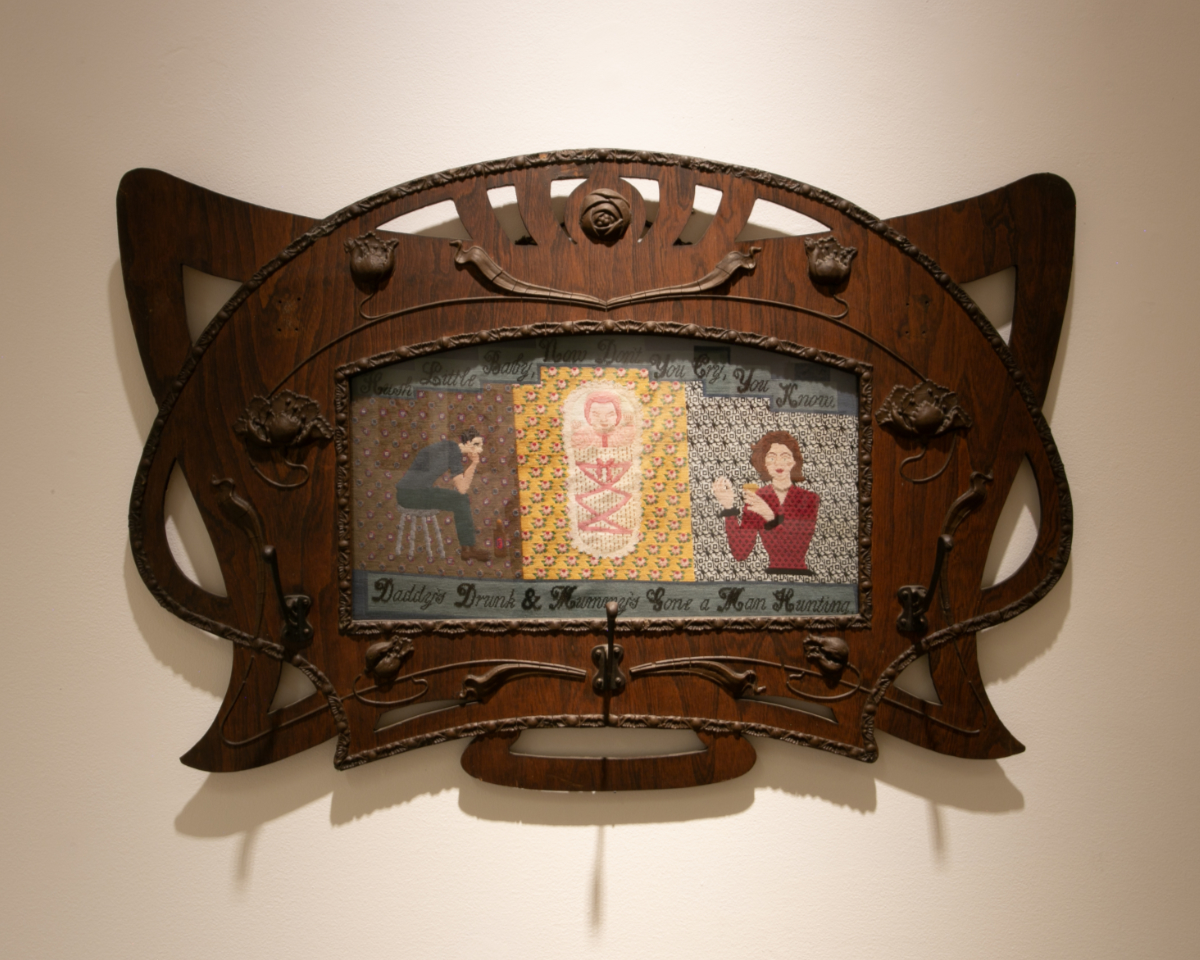
Coughlan not only explores her own rage through these works, but the anger of her mother, which was often violently directed towards her children. The dream of being a wealthy farmer’s wife had failed her. The farm’s needs always came first. So there was the church. And there was alcohol. It was an unhappy mix.
Coughlan cites American painter Agnes Martin as a major influence. Celebrated for her minimalist and abstract works, Martin rose to prominence in the New York art world before retreating into isolation, spending her final decades in the arid desert landscapes of New Mexico. Born on a farm in rural Canada, Martin lost her father at the age of two and, like Coughlan, endured a tortuous relationship with her mother, who she believed hated her. Stern and frustrated, Martin’s mother would often use silence to punish her daughter, who grew up feeling deeply unloved.
‘As a child I saw my mother struggling and would try and fix things for her, hence I hung about and tried to manage her moods,’ said Coughlan. ‘Now I can see she was very lonely, depressed, and overwhelmed.’
Rage is the energy
Far from masking her own anger, Coughlan leans into it. She’s not alone among women artists; Karla Dickens, Kara Walker, and eX De Medici each channel anger to expose histories of violence and systemic abuse. ‘You have to be nice, so I was nice, but then I was explosive,’ Coughlan said. ‘It’s a lifelong journey, learning to author your rage. But your rage is really important, because it’s the energy.’
Soraya Chemaly, author of Rage Becomes Her: the Power of Women’s Anger (2018) writes of the myriad ways girls and women are taught that anger, a universal human emotion, is deemed the moral property of boys and men, and how women police their own anger, repressing it to conform to social expectations of femininity. What if we let it out? What if, instead of mocking or minimising angry women, we listened to them? Got curious about the cause of their anger? If we encouraged girls and women to harness the power of their anger in a world that does not respect them? Think of the energy we would have to enact change and liberation.
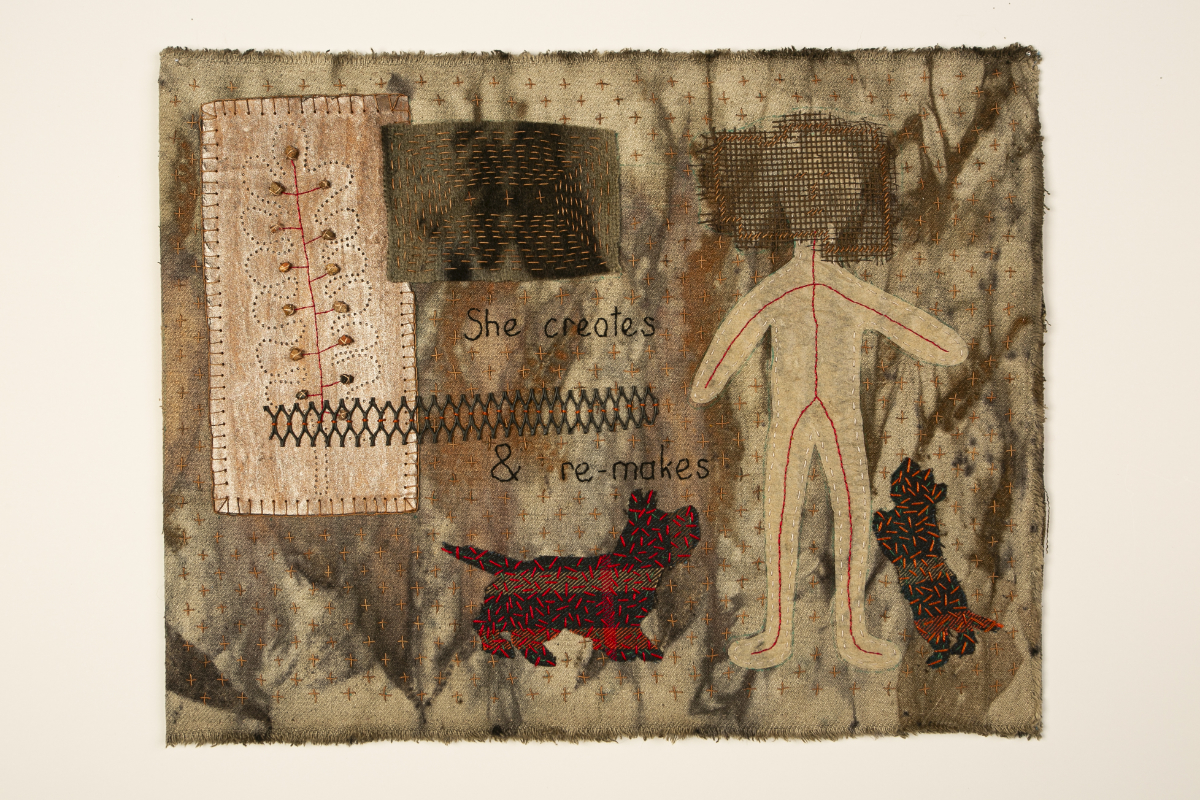
It’s this very force that has propelled Mary Coughlan through thousands of hours of solitary creative labour, transforming rage into art, one stitch at a time. While we doomscroll or binge-watch, feeling hopeless and helpless at the state of the world, this artist, survivor, counsellor and wise and angry woman, will sit in a soft chair, black scottie beside her, and pick up her needle and thread.
Footnotes
- ^ Mary Coughlan in conversation with the author, 14 August 2025.