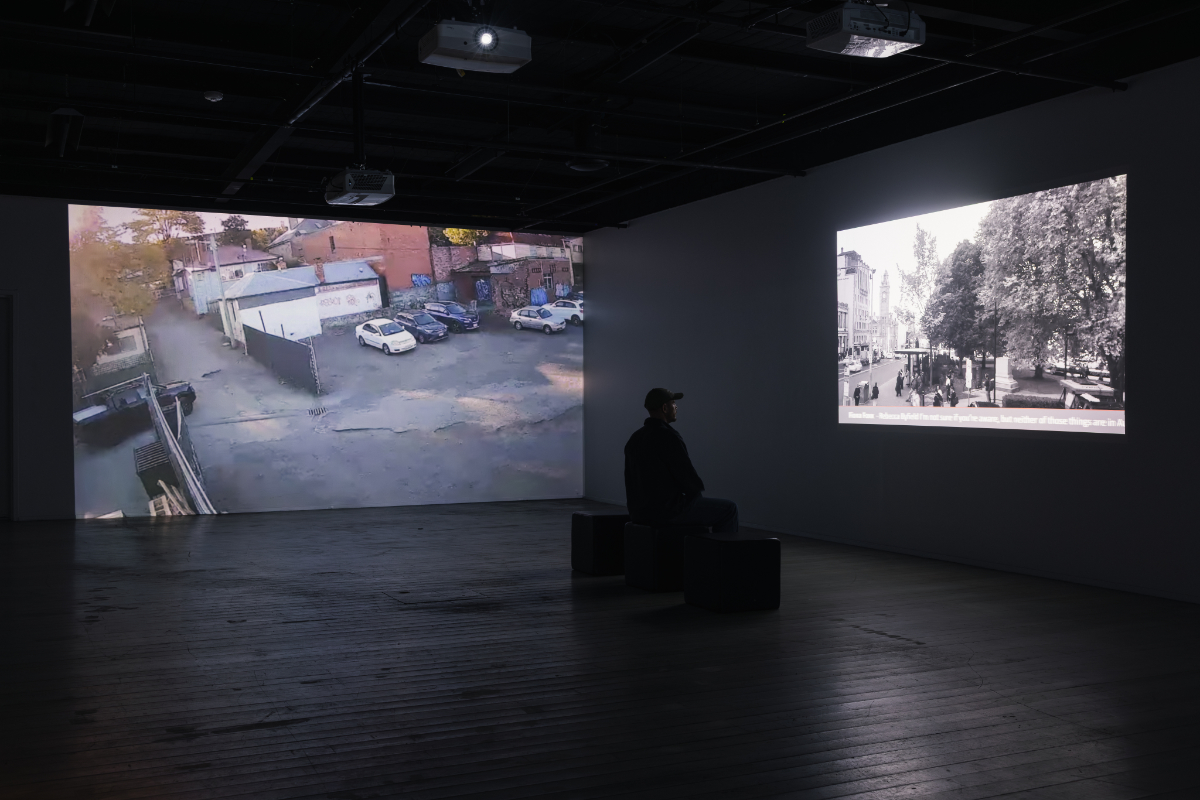
We stand around a drainage hole in a concreted carpark, stop one on Julie Gough’s psychogeographic walking tour, part of her solo exhibition, Force Field. Graffiti decorates the surrounding shipping containers and warehouse walls. Visually it’s unremarkable — it could be in any inner-city block, anywhere. Yet, unknown to most, this drainage hole in inner-city Nipaluna/Hobart was once a place of cultural and ecological significance, a meeting place known as the “Pool of the Aborigines”. As the Trawlwoolway artist notes, the waterhole and camp site was used by Aboriginal people until it was destroyed by colonists by the 1840s.
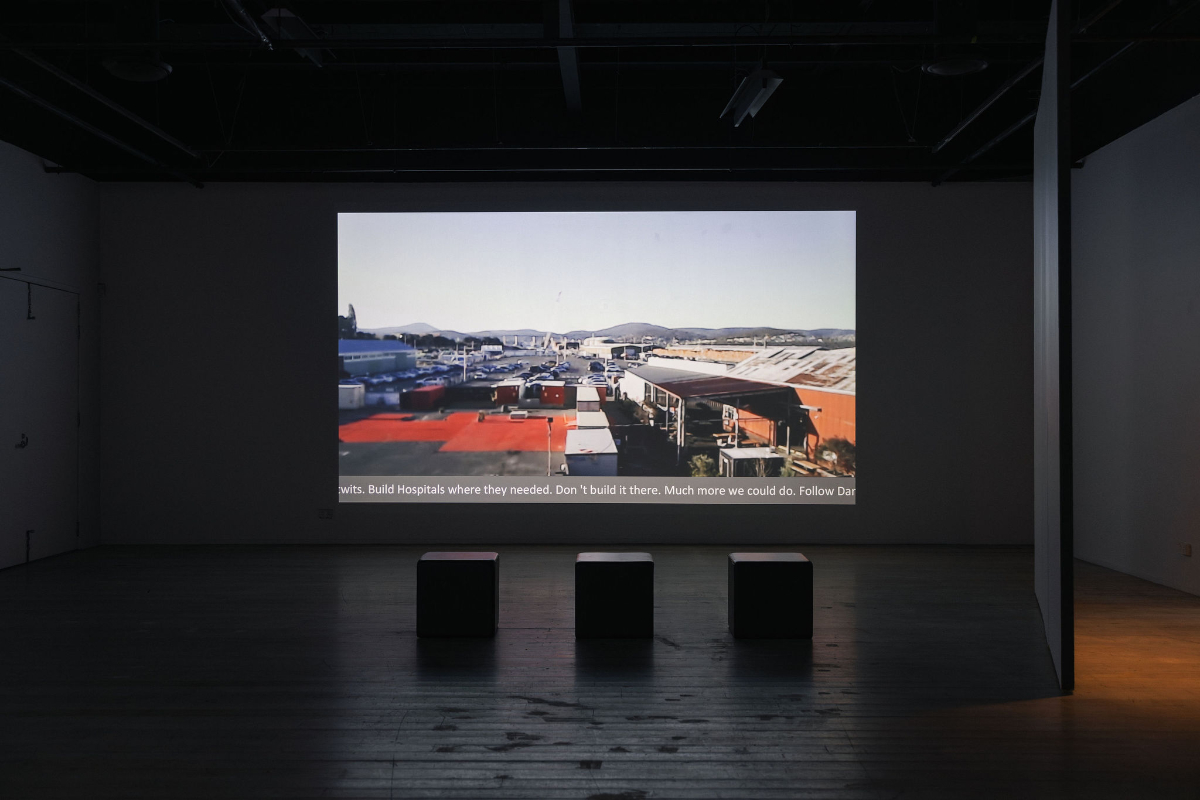
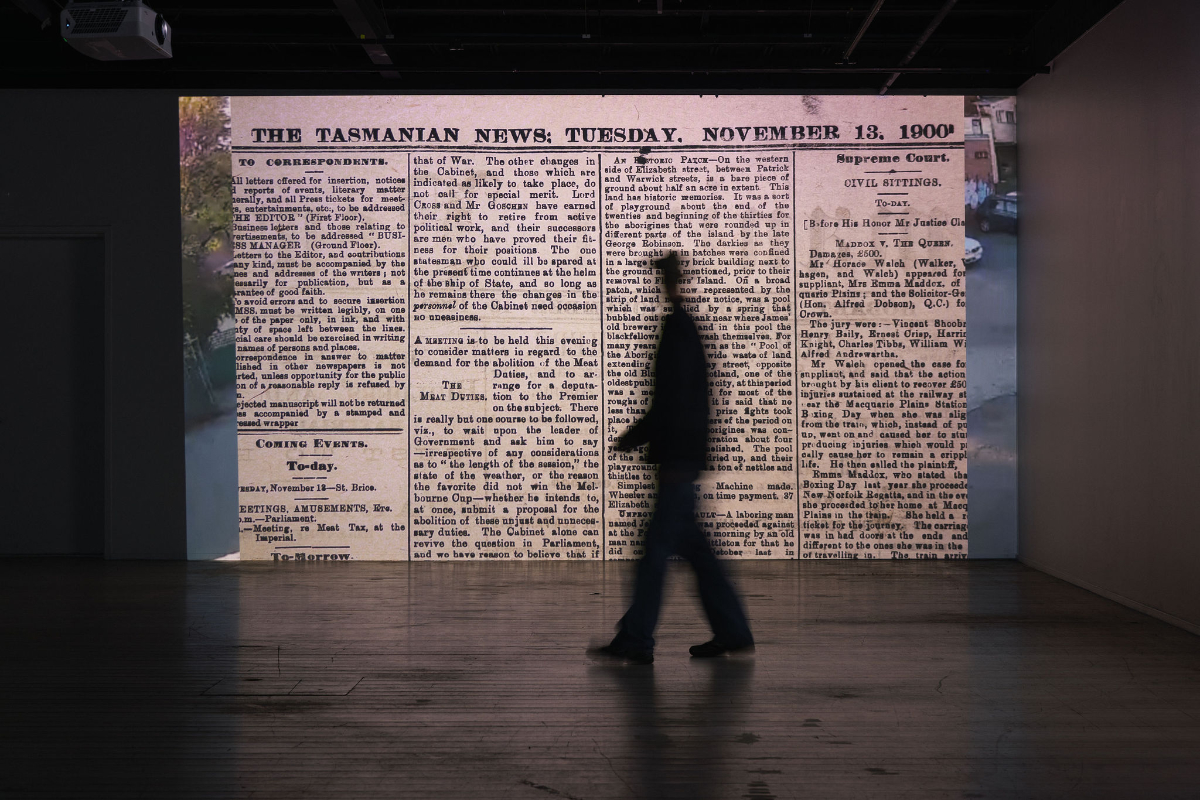
A live-stream of this site is cast to Contemporary Art Tasmania (CAT), interrupted by historical news clippings from the late 19th and early 20th century, all citing the Pool of the Aborigines. One article from 1900 observes that the once bubbling ‘pool of the aborigines has dried up, and their playground runs about a ton of nettles and thistles to the acre.’ By demonstrating that this place was once consistently named and well-known, Gough highlights not only the physical erasure of this important landmark, but of our collective memory as well.
Gough is known for her historical research, meticulous referencing, and the presentation of often uncomfortable truths through visual art. Past site-specific works, such as Missing or Dead (2019), documenting the loss of 185 Tasmanian Aboriginal children, show her determination to reveal gaps in knowledge and demand we learn alternative histories to the dominant accounts. Force Field is no different. Curated by Tash Bradley-Cross as part of CAT’s long-running curatorial mentorship scheme, the exhibition includes an ambitious public program, designed to encourage conversation beyond the gallery walls.
The exhibition includes livestreams to two additional contested sites. The second camera points towards the Hobart Brewing Co and surrounding former industrial land at Macquarie Point. The third gazes at the now removed statue of William Crowther in the Hobart CBD, capturing the constant movement of people past the empty plinth, seemingly unaware of the culture wars associated with the site. Unlike past video works where Gough’s presence is felt behind the video camera–such as in Observance (2012) where she films flashpackers walking on her maternal Country, Tebrikunna — the live-streams to CAT use fixed surveillance cameras. The videos roll whether there are people in the frame or not, which only highlights the relative lack of movement at the Pool site. If Observance was about trespass, the absence of people in The Pool of the Aborigines highlights our collective ignorance and neglect of significant Aboriginal cultural sites.
The site at Macquarie Point, on the other hand, symbolises a more deliberate neglect. A decade ago, the Mona-associated DarkLab released commissioned concept plans for an Aboriginal reconciliation and truth telling park on the former industrial site, a project that ultimately stalled.[1] A 2022 deal between the Tasmanian Government and the AFL has instead seen the land earmarked for a stadium in exchange for a Tasmanian AFL team. Subtitles over the video livestream document the divergent public discourse, originally published in response to media articles about the stadium. As with so much social media commentary, the lack of nuance and performative outrage makes it an uneasy read.
Similar subtitles are applied to the livestream of the Crowther plinth, which is currently the subject of a broader City of Hobart-led art and reinterpretation project.[2] The statue of the colonial-era surgeon and politician was removed last year amidst growing community concern over the memorialisation of a historical figure who mutilated the body of Aboriginal man William Lanne (c.1836–1869). The subtitle comments are revealing; while many celebrate the statue’s removal, other statements like ‘leave our history alone,’ ‘if it is removed the whole story will soon be forgotten,’ and ‘why mention it now?’ demonstrate a lack of public awareness of how history is written and celebrated.
Gough’s videos use the visual language of documentation. They’re not pretty, but why should they be? The subtitles are akin to breaking newscasts that interrupt the main story. The text is framed in a generic computer system grey — understated, familiar, and utilitarian. The commentary is often misspelled, occasionally aggressive, constantly jarring. It’s an uncomfortable experience, and deliberately so.
Standing in the darkened room, the three video screens concurrently demand attention as if in a security room, mirroring our distracting world. And yet nothing particularly remarkable happens. The videos show Hobartians going about their everyday lives, unaware of the remote surveillance of the respective sites. The result is an almost inverted public art where the scrutinised sites remain undisturbed, objectless, but are nonetheless activated by our voyeurism.
While Tasmania is populated with public monuments celebrating its colonial past, few recognise the island’s Aboriginal history. In her artist statement Gough asks, ‘what might re-memorialising this Pool augment? What is possible beyond this literal projection?’, perhaps imagining a more grounded project in this place. Showing us this neglected carpark grate, untouched by the artist, is an effective strategy. Asphalt tends to neutralise spaces, but Force Field demands that we rethink assumptions about the city’s history and fabric. As Gough states, ‘amnesia is not an option.’ The Pool remains a meaningful place.