Two exhibitions currently at Heide MoMA Going Back In, by Ken Whisson and South Australian artist John Foubister, and David Jolly’s survey Everything Else Falls Away offer a rarified encounter with art, not least because not one of this triumvirate of artists fits simply or straightforwardly into this or that genre or style.
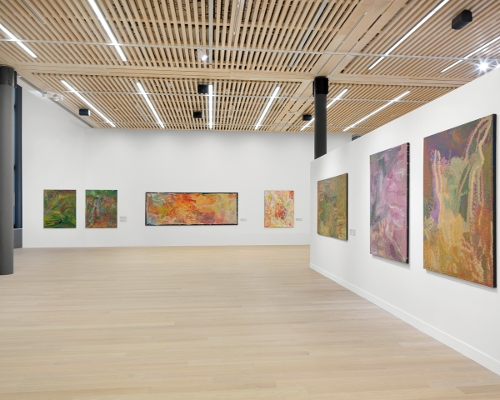
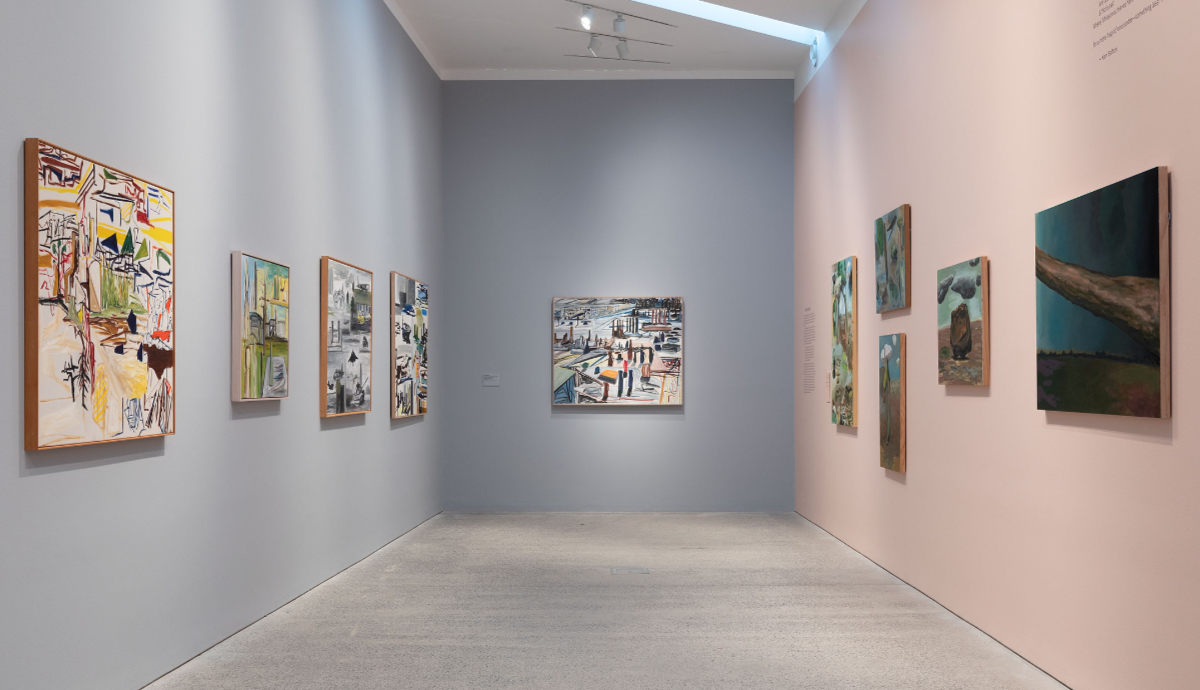
In Going Back In, curated by Anna Zagala, the ‘scene is set’ in the Kerry Gardner & Andrew Myer Project Gallery with Whisson and Foubister’s contemporary works installed alongside the Heide-associated modernists Joy Hester, Sidney Nolan and Danila Vasilieff. This grouping signifies the interconnections, exchanges and influences that have occurred between the generations: between the Heide group and Whisson in his early years, and between Foubister and Whisson (who died in 2022 at age 94) in his later years. This latter exchange is expanded upon in the Albert & Barbara Tucker Gallery, with the works by Whisson and Foubister placed on opposite walls, suggesting a ‘bouncing’ of ideas between them. Moving from one gallery to the next, what is immediately apparent is how Whisson’s and Foubister’s ‘landscapes’–or ‘mindscapes’–seem so alive; the subjects, objects and scenarios in their canvases are living, breathing and constantly in motion though the artists can only depict them as moments in time.
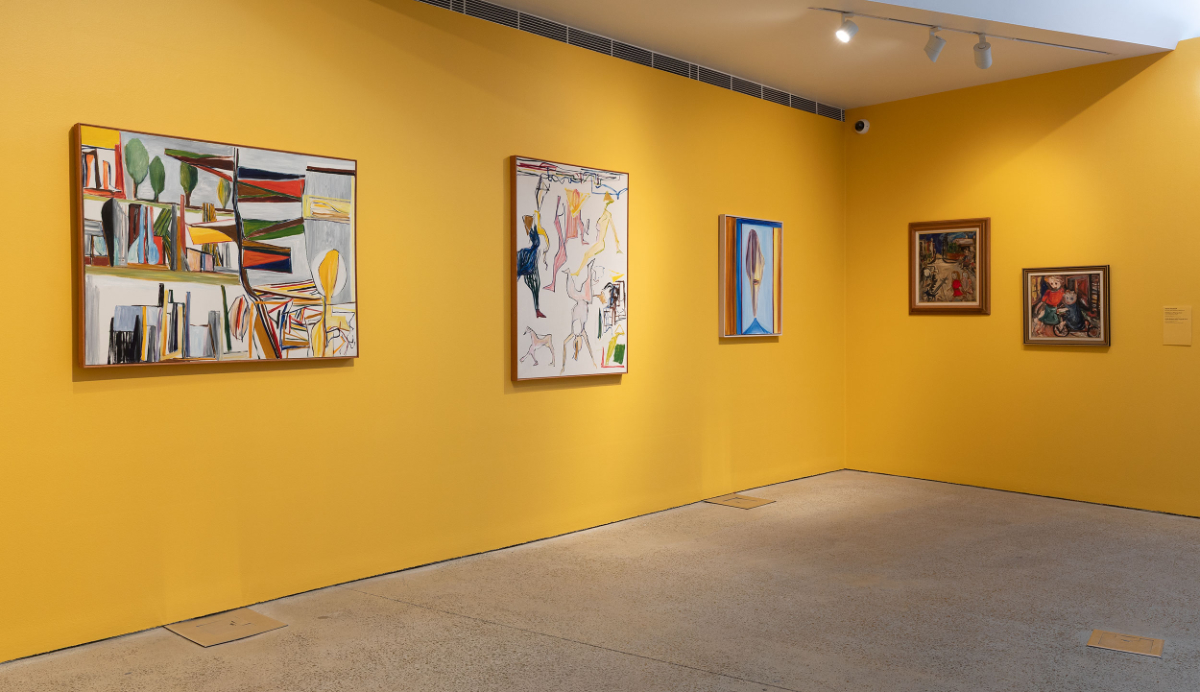
The vibrancy of these canvases derive from the distinctive techniques each artist uses. Their methods of drawing on intuition, imagination and memory give rise to wholly different uses of paint, brush and canvas with which they try to capture the spirit of their subjects in images that simultaneously play between figuration and abstraction, but in very different ways. The thirty-year excerpt of Whisson’s works, from his Flag for David Ireland No. 2 (8 March 1981) to Landscape, Still Life and Inhabitants 21/4/10, 28/4/10, 11/5/10 (2010), all appear brusque and driven by psychological expression, though Christopher Heathcote observes his was a ‘steady and deliberated’ process[1]. Accordingly, Whisson renders his work in a rudimentary style to avoid unnecessary detail as he harnesses the flat picture-plane using lines to draw/paint varyingly abstracted images with a sense of urgency and immediacy: from almost completely abstract ‘scribbles’ in Conversation (2005) to his land(mind)scapes and objects in the collage-like canvas Kitchen Table (1982) which extends out from ‘scratchy’ hints at household items on a table into a (fictional) industrial landscape.
Contrastingly, the imagery in Foubister’s works from the earliest Configuring Treeness (2011-13) to the recent A Limb Moving Through (2025) are fully rendered and illusionistic, at times surrealistic, suggestions of things such as flowers, birds and trees. In the abovementioned work, part of an indefinable limb drifts across the paintings’ empty sky with an uncanniness resembling Pat Brassington’s ambiguous photographs. Appearing in several works including in My Eye Looks into the Eye of Another (2023), eyes function symbolically to question conventional perception and rational logic. And as his self-described animistic forms hover and quiver in their imaginary worlds, they are often disembodied, cut-off at the edges or framed so we only get a partial picture, prompting viewers to think not only about existence beyond the canvas but also ‘what might exist beyond our perceptual capability.’[2]
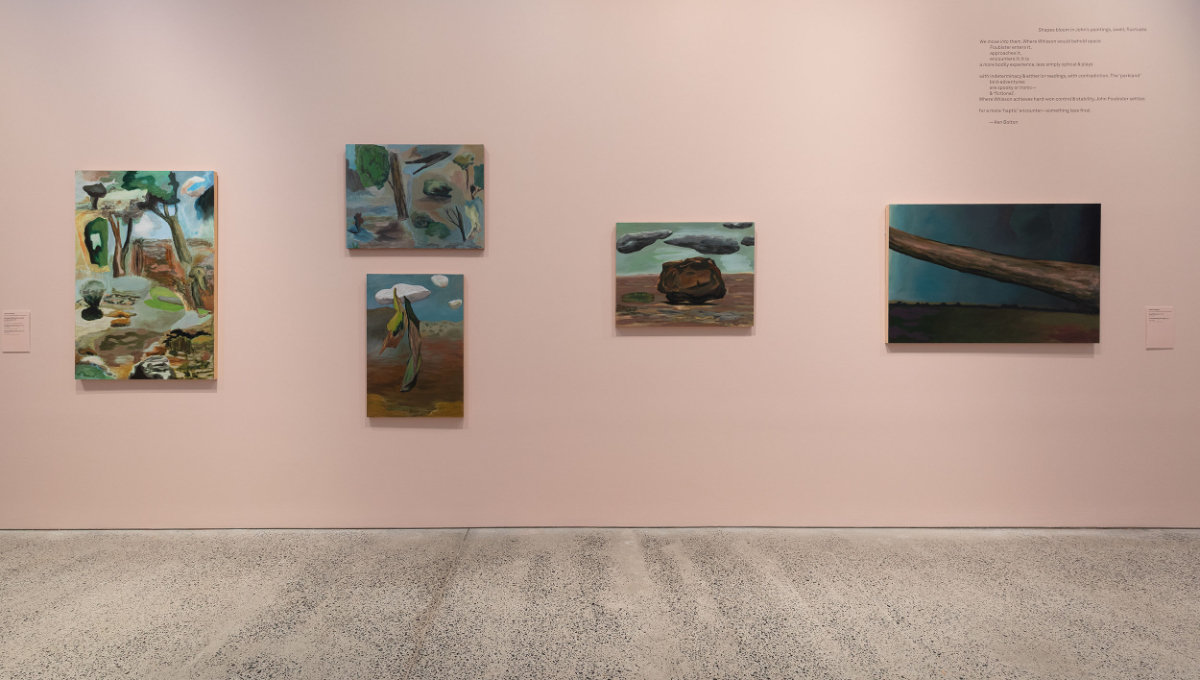
Two other prompts in Going Back In extend the theme of personal connection between the two artists. A wall text by Ken Bolton, Foubister’s fellow-South Australian, compares the two artists: ‘Shapes bloom in John’s paintings, swell, fluctuate. We move into them. Where Whisson would behold space Foubister enters it, …’ There is also a glimpse into Whisson and Foubister’s friendship by way of photographs displayed in a vitrine showing Whisson’s 1984 works, reference to an exhibition where the artists first met. Several letters between the two perhaps don’t reveal as much as a copy of Herbert Marcuse’s Counterrevolution and Revolt (1972) indicates the political and cultural ideas they likely shared, not least that the future revolution would include ‘the liberation of nature’ that both artists’ works seem to embrace. A forthcoming book by Zagala, Ken Whisson and John Foubister: Going Back In, ( Perimeter Editions), will likely reveal more of their correspondences.
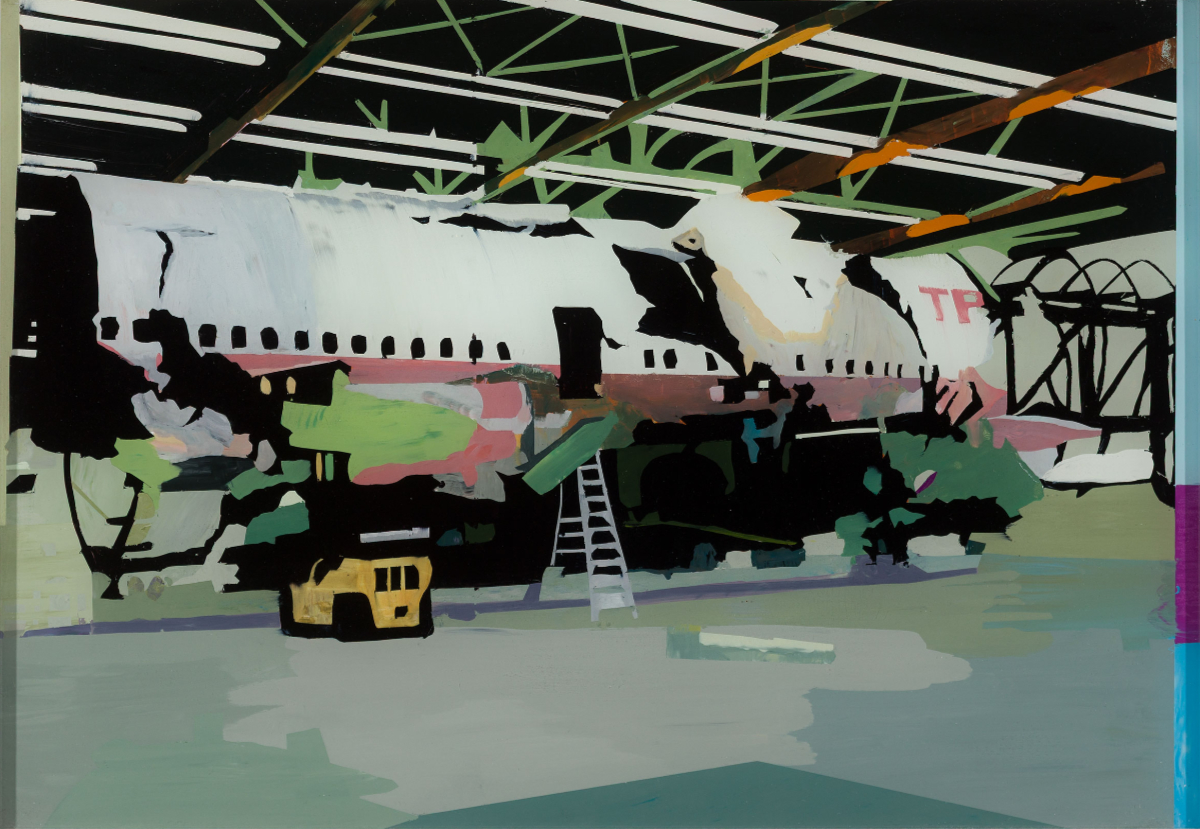
Walking across to the modernist Heide II Gallery is the befitting 30-year survey of David Jolly’s work in Everything Else Falls Away. In complete contrast to Whisson and Foubister’s imaginary, intuitive works, Jolly’s (photo)realistic paintings depict actual places and structures selected from documentary, filmic and photographic images taken by others and more recently himself. With what he calls a ‘travelling, roaming quality across the thirty-year timeframe’, Jolly’s works focus on things seen and overlooked: solid and lasting as well as delicate and ephemeral, and in urban and natural environments across the globe. Subjects include graffiti on walls and trains; post-tsunami detritus on a Sri Lankan shoreline; a dew-laden cobweb; abandoned cars in the Australian outback; clouds of pollution billowing from oil refinery smokestacks; Kuala Lumpur’s Petronas Tower-dominated skyline; Berlin’s Potsdamer Platz; and an empty tarmac and passenger terminal at Tullamarine airport.
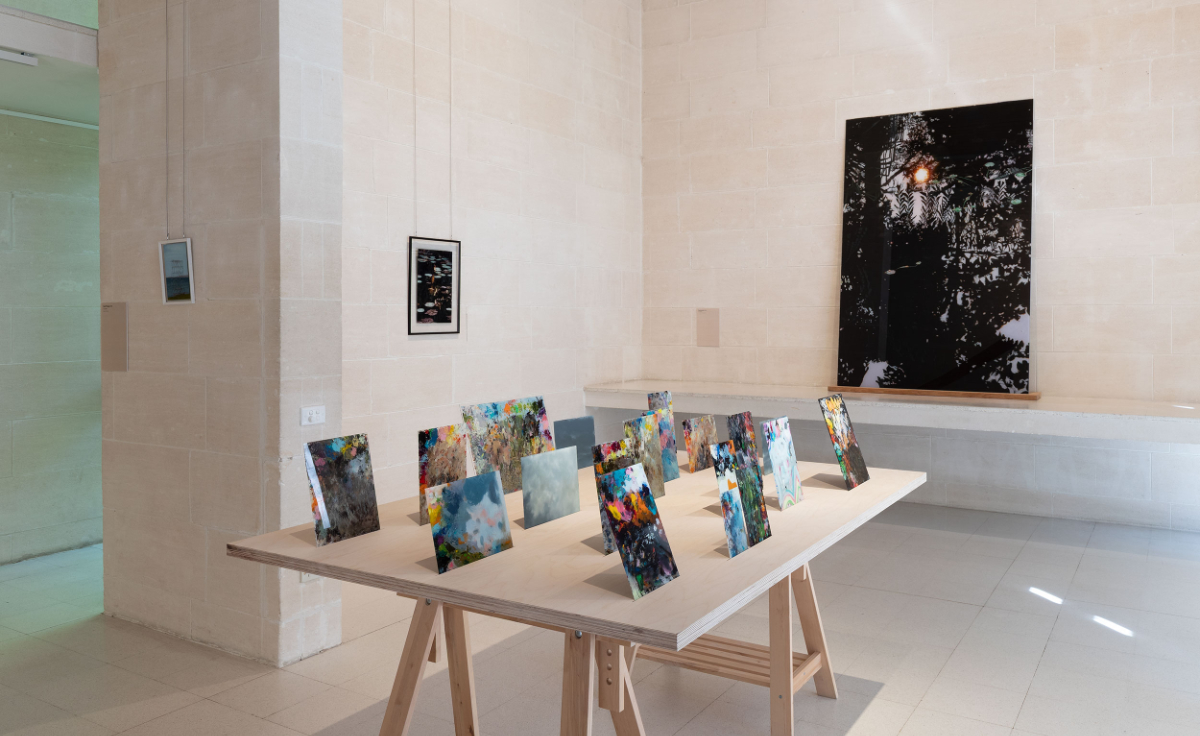
The other contrast is Jolly’s extraordinary technique of painting on glass – backwards! What viewers see from the front is a painting painted in reverse; Jolly begins with the surface layer and finishes with the ground. While his photorealistic imagery alludes to graphic production techniques, using glass in this way both aligns with and inverts two modernist strategies. Firstly, embracing the viewer’s reflection in the glass surface to highlight their involvement in the work’s context and interpretation invites political and environmental awareness. Second, among its modes, modernism deployed smooth, manufactured surfaces to deny all traces of the artist’s hand, but up-close, Jolly’s brushstrokes are evident, as is the paint, a medium he embraces intensely in his installation Birdsong (2015-16). On a table-top sit numerous vertically installed glass “palettes” covered in daubs and small mounds of paint used in an Australian War Memorial commission that realistically depicts ten moments (from about 1500 photographs[3]) of the Centenary of the Gallipoli Campaign[4]. Jolly does not distinguish between the abstract and figurative outcomes of this commission, but perhaps the “messy” palettes are both literal and metaphorical reflections of the adversity of war.
Jolly’s works are dynamic depictions of actual physical things and places captured at specific times in photographic or filmic images and rendered in perceptive and realist, or materialist, detail. Whisson and Foubister’s works are, on the other hand, animated representations of imaginary things and places captured on canvas through an idealist process using intuition and memory. While Whisson’s works appear immediate and externalised, Foubister’s appear more ‘dreamy’, more reflective, of his internal life. Unfortunately, there is only a three-week overlap to see both exhibitions in concert as together they are visually provocative in distinctive ways as all three artists explore what it is to observe, experience, think and be human within our urban, natural–and increasingly fragile–environments.
Footnotes
- ^ Christopher Heathcote, “Rocking the Boat”, Gallery Crawl, 1 May 2026.
- ^ John Foubister website.
- ^ David Jolly and Laura Lanteiri, “A Conversation between David Jolly and Laura Lantieri”, 17 September 2026, catalogue text for David Jolly: Everything Else Falls Away, Heide MoMA.
- ^ Held at Gallipoli Peninsula, Türkiye, in 2015.