Before his premature death in 2019, the Nigerian curator Okwui Enwezor committed himself to what would be—in one sense—his final international exhibition, the fifteenth instalment of the Sharjah Biennial. In a declarative email to the Sharjah Art Foundation president and director Hoor al Qasimi, Enwezor was economical. His thinking, he said, was that the biennial should work with the proposition ‘thinking historically in the present’, and that Sharjah offered ‘a horizon of possibility’ and a ‘theoretical space’ for curatorial and artistic interpretation of the theme. The theatrical flourish of this curatorial statement is qualified however by the next unequivocal line, as if he were taking al Qasimi to task: ‘I’m not interested in doing just another middling contemporary art exhibition that just disappears. I want to engage your entire institution’.
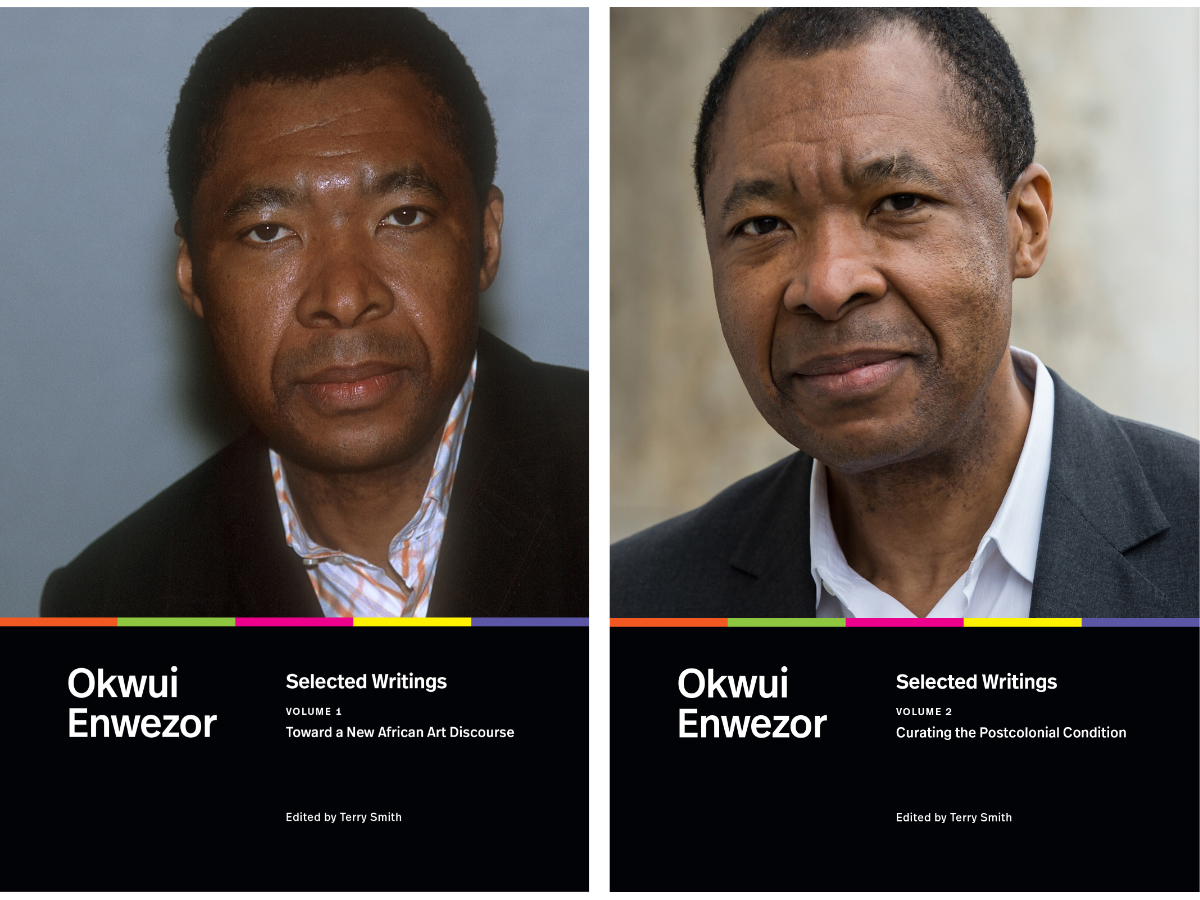
Enwezor never realised his personal vision for Sharjah. Al Qasimi would go on—by mutual agreement—to curate and stage Enwezor’s concept, or her interpretation of it, when it became evident that he was too unwell with cancer to commit further. It was not the only deal Enwezor would strike as he cleared the decks. He would extract a promise from his friend and collaborator, the Australian art historian Terry Smith, then Andrew W. Mellon Professor of Contemporary Art History and Theory at the University of Pittsburgh. Those closest professionally to Enwezor, his longtime collaborators and literary executors Salah M. Hassan and Chika Okeke-Agulu, describe Smith as his ‘veritable intellectual ally’. The depth of their friendship is evident in Smith’s deft curation of Enwezor’s lucid and elegant writing — which ranges over monographic texts on the work of Georges Adeagbo, Ellen Gallagher, Jean-Michel Basquiat, Frank Bowling, Lynette Yiadom-Boakye, Steve McQueen and John Akomfrah to curatorial essays and standalone tracts (as well as transcripts of interviews with Smith and Massimiliano Gioni). Although Hassan and Okeke-Agulu were tasked with the administration of Enwezor’s literary estate, it was Smith who pored over his personal archive to realise this undertaking to the future, published as two volumes in 2025.
An anthology of Enwezor’s writings had long been imagined — and not just by Enwezor himself. But any serious attempt in his lifetime, as Hassan and Okeke-Agulu recall in their preface to the first volume, had been frustrated by the appearance of ‘Okwui the procrastinator’. The animus ensured that Enwezor did not, as his collaborators note, ‘publish a single-authored monograph or collection of his writings in his lifetime’. I find the idea that Enwezor had time to procrastinate in his short 55 years slightly amusing, when you consider his eye-watering list of credits as a curator: Documenta11 (2002), and the biennials in Venice (2015), Seville (2006), Gwangju (2008) and Johannesburg (1997), the Paris Triennale (2012) and one-off exhibitions at the Guggenheim and Tate Modern, sometimes while working his day job as a museum director during a seven-year tenure at the Haus der Kunst in Munich (before his declining health forced him into early retirement). Enwezor was also an educator whose literary output included editorials, exhibition catalogues, readers and critical essays in addition to co-authored anthologies and standalone publications. The first non-European to oversee Documenta and the first African to curate a Venice Biennale, Enwezor was prolific. (Incidentally, Enwezor’s 56th edition of the world’s oldest biennial exhibition All the World’s Futures featured the most Australian artists ever curated into Venice’s main exhibition, including Emily Kam Kngwarray’s symphonic Earth’s Creation (1994), multiple works by Daniel Boyd based on Marshallese star navigation maps from the estate of the Robert Louis Stevenson, as well as assemblages by Newell Harry, the collaborative work of Sonia Leber and David Chesworth, and installations by Emily Floyd and Marco Fusinato).
In one of his magisterial introductory essays, Smith reminds the reader of one extraordinary fact: that Okwui Enwezor was entirely self-taught. His only qualification was a degree in political science gained from what is now New Jersey City University after gravitating to the United States in 1983, later finding his place in downtown New York among the poets who plied their trade at venues such as Nuyorican Poets Café and the Knitting Factory. Significantly, this milieu was artworld-adjacent. Enwezor recalled the halcyon days when he first became acquainted socially with the Jamaican-American artist Nari Ward, in a conversation with Massimiliano Gioni towards the end of his life.
[In 1990] I wasn’t an artist or an art critic or a curator. I was a writer, or an aspiring writer, and a poet, you could say, doing the rounds of poetry readings, art galleries, and museums. We haunted SoHo galleries and Lower East Side dives. We were intensely writing, reading, looking, and – in the jargon of the era – interrogating relations of power and domination.
He acquired his knowledge of contemporary art by being there, by simply being alive and curious. As Hassan and Okeke-Agulu note in their prefatory remarks, Enwezor’s ‘unlikely journey’ from the margins of an art world in which Africa and its global diasporic populations did not largely figure, if at all, to its ‘multiple nodal points’ as a curator, writer, critic and museum director is both ‘remarkable and telling.’ But that trajectory begins with a radical intervention, when Enwezor joined with Hassan and Okeke-Agulu to establish Nka: Journal of Contemporary African Art (in the Igbo language spoken in Nigeria, nka refers to the act of making something, through art or skilled practice). The journal, much like an unwieldy heritage biennale in Europe or a university lecture theatre, was a platform: in this case, to disrupt the lazy, myopic Eurocentrism concentrated in and on the Global North that had blinkered the West since — well, forever.
The first text in the double-volume anthology is drawn from Enwezor’s editorial in the first issue of Nka, published in late 1994. In it, he throws incendiaries at those institutions in Europe and the US — all of them, with their ‘highly policed environments’— where art from contemporary African artists is ‘conspicuously absent’. Enwezor is razor sharp in his critique, labelling attempts by knowledge producers in the West to explain the omission variously as ‘specious’, ‘shallow’ and ‘historically untenable’. Rather than speak of ‘Western influenced’ African contemporary art, Enwezor suggests that the qualifier ‘African influenced’ might be imported into the discursive space of Western modernism. He doubts that it will, in any case, because such a term ‘is potentially distressing to the idea of a wholly autonomous, uninflected Western art historical hierarchy’. The lapse in consciousness that makes three quarters of the world’s population and their art disappear, including First Nations mob here in Australia, is made possible through the ‘systemic obscuring of historical facts’, and other cognitive dissonances to which, it seems, the West is vulnerable. His criticism finds a target in this inaugural essay. In an epic takedown, Enwezor intellectually destroys Africanist curator and art historian (and the Met’s first curator of African art) Susan Vogel’s assertion in her introduction to an edited volume that (with Enwezor’s italics) ‘contact with the West has been the determining experience—though certainly not the only influence—for African art’ in the twentieth century. In counterposing an alternative theory, Enwezor is strident—not rancorous or bitter—though he may well have been. If not straight away, the editor and publisher of this marginal journal lobbing Molotovs into the self-referential, Eurocentric art world that preferred its’ exotic visions and othering constructions if it saw Africa at all, would eventually get his correction.
‘We have no agendas. Nor do we speak for any special interests’, Enwezor declares in his first editorial. But despite the disclaimer, Nka was driven by a need to counteract the absence of contemporary African art, and where it was present, to de-exoticise it, to platform the practice of artists on the continent and to implicate diasporic populations in its narrative. The journal was a platform to make contemporary African art and artists visible, but it also created a space that did not previously exist, where African art’s merits could be debated. By doing so, it challenged specious arguments denying the existence of African contemporary art and/or its modernity or to devalue it as ‘Western influenced’. Enwezor’s editorship of Nka would lead to his first major exhibition, and his breakthrough moment. In/sight: African Photographers, 1940 to the Present in collaboration with Octavio Zaya, was held in 1996 in no less a venue than the Guggenheim in New York. A year later, Africa would host his first biennial exhibition in Johannesburg.
A deft and judicious curator of Enwezor’s widely dispersed writing published over a 25-year period, Smith has acquitted the task Enwezor set, treating his subject and these legacy items of an intrepid and curious mind seriously and honestly, without sliding into hagiography and veneration (hard not to do, I find). Okwui Enwezor: Selected Writings draws together the ‘prodigious and wide-ranging’ scholarship of a visionary curator, who challenged audiences to see what was really there, or to at least question the acuity of their vision. Smith has guaranteed that Enwezor’s analysis of our postcolonial, diasporic global condition and relations of power and domination in a profoundly disordered world doesn’t go the way of those ‘middling contemporary art exhibitions’ that, like so much ephemera or content in an attention economy, ‘just disappear’. A promise kept.