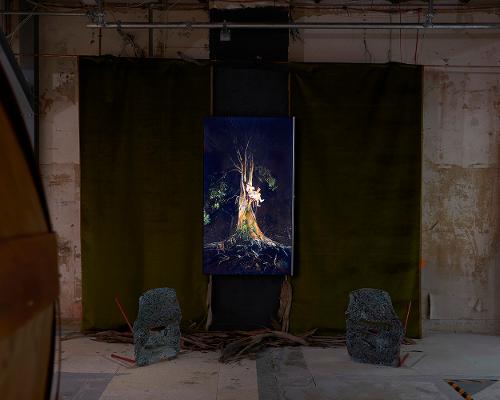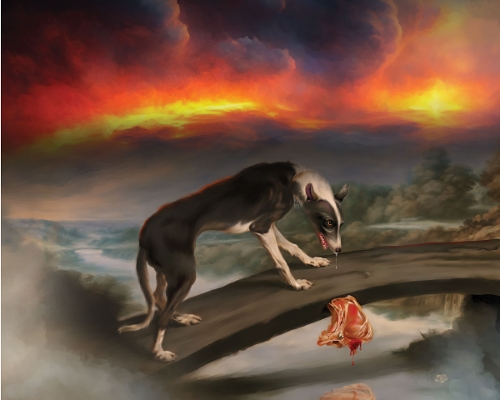
Back after a year off, Dark Mofo has insinuated itself into Nipaluna / Hobart’s nooks and crannies once again, occupying weird spaces with often weird contemporary art. Being weird rather than profane feels like a good move for incoming festival director Chris Twite, who had taken 2024 off to re-think the festival for 2025.
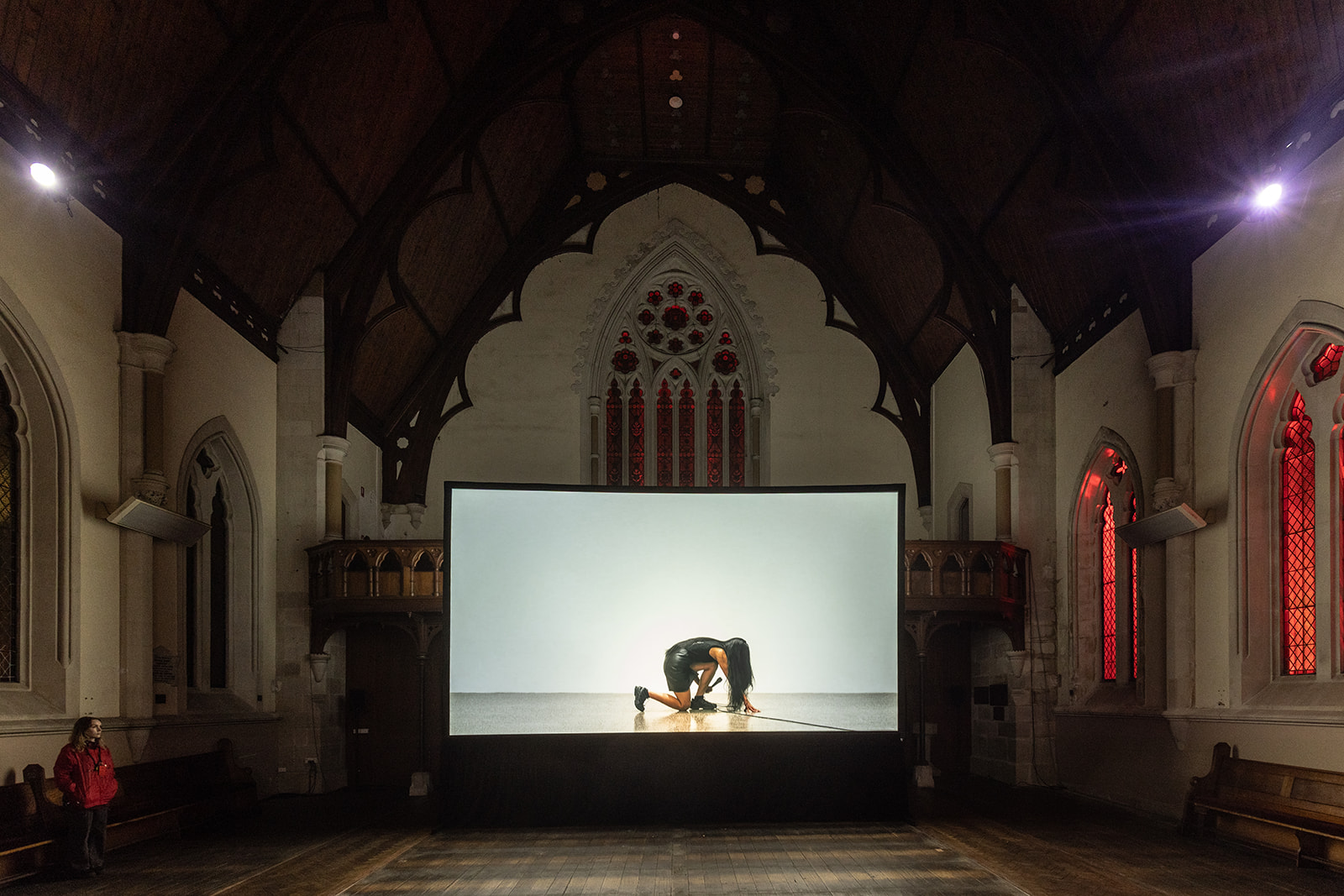
‘Dark’ and its local rituals were certainly missed last year. In the guts of Hobart in the icy June night, drifting flocks of patrons in winter coats followed the signature Dark Mofo red lights from basements to bars to a repurposed church. Baptised the Basilica for the festival, the building glowed red, seeming to leer down Elizabeth Street with insidious promise. Within, the ominous and commanding figure of Travis Ficarra’s Chocolate Goblin (2023) ruled the space. Kneeling in front of a massive pipe organ, the goblin was over four metres high. Grotesque, naked and oddly sexualized, it felt profane in this once-sacred space. Pregnant and gamely flashing peace signs, the goblin watches a screening of Mortal Voice (2022), a ritualised performance of extreme metal vocals, by Indonesian Australian artist Karina Utomo. Her monstrous invocation draws on Southeast Asian witch traditions, well paired with the alien presence of Ficarra’s gargoyle-like figure: an unsettling duo which made Basilica a highlight.
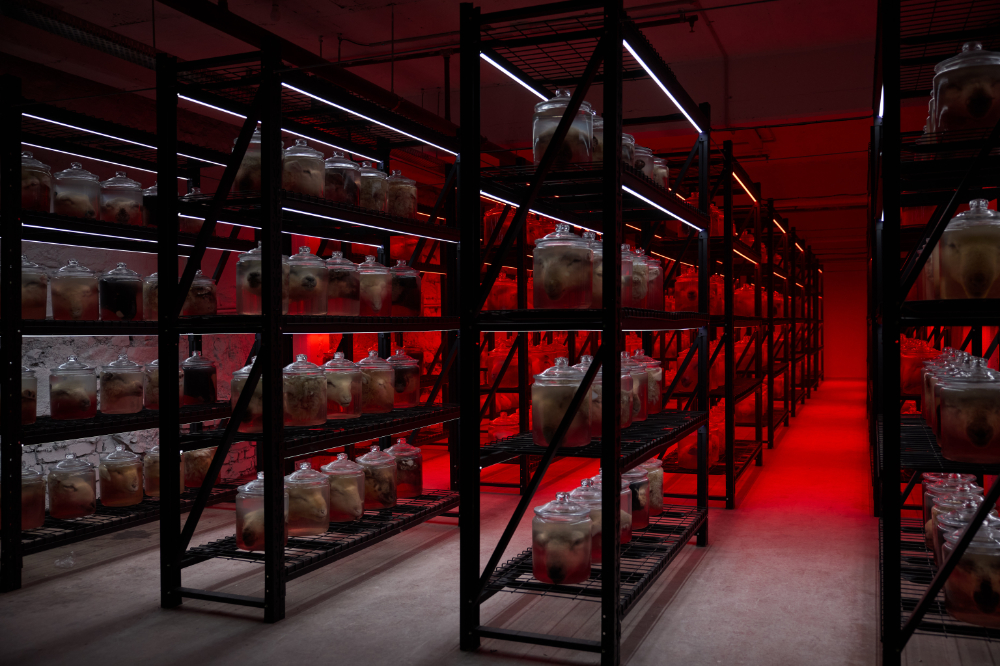
Arguably the most provocative work, Nathan Maynard’s We threw them down the rocks where they had thrown the sheep (2025) is more than weird: the artist and playwright has reached straight for horror, and well he might. Maynard is a Trawulwuy man from the north east Lutruwita / Tasmania, engaging directly with the Cape Grim massacre of 1828, when a group of thirty Aboriginal people were forced over a 60 metre cliff by four armed convict shepherds. The title of Maynard’s work comes from one of the perpetrators, quoted in the journals of George Augustus Robinson.
In a rugged cellar, through a nondescript door on Collins Street, multiple racks of sheep’s heads stare from identical specimen jars. Walking between the racks is an unnerving experience, a disquiet tinged with knowledge of the island’s terrible history of massacres of Aboriginal people. In the era of the Black War (c1824-1832), a sheep was considered more valuable than a human life, and the mortal remains of murdered Aboriginal people were prized scientific specimens. Maynard’s work is not subtle, and his strategy of resorting to this level of gore will be debated, but it’s impossible to ignore the righteous anger that informs this work.
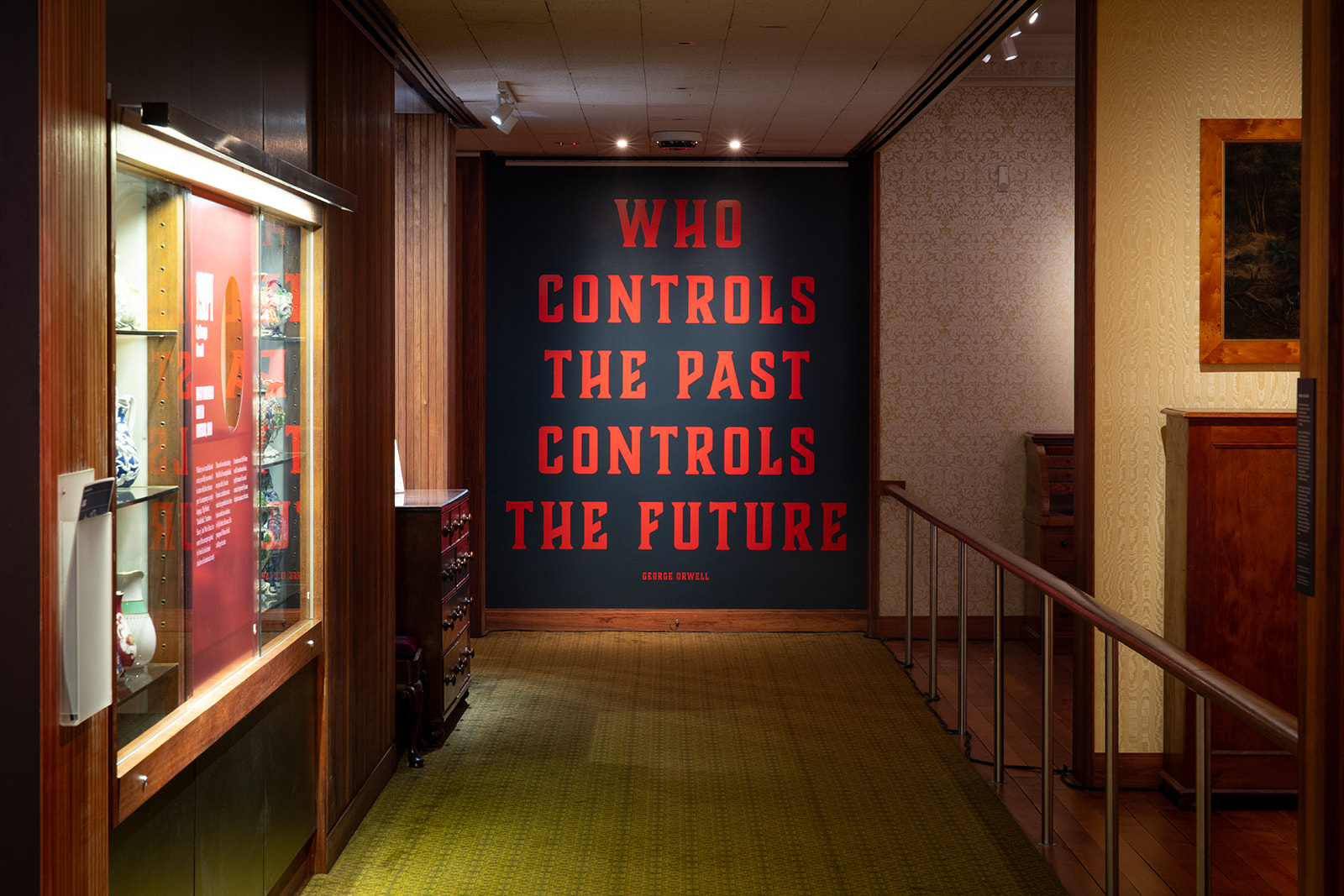
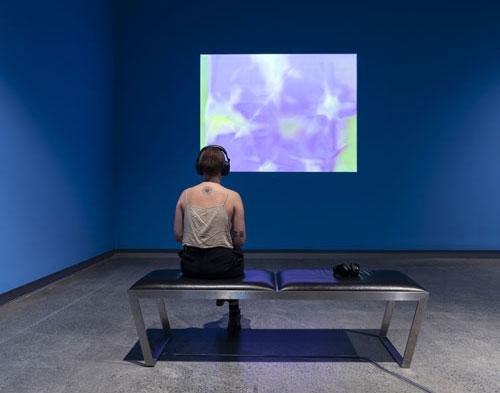
Also dealing with history and who controls the narrative is Hobart-based artist Brigita Ozolins’ Revolution and Silence at the Allport Library and Museum of Fine Art in the State Library. At the entrance, a massive, looping film projection shows books being burned, and in the library setting Ozolins has made huge banner prints quoting George Orwell’s 1984, possibly the most widely read warning about authoritarian regimes that impose cultural censorship. Strident quotes in fascist-nodding red text remind us that ‘who controls the past controls the future’ and that ‘the revolution will be complete when the language is perfect’. These ideas are as disturbing in 2025 as they were in 1949, when Orwell’s classic text was first published. Accompanied by a list of banned books, and their blacklisted authors (in red strikethrough), Revolution and Silence demands our attention to the censorship of history and the history of censorship.
What really sharpens this exhibition though is the selection of actual books, a reading room (so you can make up your own mind), and recordings of significant passages being read aloud. The inclusion of the infamous talking arsehole sequence from William Burroughs’ Naked Lunch (1959) is a strong statement, but the real shock are the more innocuous books like Gender Queer: A Memoir (2019) or Welcome to Sex, published in 2023, that were recently banned and withdrawn in the USA and Australia respectively. Ozolins has worked incredibly hard to engage with the topic of censorship, and she brings this issue into sharp relief at a time when art and artists are so vulnerable to political machinations, cancellations and retractions.
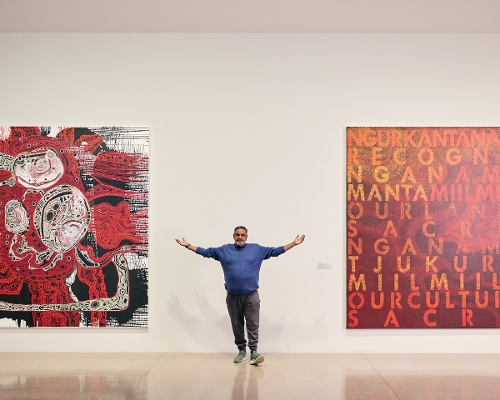
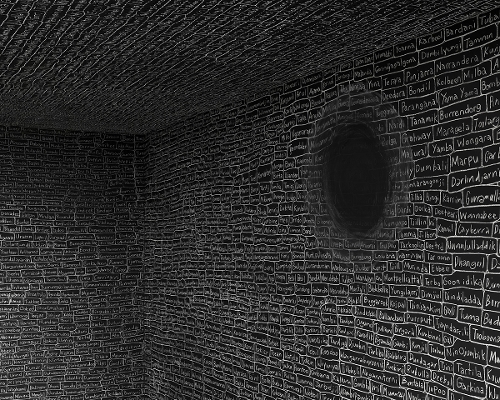
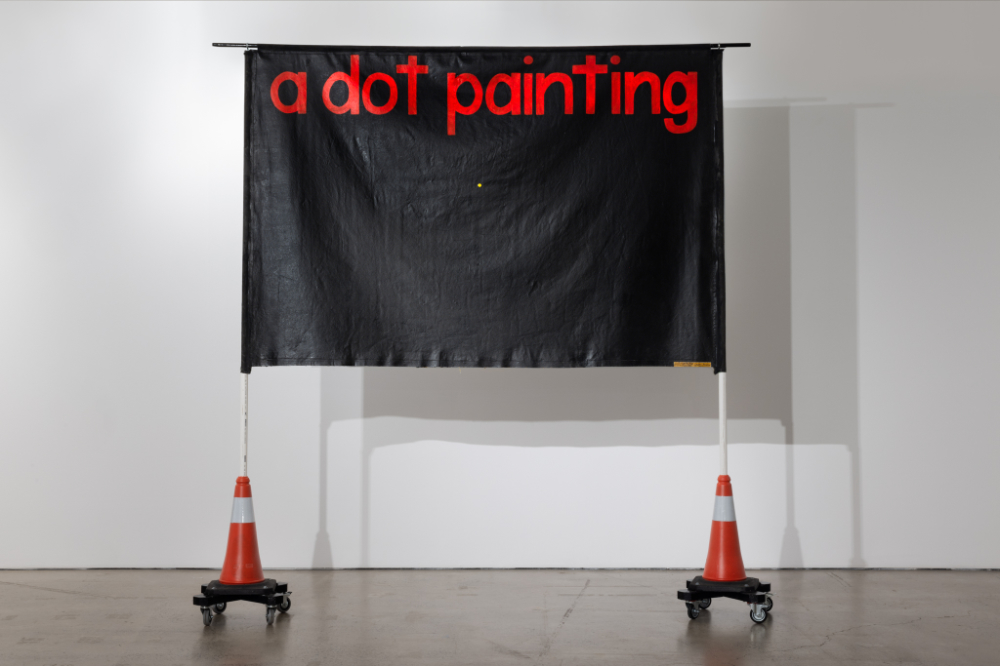
A survey of Waanyi artist Gordon Hookey’s work located at the University of Tasmania’s Plimsoll Gallery offered a striking counterpoint within the festival. Hookey’s characteristic sharp wit was in full swing — he’s a veteran piss-taker who deploys jokes, puns and wordplay. This is very deliberate: like most of his generation, Hookey was denied his Indigenous language, replaced with the imposition of English, but knows what he wants to say. His tactics are an act of resistance to traditions of colonial Australia, giving his paintings and sculptures a distinct aesthetic, but never at the expense of humour. I really enjoyed this exhibition by this seasoned artist, roaring with laughter when I saw A dot painting no. 184 (2022) — a painting of a dot.
%2C%202025%2C%20Arcangelo%20Sassolino%20Photo%20credit_%20Jesse%20Hunniford_Image%20courtesy%20Museum%20of%20Old%20and%20New%20Art%2C%20Hobart%2C%20Tasmania%2C%20Australia%20(2)_web.jpg)
The MONA “Blockbuster” festival event is Arcangelo Sassolino’s in the end, the beginning. Sassolino has a background in engineering, and what he does on one level appears quite simple: if he is dropping molten steel into water and causing sparks to fly, he shows you exactly how. Physics and engineering in action, the vision is realised in an instant of terrible, dangerous release and delivers a breathtaking moment of sublime violence.
Was there a possibility of genuine harm to someone viewing these works? We’d assume not in such a context, but a work like Violenza Casuale (2008–2025) seems to test that line. A hydraulic piston inexorably pushes at a large, solid rectangular slab of wood, eventually shattering it with an astonishing ripple of splinters, at once horrifically abject and unavoidably fascinating: its action is so destructive, so routine and so slow.
No memory without loss (2025) is also a stately work: a vast metal wheel drenched in coloured oil revolves slowly, creating a kind of kinetic, viscous series of drips. The light and oily reflections are gorgeous, and the same kind of material drama found in the torn wood and the molten steel exists here, as the oil drains into a metal catcher, recycled into a self-contained system.
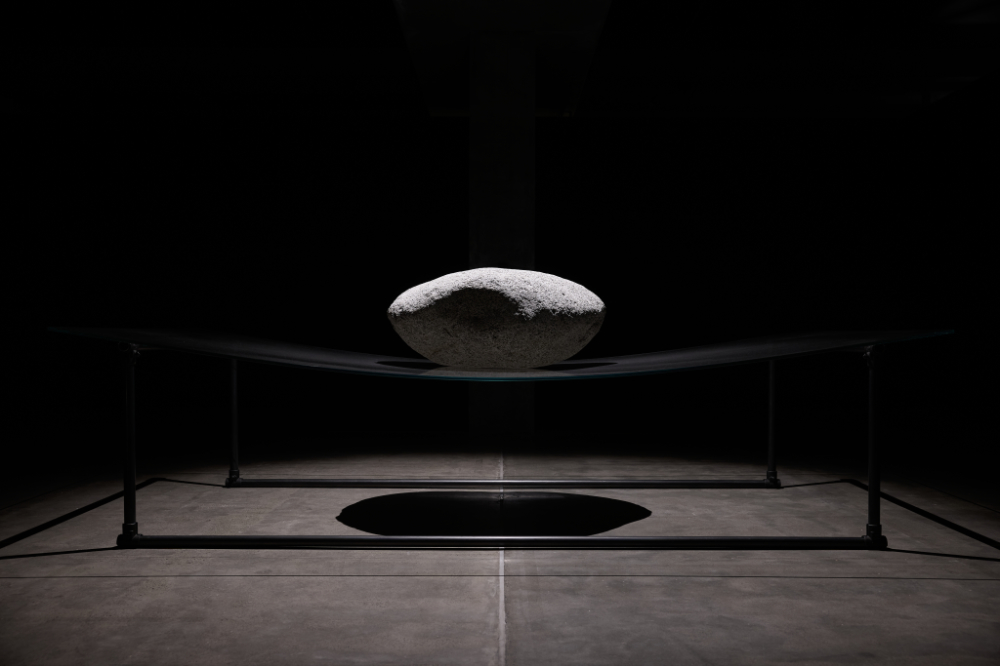
There is no release found in the paradoxical nature of life (2018). A large rock, selected from a glacier in Northern Italy, rests upon a large sheet of curved glass held in place by a table-like structure. The weight of the rock exerts pressure on the glass, creating its distortion. If the rock was removed, the glass would revert to flatness: glass constructed and tempered to the limit, just about to shatter, gives off the most palpable tension.
There are only six works making up this show, but each piece is in firm dialogue: tension, release, danger and precision mesh to create art of rare excellence. Sassolino presented us with the uber-sublime: feelings of actual physical danger. You wonder if the glass will break, deadly splinters snapping, flying into the air, and the molten steel, despite being behind glass, looks as if it would burn any errant flesh.
This is a different kind of confrontation for MONA and for Dark Mofo — it is not art that provokes the idea of ‘wokeness’ or attempts to be ‘edgy’. In the end, the beginning gives us controlled, engineered, precision and shows us exactly where the edges of physical danger are. You can get right up close to the splintering wood, but should you? Sassolino has found something that underlines the risks within work undertaken every day to make our world function as it does — and you cannot help wonder how long this can hold up, and how many people will get hurt in the process?
I found such questions far more interesting to consider than whether I should be allowed to venture an opinion that might seem offensive to someone. The strangely weird yet dark art that emerged from Dark Mofo is a pleasing shift away from their familiar modus of deliberately generating controversy — or at least publicity. An immense hand with a face sternly surveying the waterfront, Ronnie van Hout’s glorious Quasi (2016–) was both comedic and disturbing, a tone-setter for 2025: the hints of the infernal that were a Dark Mofo characteristic have drifted into a realm more defined by The Weird.
.jpg)