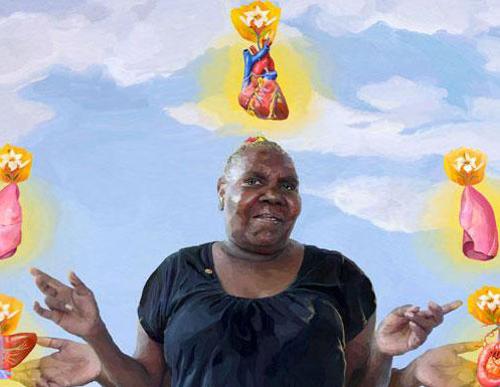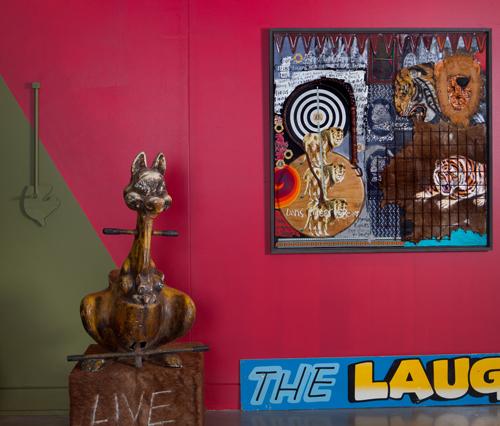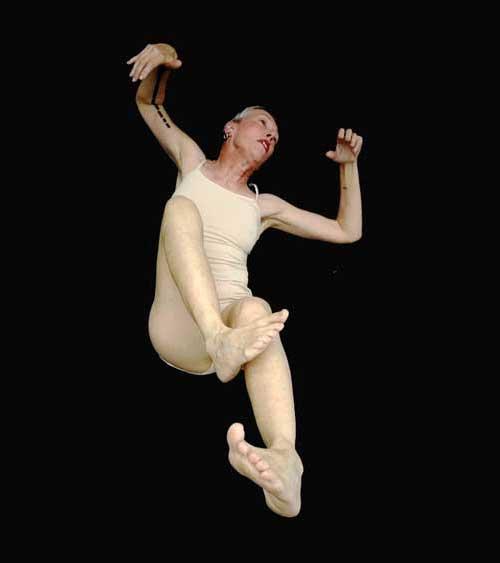
There is a certain kind of pleasure in being lost inside an artwork. Wandering around, looking for an exit. It is a beautiful kind of lost: following new and established patterns, tracing layers and intricacies, navigating through by going further in. It becomes its own journey.
I find my way out through the cracks Jemina Wyman leaves behind: traces of history, of protest, of collective action, of an individual disappearing among the crowd. I explore what she offers in Deep Surface, her survey exhibition at the Samstag Museum of Art in Adelaide. The exhibition began at the QUT Art Museum in Brisbane and will travel to UNSW Galleries in Sydney in early 2027.
Reassembling
There is a certain kind of labour in cutting something apart to find out what it means. A rough compositional idea comes first, and then the figuring out begins. One section is removed, another repositioned. Meaning emerges not from the original arrangement, but from what the cuts reveal when the pieces are assembled into pattern, to conceal and to reveal what each piece suggests. Wyman describes her process this way, and sitting down to write about her work, I recognise something of the same logic.
Ten years ago I wrote about Wyman's Conjuring Radical Openness (2015) at Commonwealth and Council for Hyperallergic and called it ‘a shrine to the many faces of resistance’. I was captivated by the floor-to-ceiling textile work, the bronze figure conjured from draped garments, the dizzying prismatic constellations, and above all by the mask. I wrote about it as if it were a solid thing—a shield that could protect a body from the state's unrelenting eye. A mask was a simple boundary. Inside sat the private self. Outside lay public dissent. Yet they converge in Wyman's collages.
Memory is porous, it does not hold its shape
Everything has changed and nothing has changed. We have survived one Trump presidency and are enduring another. Economic instability persists across the globe. Wars continue. In 2015, protests felt like an aberration, a promise of hope, hot on the heels of Occupy and the Arab Spring, when change felt possible. Walking into the Samstag Museum of Art, that decade-old review feels like it is waiting to be reassembled.
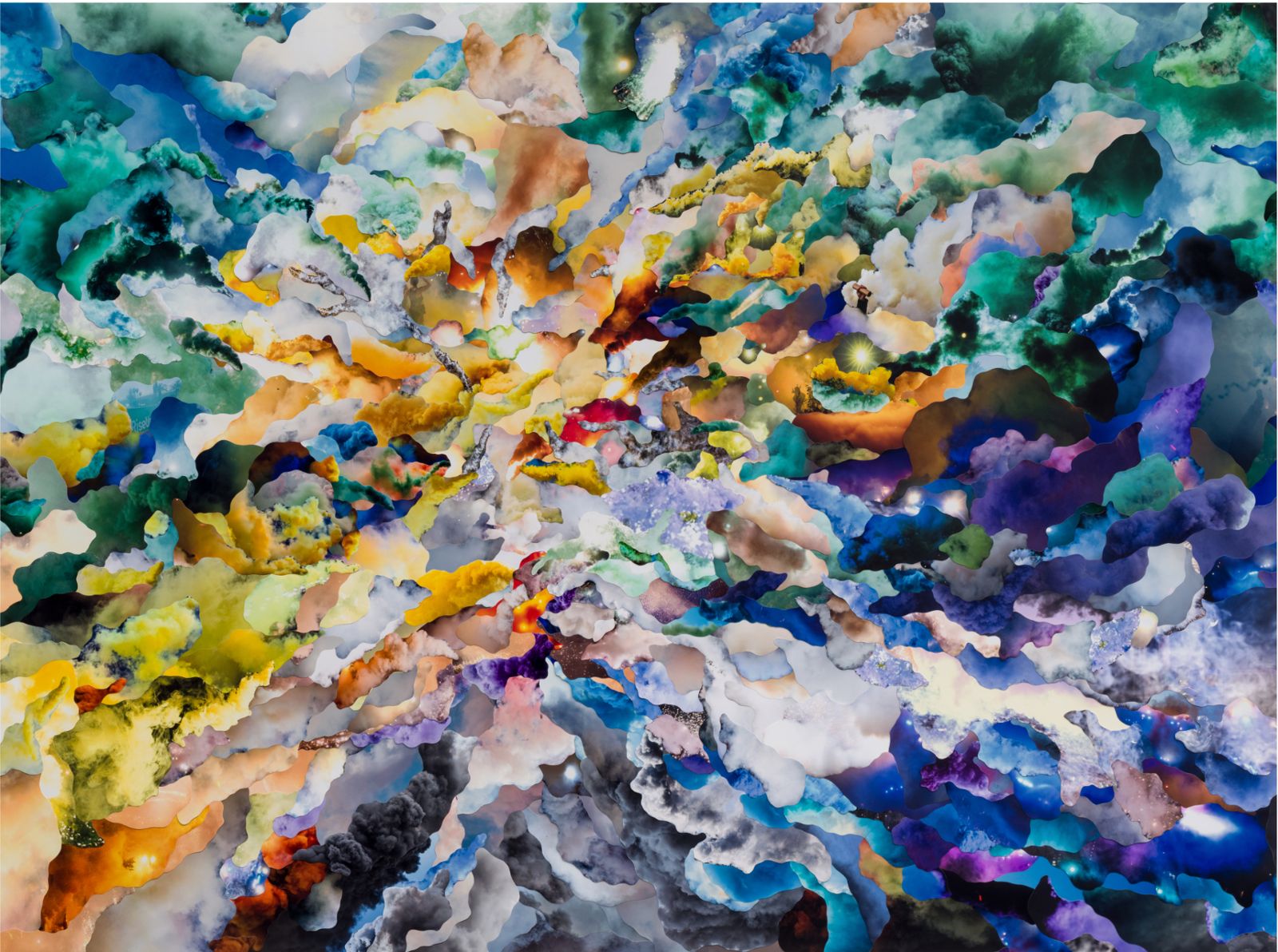
Wyman traces her methodology back to her childhood and her mother's domestic creativity. Her mother could make something out of nothing, building visually exciting environments in the home using basic means. This rooted Wyman's practice in simple materials such as paper, scissors, tape, and glue. As she puts it, ‘my practice is so rooted in DIY-ness and accessible methods, and then just pushing very basic methods into a really complicated process... through labour-intensiveness to make it something else’.[1] This ethos gives her work an accessible surface, but that accessibility is deceptive. In the series Haze (2021–2024), hand-cut photo collages of protest smoke generated from coloured flares or grenades, each work builds a visual drama. Standing before them feels like being inside a nebula. There is no perspective, no horizon, no outside. They are filled with purples, yellows, and rising clouds of grey and black. The forms fold inward. There are no boundaries to push against. Through sheer physical effort, Wyman turns paper cutouts into dense landscapes of overlapping crisis.
.jpg)
Smoke
The Haze works produce the effect of immersion. Their materiality beckons as it shimmers and shines, then disappears. With camouflage and collage, I am drawn to the shimmer, to the disappearing faces hidden under the beauty of the shapes. Standing closer, the faces of the demonstrators are gone. Wyman's cutting process has trimmed them off, leaving only the patterns they wore. The orange of a safety vest, the green-and-brown grid of military and tactical clothing, the chaotic, digitised noise of anti-surveillance camouflage: the crowd has been stripped of names, but their traces remain.
Crisis is not treated as a singular event, but as a condition that accumulates through images, bodies, and publics entangled within contested systems of visibility and concealment. Wyman describes Haze, with its non-hierarchical space as speaking to ‘the polycrisis of this point in time’. The series carries its time, each cycle corresponding to a period of six to twelve months, the way a geological stratum carries pressure.
Wyman’s practice extends a longer tradition of using camouflage, collage, and pattern as strategies for organising perception, one that runs from Dada photomontage through feminist textile practice, while reworking them for the present. But where traditional collage asks the viewer to read the tension between juxtaposed elements, Wyman's method produces a surface that reads as one.
As I look at selected collages in Deep Surface, I wonder whether beauty is the right vehicle for the urgency bound within them. There are moments where the seductiveness is so compelling that the political content recedes behind the aesthetic pleasures of looking. It is a tension the work lives inside rather than resolves, and it is worth getting lost within.
.jpg)
Water
Programmed during Samstag’s kudlila season, for Kaurna people the time when the earth is washed, Deep Surface is a return to the institution that supported her early career through a Samstag Scholarship. (Wyman attended the California Institute of the Arts / CalArts in 2006–07).
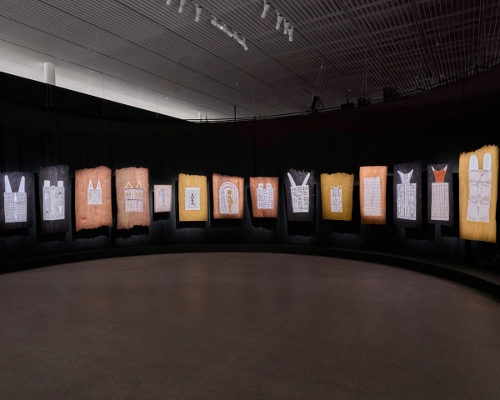
Rise and fall and rise... (2025) is a waterfall of blue fabric hanging in vertical drops of varying heights, pooling onto the floor. The panels range from pale aqua to deep navy, some translucent enough to reveal the wall behind them, others dense with screen-printed motifs of cresting waves, circular arrangements suggesting the globe, and figures submerged in blue. Each panel carries a different water motif drawn from climate crisis protests around the world. In South Africa, protesters dressed as the ocean. Groups in Cornwall mourned the dying sea. Demonstrators dressed in blue gathered at Santa Monica City Hall to protest toxic waste from the Los Angeles fires, a protest Wyman herself attended. She describes the work as ‘swatch installations’, connecting to the history of interior design and patterned fabric, while turning that domestic reference into something monumental. It is perhaps the most urgent work in the exhibition, made only last year, and the most softly devastating.
.jpg)
Ethics and the Archive
Wyman's time at CalArts embedded a core ethical inquiry into her practice. What are you contributing, and how do you interact with the world without generating more problems? For years, this translated into meticulous indexing. She spent days tracking the exact origins of photographs depicting masked protesters. This archival labour anchored her optical, psychedelic aesthetics in real-world political events. Working with masked protesters felt like a permissive space, she explains, because masks invite others to join a cause and to participate in collective action under the cover of anonymity.
The full title of Rise and fall and rise... runs to 354 words, each one a record of a specific protest, a specific body of water, a specific act of collective grief as a way of holding two spaces in tension: ‘I'm very interested in the visual, resistant space and the seductiveness of opticality and psychedelic aesthetics, but they're also related to real world events and real-world experiences, [so] the titling allows the work to operate between and to complicate those two spaces.’ This is where the work resists the flattening of complexity into spectacle. The compositions absorb viewers through layered visual fields of colour, rhythm, and surface, making visible the connections that persist within instability.
Yet as Wyman’s archive grew, tracking every image became an exhausting burden. This led to her Declassified (2023) series, constructed from studio offcuts that literally fell onto the floor and out of her indexical classification. In these works, protestors peek out of the frame and return the gaze. Outstretched arms extend beyond the picture’s frame as the state’s presence retreats into the background. Ethics evolve under the pressure of making, not as failure but as fact.
.jpg)
World-building
Early in her practice during an art school studio critique, Wyman was questioned about her approach to the human body as a pictorial device. At issue were historical associations between the choreography of massed bodies and fascist spectacle, and the potential risk of reinforcing gender tropes. In response, she reclaimed the concept on her own terms, distinguishing between hierarchical organisation and a formal horizontal arrangement, thereby creating an embodied and egalitarian expression of collective unity.
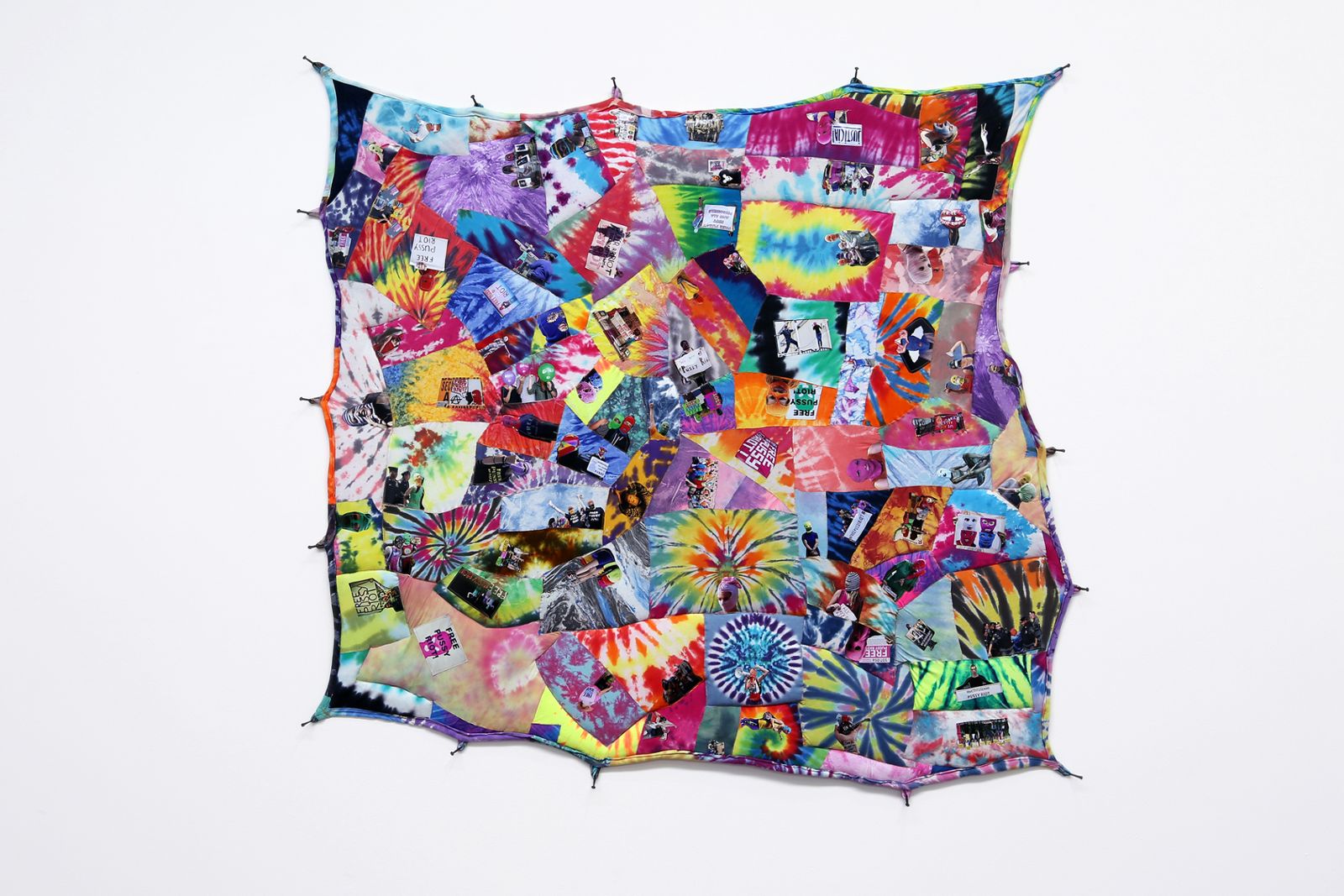
Upstairs at Samstag, the Free Pussy Riot Crazy Quilt (2014), a near-square of tie-dyed T-shirt panels pieced together and pinned at its irregular edges, with hand-cut protest photographs stitched across like dispatches from global solidarity movements. The quilt is hung with heavy black nails, as if keeping the rioters from making more good trouble. Adjacent are several small bronze figures (Protectors, 2015) cast to reflect protest gestures. They appear dark and heavy, small enough to be held in the palm, and dense enough, if pitched into the fray, to become small weapons. As permanent totems, the anonymous archetypes are simultaneously representation, record, and functional object. This material thinking carries over from Wyman’s early performance histories, where she wore full bodysuits and wrestled with physical objects. In both cut paper and cast bronze, materials act as active agents, collages and sculptures in motion and responsive to the conditions that produced them.
Curated by Katherine Dionysius (for QUT Art Museum, Brisbane), the touring survey begins with early conceptual and feminist works from the mid-1990s, making a quiet but firm argument that directs everything that follows; the protest work becomes the latest iteration of a much longer inquiry into how bodies perceive and are perceived in the world. In retrospect Wyman observed that her collage technique was already present in work from the mid-1990s. What she thought she had figured out in 2008 was already there in her undergraduate journals. By including these earlier collages, a continuous process is revealed, a practice that has been circling the same questions about subjectivity, pattern, and the body in the world from the very beginning.
.jpg)
Nothing changed, everything changed
In 2015 I viewed the mask as a metaphor for a shield, with the bust at the centre of the installation as an absent protestor seeking the protection of the gallery space. Deep Surface dismantles that perceived safety. The boundary between the body and the world has dissolved. The camouflage is no longer something worn to hide: the body itself has become the pattern.
Wyman’s work catalogues global protest. Yet, it is equally about what it feels like to be a body in a world that is always already political, porous, and impossible to see from the outside. The compositions do not resolve this condition. They hold it open.
Today, looking at the sheer volume of her practice gathered at Samstag, the work reveals itself as something more demanding than an aestheticised reflection of polycrisis.
There is a certain kind of clarity that only comes from getting lost. Wyman archives protest smoke into an evolving, porous ecosystem. By cutting into the everyday scraps of global conflict, she creates spaces to reassemble our understanding and imagine new ways of being together. The first draft is never the final one. It must be cut into, and what emerges from those assembled cuts is something no one could have predicted.
.jpg)
Footnotes
- ^ All direct quotes from Wyman from an interview with the author, 25 July, 2026.