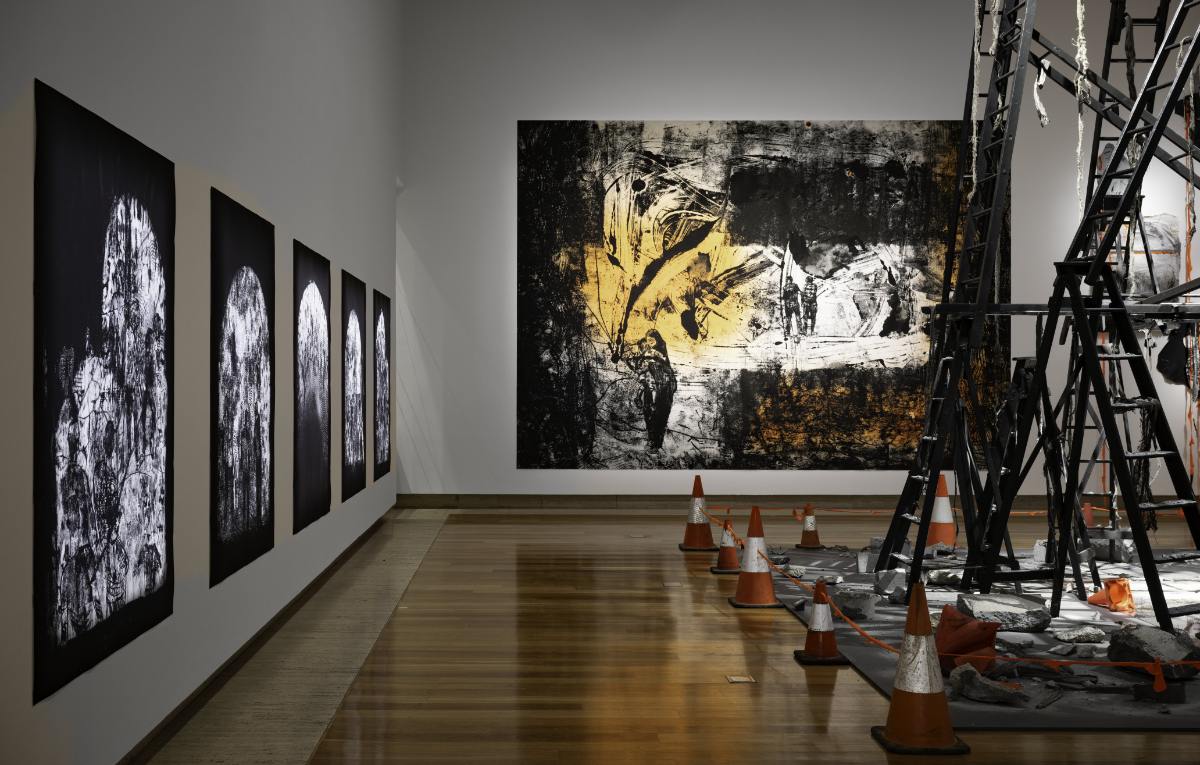
How to make art from a distance in the fallout of war, especially in today’s mediascape with its pornography of violence and suffering? Is there a poetics for torture and genocide, for calling out its architects and memorialising its victims? The traditional tragic mode of myth no longer seems adequate to the task. And not for the first time.
Pat Hoffie: I have loved/I love/I will love struggles under the weight of these questions, but it doesn’t stumble. Installed in the perfect white cube of Gallery 14 at Queensland Art Gallery, the exhibition’s ground-zero is a wreck of debris. Concrete blocks and shattered hunks strewn beneath a construction of a dozen or more black wooden ladders. (In a nod to Vladimir Tatlin, an unbuilt monument to an unrealised utopian social system). A square of mirrors on the floor dead centre reflects the coffered ceiling blocks above and the black-hole sphere of a speaker, target-like. The house-of-cards-centrepiece looks as if it’s held together by some unseen force: with ladders like these, who needs snakes? Hi-vis witches’ hats and lurid tape demarcate the shadowy, unsafe ground. But isn’t it all unsafe? Wherever we stand, this cannot end well.
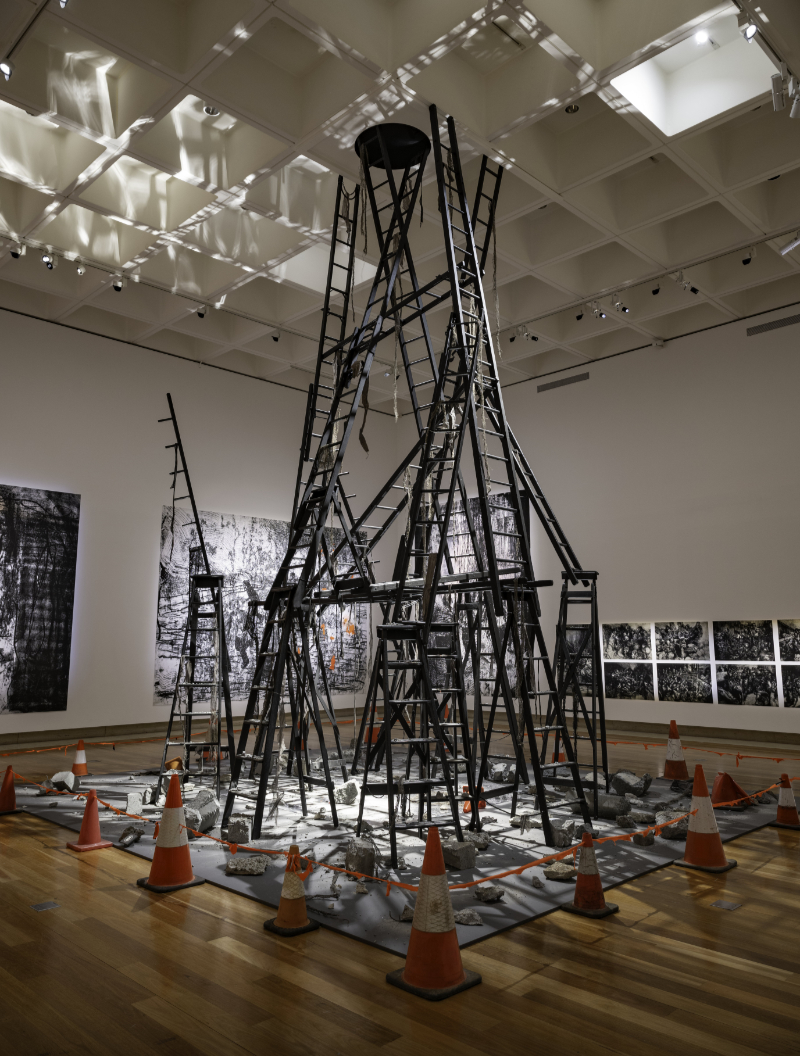
Immersion is a powerful mechanism in art, and size equals might. The scale of the provisional tower is matched on the gallery walls, where unframed multipaneled giclee prints soar upward to create a sense of enclosure, more tarpaulin than paper. The room is a graphic palette of emergency: black, white, grey and Day-Glo orange, and sparingly, the mysterious burnished warmth of flesh. Through fugitive shadows and silhouettes, fleeting figures are glimpsed. Emerging from a storm of sgraffito, a woman wearing a hijab runs towards us, out of the frame, eyes averted, the body of a floppy child gripped to hers. Alive or dead, who can know? Behind her a fiery core radiates explosive heat and two figures—adolescent boys?—turn away, seeming to attend to a minor physical wound against a backdrop of ambiguous chaos. They occupy an illuminated middle ground, a fallen cross, amid violent gestural marks that share a formal resonance with Géricault’s Raft of the Medusa (1818-19) and the visceral wastage that characterises some of Anselm Kiefer's monumental works.
These choppy vignettes continue across the five large works; figures in gasmasks grouped in violent streets, or as often as not, in casual civilian wear, standing around, waiting, watching. Broken. Between crises. Concertina wires, tumbling facades, disintegrating skies: the architecture of panic, flight and fight. Amid the confusion, the human response to the raining emergencies: a child's body pulled from the wreckage, an arm across a shoulder, victims expressing humanity under fire when all sense of agency seems impossible.
.jpg)
Boundaries and borders are provisional across these scenes of destruction, and the compositional edges blur, eyed through the recess of broken rooms and shattered doorways. A single work breaks with the rectangular format in a collage of irregular shapes climbing the wall, greyed-out windows (handmade paper) and textured skins (leather hides) in the measure of human torsos. Cross-hatching, embossing, ink and acid drips, accidental and intentional. Tears and incisions into the matrix. Make no mistake, we are in front of autographic art.
The technical printing process in these amplified works (assisted by Nina White), has eliminated pixels, the dots typically associated with print media, but the work was conceived amid the 24-hour media stream following 7 October 2023. During a 2024 Cobalt Editions Print Studios residency (with master printer Tim Moseley and assistant Jorge Marino Brito), Hoffie created a box set edition of 24 drypoints, MMXXIV (2024), drawn directly onto the plates in Brisbane but responding to Gaza under fire. A veteran artist of social conscience, Hoffie’s subject became that mediated conflict: the ‘inescapably horrific background of each day’, in which she found herself—in global company—'deeply implicated and opaquely tangled’.[1]
Goya’s 80-strong Disasters of War (1810-1820, unpublished due to political sensitives until 1863) are the best-known prototype for such images of human cruelty, only the military technology and killing methods have changed. Victims are still hurled from their domestic setting — interior objects of comfort and home as benign as chairs becoming lethal weapons that signify the end of refuge. Once-protective elements of shelter collide with flesh and limb. Processions of the displaced, meagre material possessions tied to their person, or piled high on makeshift carts, file on to who knows where? Dead are buried on the fly.
Hoffie says ‘you can’t un-see Goya.’ Born of the moving image, I have loved/I love/I will love finds its traction in the scaled-up works which reverberate with Goya’s forceful mark making and intense chiaroscuro—his enduring metonyms for abject desecration—but without his satire. The critic Peter Schjeldahl said ‘the Goya who will haunt us until the end of time is beyond politics and beyond art.’ Hoffie’s gamble is to turn a highly political and unevenly resourced war into art, using a language that is poetic, lyrical and literary. (We can flesh out the storyline well enough).
Two closely pinned displays of more conventionally scaled prints bookend the installation and pull most directly from the MMXXIV series, the artist’s self-confessed and perhaps futile attempt to ‘slow images down.’[2] On the first wall, five works take the shape of church windows, illuminating figures among the abstract surface, disguising actualities until picking through the calligraphic bones and ghostly allusions: Albert Tucker’s psychological anguish, Kathe Kollwitz’ grief-stricken mothers. To get here, Hoffie has enlisted the whole family of intaglio printing techniques. A purist may object to this spirited approach that wrestles from the technical subtleties of the printmaking tradition—to which Hoffie is a recent migrant—an allegory for such brutality.
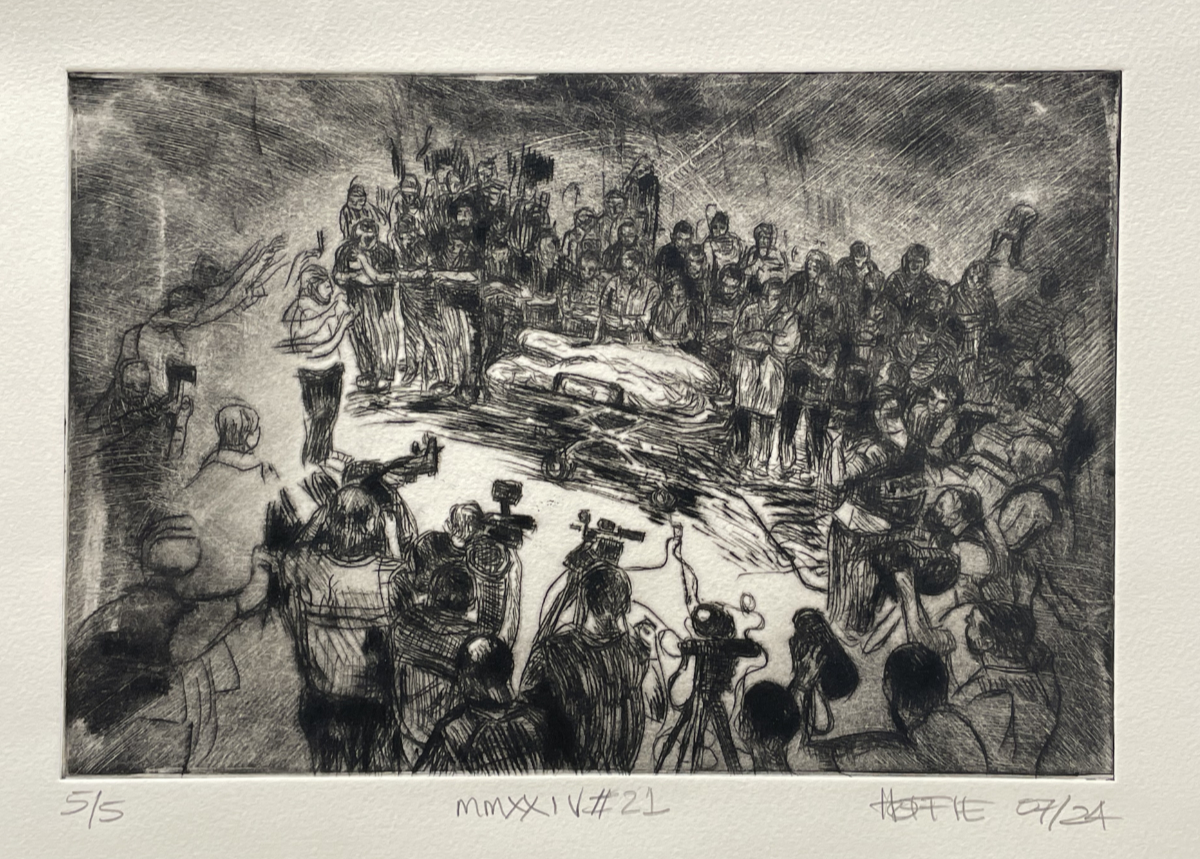
On the last wall ten prints mimic the dimensions of TV screens or gaming monitors depicting images of warfare and displacement: a brace of mothers stretching empty bowls in desperate hope of some skerrick of aid; journalists working, people reeling, falling, digging, mourning. A Jewish funeral from images of October 2023. A Palestinian crowd pulling kith and kin from the rubble: all we have to go by is the customary headwear, a media cipher for sides, not individuals.
Adjacent to QAG’s water mall, Pat Hoffie: I have loved/I love/I will love sits alongside Under a Modern Sun: Art in Queensland 1930s–1950s. This sunny collection display of regional statehood is an astute curatorial strategy, a nostalgic placemaking project in which some artists were gently engaging with international modernism at a time of last century’s rising nationalism—though at least one young Queensland artist protested during World War Two that local gallery walls were hung with vases of flowers while ‘…millions of starving and tortured people in Europe are breathing their last…’[3] Under a Modern Sun’s date-range spans the creation of Guernica (1937), when Picasso helped show the world what aerial saturation-bombing of a civilian population looked and felt like. Stepping into the sunshine and upriver to GOMA, one can experience how aesthetically sublime another war—Australia’s colonial project—can look and feel: Archie Moore’s kith and kin (2024), the star returned.
In Hoffie’s quarter, the gallery walls are not painted black, as you might expect for a subject so dark in its genesis. As the disarming wall text reminds visitors, (without naming the war), ‘in our current cultural climate, the art museum is practically the only place where we can actually step back from our own present and compare it with other historical eras.’ (Boris Groys, 2006). But getting such work in the art museum is half the battle, and over the past two years, acutely so. Consider the millions of dollars and angst spent on the Venice 2026 debacle and the censored Palestinian flag in a banner by the Indigenous Pacific artists’ collective the SaVĀge K’lub, who were invited to respond to (i.e., ‘decolonise’) Gauguin at the National Gallery of Australia in 2024. Cleary, art does not have an open passport to ‘the place’ where we can ‘step back.’ With Pat Hoffie: I have loved/I love/I will love, QAGOMA has picked up the baton.
.jpg)
Footnotes
- ^ Pat Hoffie, forward to the box set of 24 drypoint etchings, MMXXIV, 2024. (Brisbane: Cobalt Editions / Griffith University, 2024)
- ^ Pat Hoffie, I have loved/I love/I will love, limited edition artist’s book (Brisbane: Tiny Donkey Publications, 2025) np
- ^ The artist was Laurence Collinson of the Miya Studio in Brisbane. Cited in Under a Modern Sun: Art in Queensland 1930s-1950s, exh. cat. (South Brisbane: QAGOMA, 2025), 34