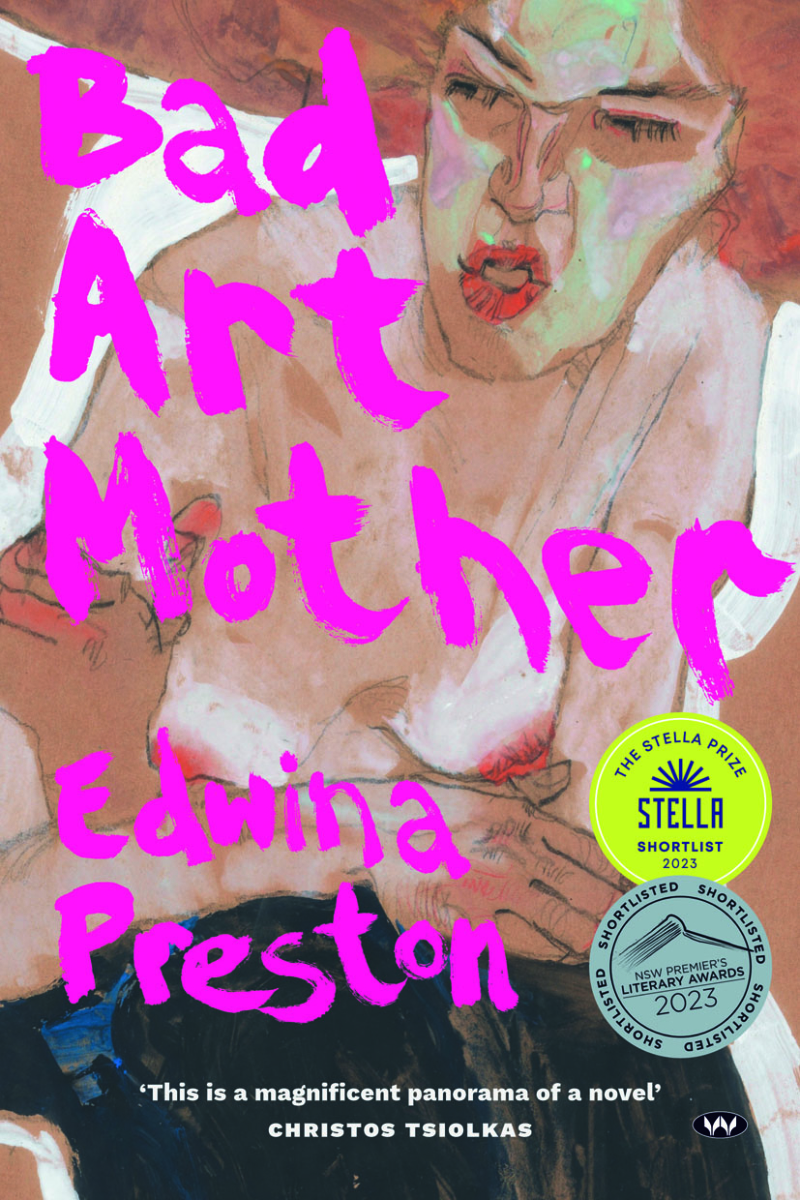
Edwina Preston’s Bad Art Mother (2022) is a narrative about motherhood leading to an artist’s withdrawal from the arts industry and vice versa. Veda, an ambivalent housewife and zealous poet in 1960s Melbourne, grants legal guardianship of her young son to a wealthy couple, the Parishes, to allow her more time to write. As implied by the title, this exchange isn’t so simple. She’s a complex figure in a world where sexism and artistic precarity overlap, and motherhood and creative labour remain mutually exclusive. The book is a historical mediation that endures: even if doors look open, gendered expectations still often freeze women out of full participation and recognition in the arts.
The book views Veda’s struggles through her son Owen’s memories, retold in adulthood. He speaks of the coming and going of family and friends, framing a story familiar to the vintage Melbourne landscape referenced throughout.[1] His narrative meanders like childhood does, blurred by a blend of naivety, curiosity and increasingly patriarchal conditioning, as he tries to make sense of his parents’ personhoods and the art world he’s immersed in from a young age. Mostly, he observes his various women caretakers: Ornella, his childless aunt, owing her steady presence to a lack of creative bones; Rosa, his restaurateur father Jo’s long-term waitress, who is also a humble artist seeking space to show her work; Mrs Parish, whose seemingly domestic hobbies bloom as craft. For his mother, he extends both empathy and judgment as she shifts in her role toward him, sometimes nurturing, sometimes neglectful, but by no means a stereotypical mother. As he comments in the book’s opening, she ‘never settled into a reliable shape.’
Preston situates her characters on the cusp of second-wave feminism, when inequities in home and art would be critiqued through interventions such as the International Women’s Year exhibitions (1975), the Aboriginal Women’s Exhibition (1991) and the National Women’s Art Exhibition (1995). Texts such as Anne Summers’ Damned Whores and God’s Police (1975) would similarly contest the exclusion of women like Veda, who failed to fit the “good mother” ideal in Australian society.
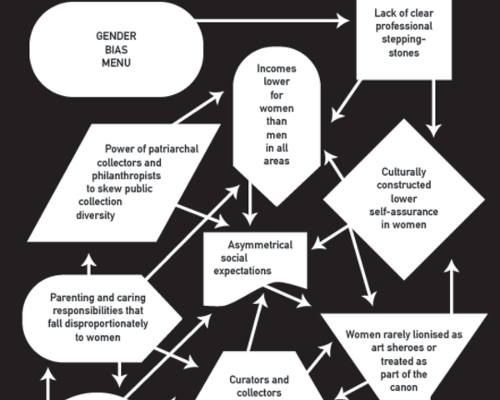
Though the story is a product of its time, it isn’t a historical relic. ‘The Australia I wrote about in the early 1970s has not changed totally beyond recognition,’ Summers wrote in 2015.[2] Women now have a presence in the art world, earning 70% of art degrees and making up 53% of the workforce, with frequent initiatives challenging the male-centric canon and highlighting overlooked practices.[3] But constraint and friction remain, despite new freedoms, as they continue to lose out across the art market, leadership roles, art prizes, acquisitions and financial income.
Counting is a feminist strategy, but we can also understand the embodied experience behind statistics by reading fictional accounts like Bad Art Mother and observing our own lives and the lives of women around us. An hour after I received Artlink’s email commission for The Mother Issue, I had a surprise positive pregnancy test. The compromises and pressures that limit mothers in this already challenging industry flooded my mind. As artist Sanné Mestrom told the Museum of Contemporary Art in an interview about her practice on International Women’s Day in 2019, ‘I felt that if I had had a baby earlier I would have disappeared into obscurity, forgotten by the art world, unable to find the momentum to return.’
A week after my abortion, I sat on a playmat babysitting, trying to steal moments to start Bad Art Mother — making up for the month that morning sickness had cost my practice. The toddler would look up from his toys to catch me distracted, triggering a cry that’d last for hours. Preston queries this multilayered paradox as Owen shares that Julia, his life partner, believes his ‘childhood was all about the adults in it,’ before adding that they didn’t have children because they’d harm them with selfishness. He continues, ‘But by that logic, should anyone have children?’
Caregiving is consuming, as is other labour that exists beside it; it’s a fragile double bind. Whatever gives way—creative work, for example—isn’t caused by parenthood itself, but by consequences and meanings we attach to motherhood. After all, men’s opportunities statistically increase when they become parents (or husbands).[4] As a host of women bring up Owen, workaholic Jo and famous poet Mr Parish remain unaffected, never vilified for their work obsessions while performing the casual role of Owen’s father-figures. Despite their connections and some superficial gestures, they mostly dismiss and harm the pursuits of creative women in their lives. They’re too distracted by, and defensive of, their own freedom to grasp what they gain (and what women lose) from selfishness versus sacrifice. As Owen later reflects, ‘Papa has no interest in the past. Though his life is a total sum of it.’
Meanwhile, Veda is scrutinised, judged as ‘troubled’ for prioritising her ambitions alongside her child. While Preston gives Owen most narrative oversight, she affords Veda a voice through letters to her sister Tilde. Granted this glimpse into her inner world, we realise she’s consumed not just by creativity, but by the professional and emotional baggage that comes with it. ‘I have had another rash of rejections. I think it is wise to describe them as a rash: it helps me see them as a temporary disfigurement rather than a permanent affliction,’ she writes.
In Veda’s letters, her declining self-worth and mental health bring a personal undercurrent to the book’s more politically didactic overtones. Preston’s anti-hero straddles the home and the art world, fitting into neither. Soon, she discovers her privileges and zest—a wealthy husband, ample childcare, and eagerness to write—aren’t enough. Her resentment spills over at a male-dominated dinner party, and again at a men-only bar. Near the book’s conclusion, this rebellion mutates into shame more than hope as she finds her barriers to be impassable. ‘I don’t have a natural affinity for anything. Not motherhood, not wifehood, not poetry,’ she says in a letter, ‘I look at the products of my efforts and see they are too small, too fragile to be in the world. I see that the world will not want them.’ Hostility—from both the art world and the home—severed her from her practice and family. Or as Owen recalls, his mother had ‘nothing left to stand on.’
Preston isn’t only depicting a pre-second-wave female artist, but a site of struggle far from resolved in the twenty-first century. Is her loss our permanent affliction or a temporary rash? Motherhood, paired with a belief in one’s creative instincts, shouldn’t be a disappearing act.
Footnotes
- ^ Preston loosely bases the plot turning point on an acrostic poem by Gwen Harwood, and her characters on some of the Heide circle from mid-20th century Melbourne: Georges and Mirka Mora, Joy Hester and John and Sunday Reed. Owen is based on Sweeney Reed, Hester’s child (with Albert Tucker) adopted by the childless Reeds
- ^ Anne Summers, Damned Whores and God’s Police (Sydney: NewSouth, 1975, reissued 2016)
- ^ Bill Browne, “Women and men in arts and entertainment” (Canberra: The Australia Institute, May 2021); National Gallery of Australia, Know My Name: Gender equity in the arts and culture context 8 March 2022
- ^ Danielle J. Lindemann, Carly A. Rush and Steven J. Tepper, “An Asymmetrical Portrait: Exploring Gendered Income Inequality in the Arts,” Social Currents 3:4 (2016): 332–348