It is encouraging to see an institution like Rockhampton Museum of Art (RMOA) centring Queensland art as timely and provocative—not only for metropolitan, national and international audiences, but for those at home in regional contexts. Since officially reopening in 2022 following a major architectural redevelopment, RMOA has been commissioning and exhibiting ambitious works by established artists in important national conversations. Leveraging a growing interest in Queensland stories, State of the Art: Reimagining Queensland, co-curated by six current and former RMOA staff members is the latest in this programming shift; it features eighteen artists affiliated with Queensland and works spanning five decades.
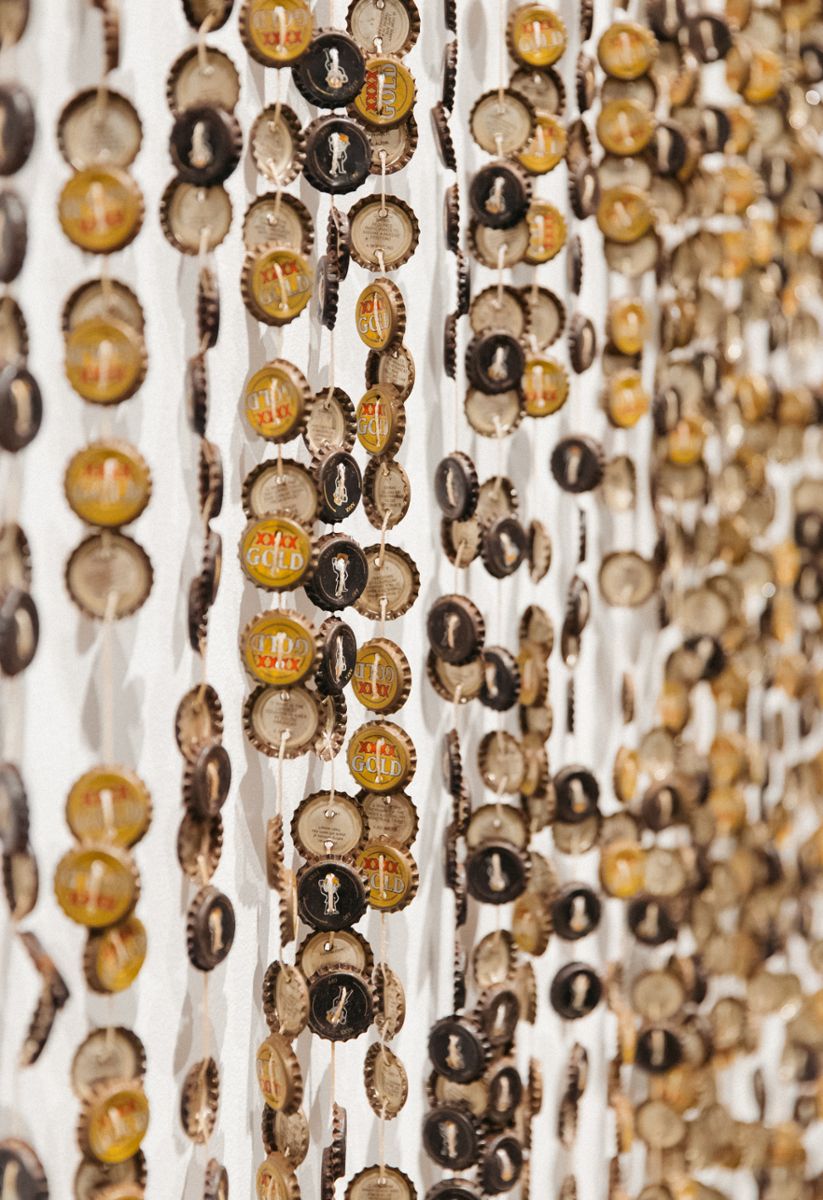
Of course, this impression of interest and intrigue may be biased and Queensland-centric, or so the tongue-in-cheek first work encountered in the exhibition implies. Noel McKenna’s Map of Australia Drawn by a Queenslander (2004) presents a minimalist map with a skewed, exaggerated scale of Queensland in proportion to the other states. The artist’s other works—a series of text-based ceramic Australian maps and a curtain of XXXX beer bottle caps—echo this sense of larrikinism and ironic state pride. Despite moving south years prior to creating these works, McKenna’s appreciation of the vernacular and humour of his youth, and of ordinary Queenslanders, is palpable in these playful works.
Nostalgia and the everyday are also evident in subsequent works by Rachel Burke and Glen O’Malley, despite their material differences. O’Malley’s thirteen black and white photographs (taken between 1974 and 2021) interweave suburban backyards in Meanjin/Brisbane with rural Queensland scenes and their residents, predominantly in small country towns along the east coast. The photographs highlight active Queenslanders going about their business, engaging with animals and the outdoors. Burke’s works, in contrast, allude to interior histories — of craft, domesticity and personal reflection. The artist’s multi-coloured, plastic quilt You Are My Sunshine (2025) and Daisy Dress (2025)—each constructed from tens of thousands of melty beads—are tributes to her sunny home state. They commemorate Burke’s commonplace experiences of gathering with friends to share stories, and of bittersweet memories with her canine companion Daisy.
By placing these three artists’ works at the exhibition entrance, the curators frame State of the Art to recognise individualism and difference within discussions of the collective state identity. The perspectives and styles appear suburban, idealised and Eurocentric. What follows throughout the sprawling, high-ceilinged gallery space, is a maximalist collection of diverse works which occasionally support this framing, but more often complicate it — bringing in perspectives grounded in cultural practice, lived history, and relationships to territory that unsettle singular views of Queensland identity.
This range is one of the exhibition’s great conceptual strengths, reflecting the scale and multiplicity of Queensland itself. The exhibiting artists and their subjects span geographic locations, communicating multiculturalism and varied migration narratives; of diaspora, the Stolen Generations, those indentured into labour and the broader impacts of colonisation. They also span genders, ages and career levels, with works of various artistic styles and mediums (despite being predominantly wall-based displays).
While there are strong thematic links between some groups of work, this mixture does lead to an exhibition that is often aesthetically and tonally jarring. Burke’s fluoro-pink-tinged kitsch works, for instance, are in direct relation to the more subtle, abstracted paintings of Clare Jaque Vasquez. The artist’s beautifully rendered interpretations of weaving practice explore her Gomeroi/Kamilaroi Country and connections between the Great Dividing Range and Queensland histories and borders. These aerial canvases blur the state’s legislative boundary markers, a nineteenth century imposition onto more fluid borders which existed pre-colonisation for tens of thousands of years. Jaque Vasquez’s work decentres ‘Queensland’ and these ostensibly arbitrary boundaries in favour of ancestral connections to weaving, Country and cultural knowledge.
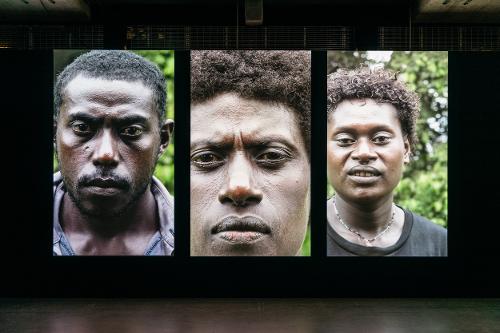
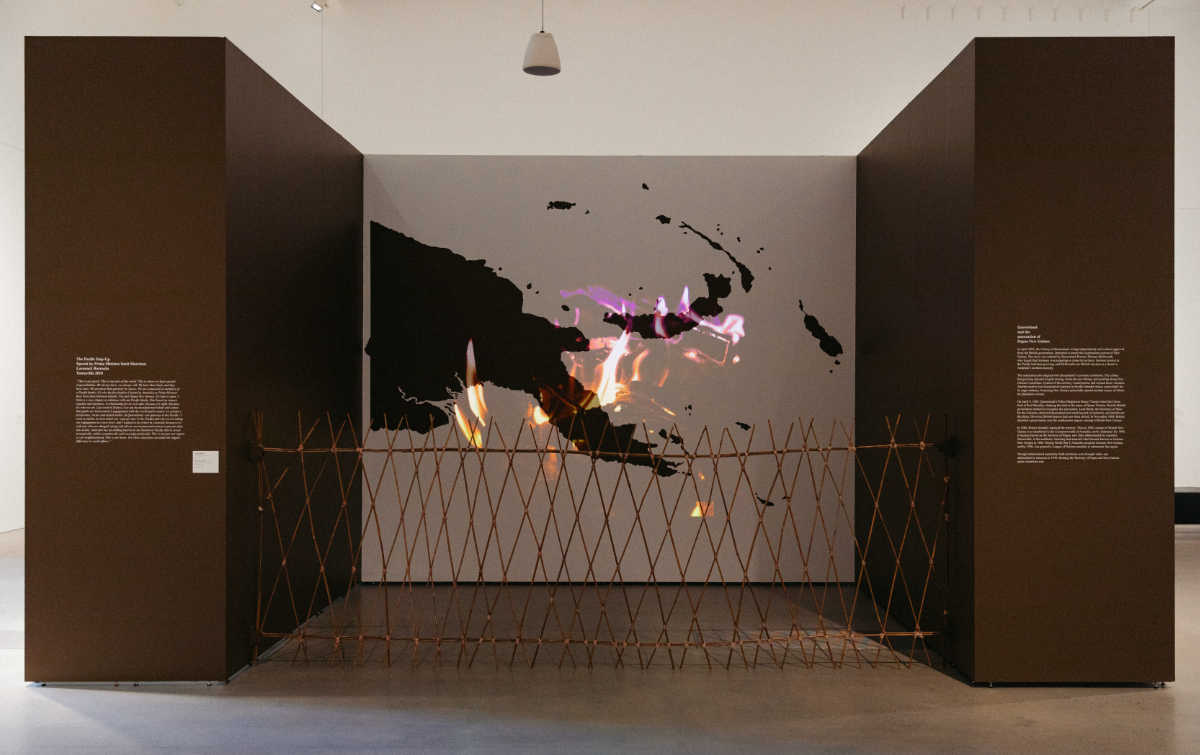
State of the Art platforms several more artists who share complex relationships to such histories. Originally from Papua New Guinea, Wendy Mocke engages with an even more recent history of reclamation and decolonisation. Her digital video work Our Patch (2025) commemorates the 50th anniversary of Papua New Guinea’s independence from Australia’s imposed administration over the territory for nearly 70 years, following German and British control. Within this context, Mocke examines Queensland’s ongoing relationship with Papua New Guinea—including communities who have migrated to the state—and considers the legacies of these colonial histories.
An 1880s photograph is a key inclusion within Mocke’s documentary-style approach. The archival photo features a group of Papuans behind a latticed bamboo fence, looking towards a larger group of more heavily dressed European figures in a government or mission building. Re-staging the fence as an installation in front of the projected work, Mocke forces the viewer into the position of the Papua New Guinea citizens. The film’s audio dominates the entire gallery space; contemporary voices offer recurrent phrasing, powerfully questioning: ‘Fifty years on… Are we still behind the fence?’
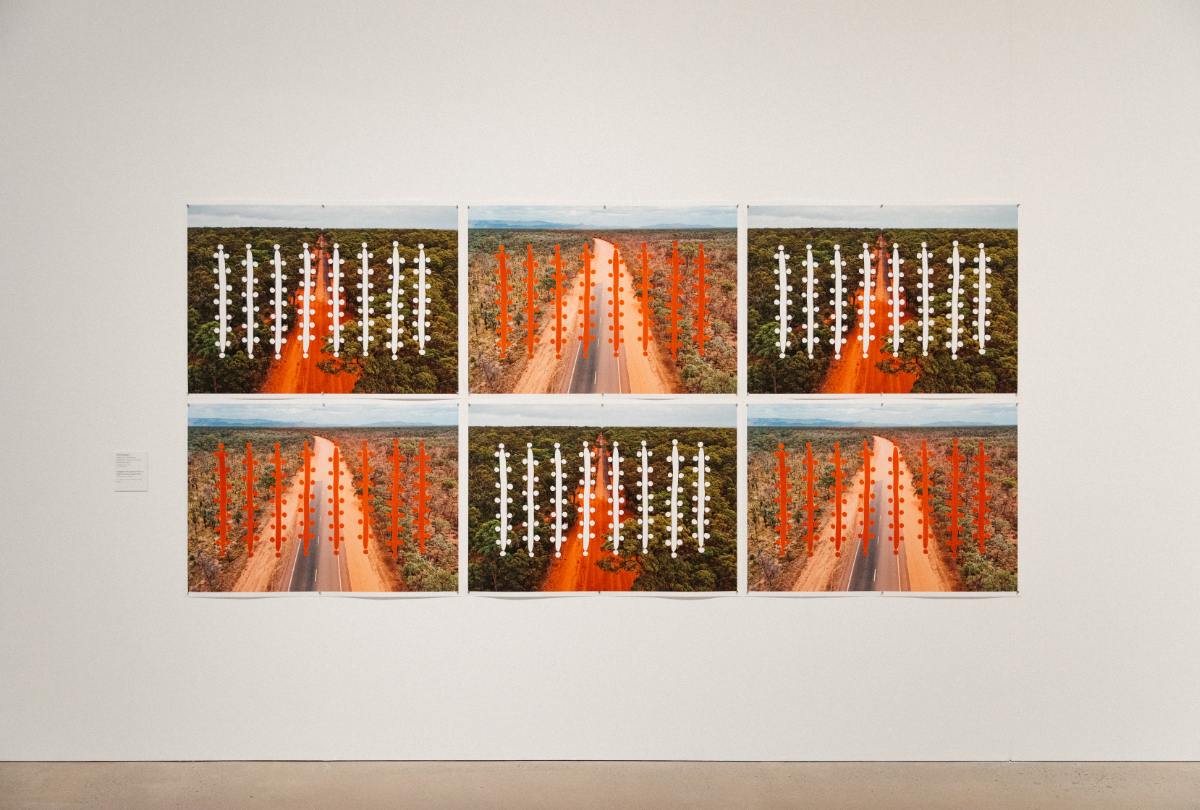
Teho Ropeyarn’s Ungganju Ana (going north to Cape York Peninsula) (2025) is another highlight. It features six panels of highly saturated aerial drone photographs of the Peninsula Development Road from Ropeyarn’s base in Gimuy/Cairns to his home Country on Cape York Peninsula. The broken white lines of the bitumen road, splaying apart the red dirt, rich vegetation on either side, are overlaid with Ropeyarn’s culturally distinctive mark-making, providing visual and conceptual tension.
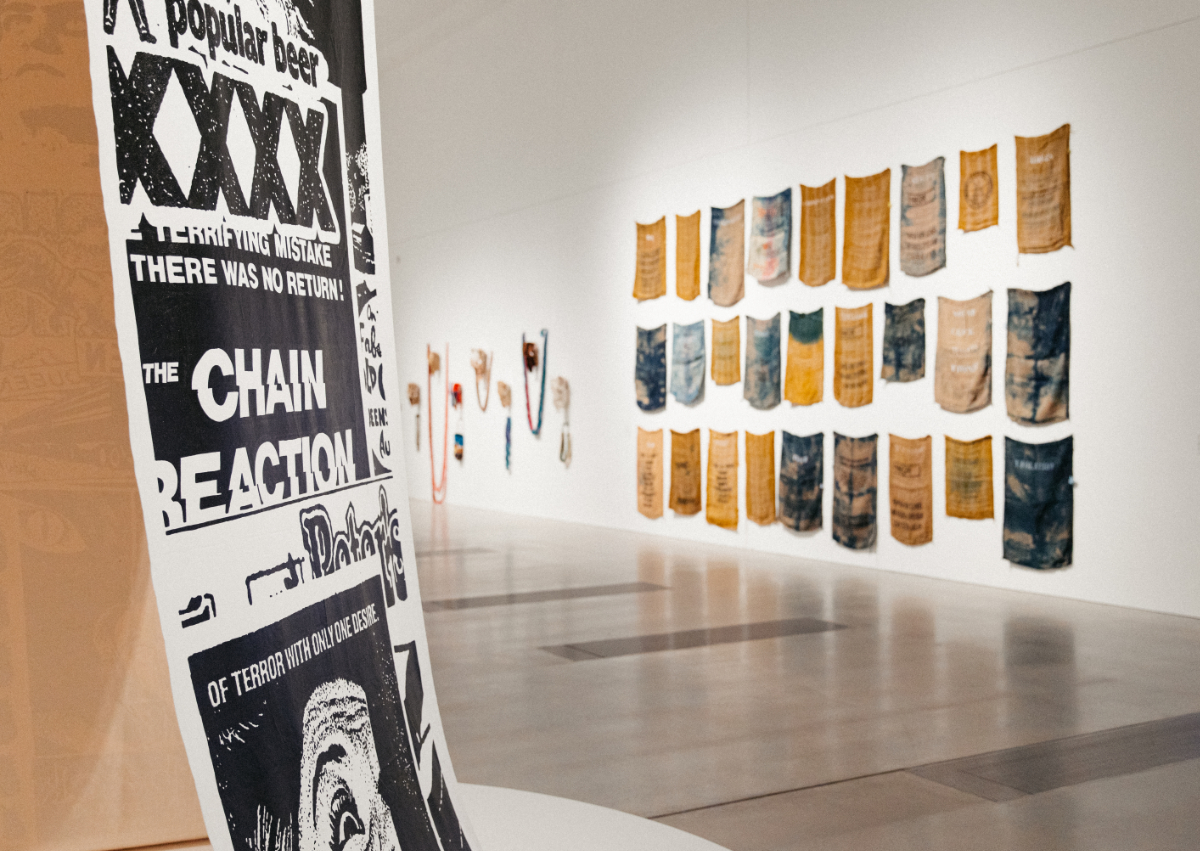
Amid these powerful cultural connections hang three enormous, hand-painted black and white banners (Between Sun and Shadow, 2025) by Meanjin/Brisbane-based artist James Bourbon. Considering contemporary Queensland through a pop-cultural lens, Bourbon juxtaposes horror movie posters with idyllic tourism advertisements, product branding (including another nod to XXXX beer) and scenic postcards.
Thematically, Bourbon’s work continues the exhibition’s narrative of exposé—sharing the idyllic stereotypes of the sunshine state then revealing its darker histories and dualities. Tonally though, the grand five metre scale and graphic aesthetic of the triangulated canvas hangings and their satirical approach sit at odds with the surrounding more sincere works.
While these clashes feel disjointed, they enable different entry points, inviting the viewer to critically consider the curatorial inclusions, and what those selections might be attempting to address beyond mere diversity. In some cases, the works are provocations to reconsider Queensland’s ‘state’ into the future — acknowledging the past and calling for truth-telling towards a shared future. Evident in Mocke’s work and in many First Peoples’ perspectives, this push to decolonise is also revealed in Sally Molloy and Ruth Cho’s works, which respectively explore displacement and cross-cultural hybridity.
In a state long stereotyped for its conservatism and racism, these approaches offer counter-narratives. This is important given RMOA’s regional context, especially in challenging the perceptions of ‘Queensland variety’ parochialism seeded in McKenna’s and O’Malley’s works.
Beyond themes of decolonising, a collective vision for Queensland’s future is unclear. In the absence of an exhibition catalogue, wall texts frame this multiplicity as a strength, suggesting that each artist and viewer will hold different visions for the state, which for many is simply their home. Across works and labels, State of the Art suggests that collective change is only possible when these individual perspectives are brought together. While this reflects Queensland’s plurality, it does feel somewhat evasive as a curatorial framework, particularly given that the exhibition has indeed brought multiple perspectives together.
A clearer narrative arc might have assisted with this scope — either opening it up to explore more options for alternative social, political or environmental futures, or honing in on specific issues. A more unified curatorial stance could have also helped bridge the exhibition’s conflicts in style and sensibility, though this was likely a challenging task given the numerous curators. Without such cohesion, the exhibition often feels more like a survey — impressive in scope but leaving its audience to do the reimagining.
State of the Art: Reimagining Queensland nevertheless paves the way for further interrogations of Queensland’s identities and futures. As artists’ and curators’ understandings continue to evolve, so too does the state itself. Migration shifts since the COVID-19 pandemic, and the forthcoming 2032 Meanjin/Brisbane Olympics (and its ‘Cultural Olympiad’) will inevitably contribute to how Queensland is shaped and perceived in the years to come.
State of the Art: Reimagining Queensland was curated by Robert Connell, Ashla Doherty, Melinda Mann, Jonathan McBurnie, Tessa Mcintosh and Emily Wakeling.
_card_Crop.jpg)