%20-%20Fotografer%20Ariyanto%20Nugroho_web.jpg)
For a week each year, Yogyakarta becomes a gravitational centre, pulling the fragmentary practices of Indonesian artmaking into a shared orbit. And each year, I return to what is arguably the most important art festival in the region — ARTJOG. In the weeks surrounding the festival, the city is supercharged. Beyond the official programme, gallery spaces buzz with openings and artist studios become impromptu hang outs, where conversations stretch over the simple choreography of potent coffee and chain-smoked cigarettes.
Adding to this year’s vibrant mix, a new event has entered the calendar: Chapter Jogja, a commercial fair launched by the same founding team. ARTJOG began as an art fair too, but in true Yogyakarta spirit gradually shifted toward a discursive curatorial model. The separation of art and market feels apt for a city where the art scene has a calm rhythm, standing apart from the faster, more commercially driven pace of the country’s art market capital — Jakarta.
On the day of the opening, I pass through the shaded courtyard of the Jogja National Museum, where tree canopies offer soft resistance against the heat. I find myself in the first gallery—traditionally reserved for the commissioned artist—that in contrast offers a cold, subterranean feel. Secret of Eden (2025), an installation by Anusapati, occupies the room like an unearthed relic. Dead tree roots hang from the ceiling no longer reaching for nutrients, their fibres calcified and knotted, casting fractured shadows across the concrete walls. A mining cart sits idle on a length of rusted track, perhaps evoking Indonesia’s extractive past. The atmosphere is intensified by Tony Maryana’s electro-acoustic soundscape, composed from natural elements—wind, water, metal, earth—that echo eerily through the space.
_web.jpg)
This year marks the final chapter in Hendro Wiyanto’s curatorial trilogy of ‘Motifs’—Lamaran, Ramalan and Amalan—each drawn from everyday Indonesian language yet culturally and historically layered. Lamaran (2023) referred to a proposal — an offering or request made in anticipation of reciprocity, as in a job application or marriage proposal. It examined how artists navigate relationality: the ethics and intentionality of offering and exchange. Ramalan (2024), often translated as ‘prophecy’, was grounded in speculative interpretation — a cultural practice shaped by dreams, signs and collective memory to imagine possible futures. It leaned into the figure of the artist as seer.
This year’s motif, Amalan, derives from the Bahasa Indonesian word amal, meaning deed or act, and is often used in religious or ethical contexts to describe one’s accumulated actions — daily habits, spiritual practice, charitable work. But in the framework of ARTJOG 2025, Amalan is disentangled from its theological meanings to become a curatorial proposition. It considers artistic practice as a deed — real, performative, embedded in the world and often without expectation of reward. Amalan challenges the viewer to not just ask what does this artwork mean, but also what does it do? What labour, what relation, what risk or care does it carry? It opens a broader conversation about the artist’s position within a community, ecosystem or society.
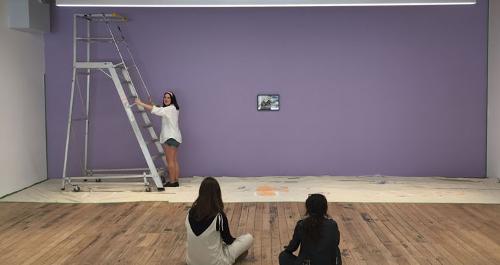
If one were to look for a work that performed amalan in its fullest sense then Perguruan Taman-ruru (2025), the participatory classroom by ruangrupa, would be the clearest proposition. A modular educational platform rooted in non-hierarchical exchange, Perguruan Taman-ruru evolved daily with the input of participants selected through an open call. Instead of presenting objects, the space facilitated workshops, readings and shared conversations.
Right next door, in a thoughtful curatorial pairing, Murakabi Movement’s Tanah Air βeta (2025) featured a circular trasah watu floor using a traditional stone-paving technique that allows water to seep into the soil and plants to grow between the gaps. Visitors were invited to sit, drink tea or bottled rainwater, and share kudapan (local snacks). This quiet act of hospitality became an embodied reflection on how we live together — perhaps the most Indonesian gesture of all.
%20-%20Fotografer%20Aulia%20Yasmine_web.jpg)
On the next floor, Tisna Sanjaya’s monumental work Seni Penjernih Air (2022, 2025)—a towering rotating wheel activated by a bicycle—invited viewers to climb up and set it in motion. Though playful in premise, the piece gestured toward the cycles of time, karma and revolution that underpin Sanjaya’s spiritual and political worldview. Its scale and interactivity made it arguably the most photographed work of the festival. I couldn’t help but wonder if its participatory nature risked eclipsing its deeper meaning. Then again, in today’s art world, attention is its own kind of currency.
Right beside it, no less monumental yet more subtle, is Yoshi Fajar Kresno Murti’s Tubuh Amalan (2025). The installation begins in Samigaluh, a rural district west of Yogyakarta, where the artist and his neighbours rebuilt the dome of a mosque in their home village, Clumprit Hamlet. Everyone in the community contributed — labour, materials, money. By relocating the mosque’s canopy into the exhibition space, Murti exposes a critical tension: in Clumprit, people don’t name their deeds amalan, their labour isn’t announced as moral, symbolic or aesthetic. It simply happens — quietly, necessarily and together.
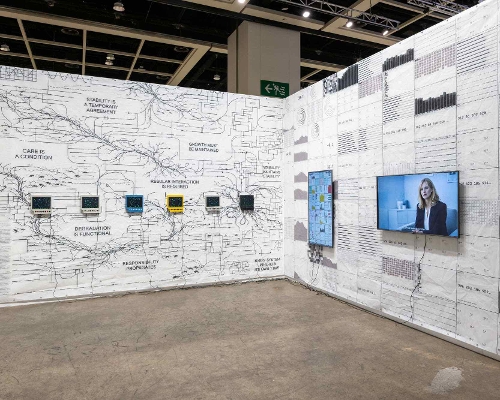
In a dark blue room, Indah Arsyad’s installation Sebiru Jerigenku, se Kelam lautku (2025) suspends golden clam shells from concrete-filled plastic buckets, forming pillars that glint under low light. A large wall screen displays animated pollution data and sediment flow. The steady clang of a bonang—a Javanese gong—echoes like a sonar alarm. It’s immersive and elegant, but only the visible tip of a much deeper activist project. The artist worked in the field with local fishermen to gather materials, while long-term research informed the data and the resulting map tracing rivers that carry waste into the Java Sea.
If Arsyad’s work is a cartography of ecological entanglement, Maharani Mancanagara’s two-part installation functions as a device for listening across time. At the core of the work is the prison diary of the artist’s grandfather—a man she never met—who was detained without trial in three of Indonesia’s most notorious prisons during the political purges of 1965–78. In a dimly lit room, Patron Ing Lelayu (2025) constitutes three 1960s-era telephone booths through which visitors can 'call' into history, overhearing fractured conversations, accounts of arrest, disappearance, forced labour. The past returns as a voice in one’s ear, intimate and haunting.
By its side, FX Harsono, a seminal figure in Indonesian political art, also mobilises memory but from a different historical wound. His video installation, The Last Survivors (2017-25), presents accounts from three elderly Chinese-Indonesian survivors of the 1948–49 anti-Chinese massacres. Through calm, matter-of-fact recollections seeps real horror: a husband taken and never returned, boys herded for execution, gunfire that marks death in the distance. These stories remain largely unarchived and unrecognised by official Indonesian history. Harsono’s commitment, sustained over decades, has been to restore these memories as his own form of amalan.
Working with what remains, and as a form of communal service, the street artist Begok Oner has reconstructed rubble scavenged from the demolished façade of last year’s ARTJOG. The gesture of Yang Terbuang Menemukan Jalan Pulang Dengan Bentuk Terpampang (After Suwage and Tita Rubi) (2024, 2025), which can be read as a reclamation of the erased, implicates the politics and ecology of artistic production, especially at the scale of mega-exhibitions like ARTJOG. Oner’s work stands as a rare example of institutional critique within the Indonesian art context.
It is impossible to speak of amalan without addressing the domestic acts that structure everyday life. Veronica Liana’s sculptural installation, Rupa Tan Matra (2025), reconstructs her experience of motherhood through soft canvas castings of household objects: brooms, toys, cooking utensils, a laptop. Each object, rendered in cotton fabric matches the colour of gallery walls, nearly vanishing into the background. The quiet violence of maternal labour—unseen, unpaid and relentless—is transposed into a ghostly inventory. It is a reminder of the repetitive acts of care that calibrate one’s life.
%20-%20Fotografer%20Sito%20Adhi%20Anom_web.jpg)
Amalan as a selfless act of service finds form in Tomy Herseta’s sound installation Alone We Hear, Together We Listen (2025). A shrill, high-pitched noise fills an empty room but as visitors gather, the volume drops. Relief is offered only through collaboration, co-presence. It reads like a choreography of collective care — one that implicates the gallery sitter, who must endure the sound throughout the day and is an unwitting performer in the installation.
This ethics of presence reverberated in Bunga Yuridespita and Matthew Oaten’s durational performance “Did you see that?” (2025), which unfolded on the opening morning. For nearly an hour, a performer—encased in a translucent, metal-framed shell of coloured glass—moved slowly through a choreography evoking traditional Javanese dance. The intimacy that emerged between the performer and the surrounding audience rendered them momentarily part of the choreography. The performance accompanied a poetic video work, in which one of the artists traverses natural terrain (or perhaps is it an inner landscape) while wearing the same luminous costume.
As I moved through the three floors of the Jogja National Museum, the curatorial proposition registered unevenly. Some works aligned with the idea of art-as-deed, while others strained under the weight of the theme. This unevenness is, perhaps, a natural consequence of scale: an annual festival of this ambition, especially one centred on national artists alone, risks this sort of tension. Though one may not fully find the truth on the exhibition floors, what I found was ‘truthiness’, as British philosopher Timothy Morton describes it — an affective artistic honesty that conveys truth indirectly, a felt reality, where the weight of practice registers through mood, tone, felt intention. Perhaps this is amalan in its most expansive form; the festival itself is an offering. Its deeds are a gift to the audience, the country and the wider world.
_card_Crop.jpg)
 Bisma (2023)_Card.jpg)