Time and space collapse in Venice. Each visit I’ve made to the Art Biennale, I’ve been transported home by the exhibitions at the Australia Pavilion. On my first visit in 2022 I saw DESASTRES by Marco Fusinato, and last year Archie Moore’s award-winning kith and kin. A deeper portal opened within Moore’s pavilion, grounded as it was in Aboriginal ways of being and knowing. In May 2025 I visited Venice again for the 19th Architecture Biennale, to see the first all-Indigenous architecture pavilion, commissioned by the Australian Institute of Architects and led by Dr Michael Mossman, Jack Gillmer-Lilley and Professor Emily McDaniel (with Kaylie Salvatori, Clarence Slockee, Bradley Kerr and Elle Davidson).
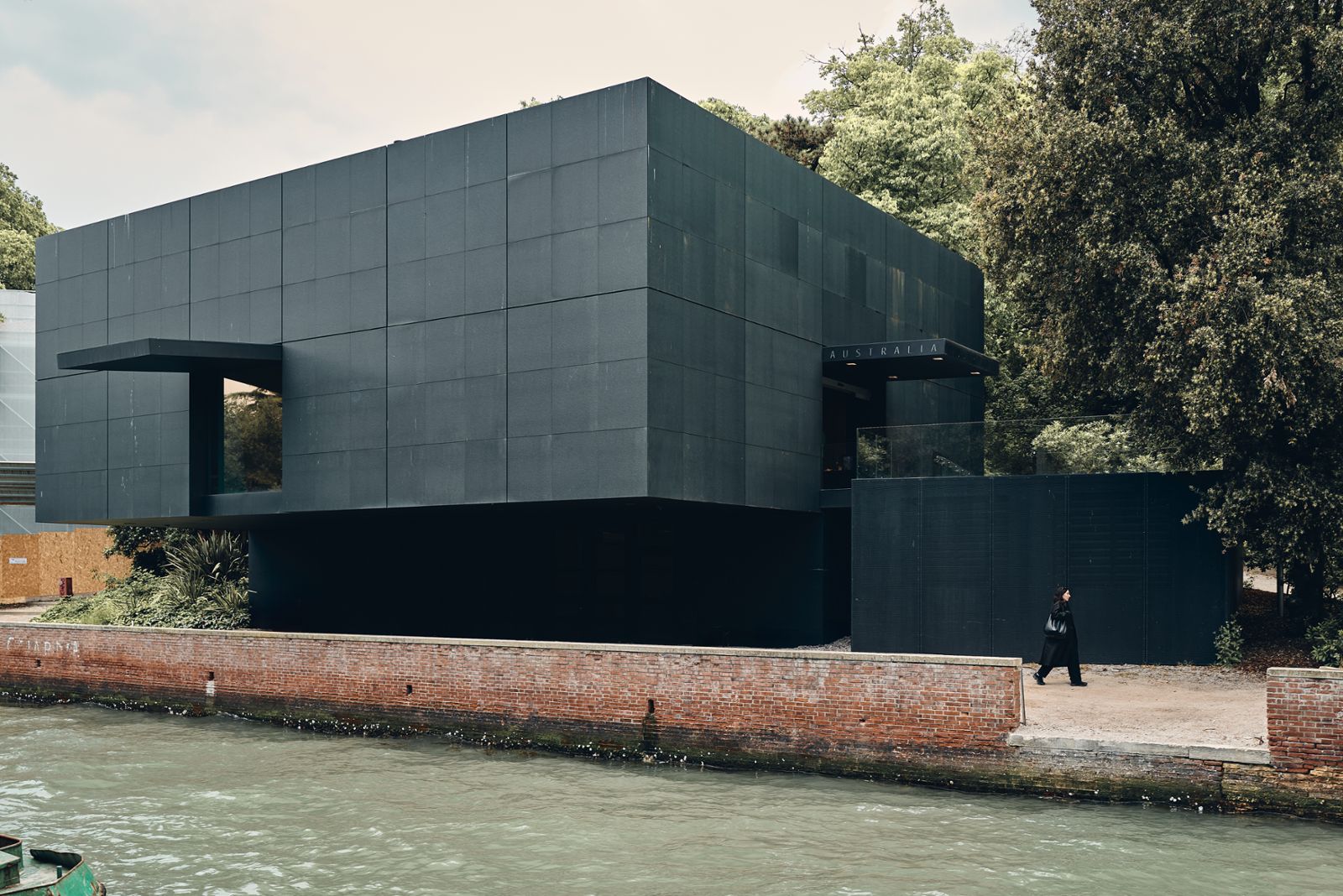
Opened in 2015, Australia's Denton Corker Marshall pavilion looms out over the canal, a blocky container in the tradition of other exhibition spaces designed by the firm: Melbourne Museum’s iconic cantilever roof, Melbourne Exhibition Centre and various additions to the National War Memorial in Canberra, to name a few. Textures and lines of buildings that defined an era of Australian architecture, inspired by shearing sheds, provide a shortcut to an Anglo-Australian identity — although in truth many Aboriginal men and women laboured in the pastoral industries.
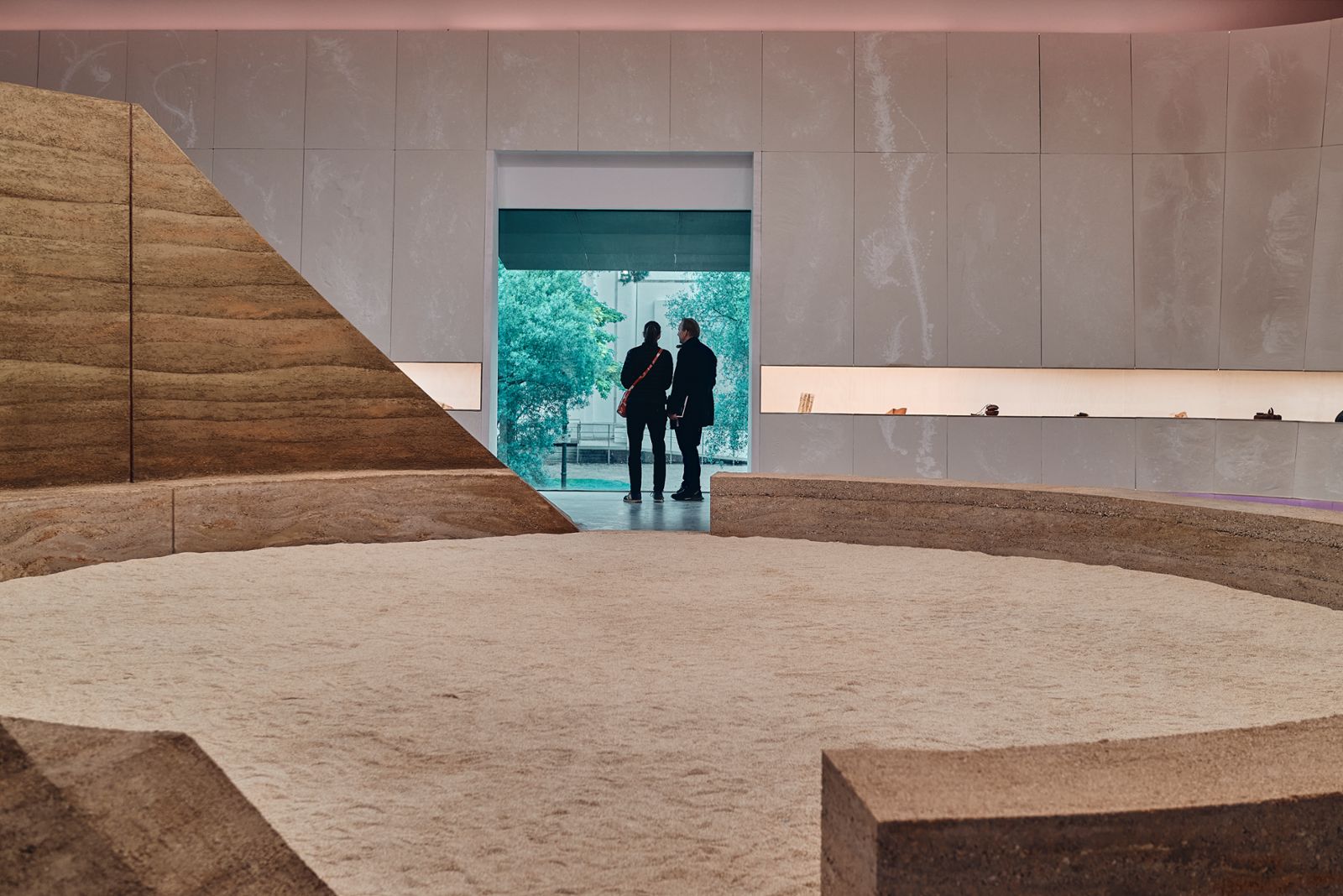
Entering through the glass doors, two golden walls curve away, filling one’s vision and countering the sharp exterior angles of the pavilion. The wall’s texture softens them further, inviting touch. The walls are made up of layers of compacted sand collected from the Veneto region, with colours that create a wave of gradients up and down the wall, crumbling slightly under my touch. The two walls take up the whole entranceway, save for a small opening where they meet, leaving a narrow gap to peep through to the open space beyond. Worimi and Biripi Guri man Jack Gillmer-Lilley explains the team’s intention to create a structural echo of their framing statement — it is an entry point to discussions about home.
For Gillmer-Lilley, home is Dark Point, a place in Northern New South Wales on his ancestral country. ‘It’s a place I can be emotionally vulnerable. A place I can take my shoes off and put my feet in the sand.’ He says these words with his feet in the sand that constitutes the central flooring of the HOME pavilion, thousands of kilometres from his actual home. This small gesture underlines the contention that home can be rituals, actions or intentions and that you take 'home' with you wherever you go.
This talismanic sense of home is infused in the ‘living-belongings’, 33 objects created by architecture and design students from eleven universities nationwide and displayed in the pink, softly illuminated vitrines that line the walls. Each object is imbued with personal memory: a recipe book featuring instructions for kofta by Riley Elias; used teabags sewn into a basket by Katie Stanley; sculptural ornaments like the gadi-urn made by Hugo Vos; Kalimparr - watery by Benjamin Baxter, a wooden book with a Wiradjuri poem burned into its pages.
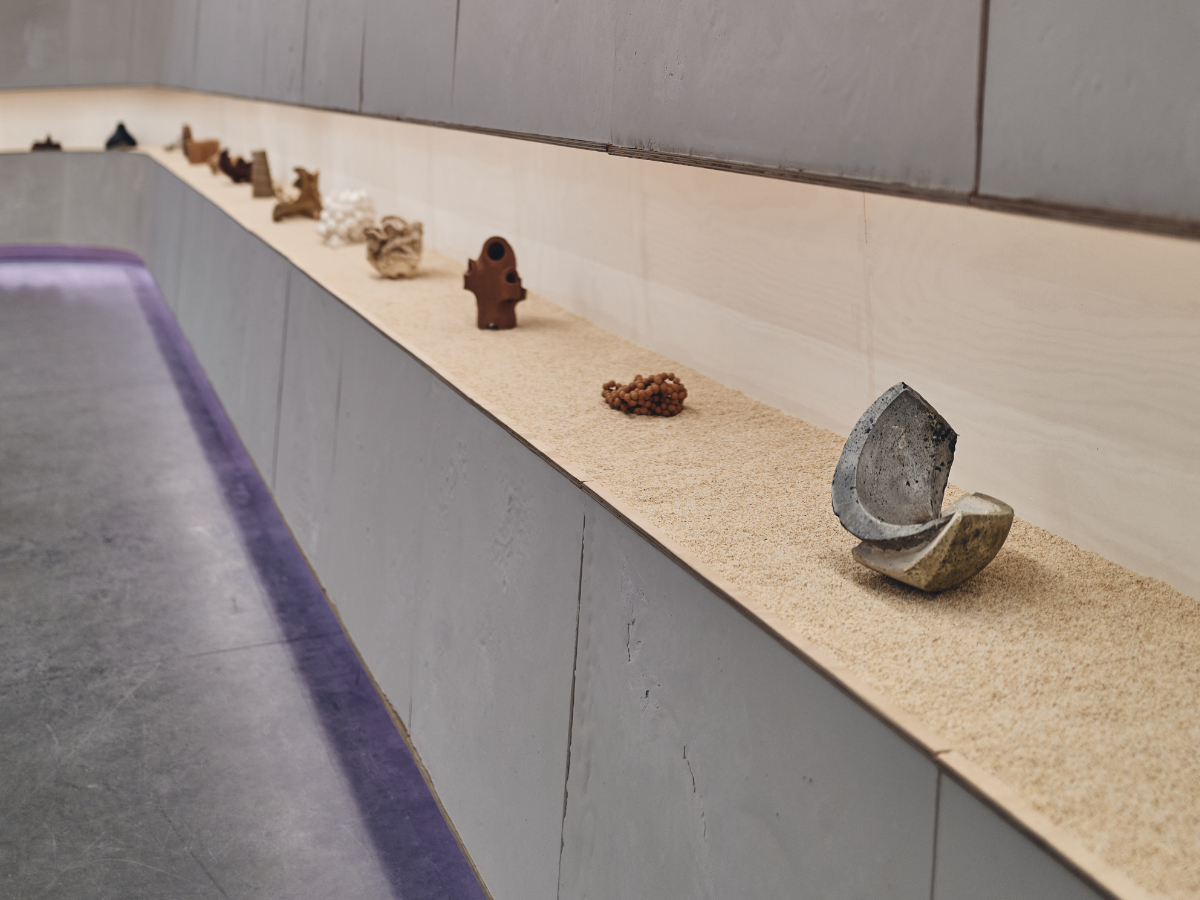
Of these objects, Gillmer-Lilley says: ‘Everything we belong to, that belongs to us, is alive with the meaning we give to it through how we care, hold, maintain and repair it.’ Unlike a typical, white-gloved museum environment, all surfaces within HOME invite touch and visitors are encouraged to pick up the living-belongings to ‘impart their oil’, meaning the bodily fluids, flakes, sweat: the traces of us we leave behind. The pavilion will accumulate these marks over time with each visitor who enters the space.
Themes of sustainability, repair, communal spaces or community housing echo through the national pavilions in the Giardini this year, in a variety of executions that are curious compared to the Art Biennale. Spain and Austria leaned a little heavily on words but incorporated innovative graphic design and installations to discuss their topics of sustainable materials and urban design respectively. Typically progressive, the Dutch pavilion developed a Queer sports bar and athletic space, executed in a strange Y2K-meets-TAB aesthetic. Restoration was another thread: the Danes invited visitors inside their under-construction pavilion, cheekily labelling mounds of dirt, while Finland’s tiny pavilion displayed a video documentary of the 50-year cycle of repairs that has dogged the Alvar Aalto-designed structure. There was a tussle between showing and telling. Some pavilions were able to prototype ideas within the space, like Serbia’s extraordinary un-weaving project, while others treated it like the showroom of their architecture firm, such as France’s unwieldy scaffolding postered with examples of how to live for the future.
A memorable blend of the two approaches was the British pavilion titled GBR: Geology of Britannic Repair. The British-Kenyan team reflected on the legacies of British colonialism across the world through an architecture and design lens. One of the featured collaborators was Palestine Regeneration Team, whose section Objects of Repair ‘confront[ed] strategies of erasure’, looking at what the land, people and its structures have endured in Gaza where rubble has been reappropriated, ‘ruins becom[ing] new architectural skins’.
The inclusion stood out while the question mark hovered over Australia’s 2026 Biennale representatives. While Khaled Sabsabi has recently been reinstated as next year's 'official' artist, it comes after a long and unnecessary political kowtow which revealed cowardice, censorship and a lack of leadership within the Australian state. Our government seemingly could not touch such a politically hot issue, even tangentially, underlining its cultural immaturity in the European context. Even our pavilion’s exterior, which hinges on agricultural references, seems like the offering of a country that can’t take its longer histories seriously in the face of Central and Northern European medieval and feudal histories, or Greek and Roman allegories. Rather, it falls in line with the European insistence that Australia is still a young country despite 65,000 years of ongoing cultural practices by First Peoples.
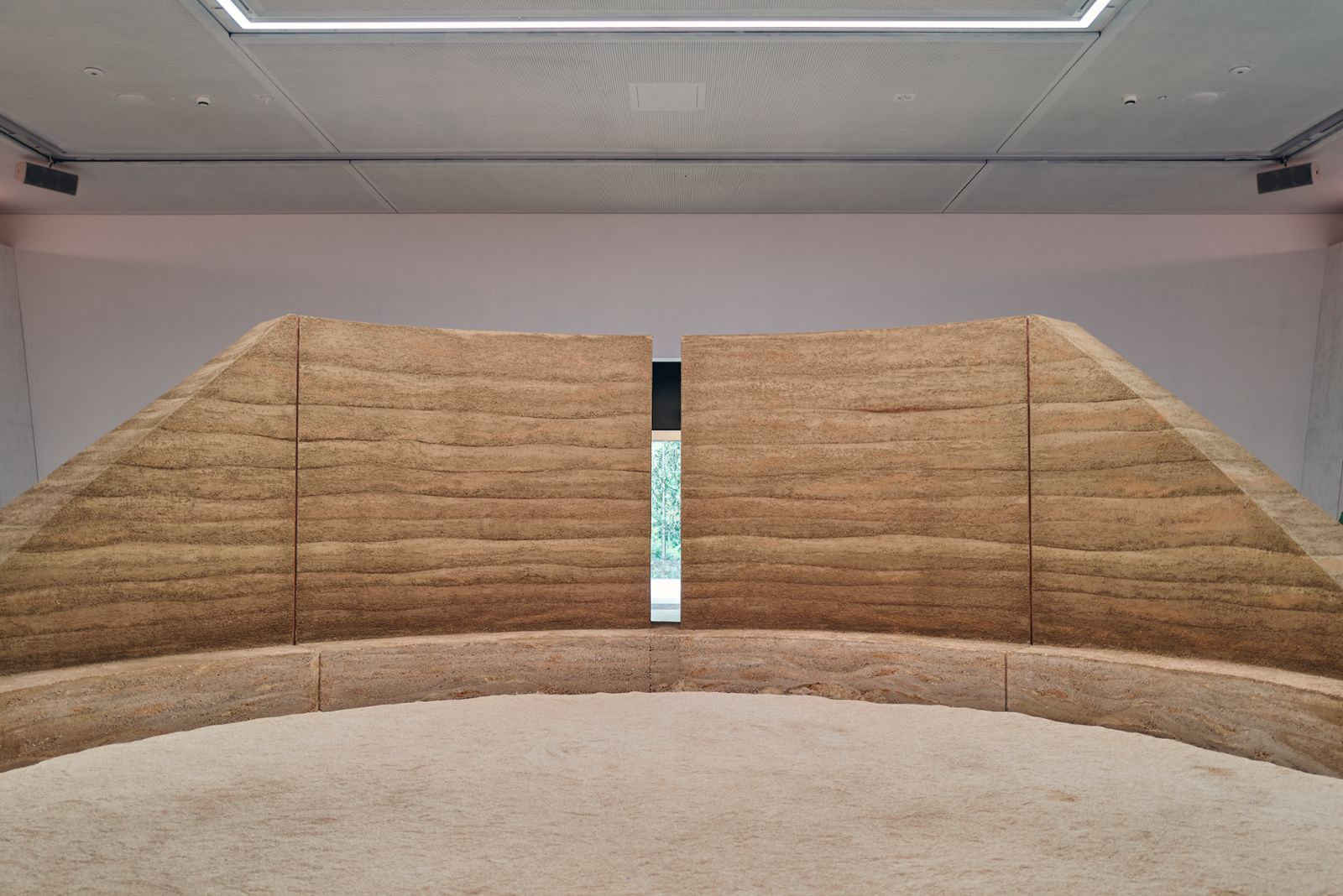
HOME offers not just quiet resistance against these lingering beliefs but also an entry point for new discussions. The circular structure of HOME is deliberate, not just because of its link to yarning circles and corroboree. As Gillmer-Lilley says, ‘The circle appears in many cultures across the world. It has been a means of finding cross-cultural global links. How can it empower people to share their story?’ Indeed, it’s a symbol I see across the national pavilions at the Giardini and Arsenale. For example, the Irish national pavilion draws an excellent parallel. Inspired by the 2016 Citizens Assembly—founded in response to restrictions on public gathering and public participation—Assembly invites conversation and reflection in the round.
The simplicity in the circular form belies its complexity; what is architecture if not who is within it, and how they use it? Public space could not be more important at a time when connection is more vital than ever. For the Biennale convenor, Carlo Ratti, a key concern in 2025 was how we create spaces in which to live our shared future. While many of the Biennale’s offerings remain utopian or hypothetical, HOME exemplifies First Nations-design thinking as a way to invite collaboration. It asks, how might we build our future together, now?
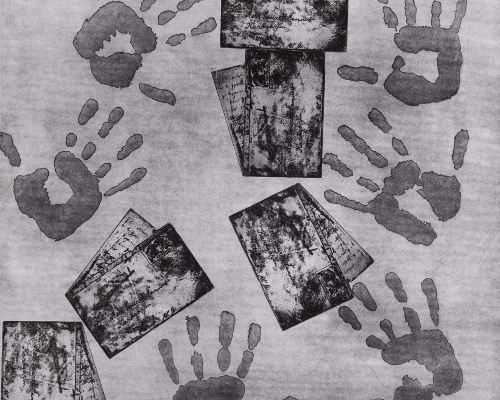
, detail. Image courtesy and © Badger Bates_card.jpg)