.jpg)
Legends says, if you eat the wongai fruit you will always return home to the beautiful islands of Zenadth Kes (Torres Strait)…
Entering Meriam and Yupungathi man Christopher Bassi’s exhibition Notes for a Palm Sermon at Cairns Art Gallery, I am greeted by rich dark paintings of the wongai fruit, as though setting up the premise for Bassi’s voyage in the creation of these works: a journey of homecoming, connectedness and honouring the matriarchal lineages of his Zenadath Kes origins.
Joining the wongai fruit paintings are dark-toned representations of frangipanis, mangos, mangroves and banana flowers—solemn deep oil paintings, nestled next to each other, they immediately draw me into their pools of dark amber. This experience is a bit unsettling, given they are not the typical bright, colourful forms we know of these plants in real life. Bassi’s works instead take me to a place of peace and quiet, his plants presented as motifs that are both representative of and integral to Zendath Kes life, motifs to be worshipped.
As my gaze is drawn away from the series of icon-like paintings, I take in the whole gallery space unfolding in front of me. A spiritually reflective space, there is a feeling of connectedness, richness and reverence, yet somehow mixed with a sense of disconnection and loss: the combination of emotions is complex as I take in all these artworks.
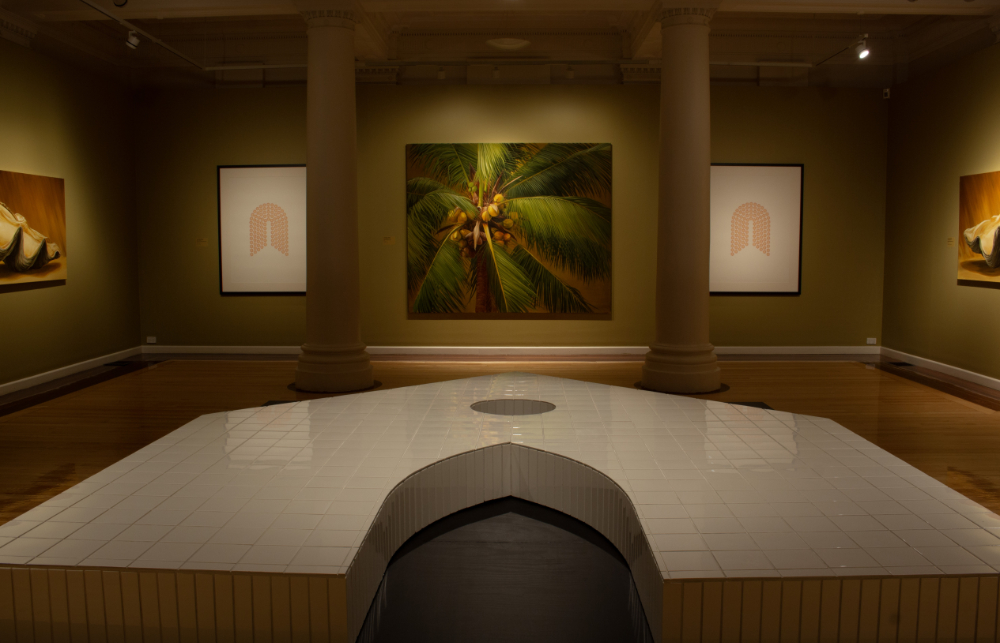
I turn to the large sculptural centrepiece that embodies these emotions I feel – aptly named Island Revelation (2023) the sculpture represents the building façade of the old Church ruins at Poid village, Moa Island – a church built with rocks, lime and coral in the early 1930s. Bassi’s use of white tiles is reminiscence of the tiles often used on traditional tombstones in Zenadth Kes. Tombstones are of great significance on the islands and signal the last series of mortuary practices, in which those have passed are commemorated with headstones often made of marble, and graves covered in tiles. In the gallery, Island Revelation engulfs the space, its shiny tiles wrapped around this symbolic representation of the church ruin, laid horizonal on the gallery floor, almost now at rest, is a powerful juxtaposition of old/new, original/introduced, death/resurrection—and ultimately, life and death.
Framing this megalithic offering are icons-as-memories of the artist’s island home. A large painting of a coconut tree, lush, deep and set in the distance space, is framed on opposing walls by two immense paintings of giant clam shell halves. This scene is linked by the delicate coloured pencil drawing Architectures, Beaded Archway (2025) of floral beading patterns arranged to imitate church archways; it is as though these icons—or even the memory of these icons—are calling for praise.
The detail in Bassi’s lovingly layered oil paint can be felt from afar, drawing you in close as though the paintings have secrets to tell. The coconut tree painting is positioned as if it deserves the highest praise. What is typically a source of food and the representation of connectedness and family coming together, here becomes a painting of both celebration and loss, recalling things once easily attained in the past which are now difficult to obtain.
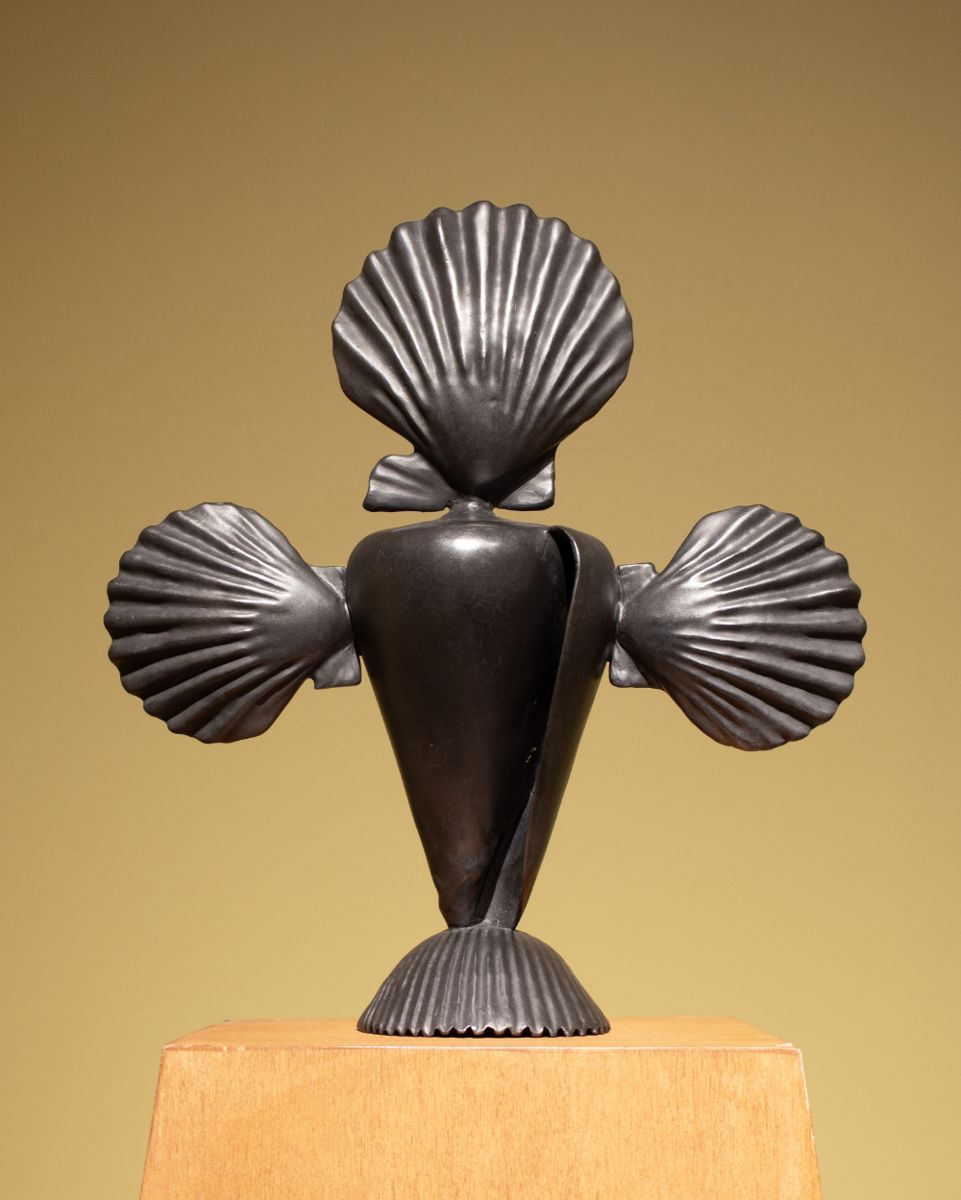
Infront of Island revelations, two cast bronze sculptures New Monument (2024), sit high on pedestals. Modelled on shells commonly found in Zenadth Kes, the works continue to push the narrative of worship and precious memories of what once was. Behind them is a beautiful beading work tenderly created by Bassi’s Aunty Daisy Ah Mat. The hibiscus bead, a common design motif in Zenadth Kes, representing trade and craft, passed from Mother to Daughter, honours the matriarchal line. Framing the beading, and setting it quietly in the space, adds to intergenerational will among the Zendath Kes diaspora to cling to these traditions and memories, feelings shared when we are displaced from our island home.
Hidden in a nook of the Gallery is a sculpture of the Catholic Church pew from Waibene (Thursday Island). Bassi sets a scene of familiar memories for Islanders, symbolic of the Sunday morning ritual – of church people singing, of ladies with bright hibiscus flowers in their hair. But the bright orange hibiscus image is set against the dark pew and a dark bailer shell set on a shadowy doily, all representations, all icons, yet set in a solemn space. I can’t help but feel loss and sadness. The church pew, in its darkness, almost disappears into the wall behind it, partially hidden but still present, you could almost miss it if it weren’t for the brilliance of the tropical hibiscus that draws you in.
Evoking the juxtaposition of imported religion and Zendath Kes culture are Bassi’s 2025 paintings Architectures, Palm Weaving set against Architectures, Balustrade, of the old church railing. Each is a form of architecture in its own right, one drawing upon cultural knowledge and craft traditions passed from mother to daughter, the other acknowledging the history and influence of Christianity.
As I exit the space, I am brought into range of three coconut oil paintings of the elements of the coconut, portrayed in the same amber hues of the wongai and other plants in the opposite entrance space. The coconut tree in Zendath Kes is central in our lives: for eating, drinking and producing its rich oil. The leaves are used for weaving, adornments, mats to sleep on, housing, baskets to carry things, bowls, brooms to clean the floor and in our amay/earth ovens. One tree provides so much for every family and every aspect of island life: it is a gift to be worshipped.
This leads me to Beadwork, Family Tree 2025, a series of nine oil-on-board paintings framed in variations of colours, like the connectedness of the family tree, different family lines and descendants take on different variations of the storyline, some remain, some move away, but all are still connected.
I pause and reflect on Notes for a Palm Sermon. It is through these works I’m drawn back into the space with a feeling of nostalgia, of honouring our mothers. Bassi’s mastery of oil painting traditions and techniques, complemented by his sculptural works, offer an intimate reflection on his subject matter. Each piece is a snippet of time, as if clipped from memory. It is though you are on the journey with him, as though you have eaten the wongai fruit and have returned to Zenadth Kes.

, detail. Image courtesy and © Badger Bates_card.jpg)