%2C%20detail_%20Image%20courtesy%20and%20%C2%A9%20Badger%20Bates_web.jpg)
Dear Jess,
I’m so grateful we’ve had the opportunity to work together again. Not only have we made something rich and layered in collaboration with many other First Nations people, we’ve utilised this opportunity to empower stories and voices that are frequently left out of the too-often elitist art-scape.
I see you Jess, the integrity and kindness you show and the utter brilliance of your curatorial and writing skills. Your beautiful provocation for this issue was electric in the magnetism of its call:
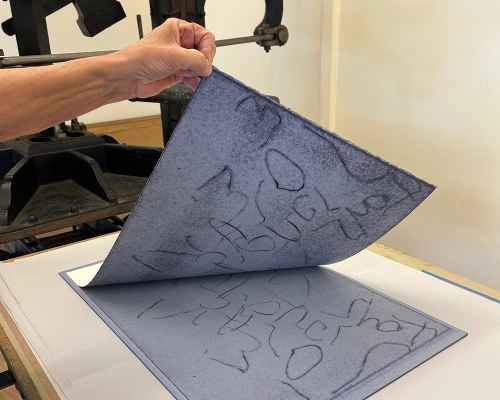
Trace explores practices which begin with what has been left behind — the echoes, residues, impressions and marks that give presence to the past. Rather than a focus on the historical or archival, such practices embody forms of continuity and the cyclical. This issue began from conversations around printmaking practices which are inherently intermedial (connected to other forms of mark making) and for which trace can provide a potent material and conceptual metaphor. Against a continued discourse on Indigenous art and authenticity that centres direct marks made by the hand of the artist, we turn towards forms of repetition, iteration, mediation, and of re-tracing the ancestral.
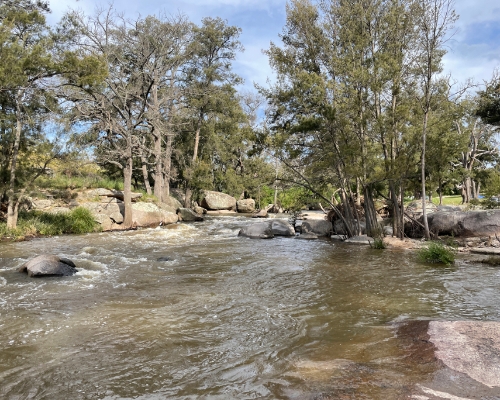
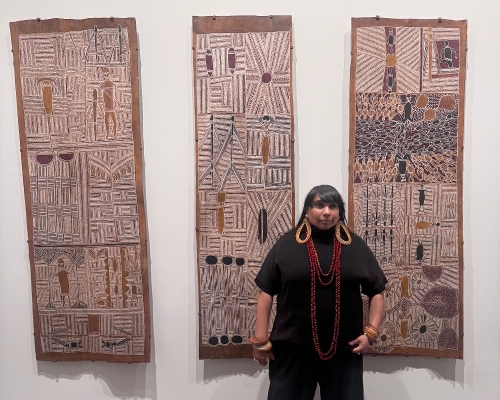
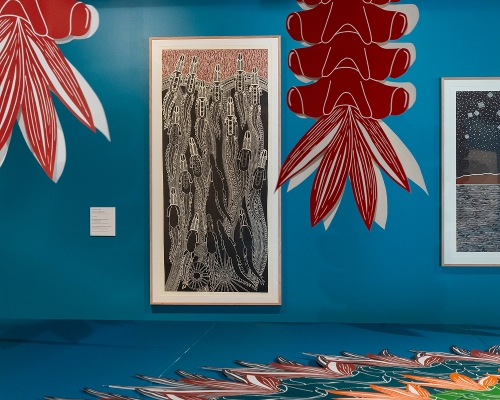
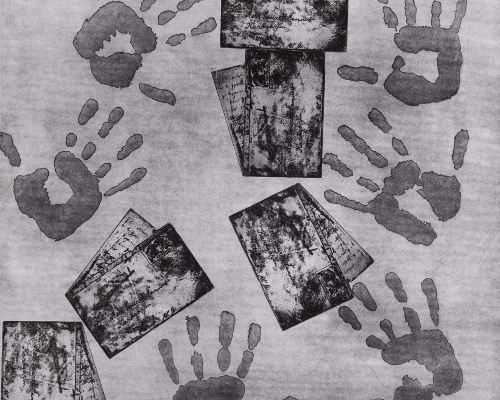
Jonathan Jones has chosen to speak of his Elder, Uncle Stan Grant Snr in a piece that is the heartbeat of all that trace can mean. Jade Turner honours her Mum, gone from this physical realm but still guiding her kin. Jacinta Koolmatrie looks at the legacy of the Tarnanthi Festival of Contemporary Aboriginal and Torres Strait Islander Art and activism around Water, while Dominic Guerrera asks what trace gatherings such as Tarnanthi can leave on Country and community. Madison Kelly takes us down rivers, into explorations of waterways, of artmaking as wayfinding and exchange. Jack Wilkie-Jans skilfully illuminates the brilliance and leadership of curator and artist Teho Ropeyarn. For me, it was most important to write about Uncle Badger Bates, living legend, guiding light, whose kindness and care has helped me to truly know who I am and what my purpose is as a Barkandji wiimpatja. A detail of his linocut Menindee Lakes Fish Kill 2018-2019 (2023) illustrates this editorial, echoing the importance of utilising our platforms to empower community and Country.
May our art-scape become less elitist, less bent on acquiescing to white rules, to the nonsense of singular genius. May we get better at critique and may we all continue to empower each other and the voices and stories yet to be heard.
Dear Zena,
I hadn’t thought before about this issue being against the ‘nonsense of singular genius’, but that’s really where it all started: being invited to join your beautiful multivocal projects that refuse to settle into a curator-as-auteur mode. You always draw in so many people, seeking to understand our art as part of wider ecologies, histories and lineages. Trace also began as a way to find a conceptual purchase on histories of Indigenous printmaking which we felt had been terribly overlooked and under-written, in part because both the collaborative nature of the print studio, and because printmaking’s mediation of direct mark-making challenges ideas around Indigenous art, authorship and authenticity.
But Trace rapidly became part of a much wider conversation around artistic and generational legacies— not in the sense of mere ‘influence’ or a ‘scene’, but in terms of the deep relational ties and traces that bring our art into existence. Under such understandings, individual expression is neither displaced or disavowed—indeed, in an Indigenous sense we are each highly accountable and responsible for what we bring into the world—but there are many agencies beyond the self that work their way through us and into what we create. As the many personal and heartfelt essays in this issue attest—through the traces gifted to us—we are embedded in a cultural world. The trace both holds us steady and releases us to our fate.
I’m proud to see some truly significant but underrepresented Western Australian art histories make it into this issue. Michelle Broun’s writing on the women’s Walyalup/Fremantle Aboriginal Screenprinters group which began in 1989, amid the burgeoning Aboriginal art scene taking flight on the west coast; and Zali Morgan’s essay on fellow printmakers—mother and son Laurel and Brett Nannup—and their leading influence within a uniquely Noongar art movement. It is Laurel’s powerful image evoking intergenerational and ancestral stories that we celebrate on our cover.
Continuing the theme of flourishing artistic movements and exchange, artist David Bosun writes on the continually experimental printmaking practices at Moa Arts, and the trace of visual traditions as they move into new mediums. Mayaili Marika’s piece on legacies of her family, particularly her late father Wandjuk Marika, looks at the agency of art to act culturally, politically, philosophically and spiritually in the world, leaving its traces everywhere. In my own essay I focus on print works by Brenda L. Croft, Cim Sears and Lisa Waup. Each evokes the turning, inquisitive, searching nature of the trace, which never resolves to an ‘origin point’, but allows us to perform continuance.