This review comes out of a fast-paced, week-long visit to Hong Kong during Art Week, with Art Basel Hong Kong as its main anchor, alongside exhibitions and events in major institutions (M+, Tai Kwun, the Hong Kong Museum of Art, the Hong Kong Palace Museum), commercial galleries, alternative pop-up events and artist-run initiatives. I leave tired, satisfied, and craving more. As I write on the return flight, I’m trying to make sense of the week. I realise there is no cohesion, no great story, no arc, only moments that stand out or linger conceptually and affectively.
On the first day of our five-day bus tour, our guide Wing draws a map of Hong Kong on her face. Balancing deftly as the bus swerves through traffic, she points to her chin: ‘this is Hong Kong Island’; her upper lip ‘central’. To reach Kowloon we’ll take one of three tunnels. ‘We’ll take this one’, pushing her index finger up her right nostril, there’s also the left nostril and her septum. As we criss-crossed the city, I kept imagining myself moving across Wing’s face, tunnelling back and forth through the city’s compressed geography. The trip had a regimented schedule, optimised to give our international delegation of arts writers and journalists a good sense of not just the Asian art scene, but a well curated impression that Hong Kong is still very much at its nexus. For this Adelaide-based writer, it offered a rich buffet of art to gorge on. Moving between the spectacle of the global art market and more locally grounded initiatives, the experience produced a sense of exhilaration and overabundance. What became increasingly apparent was the scale of investment that is made in the arts: there is big money here. Recent developments signal not only cultural ambition but a strategic positioning of Hong Kong as an international arts hub, calibrated for global circulation, whilst also nourishing its local community. Not surprising for an art fair—note Melbourne Art Fair’s 2026 theme, ‘world off, art on’—conversations and works shy away from contentious global issues. But elsewhere the world seemed switched ‘off’ too. There are gestures that suggest (self-)censorship, or moments that read as coded forms of protest, but their meanings remain elusive to an outsider. As a short-term guest moving through a tightly scheduled program, I’m aware that I cannot meaningfully read the conditions. In this crash-course immersion, under the guise of cultural diplomacy, deeper political and social textures remain largely inaccessible. Yet it’s hard to ignore the feeling of such undercurrents, and I’m left knowing more about the limits of my own vantage point than the complexities of life and art in Hong Kong.
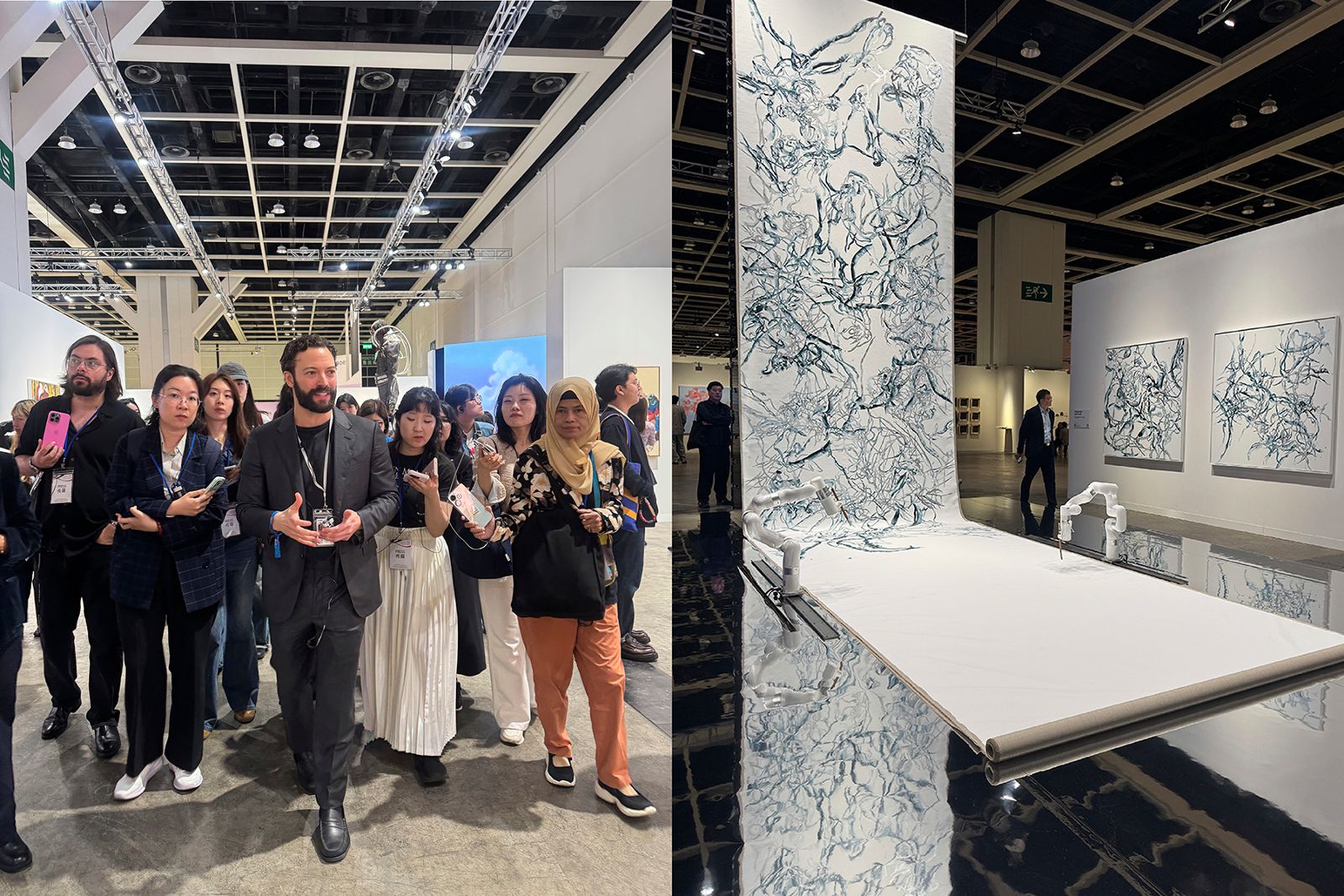
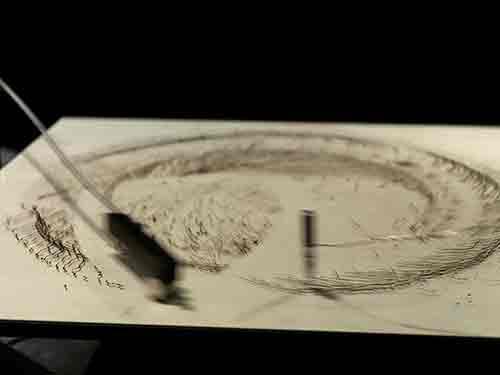
At right, Sougwen Chung 鍾愫君, RECURSIONS 遞迴, 2026, installation view. Ink, silver, and silk fibroin on linen, neural network-guided 6-axis robotic arms. Photos: Eleen Deprez
Over two days and some 25,000 steps I visit Art Basel Hong Kong: 240 galleries from 41 countries, a juggernaut. Amid the dazzling and exhausting spectacle there was however plenty of memorable work. The fair was divided into sections, with large-scale installations in the Encounters section—this year curated around the four elements (fire, water, earth, ether)—occupying the central corridors. Most installations became picturesque backdrops for photos, and with seating scarce, these open spaces swarmed with visitors, many ending up sitting on the floor. I learned that Hong Kong’s museums attract a notably younger audience (average age of 33) compared to the much older average visitor in Australia.[1] It does not surprise me. Even without mobility issues, I found getting around the museums and galleries exhausting. Spatial design seemed to prioritise circulation over rest, layouts aimed to keep visitors moving and “activated”, rarely invited to pause. It produces a subtle form of hostile architecture, where the ability to linger is limited, and recovery is outsourced to the surrounding commercial spaces. At an art fair, perhaps this is to be expected—after all, it’s about moving people through, keeping them looking and “shopping”. Still, it’s hard not to feel somewhat pitiful as I eat an overpriced sando, awkwardly perched at a narrow scandi high table with two strangers.
.JPG)
This year’s Zero-10 section made it clear that AI is no longer a novelty, but an accepted modality within contemporary art. We toured around with curator Eli Scheinman, who presents some highlights. He describes—or rather dissects—each installation. As he intersperses intricate descriptions of complex technical components with programming jargon, a new kind of art-speak emerges. I wonder if ‘cloud-based computation’ or ‘distributed training dataset’ is meant to be revealing something about the work, or to simply reinforce its complexity. Like many, I have watched (with apprehension and a slow-growing existential unease), AI’s rapid rise, eager adoption, and the blind enthusiasm it attracts. There are valid concerns about its environmental impact as well as fear for cognitive confidence or creative dilution. And yet, despite my concerns it is difficult not to be intrigued, even seduced. But is it good art? Or just conjuring tricks with smokes and mirrors, where technological complexity and procedural language make up for thin ideas?
In live performances, Chinese-Canadian artist Sougwen Chung 鍾愫君 sits with two small industrial robotic arms on a large scroll of paper hanging from the ceiling: RECURSIONS 遞迴 (2026). They paint together, an EEG sensor on Chung’s forehead establishing a communicative link between her and the machines. Their gestures are not simply imitative; they are spontaneous as they have learned from Chung’s previous work. Watching, I find myself ascribing feeling and interiority to the machines: their movements don’t seem calculated in a mechanical sense but purposive in a mindful way. It is also somewhat endearing. One arm hesitates—as if it’s reflecting on a mistake—the tip of its brush split open from pushing too hard or moving too abruptly. Chung is in deep concentration, the white sensors on her forehead theatrically mystifying the psychic control between her and the machine. Behind the scroll a parallel digital work is created in real time, using data from the painting, the EEG and the performers’ movements. What feels intimate here is not the machine itself, but the strained human effort required to sustain the illusion of responsiveness. The performance intrigues in much the same way as a conductor’s gestures fascinate, not for the sound they produce but for how they shape and control other bodies to create.
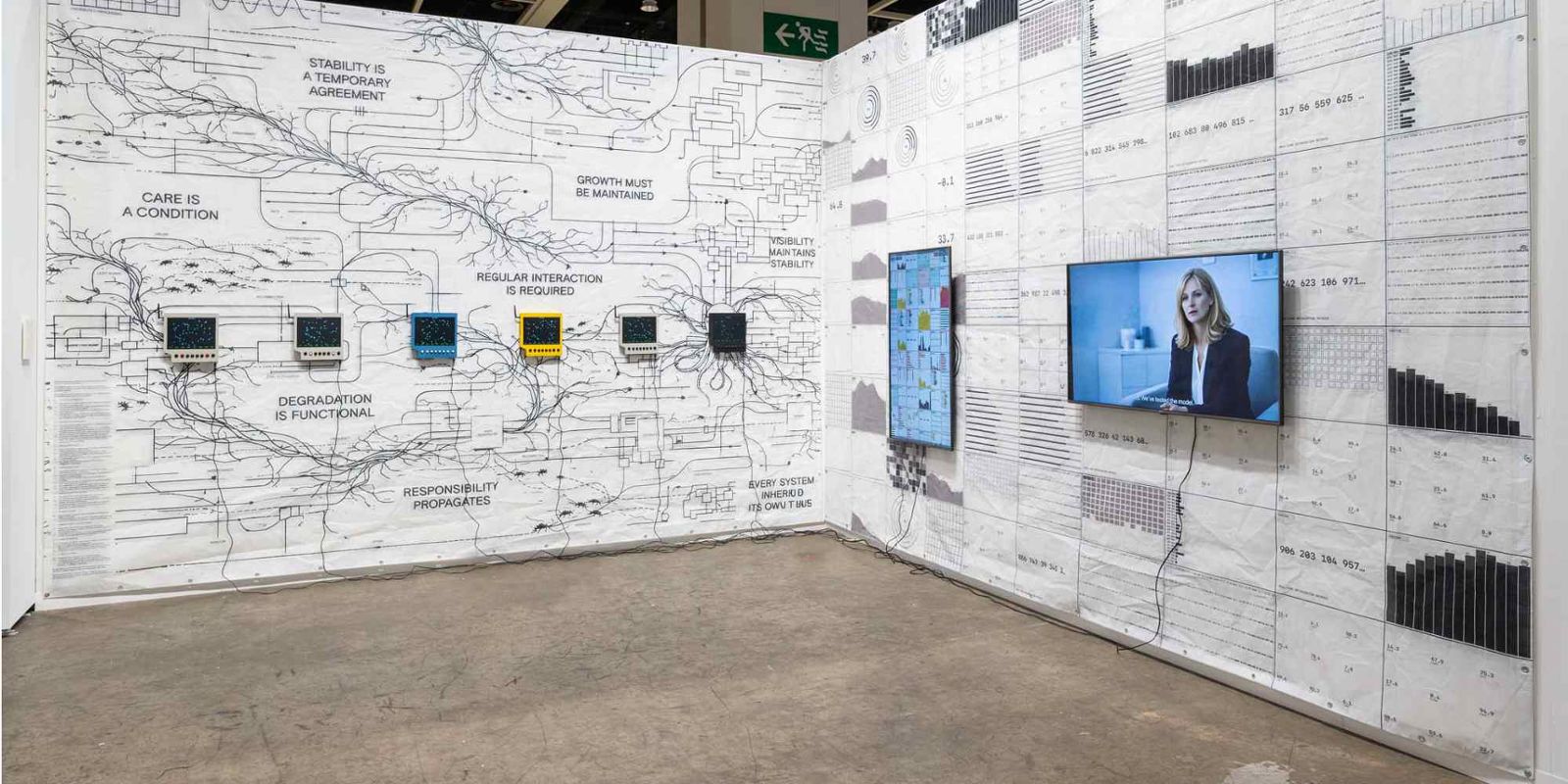
Nearby, visitors eagerly interact with Jonas Lund’s Network Maintenance (2026): retro-looking consoles running interconnected cloud-software. Once sold, each owner, by operating the clunky buttons will be responsible for maintaining their own display while simultaneously influencing the wider network. An artistic, networked Tamagotchi: a shared living system sustained through repeated engagement. If individual or collective care wanes, the system gradually decays. Works such as these shift the role of the owner from passive collector to active participant, extending the artwork from a physical object into a distributed digital ecology. Lund’s video The Future of Growth (2026) featured AI-generated short narrative vignettes with conversations in which intimate social discussions are cut through with tortuous business-speak about synergistic optimisation, operational excellence, and exponential growth. It’s funny. Two friends in a café talk about a recent date: ‘everything was going great. I’m telling her about my latest optimization, my growth numbers, and then she looks at her phone. Boom! Relationship growth potential drops from plus 4% to negative ten.’ It’s also clever. The conversations play out and, as in another work, Optimized Trajectory (2026), shown here as well, a generative, on-chain software continuously adds to the work. As such it cleverly falls victim to the endless stream of positive metrics it critiques. At √Contemporary (Tokyo), Emi Kusano negotiated the line between physical and digital with Ornament Survival (2026), training an AI on her own likeness to generate images reworking female archetypes from Japanese culture. These portraits, both NFTs and physical prints, stage speculative identities and comment on expectations around femininity, both embedded within the AI’s biases and society’s norms. Integrating digital art into the commercial circuit is still met with some resistance, but hybrid presentations like those at Art Basel, where digital play moves away from mere gimmick into genuine conceptual reflection, offer a potential bridge.
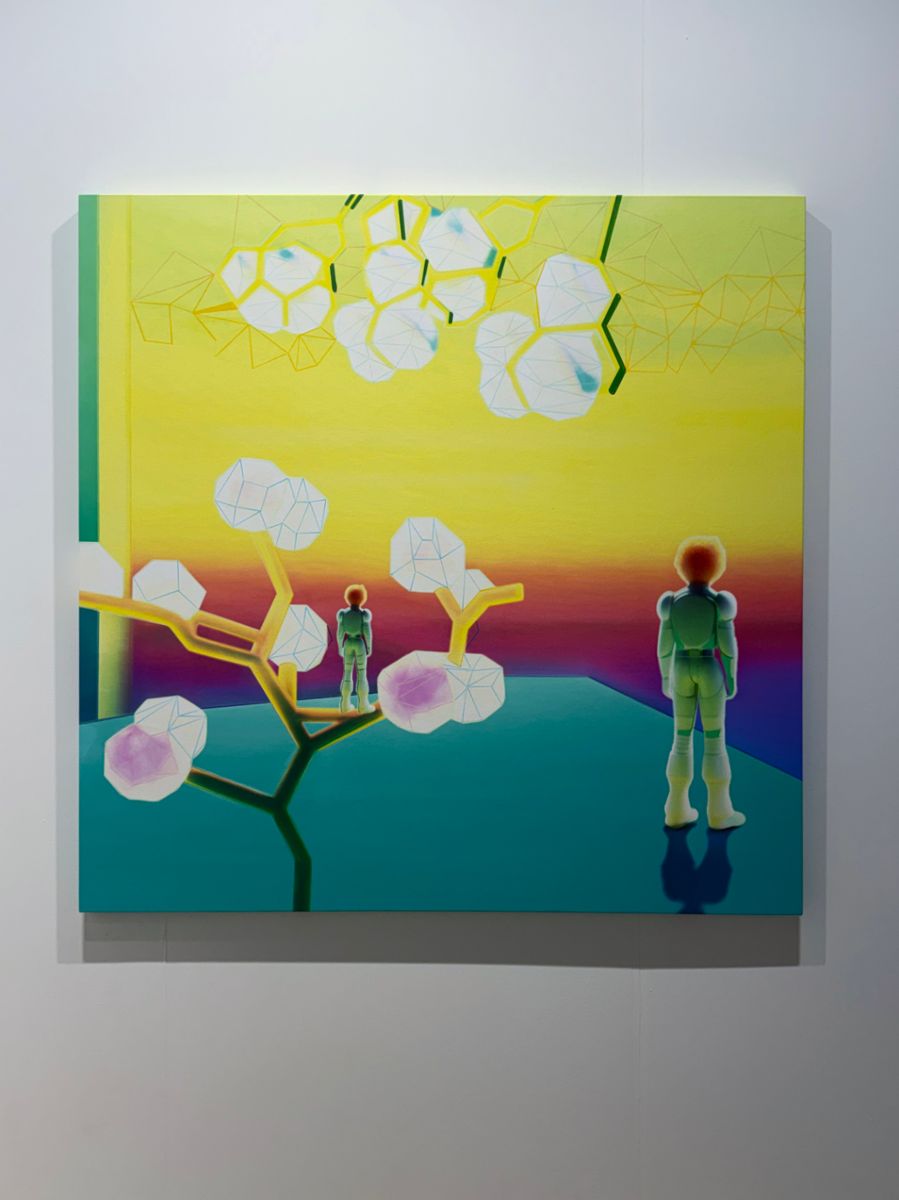
Walking out of Zero-10 didn’t mean leaving the synthetic aesthetic of AI behind; it reappeared in the work of Lov-Lov (an AI avatar, the label says) at De Sarthe Gallery. The smooth paintings are undeniably sci-fi kitsch: two almost identical figures clad in bulky armour, stand in a blue desert landscape beneath a purple to yellow gradient sky. A tree—or a clunky 3D wireframe approximation of one—stands on the horizon. I roll my eyes and try to move away, but the gallerist intervenes. The works are actually by Chinese born, New York based conceptual artist Lin Jingjing; Lov-Lov is her artistic persona. Despite their appearance, the paintings are entirely hand made. Lin adopts the anonymous, identity-free qualities of artificial intelligence using smooth, synthetic surfaces to obscure the human hand, ironically critiquing the increasing acceptance of AI styles. Painful as paintings, they’re intriguing as conceptual works.
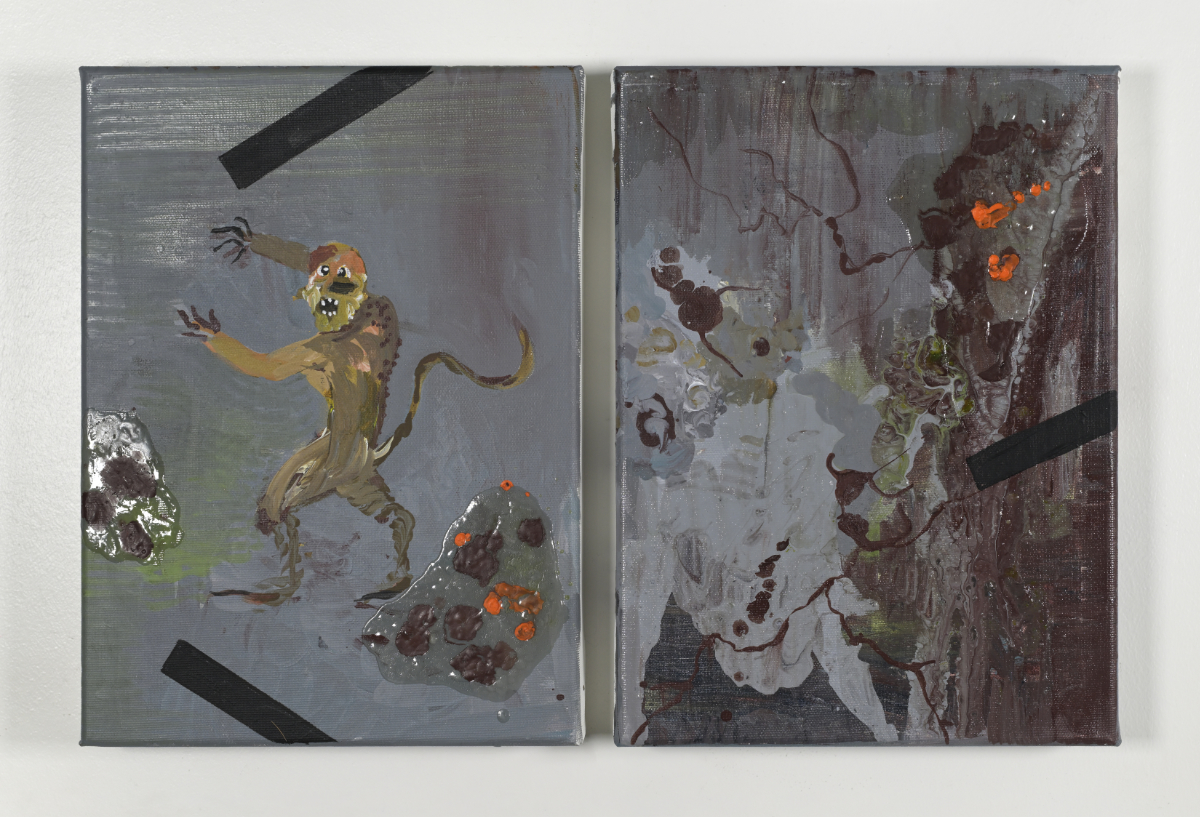
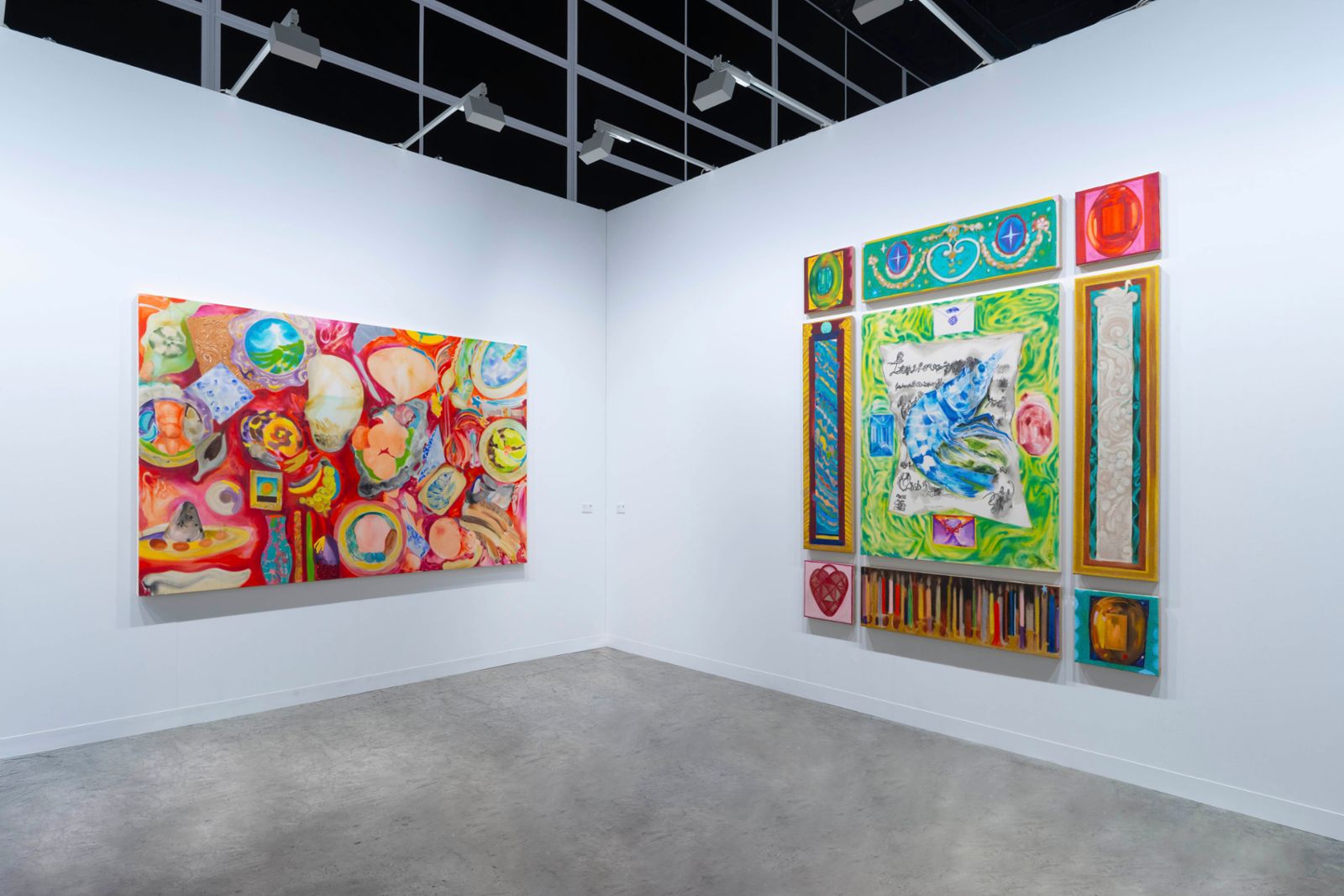
Across the fair, there was a real turn toward painting. The most compelling examples were attentive to paint as both material and language—either through overt physicality (gestural surfaces, fingerprints, visible decision-making), or through introspective intimacy. Moroccan artist Youssra Raouchi (Catinca Tabacaru, New York) presented tormented, surreal psychodramas; Çağla Ulusoy (Dirimart, Istanbul) offered exuberant explorations of decorative motifs alongside a quirky video in which a blue lobster obsessively checks social media. Work by Shinya Azuma (Cohju Gallery, Tokyo) stood out for its dry, unsettling humour, almost cartoonish in style. He stages absurd scenes: a unicorn impaling a figure, avatars ready to fight, a beady-eyed man vomiting a stream of acidic yellow. The effect is both comic and brutal, presenting humiliation with unnerving calm. Another highlight were some fantastic historically under-recognised painters. Berry Campbell (New York) showed women Abstract Expressionists including Elaine de Kooning, whose practice was overshadowed by that of her famous husband. Christophe Gaillard (Paris) curated Hélène Delprat’s cryptic visual diptychs, while 80-year-old Georgian artist Elene Chnatladze (LC Queisser, Tbilisi) presented naïve, diaristic works on cardboard and pebbles
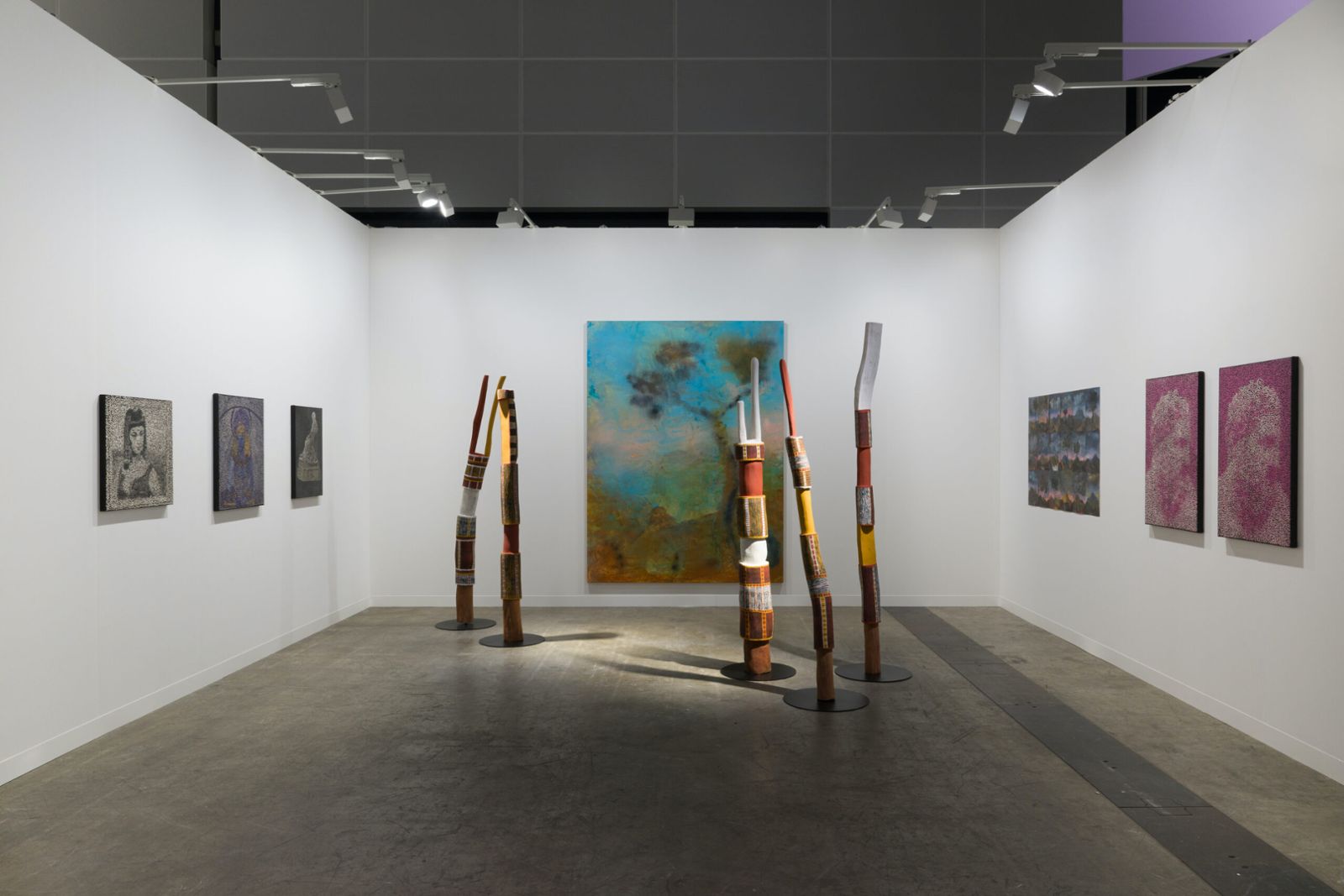
The new Echoes section featured small, curated projects with recent work. Station (Melbourne) showed Between Worlds, Within Lines, bringing together Pedro Wonaeamirri’s tutini poles, Daniel Boyd’s “dot” paintings, and Tony Clark’s myrioramas, which reference and pastiche Old Masters. It was a lovely encounter with these Australian artists, prompting a conversation between cultural memory, tradition and abstraction. Whistle (Seoul) showed sculptural work by Hyun Nahm. A tall pale pink tower, coagulated from different industrial materials (epoxy, foam, resin) looks like a post-apocalyptic dystopian relic. Multiple short-distance antennas sprout out from it, like a half-organic half-technical tumour. Smaller cast sculptures suggest an anachronistic archaeology: artefacts of the present reimagined as relics from a dystopian techno-organic future.
In Discoveries—solo presentations of artists not yet established on the international circuit—I’m drawn to the work of Neerja Kothari (Shrine Empire Gallery, New Delhi), whose On Walking (after Woolf) set A (2025) erases letters from a Virginia Woolf essay to repeat instructions from physical rehabilitation she needed to relearn how to walk. Redacted text leaves out letters to read ‘heel’ and ‘toe’, stretched across the page, the letters disconnect, like a glitching announcement board, so alternative readings appear: heel becomes heal and so on. Kothari’s work shares repetitive mark-making and obsessive writing as non-semantic drawing with the German/Italian artist Irma Blank, whose work was also at the fair with gallery P420 (Bologna).
Fairs exist as moments in time: they plunk down, then vanish—only to reappear and reinvent themselves next city or next year, without offering a curatorial vision to scrutinise in a conventional critical review. Nevertheless, as a first-time visitor, I hope the strength of painting in Hong Kong might be read, in part, as a growing response to the foothold of digital and AI practices. In defiance to the smoothness and synthesis of the digital perhaps artists are drawn to materiality and affect.
.jpg)
Footnotes
- ^ In 2018 Museums&Galleries NSW concluded that ‘older age groups are over-represented’ with 40% over 55. (2018, Katy Alexander). This is reflected in the Australian Bureau of Statistics data where the majority of museum and gallery visitors are aged 35 and older (ABS cat. no. 4114.0)