To the Owner (of multiple properties),
This might seem like an absurd proposition, but in many ways it is the most realistic path to stable housing that lies before me.
I am an artist and writer. I am seeking a patron to provide me with a house to live in free of charge for a decade.
There are approximately one million empty houses in Australia, representing about 10.1% of the nation’s private dwellings, according to 2021 Census data.
Do you own one? I will turn your empty house into a home.
You will in turn play a central role in an evolving art work of profound social importance, while supporting an artist’s career.
All the work I produce over the course of that decade long lease will be credited:
This work has been supported by (insert your name here).
I look forward to discussing this possibility with you.
Respectfully,
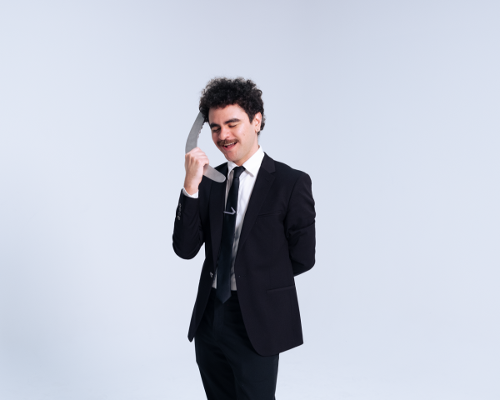
Alana Hunt
alanavhunt[at]proton.me
Since late 2025 almost 1000 of these letters—printed on over-sized A1 paper, individually signed, folded into bright yellow envelopes and addressed To the Owner (of multiple properties)—have been hand delivered to the wealthiest streets in the wealthiest suburbs of Sydney.[1] To date, I have not received a single reply. Yet the distribution continues.
The process is like a hopeful gamble. A lucky dip of sorts (somewhat akin to inheritance). It represents greater faith in chance than the likelihood of real structural redistributive economic change. All I really need is one affirmative reply. But I can’t help imagining the potential for building a global housing franchise, one over-sized letter at a time.
A friend probed me: what is of more value to the work: A house? Many houses? Or none? While I’d love to defy Maslow’s hierarchy of needs and declare the value of culture (over shelter) this is a very genuine proposition; I do want a home. I lived in 18 different (rented) houses by the time I was 18 years old, and housing precarity has continued throughout my adult life. It is my Achilles heel.
But in the absence of a single reply to my letter, I will at the very least have made some art. As they say, silence is its own kind of sound. I can also work with that. It’s likely I will find more generosity in people with less, rather than trying to find it in people with excess. This then, is also a question for art.[2]
For now, the 1% is a reasonable place to start. Point Piper, Darling Point, Bellevue Hill, Vaucluse, and Double Bay are where I have begun—the wealthiest streets in the wealthiest suburbs of Sydney and, for that matter, much of the world.
Wolseley Road. Wunulla Road. Wingadal Place. Ginahgulla Road. Victoria Road. Kambala Road. Carthona Avenue. Lindsay Avenue. New Beach Road. Gladswood Gardens. These are streets in suburbs I had never really heard of until I started this work. I’ve been marking the letter’s distribution in the pages of a Gregory’s Street Directory (75th edition) that belonged to my late grandfather. And noting the deep irony of the Indigenous-sounding street names on the most profitable pieces of stolen land on this continent.
Immense wealth is discreet. You can purchase privacy. And power. It’s the poorest suburbs we are more likely to hear of, because the poor are usually seen as a problem to be fixed. But what if we flipped that and started by fixing the rich?
Simply walking the (public) footpaths that line these streets feels like a form of trespassing, even though the houses themselves are often hidden from view behind fences, gates, tall hedges and long driveways. The people I do see during my letter deliveries are tradies and cleaners. Discussions about money also tend to be discreet. Raising the topic of income or inherited wealth in terms other than the very abstract is seen in most circles as impolite. So let’s get into some concrete numbers.
In recent years I have made about $50,000 per year as an artist. This aligns pretty closely with the average total income of artists according to Creative Australia’s research but still sits 26% below the workforce average across Australia.[3] In order to avoid rental stress I would need to earn at least $112,667 to rent a median-price capital city home.[4]
If I compare my income to Australia’s richest person Gina Rinehart whose estimated wealth is $39.1 billion (according to the Financial Review’s 2026 Rich List), $1 million dollars to her is proportionally equivalent to me spending around $1.28 cents. The discrepancy is mind boggling. Especially when you consider printing each of the letters I deliver costs $2.60, an equivalent investment of around $2 million per letter in the world of Gina.
As delusionally hopeful as I may be, I am not counting on Gina’s generosity. But how about someone genuinely passionate about the arts? Surely this could spark someone’s interest…Judith Neilson? John Kaldor? Roslyn Oxley? Kim Williams? One million dollars to Judith (whose estimated wealth is $1.23 billion) is roughly like me spending $40. For those with wealth of say $50 million, one million dollars is equivalent to me spending approximately $1000. With these numbers the general thrust of my letter starts to sound a little less absurd.
Walking the streets with these letters is fun—it feels mischievous, full of possibility, and (playfully) defiant; it’s blunt and direct. And every letterbox produces a flutter of adrenaline, like a lottery. I’m totally judging the design of these mansions—like window shopping—as if they’re within reach. Yet there are moments I am also wracked with self-doubt. Who am I to ask for a home? Is someone going to tell me to get a real job? I am not the most disadvantaged person by any means. But the question that weighs heaviest, is the one I can’t shake: who am I—as a non-Indigenous person—to ask for a place to live on stolen Aboriginal land?
Most public discussions on the housing crisis in Australia have a major blind spot; they don’t reckon with the ground of colonialism on which these houses sit. Stolen property is the foundational crime of this nation, and that stolen property has since become Australia’s largest asset class.[5] Colonialism introduced a certain way of valuing land for profit, which required the expropriation of First Nations rights to that land. And the (attempted) erasure of First Nations people from it. The legislation, tax reforms and social aspirations Australian culture fosters has—like the climate crisis—created conditions that for a growing number of people are unliveable.
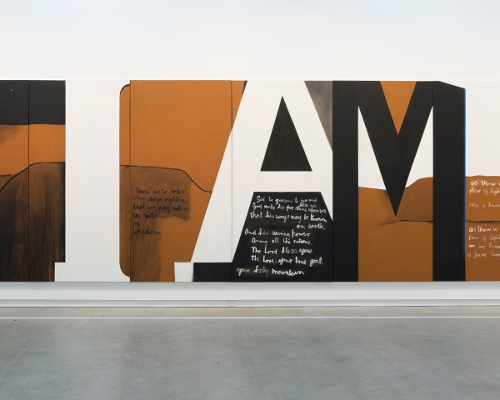
As Kevin Bell AO KC states in his book Housing: The Great Australian Right, ‘In Australia the origin of the idea that housing is to be valued primarily as a commodity for producing private wealth is colonisation. It is part of our creation story.'[6] Artist Richard Bell clarifies the ongoing obfuscation of this with his 2019 painting: A property dispute is turned into a race debate.
At the heart of every home on this continent is the displacement of First Nations people from their homes, from their Country. First Nations people are the least likely segment of Australia’s population to “own” a home and the most likely to be tenants, to be in social housing, and to be homeless.[7] Aboriginal people’s exclusion from the accumulation of wealth that private property ownership offers, is not random. It is a structural and systemic part of how colonialism continues to unfold in contemporary Australia.
Within this inherent colonial violence lies a profound tension—because equally true is the fact that every human needs a home (as in one home). Globally, decent housing is a pillar of the whole human rights system,[8] (albeit a flawed aspirational blueprint of a system failing before our eyes). But how do these ideals play out in a settler-colony, if decolonisation is not to be simply a metaphor?
So should I receive stolen goods? Should I be paying for them?
Art shouldn’t provide clean-edged feel-good answers, it can be about messy, challenging, inherently uncertain propositions and feelings. Mischievous provocations fuelled by discomfort, hope, absurdity, hard numbers, injustice and real-life needs.
I wish colonisation could be undone. I wish that it could be as simple as me moving back to where my ancestors came from. (Whose home would I be moving into over there?) But I have to face the fact that as things stand, I am willing to receive stolen goods. In essence, we all already are.
Footnotes
- ^ The Owner (of multiple properties) was first printed with the support the PICA x Copyright Agency Partnerships Commission where it appeared in the exhibition A Deceptively Simple Need at (PICA, 2025) and was hand delivered to letterboxes in Cottesloe, Western Australia
- ^ These lines were first uttered as part of my appearance in the film Sydney Opera produced by CAMP for the 25th Biennale of Sydney, 2026
- ^ Creative Australia [media release]: “Major report shows economic conditions for artists at odds with the value we place on the arts”
- ^ Stephen Clarke, “Households now need six-figure income to comfortably rent in Sydney, ABC News, 11 December 2025
- ^ Kevin Bell, Housing: The Great Australian Right, (Monash University Publishing, 2024), 28
- ^ Bell, 19
- ^ Bell, 22
- ^ Bell, 36