Salon des Refusés, August, I was back in Darwin to review the 2022 Telstra National Aboriginal and Torres Strait Islander Art Awards (NATSIAA). Away from the main event, where the competing artworks—paintings, weavings, video, sculptures—awaited the judges’ announcement in the cool, dimly-lit gallery at the Museum and Art Gallery of the Northern Territory (MAGNT), are the rejected artworks. Exhibited in the annual Salon des Refusés, these artworks hang on the walls of Gallery 5 in a run-down pop-up space perforated by the sun’s light, which takes the works—largely from up north, mostly the NT—a step closer to the conditions of their production: nearer to what the artists and their kin must see as the art is being made. Here are the rejects, the wayward, the feral, the errant—those artworks that have strayed too far beyond the selection panel’s idea of ‘tasteful’ or ‘good’ depending on their own sensibilities; art works and artists gone walkabout from the consecrated circuits of the artworld.[1] Among this cut are the Ngukurr artists.
While the intention may not be stated, fuck, it may not even be there, my mind drifts syncretically to Édouard Glissant L’intention poétique (1969)—maybe it’s the exhibition’s French title and des Refusés seems proximal to Glissant’s errance or errantry—in which Glissant, the eminent poet and philosopher from Martinique refused to reject French, the language of the coloniser. Instead, as Betsy Wing, writes in her introduction to the 1997 English translation of Poetics of Relation, Glissant ‘repeatedly destabilizes “standard” French in order to decategorize understandings and establish new relations, so that constant transformation… can form the vibrant grounds…’ And it is with the vibrancy of their artwork, their louche approach to form and medium, that the Ngukurr artists decategorise understandings of Indigenous art, at least the ‘categories’ as the ‘Telstra prize’ lays them out.
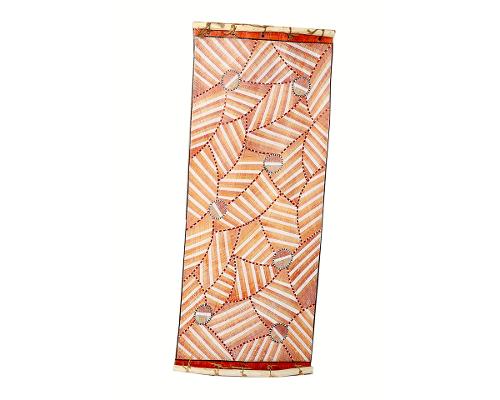
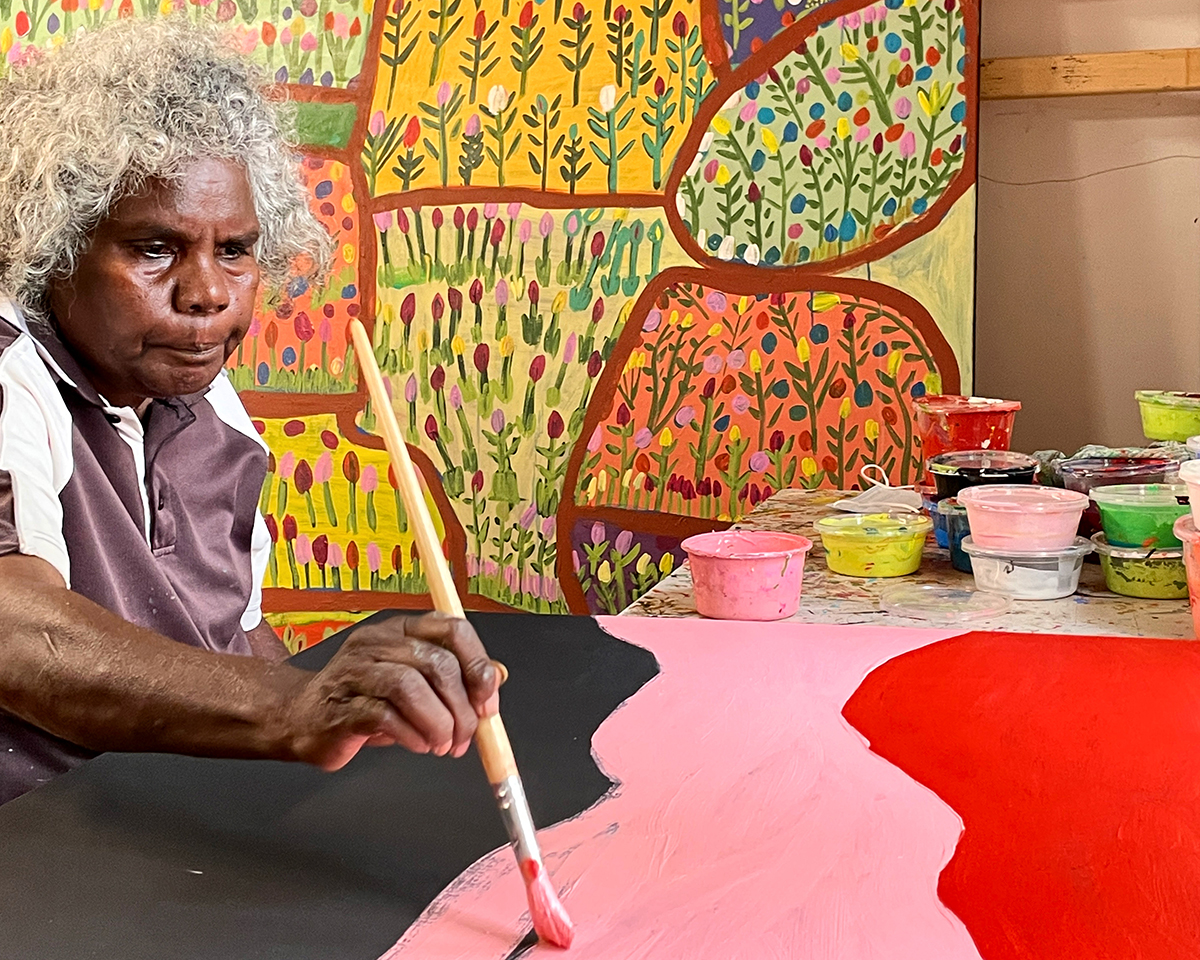
Sunlit, sombre, sad that they didn’t make it, knowing that the Telstra awards mean status, exhibitions, money, and support for mob living and making art in remote communities. But also affirmed in my recalcitrance toward the fact that Indigenous art is now mainstream, and a belief that’s what is interesting always happens in or at the margins, in the alternative. Somewhere between the fixation with the traditional and a new wave in Indigenous art, and destabilising both, is the vibrant, lived, varied, multimodal, multilingual, extra lingual, fluid art of Ngukurr. These artists draw on tradition, stories, kinship aesthetics. They paint in brilliant acrylic colours, metallic golds, and oils too: on barks, canvas, aluminium, paper, Perspex, a bullocky skull.
I’m always full with energetic curiosity before and when I speak to the mob at Ngukurr and Jude Emmett the art centre manager. It’s because whenever I hear about new materials or developments at Ngukurr I always learn about history there, the history of the Roper Gulf, and of Arnhem Land.
‘Place of many stories’, Ngukurr sits near the banks of Roper River at the south-eastern cusp of Arnhem Land in the Roper Gulf region. The community is home to the Marra, Ngandi, Alawa, Nunggubuyu, Ritharangu-Wägilak, Wandarang, Ngalakan and Rembarrnga clan and language groups. Formerly known as Roper River Mission, the ‘old mission’ was established in 1908 by the Church of England, offering refuge to the clans being attacked and massacred by pastoralists and overlanders. In 1940 flood waters washed away the old mission. Later that year it was rebuilt on a rise shielding it from the river.
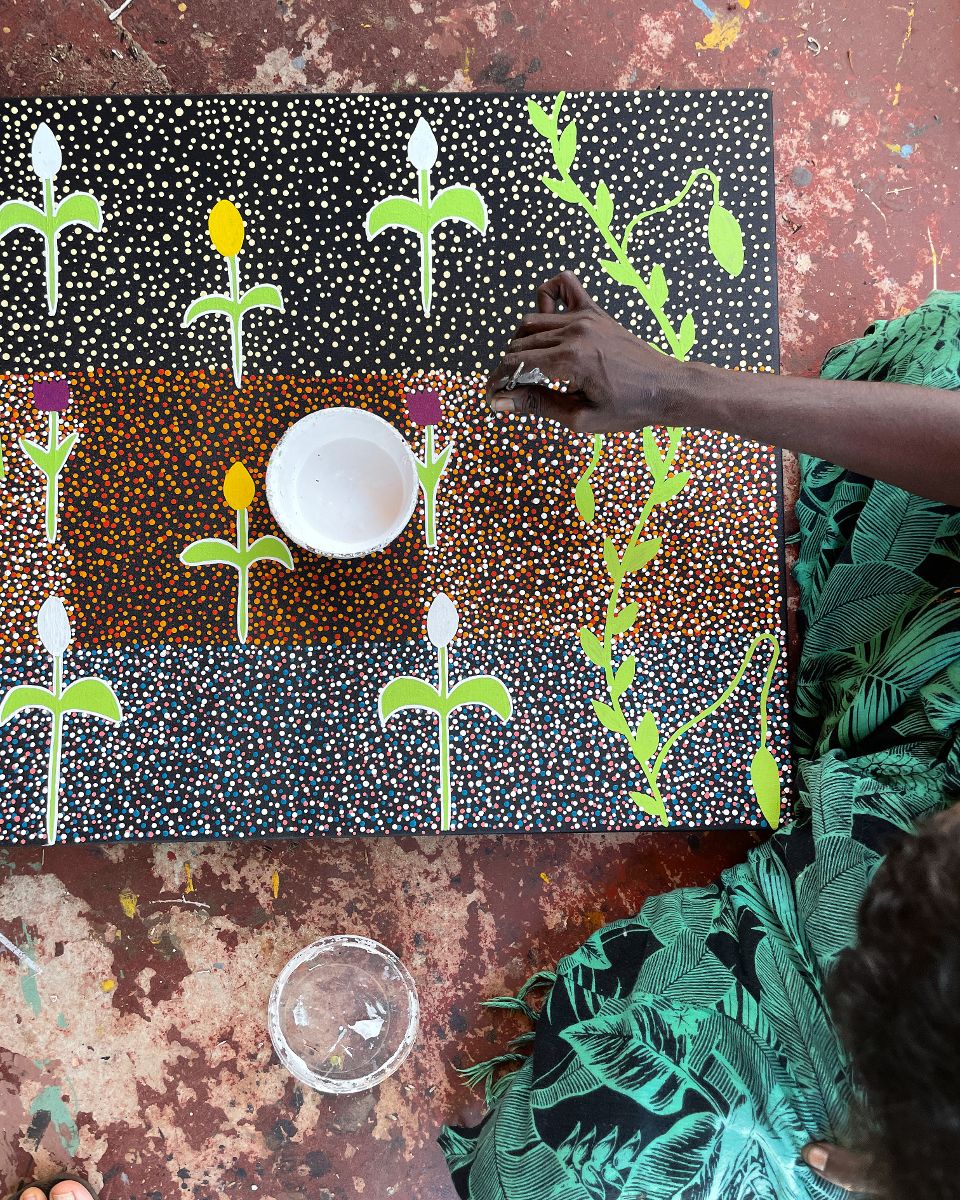
The Country around Ngukurr is storied and diverse. Mangrove flats, brushy woodlands, rock escarpments and billabongs surround the area. The stories of these places are determined by cultural practices, language, ceremony, ecology and ancestral Spirits. Like the river, stories weave webs of connection, simultaneously demarcating points of difference and coming-together.
During our Zoom conversations, Karen Rogers who is an artist and a language worker at Ngukurr tells me that ‘most artist here use vibrant colours. They have different styles of painting, but it’s always in vibrant colours.’ While most remote art centres have a readily identifiable style and, in some cases, the regulation of materials, Ngukurr does not. The high-key palette is the only thing that is consistent at Ngukurr. Although, even that is disrupted at times, by Alan Joshua Jnr for instance, who paints in oils with a more subdued palette.
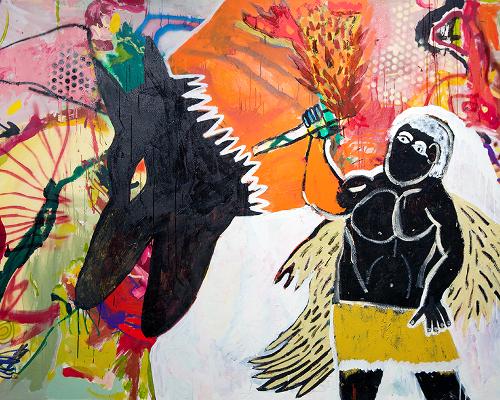
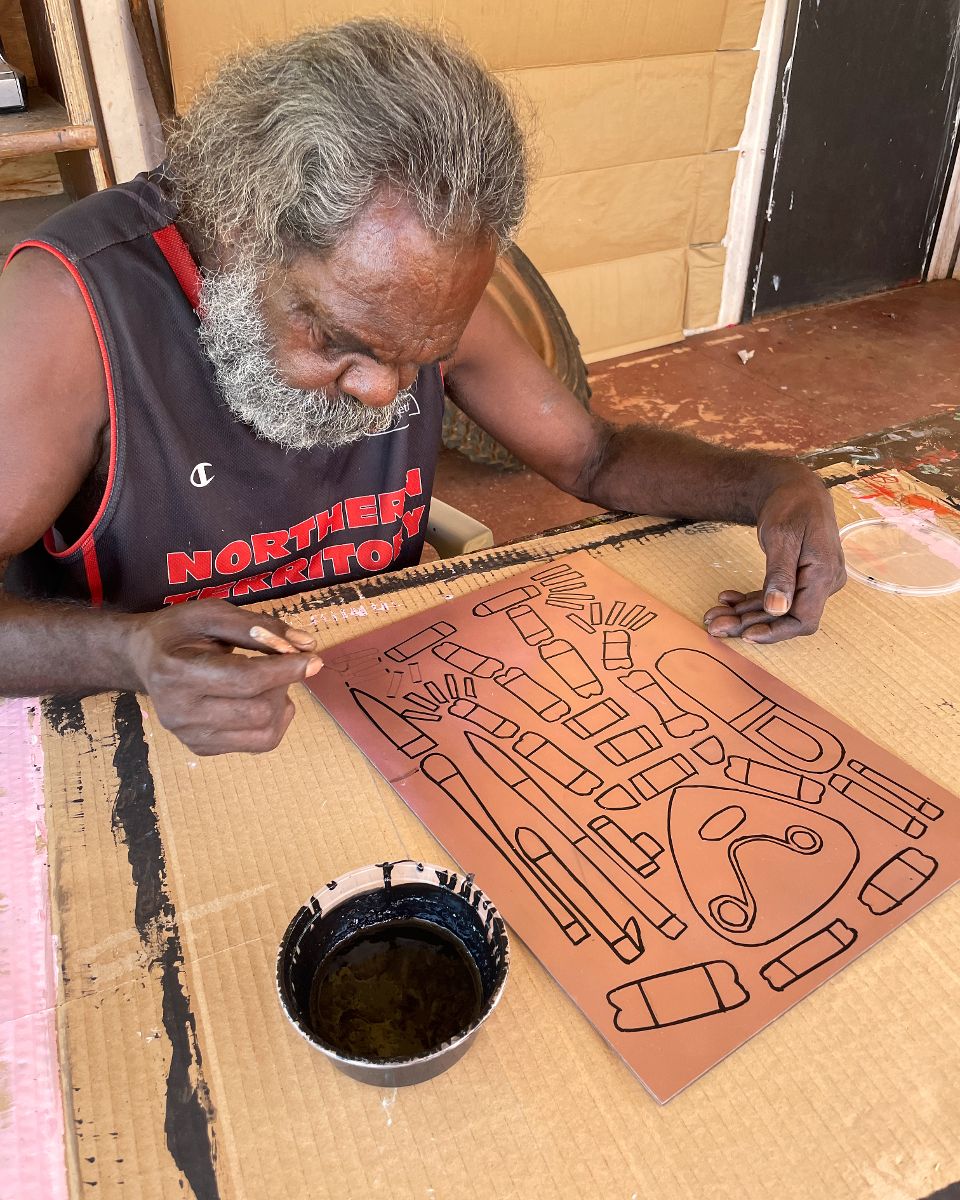
Rogers expanded practice includes painting, illustration, writing, animation, print making. She often draws on intergenerational storytelling to embody the creation of personal motifs with cultural resonance, such as her Toyota Troopy, which features across modes. Wally Wilfred turns the high-key palette all the way up, while maintaining cultural tradition, such as in his Devil Devil / Mokuy works. In indirect address, he animates counter-histories from the region with his figurative sculptural installations Dhyakiyarr vs The King (2018) and After the Rescue (2020). Wilfred reconstrues traditional aesthetics, developing a simplified rarrk style that uses luminous colours instead of intricate linework to create the shimmer effect of traditional ochre rarrk. Gwenneth Blitner’s loquacious ecologies are breathed with the vivaciousness of Country around Ngukurr. She creates a kind of bewildering ground cosmology as her painting Bush Banana and Cemetery (2021) so powerfully demonstrates.
These artists are not without antecedents: Wilfred continues in the trajectory of his grandfather, one of the first Ngukurr artists, Djambu Barra Barra (Sambo Barra Barra). Blitner’s paintings resonate with the work of Gertie Huddleston, Willie Gudabi, and Moima Samuels (Moima Willie). Along with Ginger Riley Munduwalawala, these were the generation of artists who began the movement of vivid art making at Ngukurr in the 1980s.
It’s hot and humid in Ngukurr when we have our meeting over Zoom and the power at the art centre cuts out midway through. This is not an irregular occurrence at Ngukurr, and along with the deprivation of telecommunications, food, healthcare, housing, CDEP, the now partially abandoned Basics Card, and other infrastructural violence, it’s something that is synonymous with life in remote Aboriginal communities. It’s the gubba shit, which mob must endure in order to live on or nearby their Country.
Tristen__Might as well get started then, aye? So, Karen you were saying it’s hot in Ngukurr at the moment?
Karen__Very hot, really humid. It’s very cool at night, but.
Tristen__I’ll try and make this quick then. When you make your work, whether it’s painting or sculpture— or Karen, I know you’ve been working on books and animations as well—do you normally work at the art centre, or do you work at home, or in a studio somewhere else?
Karen__Yes, most of us work in here. We’ve got some people who paint at home, they prefer painting at home. But me, Wally [Wilfred], Gwenneth [Blitner], Jill [Daniels], Bruce [Wilfred] we all work at the art centre.
Tristen__And you all work there at the same time, is there enough room for everyone?
Karen__Yeah, just for us, but if you have more in that room… hahaha. We’ve got a couple of fellas that paint outside, like Wayne [Bingal] and Bruce [Wilfred], because of a cultural reason too with Jill [Daniels], because they’re poison cousins they can’t paint in the same room.
Tristen__Do they like painting outside?
Karen__If it is too hot, they don’t like it—then they go into the gallery and paint.
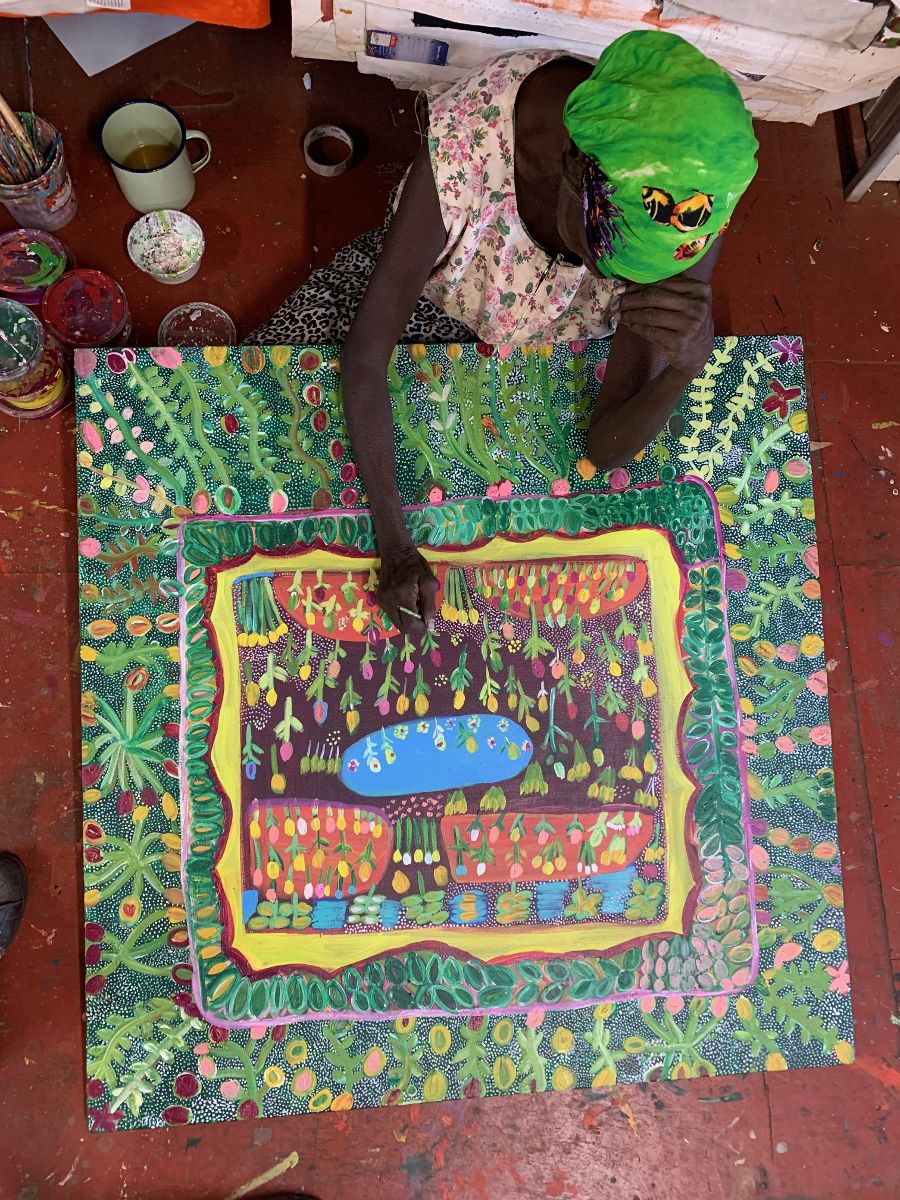
Tristen__Karen and Wally, I want to understand more about your practices because I’m interested in orientation in your work—as in which way the painting is meant to be viewed from. Do you work at a table, with easels, on the ground?
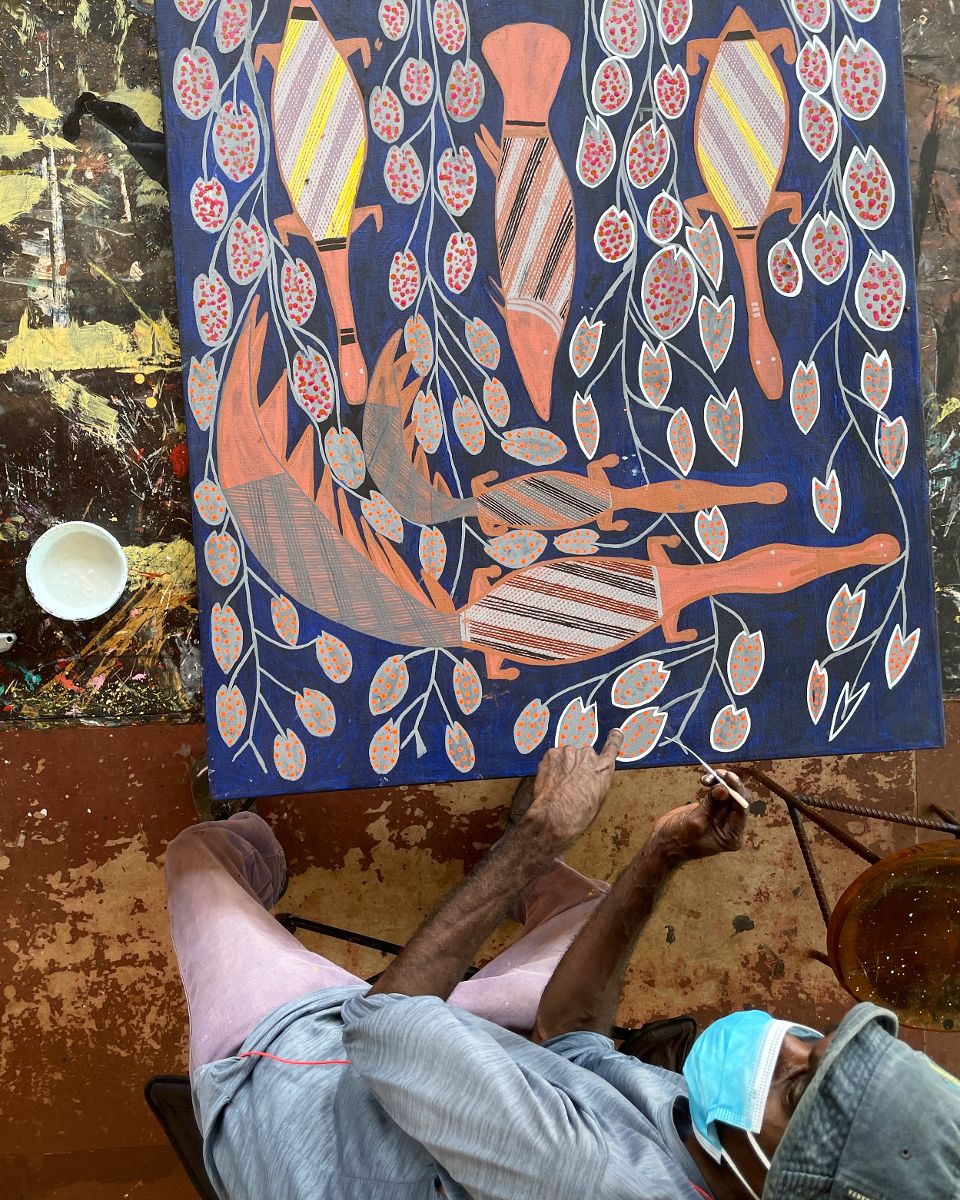
Wally__I usually standup.
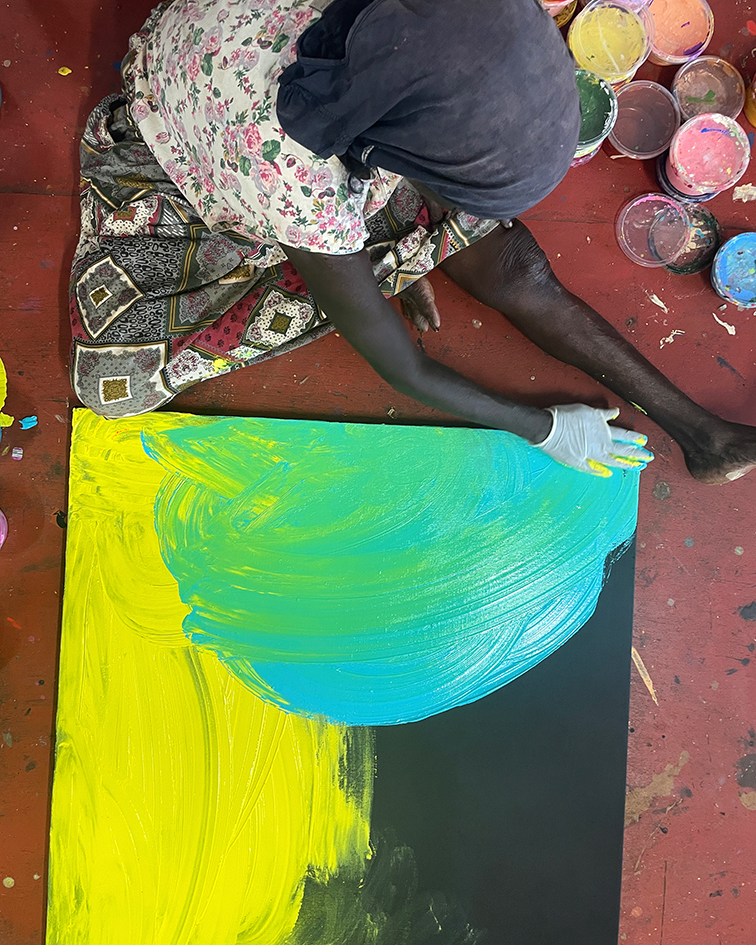
Karen__See that table over there. That’s where Wally paints [Karen turns and gestures to a long workbench in the middle of the room]. I like sitting on the ground to paint.
Tristen__Ah true, so both of you paint from like a bird’s eye view. That’s an interesting complication—I mean that in a good way—in regard to orientation in both your painting practices. As far as I’m aware the direction in which your paintings are meant to be hung is always quite clear in your work, there is a readily identifiable top, bottom, left, and right. Wally, in your paintings like the Devil Devil ones and Karen, in your work like Troopy paintings, the position the viewer is meant to see the painting from is very obvious and that’s different from the way you’d be viewing it as you paint it.
When I think about other painters who paint on the ground, this is usually very closely tied to how orientation functions in their work. An example that comes to mind is [Yolu artist] Nyapanyapa Yunupiu’s Bungul Djama Ceremony (2008), which is an amazing painting, and it could be hung on any kind of axis on the wall and still be a really strong work. One thing I love about this is that it’s not so much a rejection of orientation, instead these ‘orientationless’ paintings show up the limitations of the art gallery’s machinations.
There is an impasse between paintings as frontal 2D objects on a wall and paintings that come from the ground and are more like 3D objects, but in the gallery there is this lingering discomfort about showing paintings on the ground, a hierarchy of presentation that is really hard to move or think beyond.
Obviously, it’s not only Indigenous artists who have painted with the substrate on the ground, Jackson Pollock is probably the most famous example of a white artist who did it, but he was directly influenced by Diné (Navajo) sand paintings.
Getting back to your paintings though, I’m intrigued by the fact that you retain the practice of painting on the ground or from the bird’s eye-view, which in this sense is an Indigenous corporeal practice—perhaps one that is more prevalent in remote art centres—but your work operates along a very clear axis, fitting for a wall hang. There is a sense of transcultural hybridity here, but not in the sense of the ‘walking between two worlds’ trope—I just keep having this vision of the gallery slanting, as in the whole architecture of a gallery, but also peoples’ viewing expectations getting put off kilter.
Wally, I remember you were making those wooden sculptures, about the story of Dhakiyarr and that of Ayaiga. Were you using a chainsaw to make those?
Wally__Yeah.
Tristen__And is that something you’re still doing or is your back too sore to make that kind of sculpture now?
Wally__It’s too sore.
Tristen__Mm, so you moved more towards acrylic on paper and you’re doing those at the work bench. Going back to painting on the floor, it says a lot about the body and accessibility in relation to the kinds of possibilities and limitations for what work an artist can produce.
What have you been working on recently?
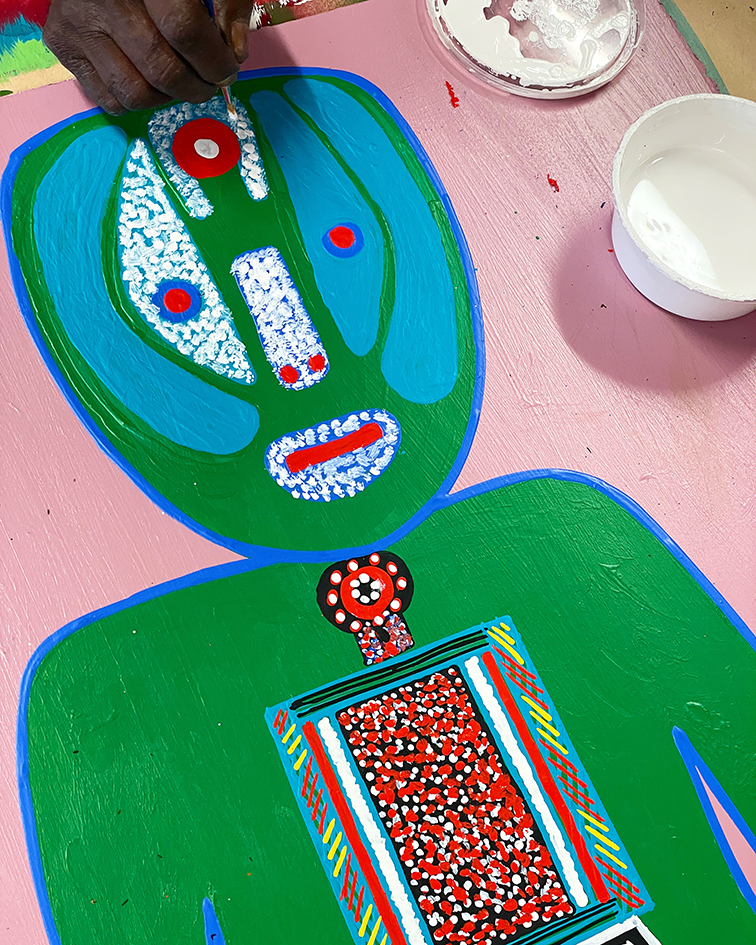
Wally__The bones, Debul Debul.
Karen__Mokuy they call it. The colour one is called Mokuy, that’s the Devil Devil.
Tristen__Ah right, so Devil Devil is Mokuy [is Debul Debul].
Karen and Wally__Yeah.
[They hold up an acrylic on paper painting that Wally Wilfred is currently working on, it depicts the figure of Mokuy]
Tristen__Mokuy! Those colours are glowing. How do you make decisions about the colour that you’re going to use in a painting?
Wally__I usually just been doing the colours. Only three, white, yellow, red, and black [ochre]. But I’ve been deciding to do different colours because I saw my grandfather, Djambu Barra Barra pretty colours. And that’s why I decided to do all sorts of colour.
Karen__Most artists here use vibrant colours. They have different styles of painting, but it’s always in vibrant colours.
Tristen__That’s what has always stood out about Ngukurr artists to me, and Cath Bowdler says that about the first generation of Ngukurr painters in her PhD thesis Peintpeintbat: Four artists from Roper Way (2008). Unlike most other art centres there is so much variation in style and materials at Ngukurr—this kind of dynamic and multifarious approach to art making seems like a kind of vibrancy in itself. That use of magically bright colour ties everything together.
Why do you think the mob at Ngukurr like to paint with bright colour?
Karen__Red, white, and black are olden days colour when they were painting on caves and the body. But there was a generation of change, the artists wanted to think about more colours in their artwork.
I think that’s happening with Wally and everybody at the art centre. I think because of the generation of changes, we are putting more colours in our artwork.
Tristen__True, thinking about the work of Munduwalawala and Barra Barra, their iridescent blues and corals come to mind and now you have Wally and Gwenneth introducing these metallic golds and Alan [Joshua] is venturing into oil painting, like his oil painting on bark, which I’ve never seen before—I’ve never seen anyone else do that.
So these vibrant colours, are they colours that you see in Country around Ngukurr, the flushes of flowers, the trees, the water?
Karen__I think that’s where it comes from—looking at the land, you know. You haven’t got red, the old kind of thing. On the land you’ve got bush flowers. The colour of water, it’s really blue. I think the vision of colour comes from looking at the land we live in.
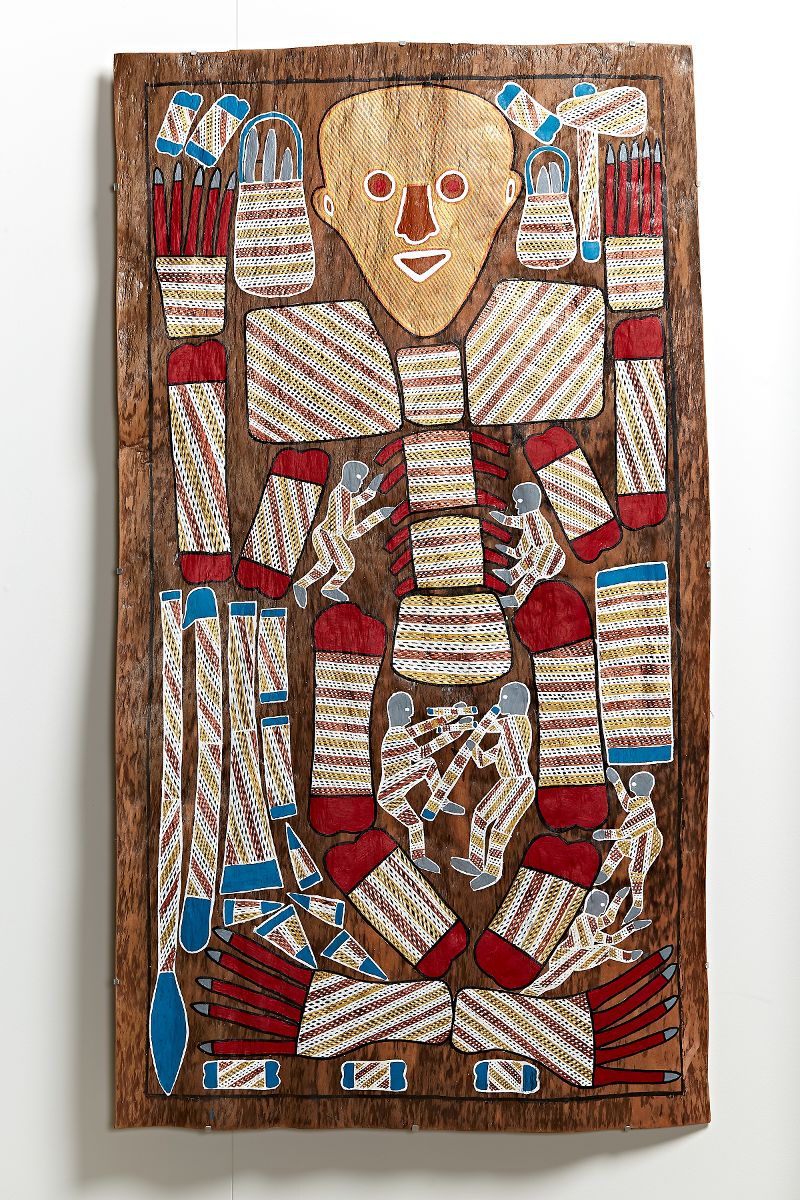
Tristen__What sort of materials do you mob typically use in Ngukurr? Wally, I know you’ve worked with barks, Arches paper, found wood, and Perspex. Material improvisation seems like a big part of art in Ngukurr. There is a wonderful moment at the beginnings of the Ngukurr art mythos when Barra Barra and Munduwalawala were so keen to start making art, they used whatever was at hand, making their first paintings with screen-printing ink and lawn curtain.
Wally__I do have barks sometimes but I’m pretty much just working on this thick paper. It’s easier and more comfortable.
Karen__A lot are doing canvas. The young boys love working on bark.
Tristen__Is it difficult to get the barks? I’ve wondered with some other art centres who’ve also transitioned away from barks—much more recently than Ngukurr—whether meeting market demand exceeding the availability of barks has been a driving force in that decision? Sorry, that’s somewhat of a digression because I know that’s not the case at Ngukurr.
Karen__The weather and the season has to be right for getting barks, but it’s been no good weather lately. The weather’s not good for barks at the moment. You need a bit of rain to get that bark ready.
[We lose Karen, Wally, and studio assistant Sean Smith from Zoom. The power has gone out at Ngukurr, cutting off the WIFI connection. Jude and I continue talking]
Jude__I got the Perspex and aluminium for the rarrk painters. Canvas has got a bit too much tooth in it compared to bark, which is quite smooth when you finish it up. Normally we would try and get more bark, but it was a really shitty wet season.
It has to be wet to get enough to harvest barks. The bark grows according to how much it thinks the tree is going to grow. If it’s a dry year and it thinks the tree is not going to grow much the bark is going to be hard to get off the trunk—it won’t have expanded. We won’t really collect bark this year.
Tristen__I knew that the wet was the time to collect barks, but I didn’t realise just how much seasonal variation there is in the availability of barks from year to year. It does make me think about this trend towards environmental or ecological art and art pedagogy that’s been happening down here [Melbourne], which is fraught and tepid at best. Bark painting in ochre is so deeply tied to the ecology of a place and I know it can and often does kill the stringybark trees. But—and I don’t really know enough about it—I’ve heard of it also being used to actively manage tree populations as a kind of living-with and caring-for Country. I hate putting things in categories but bark painting, in this sense, is eco art. It’s also the best eco art pedagogy. It’s deeply informed by environmental philosophy and it’s always about transmitting knowledge of that, which of course is entwined with cultural and cosmological knowledge—I mean it sounds foolish even thinking those things apart from each other.
So, if rather than the artists changing their practices to meet market demands—when I say market I’m talking about collectors, curators, the works—the market met the ecological imperative that is embedded in the art—the art world could move towards a better way of practicing … maybe.
I know you mob don’t work with bark all that much but when I look at the artistic output of Ngukurr it definitely appears to be an art centre where artists are permitted to follow their creative intuition. Not to say the work is without cultural tradition, Mokuy is an obvious example that it is deeply concerned with tradition. But there is a willingness, perhaps driven by necessity, to find new forms for tradition. In this sense keeping the old new is about constantly re-producing it. For me, this adheres to how I understand oral tradition, oral history, which is dependent on a sociality of presence, of relation, and reproduction or retelling more so. And to clarify (for the people who are going to read this when I type it up), artistic intuition, improvisation, inventiveness—all of these things are not individualistic at all—they’re dependent on and arise out of a social, environmental, and aesthetic context, which is always relational and informed by historical and economic constraints. No one is a ‘single being’, I got that from Fred Moten.
Jude__Yeah, yeah, it was a lousy wet season. And some people’s work just looks better on bark. Particularly, classic rarrk style, you know. It just works with the geometry of the bark. So, I think the style of Wally and those fellas, if you transfer it to canvas it just loses its quality.
Tristen__And as you were saying before the texture is quite different to canvas. There is that smoothness to it, which perhaps helps the rarrk shimmer as its meant to. Perspex and aluminium are substrates that have a reflective shimmery kind of quality works with rarrk styles, I think. Yeah, that’s right.
Jude__From a studio perspective, sometimes people can get a bit stuck. So introducing them to a new material can inspire them to approach their work in a different ways.
Tristen__It’s exciting, creating the potential for new motifs or gesture or colour or whatever it may be.
Jude__We try and mix it up and then each artist finds their own voice in it.
[The power is still out in Ngukurr, Karen is trying to give Jude a ring]
Jude__She’s [Karen] just trying to get hold of me, I’ll give her a call.
[He returns her call; they’re working on a solution to get back on Zoom].
Jude__It’s a real thing when the power goes off. It’s always this time of year and it’s probably close to 40 degrees if not 40 degrees. It’s fucking punishing. It’s punishing.
[Karen, Wally, and Sean come back online using the data from Sean’s phone]
Tristen__I can see your ceiling fans have stopped working. The power is still out?
Karen__Yeah, but I’m using the data on Sean’s phone.
Jude__That building [Ngukurr Art Centre] is the old principal’s office.
Karen__This room we’re in used to be the old principal’s office. We just made a new printing studio earlier this year, so we can do things like printing on textile. That’s in the old classroom.
Tristen__So the art centre is in the old school. Is that where you went to school?
Karen__Both of us went to the school there, but Wally went before me, he’s older.
Tristen__Can you tell me about the prints you’ve been making in the new studio?
Karen__I’ve been printing on fabrics, but we still haven’t got a design for Wally.
Tristen__I remember seeing dresses with your Troopy design.
Karen__We’ve also got t-shirts that we print ourselves here.
Jude__Karen has done 3D works recently—modelling with plasticine and then getting it cast.
Tristen__What have you made, is it the Toyota, the Troopy?
Karen__It’s a Toyota model. I mean, it’s being cast by someone who does set design that is making the mould for us.
Jude__We’ve had moulds made of Wally’s work. I just have to get the money so we can afford to get it cast, it’s a bit more expensive than anticipated.
Tristen__I was going to ask if Wally was doing any more sculptural work?
Jude__He did the model for the mould, which was made out of clay and it’ll be cast in a kind of polymer probably. We might try recycled aluminium as well.
Tristen__When I was up in Darwin in August, I saw all the Ngukurr mob had work in Salon de Refusés. I was surprised that no one got into the Telstra’s?
Jude__That’s right, Wally had a big bark and Alan Joshua had a work. I was surprised Wally’s bark didn’t get in, or the other artists’ works too, really. You know, I’m always surprised. I was really happy about the weaving that won [Margaret Rarru Garrawurra’s Dhomala (pandanus sail) (2022)].
Tristen__For sure—not that it’s the first time a weaving has won the main prize—Bonnie Burarngarra and Freda Ali’s An-gujechiya (2021) won the 3D prize for their weaving. I feel like it’s a sign that weaving should have a category of its own, instead of being lumped into the 3D prize.
Karen__I got into the national Canberra [the National Capital Art Prize] one this year with my Toyota one [Day Out Bush (2022)]. I’m glad I got in actually, I was happy about that. And I got into the Telstra’s last year with my animation.
Jude__Some things, like Wally’s sculptures never got in [to NATSIAA], but they don’t photograph well, it’s really hard to get in with work that doesn’t photograph well.
[Gwenneth Blitner walks into the Ngukurr studio]
Jude__That’s Gwenneth in the background, do you want to say anything Gwenneth?
[Gwenneth holds up one of her paintings]
Tristen__Gwenneth has got a painting there. What’s that one?
[She passes the painting to Sean who holds it up to the camera]
Tristen__Oh, amazing! Is that metallic gold you’ve used in some of the line work?
Karen and Gwenneth__Yeah. Yeah.
Sean__So it changes as the light changes.
Tristen__Oh wow, I can see it shimmering on some angles, like the surface of a river when the sun’s rays hit it.
Jude__All the artists have been using, well not all of them, but a lot of artists have been using gold in their work recently. It’s hard though, it’s another thing that is difficult to photograph.
Tristen__It’s fucked that how photogenic an artwork is plays such a part in how it is received, across the art world in general. It’s really got nothing to do with how good an artwork is, but in part, it determines if a work is going to be collected, exhibited, accepted into a prize. I mean particularly for remote art centres, where you don’t have the same access to photographers or curators.
Jude__It’s been interesting for Ngukurr, work that photographs well because it is quite poppy. Things like the metallic gold can end up looking muddy. But when you see it in person, you know, when it’s lit properly, it just totally transforms.
Tristen__True, true. I don’t want to hold you mob up for much longer. But to finish up, Karen, maybe you can tell me about the different stories and designs you mob paint?
Karen__Most of us, what we paint... we’re different tribes and we paint our grandmother’s and mother’s dreaming and Country. We’re not allowed to paint our dad’s side of the family. But nobody is just grandmother or grandfather around here, you’ve got to know what to call them. So that’s why we say abaija and gagu.
Tristen__Just like your beautiful book Main Abaija My Grandad (2021). Well, thanks for everything you mob. I’ll go and write this all up.
Footnotes
- ^ The judges who decide the final prizes do not choose the shortlist. They judge based on what is presented to them by MAGNT. In 2022 the judges were Myles Russell-Cook and Joanna Barrkman.