Long defined as a place unchanged by human influence, the notion of wilderness as a pristine environment is losing currency as knowledge of the global impact of human activity, even on places as remote as Antarctica, has grown. New understandings of the ways in which the natural world is adapting to our impact are developing as evidence of the ability of some threatened native species to survive and even thrive in developed areas is discovered. Tasmanian artists and curators have a long history of engagement with environmental and wilderness issues, and are responding to these new ideas from a wide range of perspectives. Developed by Hobart-based curator Jack Robins as part of CAST's Curatorial Mentorship program, Companion Planting addresses 'the space where people and plants, city and nature merge'.
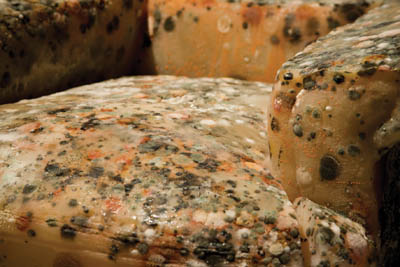
Lucy Bleach's nature is a language can't you read (2008) provides a startlingly organic interpretation of these themes. Casting a favourite armchair in agar jelly, the artist has created a nourishing environment onto which mould spores can settle and flourish. After several days in the gallery the chair's surface resembles pink and green mottled velvet, alive and engaged with its surroundings. On a nearby wall hangs a rough-hewn shelf made from the branch of a pear tree, bearing silk embroidered 'moss', silver lockets and glass pears. Combining delicate craft and organic anarchy, nature is a language can't you read straddles the nature-culture divide and expresses a yearning for a stronger connection with the natural environment in the everyday.
Remote Viewing (2008) by Amanda Shone traverses notions of survival and shelter. Constructed from used sleeping bags, this large, soft sculptural form resembles a rugged mountain range and incorporates a 'cave' which visitors can enter. A hidden sound system feeds back noises made by occupants in a sequence of diminishing echoes. Bearing remnant imprints of the bodies which once occupied them, the primary materials of this work evoke multiple associations of human encounters with nature, of our vulnerability to the elements and the gradual loss of our ability as a species to survive unassisted in the wild.
Exploring ideas of urban ignorance and disconnection, Dean Chatwin's It won't grow (2008) presents a sprinkler continuously spraying water onto a slab of formed concrete. The water pools and runs off the edges, disappearing beneath. Despite the obvious illusion (the water is recycled through a pump), lifelong memories of suburban water restrictions make it a discomforting experience. Lengths of steel reinforcement bars extend from the edges of the concrete, suggesting its place as a fragment of a larger system, and the widespread scale of careless water consumption.
In a similar vein, Raef Sawford's Disturbia (2007) presents an Arkley-esque image of a new housing estate, a quasi-surreal landscape of Neo-Modern architecture with manicured lawns, restrained gardens and sun shining on empty streets. The image is devoid of any human presence; the only sign of movement at street level is the occasional stirring of leaves. Overhead dark thunderclouds roll by as a digitally looped storm perpetually brews. On the ground the scene remains static, oblivious to the gathering forces of nature.
Inspired by natural forms and materials, Michelle Cangiano's exquisite jewellery series, Looking Back Made Easy, suggests leaves, branches and growth rings. Presented in the context of this exhibition, these pieces take on a sense of memento mori, a reminder of life and our place within the natural environment. Designed to be worn on the body, these objects take on a talismanic quality, becoming touchstones which are vessels for memory and symbols of intention.
Although occasionally straying into clichéd territory regarding suburbanite attitudes, this exhibition is a visually exciting and philosophically engaging experience. Jack Robins and the artists in Companion Planting challenge the notion of the environment as something 'out there' and bring the perplexing paradox of modern human existence and environmental preservation closer to home.