It has often been said that a picture is worth a thousand words. Never have truer words been spoken than in relation to the evocative and visually overwhelming art of Enrique Martinez Celaya. Drawing upon the literary work of Osip Mandelstam and Harry Martinson, the artist insists that his interest in the two poets marks them as 'companions more than influences' in his art practice. The Lovely Season at Liverpool Street Gallery is just that, lovely, but this hollow assertion gives neither the artist nor the viewer any credit. The true beauty in Celaya's work lies beyond the initial aesthetics, beyond what is seen, to an almost transcendental exploration of the interconnectedness between the figure and the landscape.
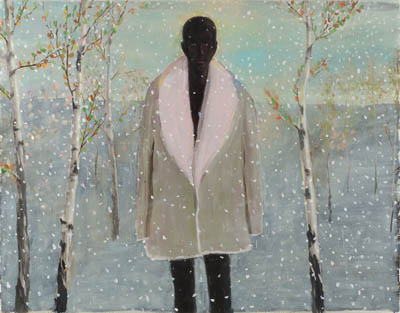
Unquestionably the most powerful work in The Lovely Season is The Burnt (2007). A tall figure with burnt skin stands amongst a snow-covered forest, his body facing toward the viewer. The snow that gently falls, surrounding the imposing figure, evokes a sense of calm and mystical embodiment. However, what makes this work so captivating is the expression in the man's eyes, as though he has the capacity to stare straight through you and in his intense gaze lies a veiled question that has the propensity to make you look away. The stark contrast of the darkness of the figure against the translucent white of the snow evokes an illusive quality and a spirituality that appears to question the very limits of humanity and mortality.
Another work that utilises visual contrasts is The Fire-Wood (2007), which appears almost as a before and after snapshot of a forest in the midst of a fire. In the centre of the work lies the word 'Martinson', a reference to the Nobel Prize- winning poet laureate Harry Martinson whose literary work has been said to combine an acute eye for love and nature with a deeply felt humanism. These facets could also be said to underpin Celaya's entire body of work in The Lovely Season. With apparent references to rejuvenation and re-birth, The Fire-Wood is an embodiment of the cycle of nature, reminding us that resurrection often follows a fall.
Knight of Faith (2007), a series of watercolour, ink and acrylics on paper, is vaguely reminiscent of the well-known Brothers Grimm fairytale Hansel and Gretel with images of children surviving in the wilderness. This sense of the wild and the untamed is alluded to throughout The Lovely Season, both through the depictions of the landscape and the people that inhabit it. There is also a feeling of isolation that perhaps relates back to the artist's own feelings of detachment and dislocation from his Cuban heritage, having fled Cuba with his family at the age of eight.
The beauty in Celaya's Rainbow (2007), resides in its simplicity. Small in scale, it would be possible to simply pass it by without so much as a second glance, but this would be a misfortune as the canvas embodies all that is enigmatic in nature. The work encapsulates the discrete beauty, with subtle undertones and a fanciful quality, that will forever be associated with the illusion of rainbows. This sense of spirituality can be seen to reference the art of early American modernist painter Arthur Dove, whose work was often based on natural forms. Similar to The Fire- Wood (2007), this work is as a symbol of rejuvenation and re- birth, as the rainbow is a symbol of the calm after the storm, of survival.
There is a certain profound darkness in Celaya's work as he loses himself in the beautiful melancholy. The Lovely Season is all at once fanciful and serious, evident and elusive, intense yet with an overwhelming sense of calm, much like the artist himself.