A decade ago the word terrorism was not a common turn of phrase amongst suburban Australian society. An 'act of terror' was more likely to be associated with the antics of a naughty child then the calculated destruction of a nation. Multimedia artist Khaled Sabsabi's new work mediates on the very real fears of people who exist in a world dominated by civil war and whose fears are fuelled by a continual onslaught of media propaganda. Born in Lebanon, Sabsabi migrated to Australia with his family in 1978 due to the civil war in their homeland. This sense of displacement and identity permeates the exhibition, challenging the audience to question their own place and purpose.
The digital video guerrilla 2007 incorporates three screens on which three people recount their stories. The images oscillate between the people and footage of, what one presumes, are the results of guerrilla warfare. Buildings are destroyed; streets littered with debris and children wandering aimlessly amongst the rumble, their homes now only a distant memory. Despite the fact that the audience may not be able to understand what the civilians on the video are saying, their message is powerfully portrayed through body language, facial expressions and the inflection in their voices, bringing to mind the age-old adage- 'A picture is worth a thousand words'.
It could be said that this is a theme that highlights the power of the captured image. Football 2007 alternates between two images. The first is what appears to be a news report on a riot at a football match where the crowd takes to the field in defense of a lone man who interrupts the game by running across the field holding up a sign. This man was subsequently caught by security and beaten, inciting the crowd and acting as a catalyst for their violence. The second image is of children playing football in the street. Their apparent innocence and the sound of their voices as they call to one another is in directly contrast to the images of violence and the sounds of anger that result from the football match. As the image changes, in a 'blink and you would miss it' moment, a street sign that says 'Palestine' emerges, reminding us of where we are and reflects Sabsabi's comment that 'the discrimination today still exists'.
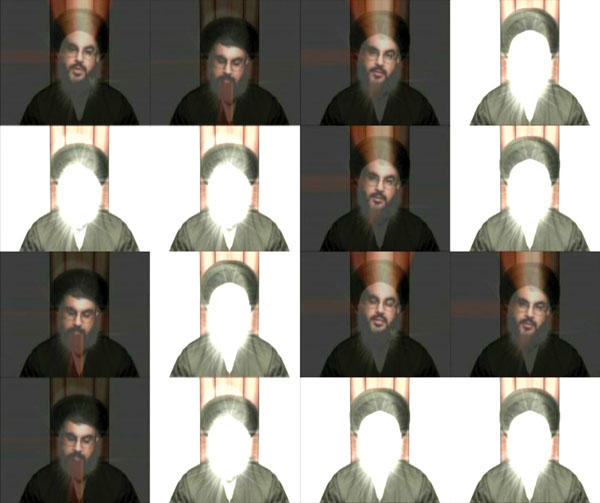
The work You effectively capturing the role of the media in civil disturbances, presents two simultaneous images. Overwhelming in its intensity, one half of the work portrays the apparent image of Hassan Nasrallah, Secretary General of Hezbolla, performing a speech. The single screen is divided into three identical images of Nasrallah from the chest up and as time passes his likeness multiplies until hundreds of images fill the screen. Interestingly approximately half of the images are unrecognisable as a white light radiates from Nasrallah's face. The image could be interpreted as reminiscent of religious art from the Renaissance period, in particular, depictions of Christ and the Virgin Mary, as the white light is suggestive of a halo or some other higher purpose. Accompanying this visual display is what sounds like a rally. A man is making a speech amongst cheers and applause, the same phrase is repeated over and over. A second screen shows another grid formation with the distinguishing feature of writing which appears to be Arabic running through it. There is a sense of chaos here that presents a direct contrast to the control of the first image.
ON'n'ON challenges the audience to ask themselves if they should truly believe everything they see. Reflecting the way in which society has become complacent through the onslaught of propaganda, Sabsabi does not offer an explicit narrative through his work, rather he is asking the audience to uncover the layers of presentation, defying any preconceived ideas. After engaging with the work and upon reading the artists' words, there is an almost overwhelming sense of hopelessness. He asks: 'I often think about my son, did I burden him by bringing him into this world... I ask myself is this child going to be pleased with me for bringing him into this world, some days I ask myself, what did our parents bring us to do in this world? Sabsabi effectively answers his own question through his engaging work which tells the story of his present and his past while leaving the future ultimately undecided.