At first glance The Road to Here may be misconceived as a collection of historical photographs; yet the myth of the photograph as 'historical document' is precisely what David Martin sets out to dispel in this engaging re-contextualisation of a number of images selected from the Robinson Collection. The Collection consists of approximately 25,000 negatives taken by Bert Robinson and his son Albert around the northwest of Tasmania from the late 1920s through to 1975, and is commonly interpreted as a record of the region's history. The Road to Here is the third exhibition initiated by Devonport Regional Gallery featuring photos from the Collection; and while previous exhibitions have predominantly included photographs taken within the studio, The Road to Here considers images relating to the landscape. David Martin, acting as curator and artist, has re-presented these images in a way that questions the role of the photograph as historical document, suggesting that the photograph and landscape alike are constructed by both the photographer and viewer.
Martin's involvement has extended beyond the selection of images on display. By manipulating the photographs during the printing process, for instance, he manages to convey his own personal interpretation of the chosen images. The photos are printed on various types of paper, some of them deliberately torn or damaged at the edges in response to damaged negatives, often on multiple pieces layered to form a whole, and range in scale from small intimate prints to enlargements that tower over the viewer. Ill-fitting and glassless aged frames surround select images, which are directly pinned to the wall, a technique that removes the 'aura' commonly accompanying historical photographs.
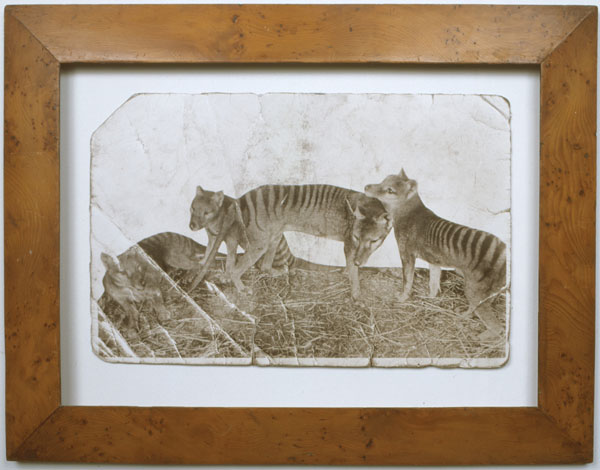
Additionally, Martin's choice of titles indicates his contemporary interpretation of the Robinson photographs. An image of a group of captive Tasmanian tigers, for instance, is aptly named after a recent Tasmanian tourism slogan: Tasmania the Natural State (1941/2007). The adjacent, ironically named Tiger Dreaming (1927/2007) is a large image of a gun shop's window, dressed up like the interior of a hut, with roughly hewn wooden walls covered in glorifying photos of hunters and their catch, posters advertising ammunition and most confrontingly, a poster announcing a reward for the heads of native hawks.
The exhibition is roughly divided into two themes. Photographs of suburbia and the built environment are presented on one side of the gallery, while images relating to the natural environment are hung opposite. The placement of photos and the order in which they are hung are not arbitrary; and as with the two images mentioned above, Martin's groupings are significantly placed to convey specific interpretations of these mostly anonymous subjects. Like the manipulated prints, the juxtaposition of images successfully highlights not only the subjective nature of these images but also the problematic notion of the photograph as historical document.
There is little or no information about many of the negatives in the Robinson Collection, and so the subjects, such as the location or identities of people, and the intentions of the photographers are largely open to interpretation. Consequently, the Collection lends itself well to the exhibition's theme. What makes the photos in this exhibition particularly intriguing is the sense of mystery conjured by the very lack of information available, and rather than accepting Martin's interpretation as 'truth', I spent a great deal of time inventing my own narratives to these photos, drawing my own conclusions from what I was observing.
The Road to Here successfully demonstrates the subjective nature of photographs; and rather than interpret the Robinson photographs as 'historical documents,' Martin suggests that 'photographs and our relationship to them is, perhaps, ultimately a question of appearance's and the relationship to one's own reality.' Although the Robinson Collection is particularly significant to northern Tasmanians, it is a great shame that there are no plans for The Road to Here to travel to other galleries; for Martin's exhibition successfully illustrates that photographs, particularly those of an historical nature, need not be defined by location or identity.