Louise Weaver's survey exhibition is a seductive experience. Drawing on the aesthetics of modern art, design and fashion - where surfaces and materials are prized - her exquisitely crocheted sculptures, installations, drawings and prints reveal the poetic and narrative potential of everyday objects, relics and animal forms.
Exploiting craft's historical links to religion and ritual with shamanistic style, Weaver's earliest works include a brown shroud for a painting, and an evening bag made with human hair. Her first application of crochet as 'skin' over a hard object appears in 1995, and every soft, woollen cover since changes our perception of its host. Blue Bred (1998), for example, becomes a woolly blue phallus, homage to Man Ray, and bizarre cultural artefact while Rainbow Lorikeet (Grafting) (1999), a taxidermied bird, is weighed down by a dense costume of crochet, sequins, light globes, silk, beads and Indian mirrors.
In more recent years, Weaver has expanded her animal repertoire. A fox, hare, raccoon and ermine are duly domesticated and firmly fixed inside individual cases, their vibrant coloured skins variously detailed with stitching that mimics fur, a sequined lightning bolt, a sash of glass eyes, and a diamanté eye piece. Meanwhile, in her nineteen works on paper, Weaver draws, screenprints or punctures the page with fine embroidery, adding sequin and glitter details. These romantic ruminations on imaginary places like Sketch for an ice cave (2000-01) provide insight into Weaver's working methods, since this initial use of freehand stitching on paper is later applied to her sculptures as a tight layer of fur.
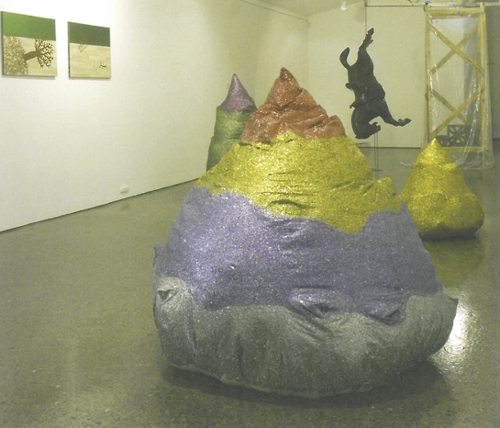
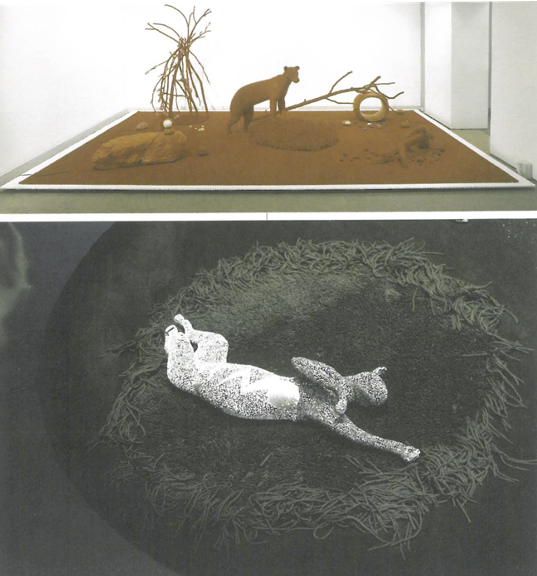
The development of Weaver's sculptural practice into integrated, surface rich environments raises the emotional temperature of the work. If the lone animals seem frozen and boxed, the larger installations see them luxuriating in lush habitats. Weaver's work seems to stem from a desire to spend time with wild animals and this extended interaction pays off in room-sized theatrical works like Moonlight Becomes You (2002-2003). Here high gloss brown rocks, looped shag pile and clipped black carpets set an enchanting night-time scene for an unlikely meeting of otters, squirrels and a bobcat.
In Taking a Chance on Love (2003) a slender red bear stands benignly in his all red and pink surrounds, complete with cherry blossoms a la Issey Miyake, patterned Japanese silk covered stones, a Vico Magistretti light, and themed elevator-style music tingling all around. The vibrant red room is blinding, but not alarming - it's like a giant valentine.
Real nature - urgent, rough and unpredictable - is some distance from Weaver's domesticated production and presentation. If her crafty concealment of all these animal bodies is an act of suppressing vulnerability, sexuality and death, it is also a tempting offer of reincarnation - into a utopian, feminine world.