The flooding of Queensland in early 2011 affected more than two-thirds of the state, highlighting the unpredictability of Australian food production at a time of natural disaster. According to The National Farmers' Federation, the floods will cost the agricultural industry around $700 million. The flooding, fires and cyclone of the new year makes two exhibitions Melting Moments by Janet Tavener and Still Life: The Food Bowl by Ken + Julia Yonetani especially poignant. The representation of food has long been a popular subject in art. Within the Western tradition, the still life has been valued for its formal qualities and the way it can work as a metaphor for other meanings. These contemporary still lifes cast and moulded from water and salt underline the issues of modern food production and consumption.
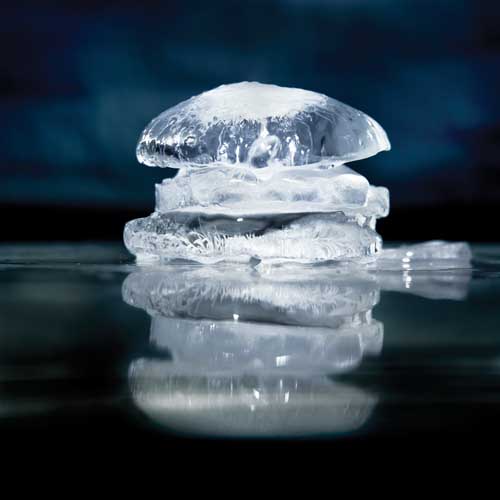
Tavener’s photographs featuring sculpted ice freeze a moment in time, highlighting the temporality of life and the precarious position of the environment as food production increases the demands upon the earth. The artist works with several copies of each ice form as they constantly change and evolve while dissolving in the heat. The melting sculpture, stilled by the camera, alludes to much larger ecological issues. The notable forms she casts into ice include hamburgers, french fries and the iconic shape of the Coca-Cola bottle - all products of a globalised food industry. The international movement of produce contributes to some of our greatest environmental concerns with the melting ice of the sculptures mirroring the thawing of the polar ice caps. Tavener notes the consumer need of instant gratification through the inclusion of a sculpted bowl of berries, a product now available year-round in supermarkets regardless of the season. The need for suppliers to meet demand is resulting in the disappearance of our most basic need - water - just like in the sculptures in Tavener’s photographs.
Ken + Julia Yonetani directly reference the water issues of the Murray-Darling Basin in their sculpted still life tableaux, made by forming fruits and vessels from the salt drawn from the groundwater of the region. The Yonetanis began investigating the effects of salinity in the basin during their recent residency at Mildura. Ken Yonetani exhibited at the Venice Biennale in 2009 with sculptures made of sugar and it was this casting technique that was modified to work with salt. Within the context of food production and preparation, salt possesses a dual nature. Historically it was used in the preservation of food thus essential in sustaining life. However salt is also a poison. It prevents the growth of flora and the use of groundwater for irrigation. The title of the work suggests life; the produce and sea fare are living entities that have been contained within the sculpture. The name 'still life’ is derived from the French nature morte, which translates literally to nature dead. The irony is not lost that a still life, depicting the nourishing foods that maintain life, is cast in a substance that simultaneously preserves food and prevents growth - thus embodying both life and death.
The consumption of food is a universally shared experience, enabling viewers to easily connect with the issues explored by Tavener and the Yonetanis. The salt sculptures with their ghostly pallor and the effervescent fleeting ice forms embody the transient nature of organic materials. According to Associate Professor Poh-Ling Tan from Griffith University, through modern farming practices shallow-rooted plants replace native vegetation causing the dissolved salts stored in the ground to rise and contaminate water systems on the surface. The result is saline water, demonstrating the way both water and salt are intrinsically linked. Through both these exhibitions the need for conscious awareness of where food is sourced and how its consumption affects the environment is reinforced. In the words of Thomas Fuller in Gnomologia (1732): "We never know the worth of water till the well is dry".