Recently I came across a pile of transaction records, tram tickets and receipts acquired by me during a period of change, confrontation, poetics, disparities, connection and disconnection; a time when hyper-analyses and heightened emotion dominated my walks, grocery shopping and the like. These traces - mementoes with precise times and amounts paid, neatly sorted into chronological order – formed a narrative that was authorised by the official stamp of the public network. Here was confirmation of my self in space-time, of what I was going through, felt and thought.
It was in this context that 'Facts', an exhibition of Charlie Sofo's latest work at Utopian Slumps – and the last show for its Collingwood phase – had an immediate resonance. Like me, Sofo seemed concerned with merging into a formalist syntax an experiential element that bordered on obsessive. Successfully eschewing the didacticism that underlies much contemporary art dealing with experience and event, where the object itself is no more significant than the entry ticket, Sofo’s work is imbued with a measured formalism informed by craft practices and a process of found and made in which the subject maintains its 'aura’.
At the entrance appears the artist’s incessant obsession with one phone number, manifested in various forms on different pieces of paper and wood. The workbench in the main space holds an intricate arrangement of thin bamboo sticks topped with tiny balls of medication foil, 'One Full Course of Antibiotics' (2009) accompanied by a Duchamp-style rack adorned with thick red rubber bands (found during walks) and a beautiful stump of white birch that supports a carefully balanced array of colourful paper balls. A set of neon light interiors cast in candle wax sits in front of a video of flickering neons in numerous locations. Accompanied by a drumbeat, each flicker becomes mesmerising: a hagiographic event in itself.
In 'One Full Course' there is a method as well as madness. Dutifully taking his prescribed dose, Sofo externalises the curing process into a tangible point of exchange between the viewer and the artist, between the gesture and its significance. The quiet and premeditated obsession of documenting such an ascetic event deeply resonated with my remembered desire to compile tram tickets and contextualise the fragmented remnants of experience into a set of deeper meanings.
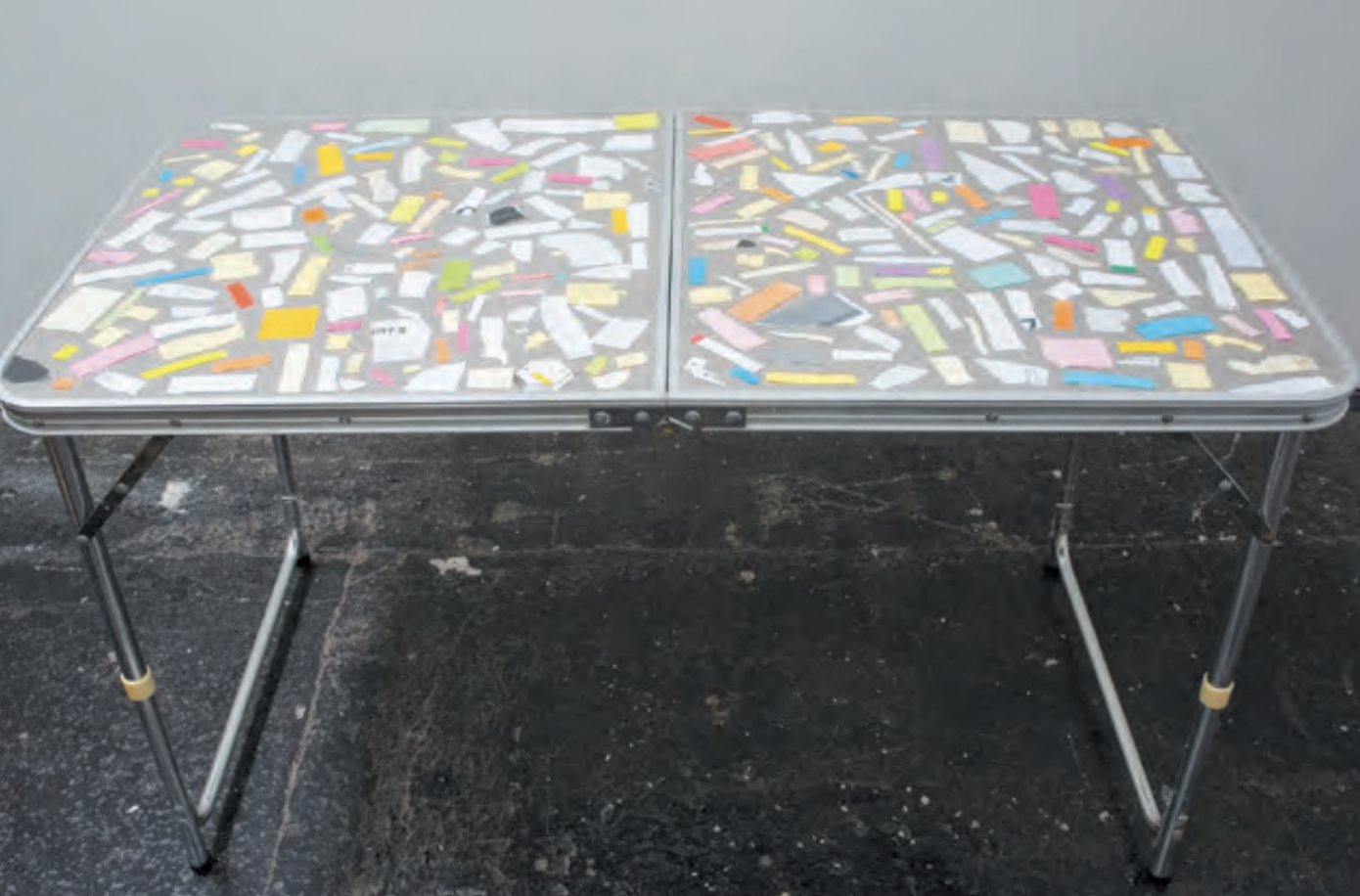
In 'Bookmarks' a picnic table stands on its own, covered with torn pieces of paper found by the artist in library books, inscribed with page references, comments no doubt crucial to the main argument of an undergraduate essay, or simply left blank. Although the most didactic of the works, in it Sofo chooses carefully when to resort to the index and strike with affect. Seeing the remnants of a vast but by no means exhaustive collection of links to thought dotted throughout the repository of public knowledge, there is a dormant panic that the one thought so overpowering at the time of reading a text, warranting leaving a ‘mark’ to return to it, is lost forever. By removing the mark, Sofo writes himself into the script, coming so close to (and almost becoming) that space between the author and the reader.
The obsessive hoarding of ‘thoughts’ in this show seems symptomatic of Sofo’s methodologies. The artist’s 'facts' – the things done or performed, as the word’s initial definition would have it – materialise quietly, spawned by a ubiquitous drive to capture the ‘punctum’ latent in the details of the everyday. The superficiality that sometimes dominates such an exploration in contemporary art is here countered by the poetics of the object, by expanding the object both conceptually and formally, integrating a system of thought and experience into a system of craft gestures, and simultaneously sustaining our intrigue with the production as well as consumption of art.
While for some it may be a revelation of the minute and the poetic, for others Facts may serve as a confirmation of their own obsessions and attempts to hold on to any tangible evidence of remaining humanistic traces embedded in the way we order our world. The parameters of Sofo’s work extend beyond a simple affinity between the viewer and the process into a world that needs us to make it meaningful.