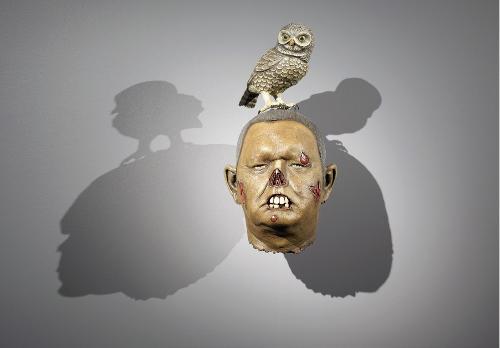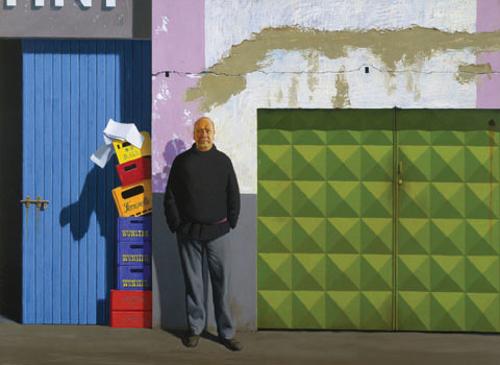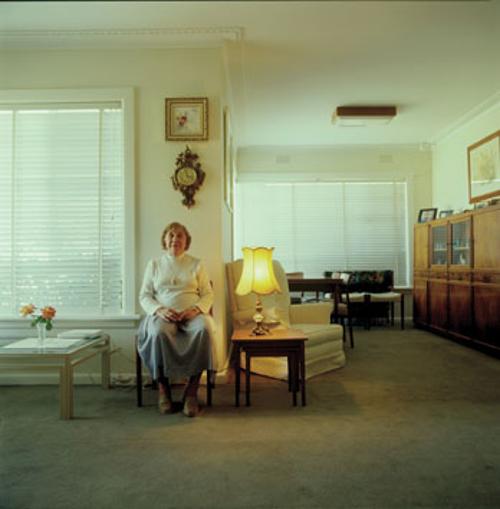
This year Hobart adds yet another festival to its busy summer schedule, an exciting alternative music and art event initiated by Salamanca Arts Centre and curated by musician Brian Ritchie. The Museum of Old and New Art/ Festival of Music and Art, shortened to the more catchy MONA FOMA, included an exhibition of sound art titled 'Discord: Art From MONA', curated by Nicole Durling and featuring an eclectic but ultimately complementary range of artworks. The works were apparently on loan from the festival's major sponsor, the eagerly anticipated Museum of Old and New Art (MONA) owned by Tasmanian art collector and philanthropist David Walsh, and due to open in 2010.
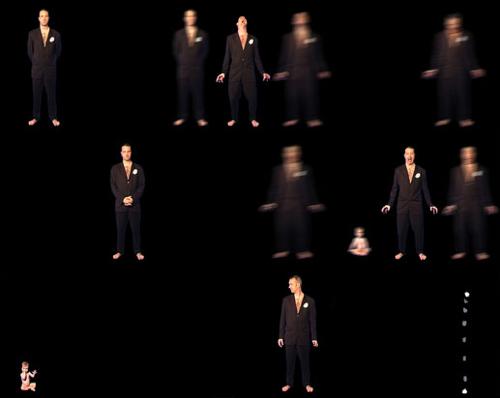
The artworks in 'Discord' were scattered around Hobart. Manon de Boer's Two Times 4'33", a film based on a performance of John Cage's composition 4'33", was at the Tasmanian Museum and Art Gallery; Jensen Tjhung's tiny singing weatherboard structure 'Roaming District Church' could be spotted in the TMAG carpark, Moorilla Winery, or perched on Mount Wellington; and Cameron Robbins' site-specific 'Southern Marine Music Test Rig' sat on a wharf outside the CSIRO.
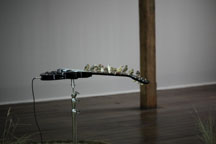
Céleste Boursier-Mougenot's 'From Here to Ear', exhibited in the Long Gallery, is the sixth work in a series of installations that use birds to generate live music. The Paris-based artist transformed the gallery into a giant aviary complete with an artfully shaped island of sand, native grasses, microphone stands, amplifiers, upturned guitar cases topped with seed and water, and horizontally positioned electric guitars. The surreal enclosure was filled with tiny chirping Zebra Finches, which by their nature jump erratically from sand to stand to guitar, flapping, sliding on and even pecking the strings of the guitars to create a unique musical composition. Visitors enter the enclosure in small groups, and are encouraged to collaborate with the artist and birds, by moving around the gallery thus influencing the birds' movements and the music. The environment is considered and strikingly beautiful with the delicately coloured birds; almost futuristic in the sharp contrast between natural elements and electric objects; yet contains elements of humour thus appealing to a wide range of audiences.
Like 'From Here to Ear', 'Robbins' Southern Marine Music Test Rig' draws attention to everyday movements and sounds. Using elements of nature and chance, he employs familiar musical instruments to make unconventional sounds. However, instead of birds, the sea activates Robbins' work, which is in turn influenced by the changing tides, passing boats, wind and weather. The 'Test Rig' is significantly positioned outside Hobart's major scientific research building, and is a quaint structure with a decorative roof and million-dollar harbour view, housing a number of 'organ pipes' tuned to an F minor chord. At low tide, only the thick industrial-looking metal pipes create sound, soft, low hooting noises, mostly triggered by passing sailboats. At the recommended high tide however, the viewer is confronted by the comparatively aggressive honks of bass and alto recorders activated by the higher water level. The rhythms created by the pipes, while unpredictable, uneven, and at times ear-splittingly shrill, are in harmony with the lapping of waves on the nearby shore, boats chugging by, the shrieking birds and the horn of a ship leaving for Antarctica. Interestingly, it's the ambient noises, those not created by Robbins' experimental instrument, that end up being the focus of attention.
John Cage once said that 'everything we do is music' - a statement that rang true in not only Boursier-Mougenot and Robbins' work, but was also highlighted in the rest of the 'Discord' artworks. Because each piece was reliant on the ambient noises or surrounding environments, the separation of the works in 'Discord' suited the exhibition. Also, as individually powerful works it's possible that they could be too overwhelming en masse.
'Discord', like the rest of MONA FOMA, was a stimulating and well-curated exhibition. There is already talk about making MONA FOMA annual, which is an exciting prospect, as this alternative and engaging music/sound/art festival, with its numerous quality and generously free events, fills a significant gap in the Hobart summer festival program.