It is often hard for curators to devise a concept for an exhibition that is truly innovative. This however was not the case with the exhibition Trades curated by Craftsouth project manager Niki Vouis which brought together eight artists and eight tradespeople in teams to create bold and inspiring bodies of work in a diverse range of mediums and trades including plumbing, tree-pruning, tattooing, furniture design and glass. Through working collaboratively, both the artists and the tradespeoples explored fresh ideas and generated new ways of thinking. Works ranged from 'Electric Hammock' a sculptural piece by textile artist Annabelle Collett and electrician Jethro Adams made from woven electrical wires with lit lights hanging on its ends and 'Mrs Tesla's Dress' by the same pair which included a controlled spark that resounded periodically through the gallery, and sets of artful yellow, red and orange chocolate rabbits cast and glazed by ceramic artist Irianna Kanellopoulou and pastry chef Kirsten Tibballs.
Glass artist Gabriella Bisetto teamed up with scientific lampworker Monty Clements to produce two series 'Anatomy study' and 'Growth: Cluster cells' around a laboratory theme. Conceptually, the pair made a perfect team, with Gabriella's continued interest in the body and its inner workings complementing Monty's background in making scientific apparatus – a skill he has perfected over thirty years. Each work was mounted on the wall and suspended on a metal retort stand. Each was as visually beautiful and delicate as a real specimen. So frail are the pieces that one, 'Growth Cluster cells #1', broke during hanging. The brittleness involved in the skill of lampworking highlights the fragile nature of the body, an underlying ongoing theme in both Monty and Gabriella's work.
Brothers David and Rod Archer teamed up to create one of the focal points of the exhibition 'Pearls before Swine', a water-powered pig which appears to transform pearls into sausages. David's continued love of creating hand-automated constructions inspired by carnivalia and tongue in cheek humour was strongly evident in this work. As a technician in the ceramics and glass department at the South Australian School of Art, as well as a sculptor, David has accumulated a vast range of problem-solving knowledge. However, Rod's twenty-five years of plumbing experience were crucial for the construction of this particular piece, as the interior of the pig was plumbed to allow water to power the piece. The work was designed to be aurally and visually appreciated, with the water wheel creating a soothing and rhythmic soundscape.
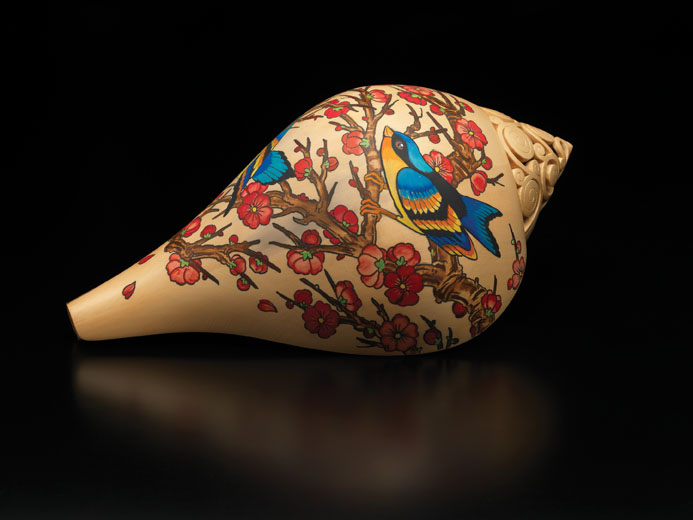
Amy Duncan and Adrian Potter were an unlikely pairing as Duncan is a tattooist and Potter a furniture design-maker. Whilst each comes from a different working background they quickly identified a theme which they both explore in their work, life and death. This led to them producing 'Spring Blossom Tattoo' which was inspired by a conch shell, an object that represents life-force in many cultures. The shell was handcarved by Adrian who, inspired by Amy's tattoo designs, created an intricate swirling exterior pattern on the shell, not dissimilar to traditional Japanese woodcuts. Amy then tattooed the design with drawing inks, gouache infills and inlays.
'Trades' was about much more than an exhibition of work – the eight artists were given the opportunity to learn new processes which will enable them to further their art practice in the future projects they undertake. The eight tradespeople were given the opportunity to explore new ways of thinking and create something they otherwise wouldn't have. Through this project Craftsouth hoped to raise the general public's awareness of the role art plays in all working professions. They have achieved this, whilst also providing an exceptional exhibition and as much as I enjoyed it I am looking forward to seeing the next body of work by each artist.