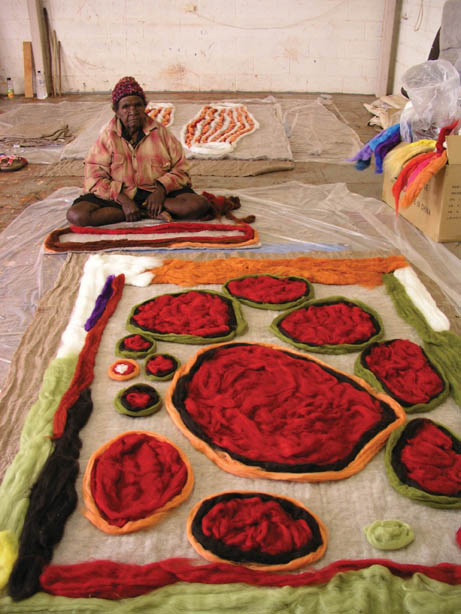
Warburton Community, largest of the eleven Ngaanyatjarra communities, is in the remote Gibson Desert of Western Australia, an 18 hour drive northeast of Perth. In 2010 the Arts Project will celebrate its twentieth anniversary. Over this time Warburton artists have been innovative in their use of media, working with wood, ceramics, glass, textiles and multi media as well as painting. Warburtonta-latju Warntu Palyaranytja was the first showing outside the community of the results of an ambitious pilot project to make felted pieces based on stories of country. The move into felting is in keeping with the Arts Project's history of innovation in their search for new ways to express cultural heritage and realise an economic outcome. Warburton Arts Project Coordinator Albie Viegas and workshop leader Sujora Conrad initiated discussions about what form a new initiative might take and the artists were immediately enthusiastic about the physicality of felt and confident of their ability to be involved in the process. The complex and accomplished works glowing on the gallery walls were testament to the excitement and commitment the project generated. Valuable support was also forthcoming from Janet Holmes à Court who visited Warburton to see the work in progress and acquired a number for the Holmes à Court Collection.
Working seated on the floor in the manner of making paintings, the group of senior artists built their images by selectively laying down layers of prepared coloured fleece. To create felt, this thick multi-layered object is dampened with soapy water and then subjected to rolling and beating until the woollen fibres hook into each other and form a dense, strong mat. As a result of this process the image and the object form a seamless unified whole. This evident unity of material and process, combined with a rough surface texture gives the works a powerful visceral presence, evoking the embodied landscape at the heart of Aboriginal art practice.
Metonymically formed by natural processes, dyes staining the work like minerals in rocks, the works have a profound density and a breadth that imaginatively exceeded their edges which were not cut off but formed by the process of felting. The clarity and detail of imagery in pieces such as Nola Hunt's Tarntjarranya and Nyumitja Laidlaw's Kungkarrangkalpa Tjukurrpa (Seven Sisters Dreaming) showed that the medium is capable of handling the complex imagery and colour palette demanded by Ngaanyatjarra artists, and demonstrated the level of skill they attained.
The impact of the corporeality of felt was best realised in the large scale works. These made me think of Joseph Beuys' shamanic use of natural materials and also of tapestries with their sheer physical presence and their suitability for large architectural spaces. This latter quality holds particular promise for further development, especially as Warburton also produces glass panels that are suitable for architectural commissions. Unlike glass, felting requires little or no specialist equipment, a point in its favour for sustainability over the long term. Included in the exhibition was a demonstration piece by Sujora Conrad who had faithfully replicated an earlier painting. Like tapestry the medium can be used to 'edition' existing work whilst the original can remain in Community hands. Since 1988 Warburton Community has purchased significant works by senior Ngaanyatjarra artists, with the vision of developing a living cultural resource held in perpetuity for Ngaanyatjarra people. Currently the integrity of this priceless heritage is under threat as economic and management problems have given rise to suggestions that it could be dispersed. This would seem to be a very short-sighted way to deal with the ongoing issues of its physical and curatorial sustainability. Perhaps the reproduction of works in the felt medium could be some part of a strategy to generate income from it whilst the collection itself might be cared for under the auspices of a larger collecting institution with a will to see it remain intact and available.
For a new initiative to be economically sustainable, it must successfully negotiate a balance between truth to cultural and artistic integrity, originality and marketability. It seems to me this new work is quite up to the task, all that is needed now is a commissioner with similar vision.