Contemporary artists are inclined to get a little uncomfortable, or at least cynical, around things sentimental and it's hard to think of a bigger sentimental cliché, or one that more cleanly divides the subject matter of professional (contemporary) and amateur artists, than sunrises and sunsets, loaded as they are with kitsch, romantic references. Such matters were, however, the initial inspiration for Liminal. In part the exhibition takes its cue from the Picturesque and German Romantic traditions where the threshold between night and day becomes a metaphor for big themes such as life and death, the passage of time, the nature of beauty, and the beauty of nature.
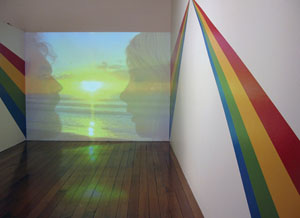
Significantly, for the most part, the artists have treated the subject seriously. The exception to this is Spewtiful, a video work by Ali Sanderson in which two amateur singers croon Sunrise, Sunset from Fiddler on the Roof to each other with an equally amateur musical backing. Their profiles frame the shot and are overlaid onto a kitsch scene of a golden beach sunrise. Sanderson ramps up the Mills and Boons corniness of the sunrise/sunset theme and in the end even the singers can't help but laugh. In some ways this work sits uncomfortably amongst the more sombre tone of the rest of the exhibition. However it can also be seen as the one work which uses the theme of sunrise/sunset to intentionally interrogate the line between amateur and professional that was an important curatorial catalyst for the exhibition.
At the other extreme of the emotional register from Sanderson's work are the gum dichromate prints by David Martin, Memento Sister Jane, Tuesday morning February 5 2008 and Memento Sister Jane, Saturday morning, February 9 2008. The gum dichromate process uses a simple, light sensitive emulsion which Martin has applied to a heavy, handmade paper. Martin's sister Jane, who was in the last stages of a terminal illness, lay onto the paper in the morning sunlight and the resulting poignant images capture traces of her physical presence, pale against the murky, dark, exposed areas of the paper.
The unavoidable emotional response to the swastika is exploited in the pinhole camera photograph of German artist Thomas Bachler, who bravely takes this loaded symbol and re-presents it in its form as a pre-Nazi derivation of the 'sun cross' of ancient Europe. The pinhole of the camera used to create this work was made in the form of the swastika, and as such the points of light in the resulting blurred colour photograph of a car park all take the swastika form, including the sun which sits just above the horizon, and which is the sharpest and brightest point in the image.
The sun is also a central visual element in Shift Work by Richard Giblett, but the threshold explored in this work is that between reality and illusion, between the actual and the reflected. Giblett has constructed a complex plywood sculptural work which stretches over two metres of wall space and depicts a generic city skyline in miniature twice, one is the reverse of the other. The piece sits just proud of the wall and a miniature red sun illuminates it all from behind creating the effect of a skyline reflected in the river. We almost believe we are seeing a reflection, a mirage, but in fact the apparent reflection below is as solid and real as the skyline above.
Ultimately, Liminal is not so much an exhibition about sunrises and sunsets as a musing on the psychological intensity of that unsettling, transitory, in-between time of day when the senses are both heightened and blurred. While I was initially concerned that there was perhaps something a little flippant about the premise for Liminal, the exhibition demonstrates that even the kitschiest clichés can have hidden depths worthy of artistic exploration.