Pantjiti Mary McLean's retrospective A Big Story showcases a fascinating oeuvre that has developed during a relatively late but prolific artistic career spanning more than a decade.
Curated by Nalda Searles, the retrospective comprises drawings, paintings, carved and sewn artefacts as well as an intriguing collection of archival material, such as sketchbooks, journals and paraphernalia. Accompanying this substantial selection of visual material is a superb catalogue that includes erudite, instructive essays by John Kean, John Stanton, Brenda L. Croft and Nalda Searles.
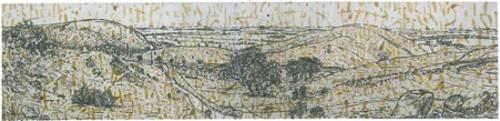
The impressive compilation of paintings, drawings and artefacts present a stunning universe brimming, bustling and buzzing with detail, energy and movement: figures hunting, collecting fruit, swimming, mustering cattle, and roaming lush, fertile landscapes teeming with abundant flora and fauna.
Scrutinising the artist's imagery throughout her prodigious career, one may discern a consistency of theme and style that continuously undergoes novel and dynamic transformations.
In her early paintings, McLean, a Wongutha woman from the Ngaatjatjarra people of the Northern Territory, deploys the visual language synonymous with Western Desert art: aerial perspectives of landscape overlayed with concentric circles, animal tracks, footprints, U-shapes and straight lines, and more figurative forms. In Wati Kutjara with Nesting Emus (1992), the canvas flickers and pulsates with a rhythmic amalgamation of dots, circles, seated U-shaped figures and a flock of silhouetted emus.
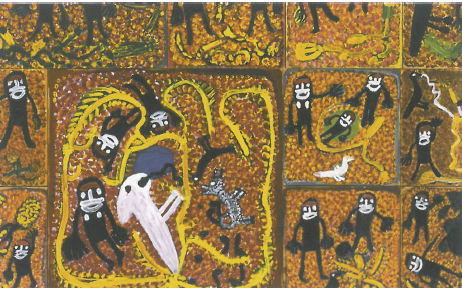
This alluring blend of contrasting perspectives and symbols intensifies in McLean's subsequent paintings which are distinguished by lusciously stippled backgrounds, chunky clusters of multicoloured dots, fluent, sinuous brushstrokes and, most prominently, swarms of starkly accentuated figures with stocky frames and skeletal arms and legs. These figures proliferate throughout McLean's sketchbooks, drawings, carved artefacts and acrylic paintings, often confronting the viewer and commanding their attention with their upraised hands.
In sprawling, colossal canvases like Collecting Bush Tucker (1994), there is an explosion of figures across the dense, dazzling, heavily-worked background. Here, McLean's idiosyncratic figures spin, swirl, flow and unfurl across the landscape, framing its contours and circling its features. In Jesus the Teacher (1997), the repetition of certain characters and symbols across the painting enables the artist to convey a number of episodes sequentially: the recurring figure of a bearded Christ and his corresponding trail of footprints conjure three interconnected episodes of his ministry.
In these, and in most of McLean's paintings and drawings, one encounters multiple perspectives, numerous flows of movement and extreme distortions of scale whereby the landscape and its characters are pictured. Indeed, the potency of McLean's aesthetic resides in its capacity to amalgamate contrasting views of her subject matter (aerial, full frontal, side profile). One marvels at the way McLean's visual gymnastics bends and ruptures the flat uniformity of the picture plane, loading and overflowing it with scrumptious colour and fizzy, erratic detail.
The meticulously researched essays in the chic, compact catalogue furnish numerous contexts for interpreting McLean's art. John Kean and Brenda L. Croft offer indispensable insights into the symbolism deployed in McLean's art, its relation to Western Desert iconography and storytelling techniques, and the work of a wide range of Indigenous Australian artists. John Stanton provides a rich, historical backdrop, describing McLean's early, itinerant lifestyle as a stockwoman and boundary rider; an experience that is vividly evinced in the artist's crisp, lively and frenetic Mustering series of drawings (1998). Nalda Searles addresses the strong spiritual and mythological dimensions of McLean's paintings, and reflects on her collaboration with the artist on Jesus the Teacher and other works.
The artist's own voice and sharp wit also resonates throughout the text. McLean once proposed that 'with little boards there will be stories from my mother's country, my father's country & those places where I was running around'. This vision is spectacularly realised in Palunya - that's all (2002-2004), perhaps the centrepiece of the retrospective: a mammoth mosaic of paintings that weave together different strands from the artist's life and exemplify the complexity, vibrancy, and vigour of her engaging aesthetic.