One of the many enjoyable experiences of viewing the recent National Sculpture Prize and Exhibition 2005 at the National Gallery of Australia was the engaging exhibition design that presented the forty-two selected works throughout the entire wing of the galleries' temporary exhibition spaces. The exhibition layout mapped an exciting journey of formal and symbolic relationships within the various spaces and between the individual works. The exhibition was full to the brim, yet very successful in conceiving of categories and groupings which created multi-layered connections between works and rooms. It also managed to remain on every occasion sympathetic (without being obvious) to an individual artist's conceptual space and viewing possibilities.
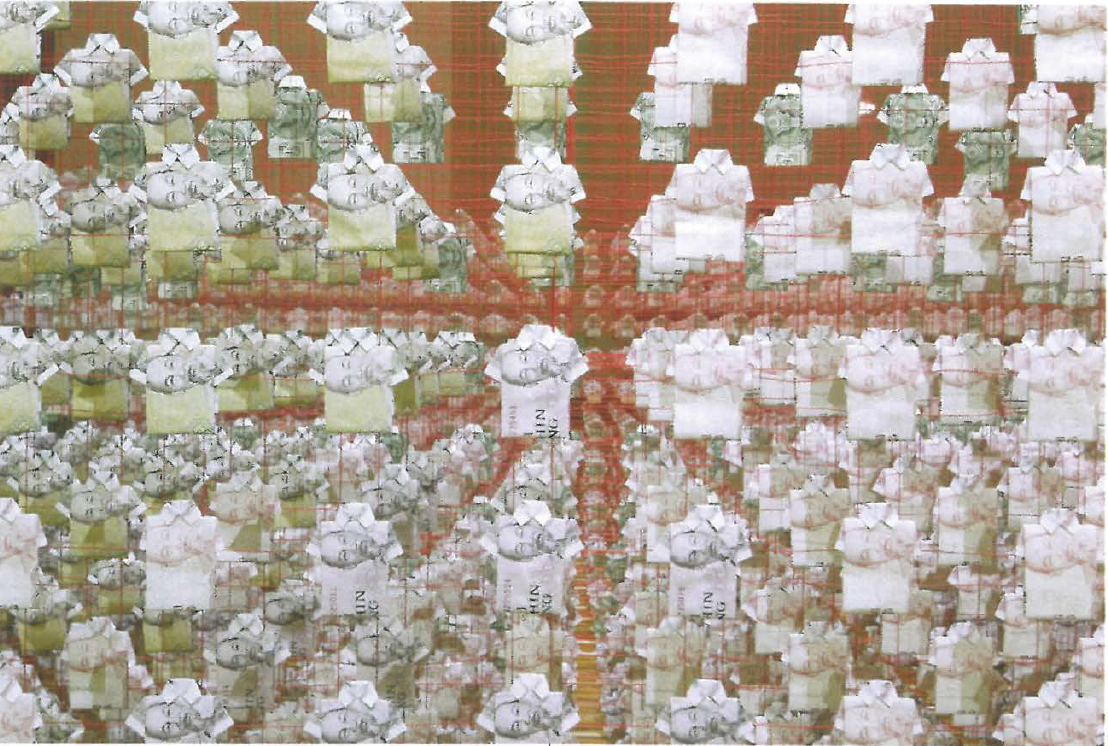
The winning work American crater near Hanoi#2 by Glen Clarke uses Vietnamese and US currency folded into tiny shirts, threaded into a graphed cubic grid drawn in red string. The shirts arranged at regular increasing heights formed a convex illusion within the cube's centre that read like a digital or virtual void revealing further complex detail and perspectives as you moved around it. A quote from Clarke's catalogue statement provides a conceptual overview of sculpture's implied carving of space and reveals its now deft hand at arranging and transforming ready made objects already inscribed with meanings as a trope visible in many of the works on show and the exhibition design itself; 'The correct distance between objects is critical, whether that distance is physical, cultural or emotional. Two objects too close to each other become one, two objects too far apart no longer relate to each other.'
The viewer is initially greeted by works in the open foyer area where the People's Choice Award winner Floribots by Geoffrey Drake-Brockman swept an outrageous sea of colour, movement and clacking sounds in the shape of a large grid of animated flower pots, each with extending and retracting stalks of folded paper flowers breathing in a rhythmic yet urgent celebratory wave. Although this work offered its own cliches with its DIY Hardware House aesthetic and primary IKEA style colours, it introduced a playful air to the proceedings through its youthful optimism. The foyer also housed Wall Zipper by Simeon Nelson and Built for comfort by Christopher Langton who, along with Bert Flugelman's Caryatid minataur, all appeared to draw on childhood fantasies and inventions embodied within their reflective magical materials of brushed stainless steel, polyurethane and pigment on PVC and beeswax.
From the foyer your options were to enter through one of two doors. I took the right-hand anticlockwise direction, drawn towards a glimpse of Maria Fernanda Cardoso's Woven water: submarine landscape, a web of white dried starfish suspended in skydiving formations in a number of groupings. The white starfish, almost cruelly screwed together, visually jumped out from the mid-grey painted walls and prescribed a deep sea darkness as you wove into the next space, where a white mass construction of building materials formed Continuous moment by Damiano Bertoli. This floated beside The fall by Mel O'Callaghan, a flat screen porthole whose video footage follows the descent of a body attached to a parachute as it sinks deeper and deeper underwater.
Each room explores various associations through materials, activities and assemblages, drawing at times humorous conversations such as between Wanda Gillespie's motorised hum of vacuum cleaner bodies Impossible Flight, and Tony Schwenson's wheelbarrow memorialising aspiration, familiar as the grass roots philosophy of Australia's voting public in Monument to progressing thought (after Homer Simpson). Hany Armanious expertly conjures a gelling of ideas through arrangement in Turns in Arabba an unrefined but exquisite open cabinet which allowed the viewer to almost smell the substance of his self-reflexive objects, such as electric lights, pepper grinders and chess pieces constructed in clay, wax and sand to reference both provenance and the poetic potential of everyday objects common to many cultures. The exhibition was a jam-packed and stimulating testament to an incredibly diverse range of art practices.