Changing Climates in Arts Publishing
vol 29 no 4, 2009
In a world where newspapers and journals are being replaced by online versions, and traditional copyright is being challenged, many new scenarios present themselves. Artists and publishers are being asked to make choices and address questions that are environmental, technical, aesthetic, legal and financial all at the same time. * carbon emissions from print/online content * should all content be free * effect of re-mix and Creative Commons on creators' rights * search engine uses of arts content * catalogues and zine publishing * art biography as online data bases emerge. Powerful climate change imagery, new work by emerging and established Australian artists, flows through the pages. Plus bonus review section: 17 recent books & catalogues. Based on the Changing Climates in Arts Publishing forums organised by Artlink in Adelaide and Sydney in 2009 More on the forums including programs and vodcast. Discussions of a lively team of experts, writers, artists, copyright lawyers, arts publishers, activists: Zina Kaye, Elliott Bledsoe, Linda Jaivin, Daniel Thomas, Tess Allas, Joanna Mendelssohn, Sean Cubitt, Tamara Winikoff, Andrew Frost, Donald Brook, Lisa Havilah, Djon Mundine, Zoe Rodriguez, Bill Morrow.
- Artists and Authors
- Order this issue (from $12 inc. postage)
Subscribe to Artlink - from $52. Subscriptions available for readers anywhere in the world.
Advertisement:
Shih Chieh Huang : Cubozoa - L-09
Sally Butler, reviewShih Chieh Huang : Cubozoa - L-09
Shed E @ Howard Smith Wharves, ARC Biennial of Art, Brisbane
9 October - 1 November 2009
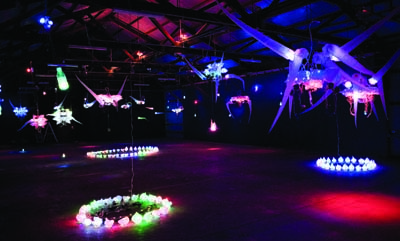
Sustainability is a term that comes at us these days like a dose of medicine - we need it because of our global poor health. We administer it to ourselves out of fear of even worse symptoms. Shih Chieh Huang's interactive inter-media installation at Brisbane’s impressive September - November event 2009 ARC Biennial Of Art managed by the Queensland Artworkers Alliance turns this condition of fear around. His floating assemblages of recycled material are moving breathing audio-tech organisms that have a character about them that makes you smile - you can’t help but like them and want to culturally own them as 21st century beings.
Taking ownership of who we are in the 21st century is no mean feat. The fragile legs of the Kyoto Agreement suffice as evidence of our global identity crisis. We seek an image of ourselves as living with environmentally sustainable technology but we just can’t make sustainability sufficiently glamorous. It is still too "medicinal". This is where art has an important role, because we need contemporary artists whose vision of the future stimulates change out of a sense of pride rather than fear - creating an image that is both reality check and dream machine at once.
Enter Shih Chieh Huang.
This New York-based Taiwanese artist is internationally renowned for weaving technological ingenuity and environmental sustainability into a language of beauty. He was one of the artists who created China’s first zero energy media wall Greenpix built near the site of the Beijing Olympics. His work also featured at the 2007 Venice Biennale, The Smithsonian Museum of Natural History and numerous other prestigious international venues. What he generates in all of his work is a genuine sense of technology as life form - technology as life rather than death, so to speak. In the Brisbane exhibition his evocative colour fantasies hang from the ceiling and sit on the floor of the darkened shed, creating a habitat of responsiveness that senses us, and breathes in pleasure at our presence. This breath is palpable through inflating plastic bags generated by recycled hard-drive fans, sound detectors and guitar tuners. Recycled plastic bottles glisten with the psychedelic colour of chemical fluids, and cable ties assemble themselves as the graceful arch of sea-horse figures floating in space. Each installation piece has an ecology of its own - one motion stimulating another, transforming from movement to light to sound - and all the while responding to the human visitor moving around.
If audiences feel profoundly responsive to Shih’s art it is because the artist has made “responsiveness” his conceptual mantra. He describes his recycled installations as “whimsical characters” who “are excited to be free from their tedious functional shackles” (Shih Chieh Huang website www.messymix.com). The exhibition takes its cue from the blue blubber jellyfish that have invaded the Brisbane River now that many other marine species have been depleted. This theme also responds to the location of the exhibition at Shed E @ Howard Smith Wharves which is situated on the banks of the Brisbane River immediately below the Story Bridge.
This year’s ARC Biennial Of Art was an excellent example of the deep thread of responsiveness in contemporary art today. The exhibition program of four installations, titled New Worlds New Futures, covers sites that encourage new audiences for contemporary art. The Howard Smith Wharves are an innovative urban venue, located close to the city and the high residential zone of New Farm, and yet still have a sense of being on the edge - unnoticed scraps of real estate that suddenly spring into life and generate potential for new social activity. The entire 2009 ARC Biennial program of events included touring exhibitions, forums, performances and workshops, and innovative venues such as Fort Lytton (a former Fort and quarantine site built in the 1880s and now a national park), 19 Karen Contemporary Artspace at the Gold Coast, Desert Rain at Noosa Marina and Gympie Regional Gallery.
There is truly something for everyone in Shih Chieh Huang’s exhibition, because this artist knows what makes the twenty-first century tick, and how to extend its measure into the future.
Articles in this issue
-
ETW: Exhibitions 2 Watch: December 09 - February 2010

-
Artrave: Artrave

-
Editorial: Editorial

- Feature: Artistic intention, branding and value
- Feature: Artists want catalogues
- Feature: Collaborative Practice
- Feature: Communicating and the law
- Feature: Copyright materials in university teaching
- Feature: Copyright: Copyleft
- Feature: Creative commons: fair to share?
- Feature: Don't look it might bite: censoring the visual arts
-
Feature: Environmental costs of going digital

- Feature: Finding the right balance: print + online
- Feature: Freedom of expression and the mode of detachment
- Feature: From here to everywhere: the evolution of blogging
- Feature: Lean, mean and living dangerously
- Feature: Libraries, creators and Google
- Feature: Lives of the 'settled' artists
- Feature: Measuring the footprint: dead trees vs live text
- Feature: Mix and mash, take it, change it
- Feature: Netting the big and the little fish: monographs and biographies
- Feature: The Ramingining Megaphone
- Feature: Writing in the age of graphomania
- Feature: Zine publishing and the long tail
-
Preview: Acts of transformation: 2010 Adelaide Festival, Adelaide Biennial of Australian Art

-
Review: *some text missing*

-
Review: 4th Fukuoka Asian Art Triennale, Japan

-
Review: BeginningMiddleEnd

-
Review: Fiona Davies: Intangible Collection

-
Review: Floating Life: Contemporary Aboriginal Fibre Art

-
Review: Kathy Temin

-
Review: Kazuyo Sejima + Ryue Nishizawa / SANAA : an architectural intervention

-
Review: Milestones: Ken Orchard 1980-2009

-
Review: Nyukana Baker : Retrospective

-
Review: Shelter: On Kindness

-
Review: Shih Chieh Huang : Cubozoa - L-09

-
Review: Simon Gilby: The Syndicate

-
Review: Tim Burns: From the Garden

-
Review: Western Australian Indigenous Art Awards

-
Review book : Twelve Australian Photo Artists by Blair French and Daniel Palmer

-
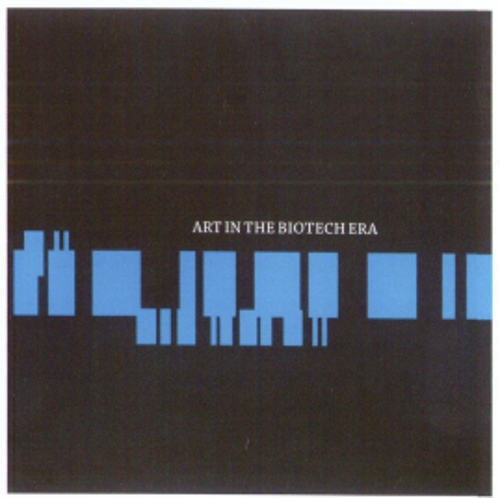
Review: book: Art in the biotech era Edited by Melentie Pandilovski

-
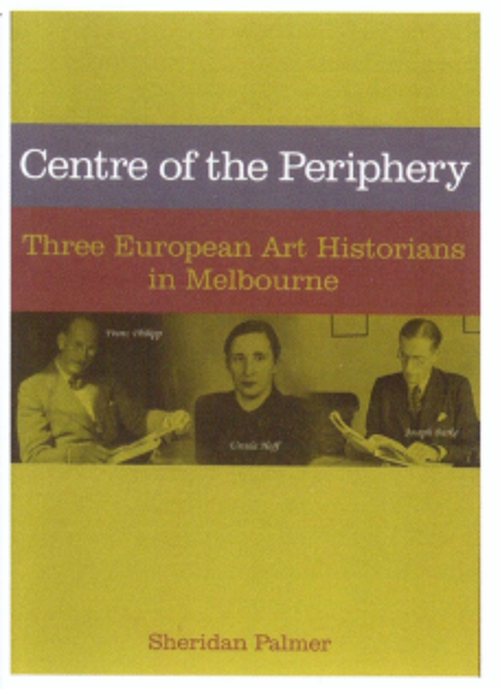
Review: book: Centre of the Periphery: Three European art historians in Melbourne by Sheridan Palmer

- Review: book: Colour Country: Art from Roper River by Cath Bowdler and My Father, my brother: stories of Campbelltown's Aboriginal Men by Dvora Liberman
- Review: book: Gallery A Sydney 1964-1983 Edited by John Murphy
- Review: book: Hedonism, populism and colonial pictures; The Art of Australia: Volume 1: From Exploration to Federation by John McDonald
- Review: book: Modern Times: the untold story of Modernism in Australia Edited by Ann Stephen, Philip Goad and Andrew McNamara
- Review: book: Photography Between Poetry and Politics: The Critical Position of the Photographic Medium in Contemporary Art Edited by Hilde Van Gelder and Helen Westgeest
- Review: book: Possession
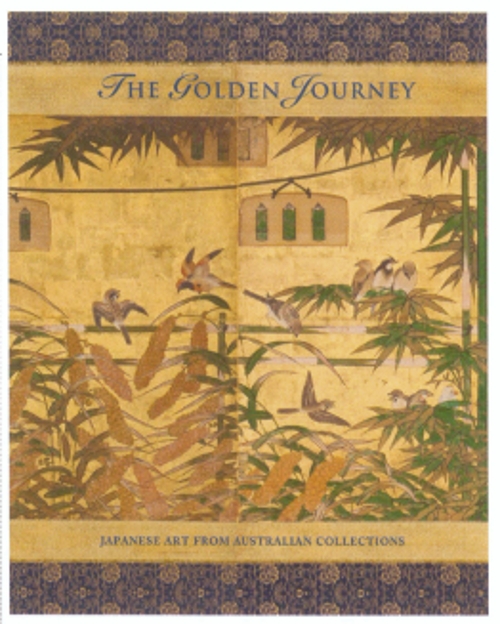
- Review: book: The Golden Journey: Japanese Art from Australian Collections by James Bennett and Amy Reigle Newland
-
Review: book: Wild Design - ecofriendly innovations inspired by nature by Alan Marshall and Back to the City - Strategies for Informal Urban Interventions Edited by Steffen Lehmann