Changing Climates in Arts Publishing
vol 29 no 4, 2009
In a world where newspapers and journals are being replaced by online versions, and traditional copyright is being challenged, many new scenarios present themselves. Artists and publishers are being asked to make choices and address questions that are environmental, technical, aesthetic, legal and financial all at the same time. * carbon emissions from print/online content * should all content be free * effect of re-mix and Creative Commons on creators' rights * search engine uses of arts content * catalogues and zine publishing * art biography as online data bases emerge. Powerful climate change imagery, new work by emerging and established Australian artists, flows through the pages. Plus bonus review section: 17 recent books & catalogues. Based on the Changing Climates in Arts Publishing forums organised by Artlink in Adelaide and Sydney in 2009 More on the forums including programs and vodcast. Discussions of a lively team of experts, writers, artists, copyright lawyers, arts publishers, activists: Zina Kaye, Elliott Bledsoe, Linda Jaivin, Daniel Thomas, Tess Allas, Joanna Mendelssohn, Sean Cubitt, Tamara Winikoff, Andrew Frost, Donald Brook, Lisa Havilah, Djon Mundine, Zoe Rodriguez, Bill Morrow.
- Artists and Authors
- Order this issue (from $12 inc. postage)
Subscribe to Artlink - from $55. Subscriptions available for readers anywhere in the world.
Acts of transformation: 2010 Adelaide Festival, Adelaide Biennial of Australian Art
Sarah Tutton and Charlotte Day, Previewacts of transformation
2010 Adelaide Festival
2010 Adelaide Biennial of Australian Art
Before & After Science
27 February - 2 May 2010 at the Art Gallery of South Australia
Daily 10 – 5pm. Admission free.
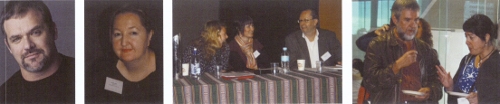
Artlink talked to co-curators Sarah Tutton and Charlotte Day.
Woven into your choice of artists is a use of the oblique rather than the literal. Unlike some big exhibitions of the last decade or so in which much of the work comprises videos with a documentary element there is very little that relates directly to political events or sociology.
We have purposely avoided prescribing a certain theme or seeking out practices to illustrate a particular concept. In our travels through metropolitan and regional Australia visiting studios and galleries what struck us most keenly were the ways in which artists are drawn to and inspired by the tension between what is known and unknown, what we can put a finger on and be specific about, and that which eludes us and defies simple explanation and reasoning.
Our desire for the exhibition is to bring to the forefront such speculative practices that involve a push and pull between the realms of art and science, between intuition and reason, and between faith and knowledge. Our own points of reference have ranged from Buckminster Fuller's utopian designs and American Shaker drawings, to the writings of Michael Taussig and Elizabeth Grosz, and Frances Yates who is known for her work uncovering the alchemic underpinnings of Modern philosophy.
Most of the works aren’t straightforwardly making a statement about a particular subject but nonetheless come out of an awareness and responsiveness to contemporary issues. Nicholas Mangan’s second instalment of his Nauru project for example, features a film and a curious table fashioned from local coral limestone that tells a material and cultural story of micro boom and bust, resources and their depletion that has particular relevance to resource-rich Australia. Christian Thompson brings distant voices sourced from anthropological recordings into dialogue with the present in his arresting sound work that resonates with memory, loss and the possibility of rejuvenation.
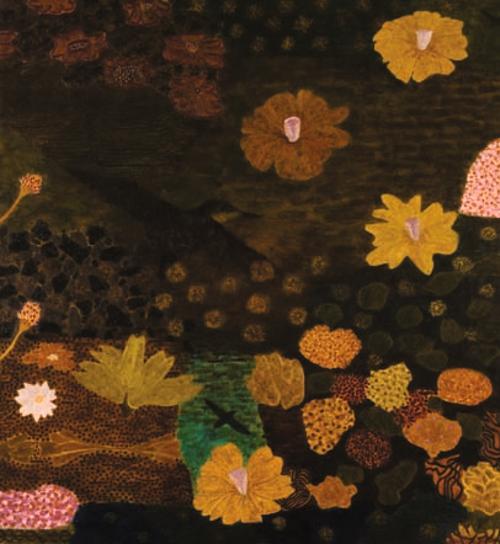
The large-scale painting Ngayarta Kujarra made earlier this year by a multigenerational group of Martu women from the remote Indigenous community in the Pilbara has particular political imperatives. The painting depicts the women’s country, the lake and its verdant surroundings, including a scattered array of waterholes that is a strong rejection of European maps of the same region and the colonisation of their country.
Low-tech kinetic and unpolished performance work on video mingles with objects and installations made with humble materials, clay, lead, cloth, string, paper, recycled machine parts. When seen together, a whiff of the 1970s is noticeable in much of the work. Are the ideas of 35 years ago becoming increasingly relevant today or is it a rejection of the pre-GFC super-commodifcation of art?
If a touch of a 1970s aesthetic is apparent, it may be because we have purposely avoided the kinds of slick and spectacularised practices that have dominated much contemporary art since the 1980s. While most of our discussions with artists began well before the Global Financial Crisis came to a head, we were conscious of the homogenising effect of the market in many instances and were drawn to artists who were confidently creating their own terms of reference for their work. There is a definite emphasis on practices that are more provisional, that re-use materials, or are performative. This is not a show of major statements and large-scale works. We have opted for a quieter, more reflective tone and this is in response to the times we live in.
Stuart Ringholt and Simon Yates seem to be interested in an intimate relationship with their audience. How do they go about this?
Ringholt’s work is very much about his relationship with his audience. In many ways it is premised on the question: 'Can art literally improve my life?’ a question that he turns on himself and on his audience. He is exhibiting a single screen video work of a man and a woman practising a condensed version of the twelve stages of Aum, a New Age meditation process of emotional release. Whereas Simon Yates’ work explores psychological vulnerabilities and the affinity between positive and perceived negative emotional states, his fragile paper robots are life size stand-ins for human beings. What we especially like about them is the way they occupy the gallery – taking up residence there and eliciting a connection with viewers.
Justene Williams’ performance video Bighead Garbageface Guards Ghost Derr Sonata goes further back in time to the turn of the 20th Century. What is the intention of this work and how did she arrive at it?
This video installation is inspired by the dance performances of Sophie Tauber-Arp at the Cabaret Voltaire and is part of an ongoing series that uses as its starting point forgotten and sidelined women artists of the past. When we first saw this work at the Art Gallery of New South Wales we were blown away by the intensity of it, it’s a very noisy, frenetic work, with an almost shamanistic quality. It’s as if Williams, who is the figure in the videos, channels Tauber-Arp, bringing her back from the grave and forcing her into our consciousness.
The eerie abstract paintings of Diena Georgetti are also sending probes back to the past. The artist uses a sampling technique taking the genres of Leger, Miro, Picasso, Kandinsky and others to create a carefully constructed re-mix of these well known expressions. Is this a wish to remind us of the revolutionary legacy of these artists?
What is distinctive in Georgetti’s work is that her process is so subjective and emotive – she imagines herself in other places and with particular art works; she also imagines art works as they are lived with and grow into and out of their surroundings. Her paintings have an amazing dimensionality about them moving in and out of two, three and into distant real and imagined dimensions stretching and distilling time and space. It’s about being able to key into a spirit of a time, of a practice and to feel it present. ?
Subscribe to the Artlink newsletter now
Articles in this issue
-
ETW: Exhibitions 2 Watch: December 09 - February 2010

-
Artrave: Artrave

-
Editorial: Editorial

- Feature: Artistic intention, branding and value
- Feature: Artists want catalogues
- Feature: Collaborative Practice
- Feature: Communicating and the law
- Feature: Copyright materials in university teaching
- Feature: Copyright: Copyleft
- Feature: Creative commons: fair to share?
- Feature: Don't look it might bite: censoring the visual arts
-
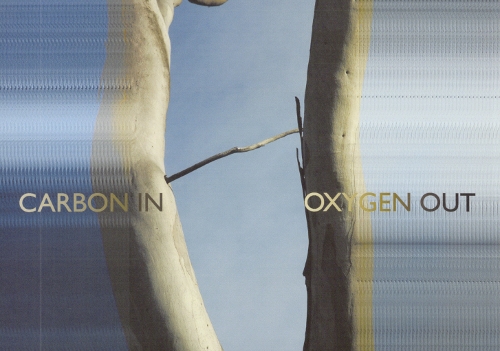
Feature: Environmental costs of going digital

- Feature: Finding the right balance: print + online
- Feature: Freedom of expression and the mode of detachment
- Feature: From here to everywhere: the evolution of blogging
- Feature: Lean, mean and living dangerously
- Feature: Libraries, creators and Google
- Feature: Lives of the 'settled' artists
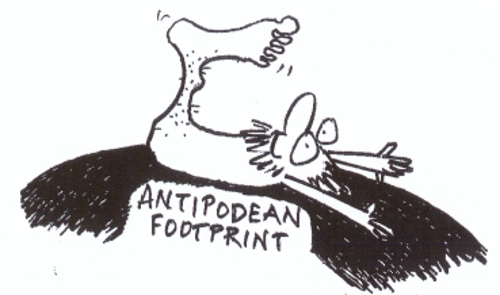
- Feature: Measuring the footprint: dead trees vs live text
- Feature: Mix and mash, take it, change it
- Feature: Netting the big and the little fish: monographs and biographies
- Feature: The Ramingining Megaphone
- Feature: Writing in the age of graphomania
- Feature: Zine publishing and the long tail
-
Preview: Acts of transformation: 2010 Adelaide Festival, Adelaide Biennial of Australian Art

-
Review: *some text missing*

-
Review: 4th Fukuoka Asian Art Triennale, Japan

-
Review: BeginningMiddleEnd

-
Review: Fiona Davies: Intangible Collection

-
Review: Floating Life: Contemporary Aboriginal Fibre Art

-
Review: Kathy Temin

-
Review: Kazuyo Sejima + Ryue Nishizawa / SANAA : an architectural intervention

-
Review: Milestones: Ken Orchard 1980-2009

-
Review: Nyukana Baker : Retrospective

-
Review: Shelter: On Kindness

-
Review: Shih Chieh Huang : Cubozoa - L-09

-
Review: Simon Gilby: The Syndicate

-
Review: Tim Burns: From the Garden

-
Review: Western Australian Indigenous Art Awards

-
Review book : Twelve Australian Photo Artists by Blair French and Daniel Palmer

-
Review: book: Art in the biotech era Edited by Melentie Pandilovski

-
Review: book: Centre of the Periphery: Three European art historians in Melbourne by Sheridan Palmer

- Review: book: Colour Country: Art from Roper River by Cath Bowdler and My Father, my brother: stories of Campbelltown's Aboriginal Men by Dvora Liberman
- Review: book: Gallery A Sydney 1964-1983 Edited by John Murphy
- Review: book: Hedonism, populism and colonial pictures; The Art of Australia: Volume 1: From Exploration to Federation by John McDonald
- Review: book: Modern Times: the untold story of Modernism in Australia Edited by Ann Stephen, Philip Goad and Andrew McNamara
- Review: book: Photography Between Poetry and Politics: The Critical Position of the Photographic Medium in Contemporary Art Edited by Hilde Van Gelder and Helen Westgeest
-
Review: book: Possession

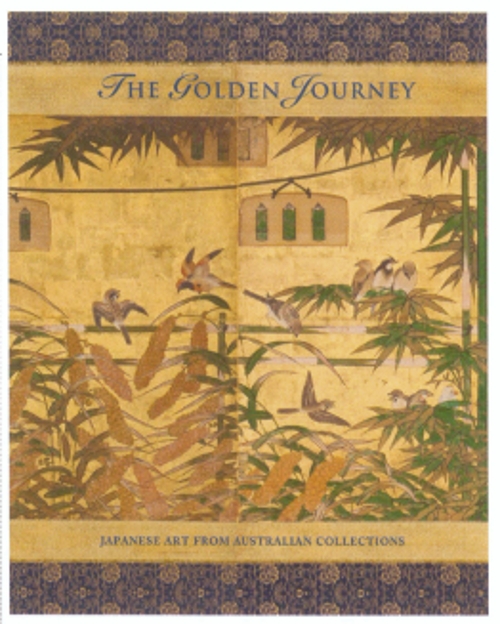
- Review: book: The Golden Journey: Japanese Art from Australian Collections by James Bennett and Amy Reigle Newland
-
Review: book: Wild Design - ecofriendly innovations inspired by nature by Alan Marshall and Back to the City - Strategies for Informal Urban Interventions Edited by Steffen Lehmann