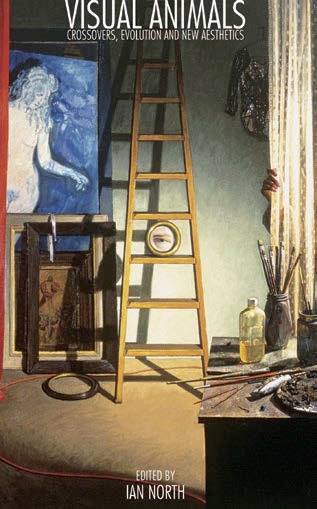
Visual Animals sits proudly in the hand. The tall ladder on the cover is dramatically reflected in the precipitous vertical orientation of the pages. The book feels like a pedestal, and in some ways it is.
This publication emerges from a symposium convened by Ian North with the Contemporary Art Centre of South Australia in April 2007. Ian North initiated discussion with a statement that challenged the dominant school of cultural critique in the academies. He proposed orienting theory 'from the ground of art experience' rather than the imposition of an 'abstract ideology'. He identified this ground in the biological approach to art, with intimations of spirituality.
The book is divided into three sections: the first and third warrant particular attention. In Art and the Natural, writers react directly to North's challenge. Nabokov specialist Brian Boyd argues for an evolutionary reading of art based on the simple fact of its survival. He nominates the critical need for pattern recognition as the key to art's success. This argument is continued by neurophysicist Marcello Costa, art theorist Ian McLean and philosopher Denis Dutton. In expanding on the theme, North critiques what he sees as a 'fetishisation' of theory in the art world that followed the demise of modernism. He argues in its place for 'strategic essentialism' that opens lines of communications between cultures. At the heart of this essentialism is the recognition of transcendental beauty, as evident in the pre-judgemental appeal of works by Emily Kngwarreye.
The third section Art and Social Animals strays from evolutionary functionalism while staying within the straight and narrow of universalism. Linda Williams offers the fold as a means of re-introducing nature and countering Foucauldian epistemologies. Rex Butler and A.D.S. Donaldson continue the volume's contrarianism with an alternative history of non-Australian art, featuring artists overlooked because of their irrelevance to the nationalist canon. Jill Bennett presents the NGV's Contemporary Commonwealth 06 exhibition as a 'migratory aesthetics', a kind of 'transitional politics' that abstracts diasporic identity to a more universal experience of dislocation.
While provoking a range of 'correctives' to ethnocentric theory, at its core Visual Animals argues for the recovery of a universal theory of art based on its evolutionary function. As such, it suggests a broader movement that seeks to counter the mystification of theory with a sophisticated version of 'common sense'. Parallel moves might be found in the celebration of beauty in craft by fellow Adelaide curator Margot Osborne and the inquiry into perceptualism in Aboriginal art by Robert Nelson.
It is possible that now de-commissioned veterans of the culture wars would seek to recruit this volume into a revived crusade against the politically correct latté set. That would be a shame, as this book gives new life to a position that needs to be maintained, at least for argument's sake.
But this push might have been more incisive if it was positioned within a broader understanding of functionalism in art. Why not include Bourdieu? If you're playing the functionalist card, then I'll see your Darwin with my Marx. How might the function of art in the reproduction of social class be any less a paradigm for aesthetics than the reproduction of genetic codes? I suspect the problem with Bourdieu is not the theoretical process, but the world it evokes. Rather than a consensus of common senses, we arrive at a battle of highly contested positions for which there is no universal set of values.
But for me, the greatest challenge to the evolutionary logic of Visual Animals lies in the school of Generative Anthropology, which argues for a fundamental break with biology through the discovery of language. For writers like Rene Girard, culture emerges as an economy of meaning which breaks the cycle of violence over finite resources. By contrast with food, the value of a word is only increased with distribution. This advent of culture is premised on a fundamental breach with the utilitarian world, forever separating the sacred world of meaning from the profane domain of existence. From this common scene springs an efflorescence of symbols.
While you might disagree with Visual Animals as a fundamentalist push – albeit a nuanced version thereof – it's a challenge deserving respect. Its humanist leanings offer an alternative to the tribalism that has emerged thanks to the reduction of culture to ethnic identity. The challenge is to find a humanism that sustains diversity, and so resists the technocratic potential of universal functionalism. As 21st Century animals, our concern is more to protect endangered species than accelerate natural selection.