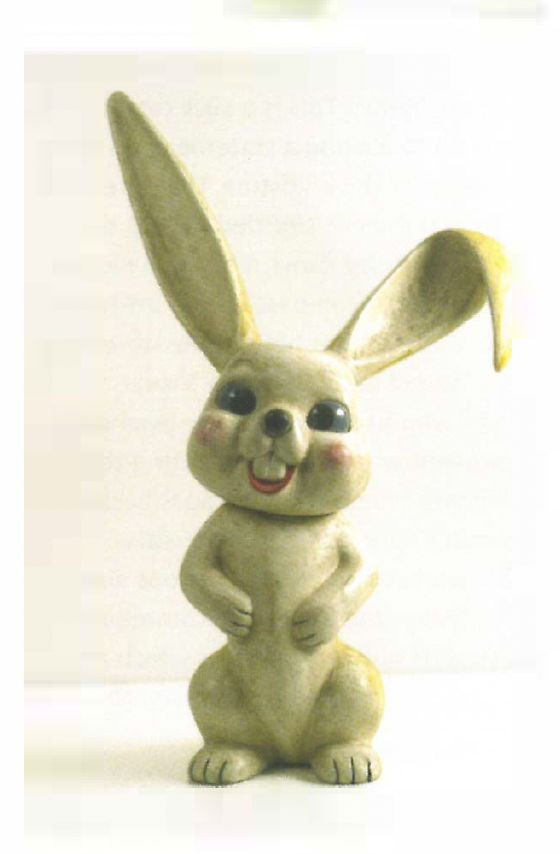
Stephen Hart's survey exhibition is testimony to his sincere and consistent vision. His work is figurative sculpture, carved and then often polychromed (like religious sculpture of old). In this exhibition, in a departure from simply showing finished work, a large, glass-cased installation provides the viewer with an opportunity to share his inspiration with a gathering of the many rabbits, sketch books and research objects usually located in his studio. His interest in the 'everyman' is thoroughly demonstrated, together with his ongoing existential quest for meaning in humanity.
The exploration of good and evil is symbolised by the rabbit motif (which became Hart's artistic talisman during the 1990s), stimulated by a newspaper photograph of Nazi war criminal and holocaust protagonist Adolph Eichmann (the epitome of evil) cuddling a white angora rabbit. The blurring of boundaries between goodness and evil has provided significant ongoing inspiration for Hart over the thirteen years covered by the survey.
The first room in the exhibition is focussed on the eternal human quest for enlightenment. In Memento mori 2004 a smugly triumphant, gym-booted rabbit balances on a human skull, blowing a trumpet, atop an enormously thick and importantly-bound book titled The Book of Answers. However, in Question and answer 2004, the credibility and wisdom inferred by this solemn object is undermined with a series of truisms and cliched answers to banal questions suggesting, perhaps, that the quest for answers is in itself a trivial pursuit.
The second room explores Hart's Gravitas and Guardian figures. In Guardians 2001, an African-influenced head, angular features hewn from the heavy recycled timbers which Hart recovered from the demolition of Brisbane's historic wharves, is topped by a collection of coloured male figures, looking ordinary, if slightly scared and overwhelmed. For me, those works where the figures' vulnerability is infused with humour are most effective. In Gravitas, 1999, chair legs sway to one side, like those of an uncertain gawky teenager. A crowned head lies on top, wearing a silly grin. In this work Hart is able to capture existential doubt without earnestness.
This selection of work also demonstrates Hart's extraordinary technical ability which furthers his figurative focus. Though I walk 2005 is mesmerising in its capture of the mirror image of Hart's everyman figure within a perfect circularly carved 'O', atop a shiny black granite base. Inspired by Hart's daily walking habit it is unerring in its accuracy and the circular nature of such repetitive activity.
Hart's most ambitious work, Endless column 2003/2005 is a fitting finale to the exhibition. A series of figures, walking, protesting, beating drums, playing instruments in an endless column is well crafted and managed. Representing humanity, the repetitive life cycle and endurance, this is a work which draws you into its minute scale, but would also translate well to life size – a popular public art work perhaps in its marriage of figuration with larger human ideas.
Hart's extraordinary technical skills and ability are undisputed. His work forms a continuum within his internal dialogue about the human condition. His status as a contemporary artist now depends on his ability to go forward from these ideas, to open up new gateways and areas of insight.